
The Empathy Engine: Behaviour Analytics for Human-Centric UX in 2026
Published on: 29 Jun 2026
The Empathy Engine: How Behaviour Analytics is Powering Human-Centric UX Design in 2026
Introduction
In 2026, the most successful digital products don't just look good—they feel right. They anticipate your needs, respect your time, and adapt to your mood. This isn't magic; it's the result of a powerful synergy between behaviour analytics and human-centric design. At EishwarITSolution, we call this the 'Empathy Engine'—a data-driven approach that puts genuine understanding at the heart of UX/UI.
Learn more about our Website services
For business owners, marketers, and professionals in India, building an empathetic digital presence is no longer optional. Users are overwhelmed with choices. They will abandon a site that feels cold, confusing, or self-serving. Behaviour analytics gives you the tools to decode what your users truly want, not just what they click. Let's explore how you can harness this engine to create experiences that build lasting loyalty.
Consider this: a user lands on your e-commerce site, browses for five minutes, adds items to the cart, but leaves without buying. Traditional analytics tells you 'abandonment rate.' The Empathy Engine tells you that they hesitated on the shipping cost page, re-read the return policy twice, and then left. That insight allows you to redesign the checkout flow with transparent pricing and a reassuring trust badge—directly addressing the user's anxiety. This is the power of moving beyond surface-level metrics to uncover the emotional drivers behind every click.
Main Section 1: Decoding the Empathy Engine – What It Is and Why It Matters
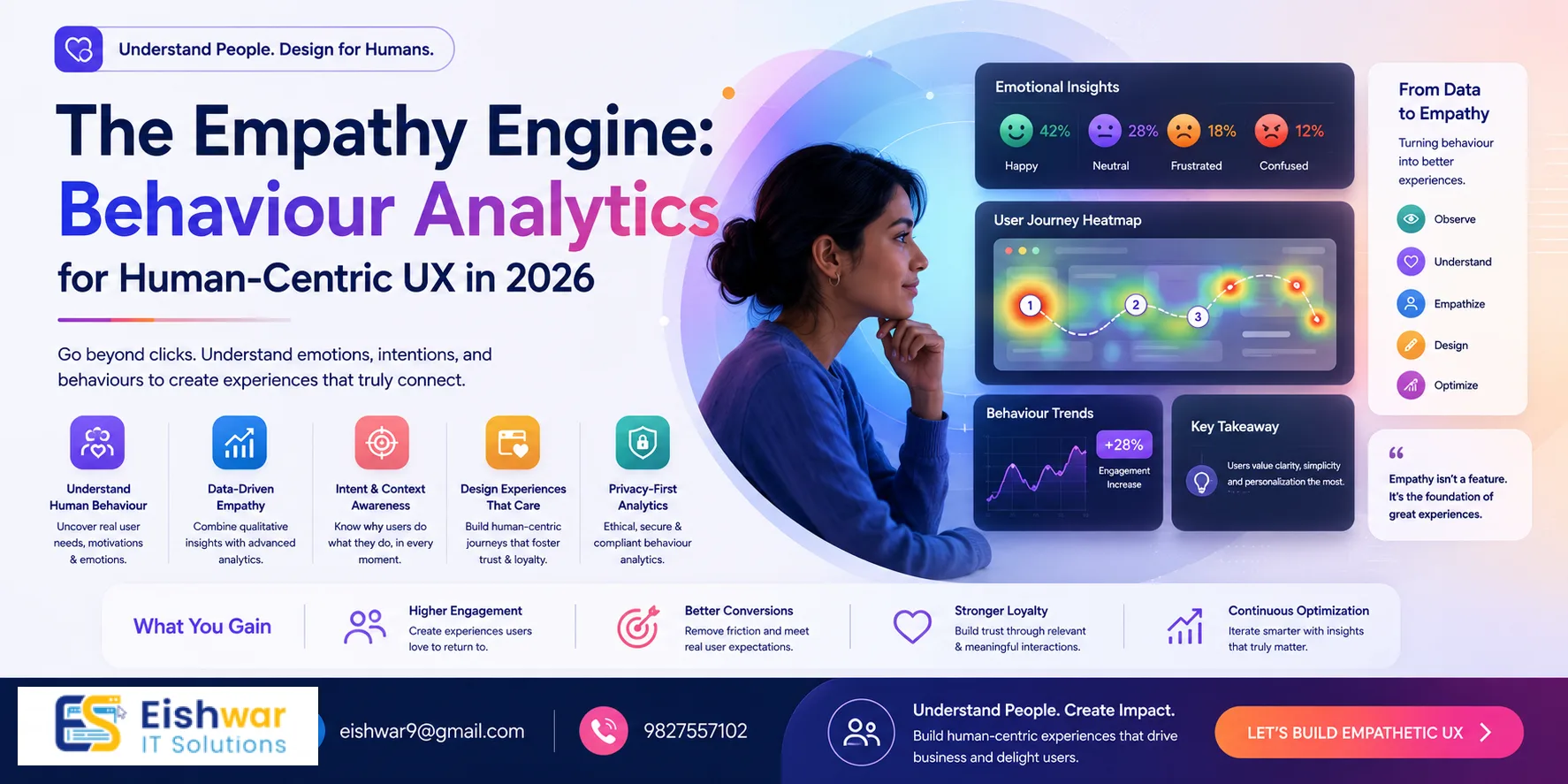
The Empathy Engine is a framework that combines quantitative behaviour data (clicks, scrolls, time on page) with qualitative insights (session replays, heatmaps, feedback) to understand the 'why' behind user actions. It moves beyond vanity metrics to uncover emotional drivers and friction points.
Why does this matter for your business in India? Consider this: a user lands on your e-commerce site. They add items to the cart but leave without buying. Traditional analytics tells you 'abandonment rate.' The Empathy Engine tells you that they hesitated on the shipping cost page, re-read the return policy twice, and then left. That insight allows you to redesign the checkout flow with transparent pricing and a reassuring trust badge—directly addressing the user's anxiety.
Human-centric UX is about designing for real people, not personas. Behaviour analytics provides the evidence to make design decisions that reduce friction, build trust, and create a sense of being understood. In a crowded market, this is your competitive advantage.
For example, a travel booking site in India noticed that users from tier-2 cities were abandoning the payment page at a high rate. Behaviour analytics revealed that these users were unfamiliar with certain payment options and felt insecure about entering card details. By adding a local payment method like UPI and a security badge, the site saw a 20% increase in completed bookings. This is the Empathy Engine in action—using data to understand and address specific user anxieties.
Main Section 2: Practical Steps to Build Your Empathy Engine
Ready to implement the Empathy Engine in your workflow? Here's a step-by-step guide for your design team.
👉 Don't wait for the perfect moment; turn your vision into reality today.
Free ConsultationStep 1: Define Empathy Goals
Start with the user's emotional journey. What feelings do you want to evoke at each stage? For example, 'confidence' at checkout, 'delight' after a successful search, or 'calm' during onboarding. Map these to specific behavioural signals. For instance, if you want to evoke 'confidence' at checkout, look for signals like hesitating on the payment page or re-reading the return policy. Set clear metrics for each emotion, such as reducing hesitation time by 30%.
Step 2: Choose the Right Tools
Invest in behaviour analytics platforms like Hotjar, FullStory, or Microsoft Clarity. Combine them with session recording, heatmaps, and survey tools. For Indian businesses, consider tools that handle regional languages and mobile-first traffic effectively. For example, Hotjar supports Hindi and other regional languages for surveys, while Microsoft Clarity is free and works well on mobile devices. Also, consider tools like Crazy Egg for heatmaps or UserTesting for qualitative feedback.
Step 3: Connect Data to Design Decisions
Don't just collect data—act on it. If heatmaps show users are ignoring your primary CTA, test a different colour, position, or copy. If session replays reveal confusion during form filling, simplify the layout. Every change should be hypothesis-driven and measured. For example, if you notice that users are clicking on a non-clickable element, consider making it a button. Use A/B testing to validate your changes and track metrics like conversion rate or time on task.
Step 4: Foster a Culture of Empathy
Share user stories with your entire team. Create 'empathy maps' based on real behaviour data. Encourage developers, marketers, and designers to watch session replays together. When everyone understands the user's pain, solutions become more human. For instance, schedule a weekly 'empathy hour' where the team reviews session replays and discusses insights. This practice can lead to more collaborative and user-focused design decisions.
Main Section 3: Real-World Examples of Empathy-Driven UX in India
Let's look at how Indian brands are already using behaviour analytics to build empathy.
Example 1: A Fintech App Reducing Anxiety
A popular Indian mutual fund app noticed high drop-off during the KYC process. Behaviour analytics revealed users were overwhelmed by jargon and document requirements. They redesigned the flow with plain language, progress indicators, and a 'chat with an expert' option. Result: KYC completion increased by 40%.
Example 2: An E-Commerce Site Personalising Trust Signals
An online fashion retailer used behaviour analytics to segment users based on browsing patterns. First-time visitors saw more trust badges and customer reviews, while returning users got personalised recommendations. The result? A 25% increase in conversion for new visitors.
Example 3: A SaaS Platform Improving Onboarding
A B2B SaaS company noticed new users were skipping the tutorial. Session replays showed they found it too long and irrelevant. They used behaviour data to create a 'choose your own path' onboarding experience. User activation rates jumped by 30%.
Example 4: A Healthcare Portal Simplifying Appointment Booking
A healthcare platform in India used behaviour analytics to discover that users were struggling with the appointment booking form. Session replays showed that users were confused by the date picker and the list of doctors. By simplifying the form with a search bar and auto-suggestions, they reduced booking time by 50% and increased completed appointments by 35%.
👉 Free Website Audit
Get Free AuditExpert Tips
- Start Small, Think Big: Begin with one user journey (e.g., sign-up) and apply behaviour analytics to optimise it. Then expand. For example, focus on the checkout flow first, then move to product discovery.
- Combine Quantitative and Qualitative: Numbers tell you what happened; session replays and surveys tell you why. Both are essential. Use quantitative data to identify issues, then use qualitative data to understand the root cause.
- Respect Privacy: Always be transparent about data collection. Obtain consent and anonymise data. Empathy includes respecting boundaries. Use tools that offer privacy features like IP anonymization and data masking.
- Iterate Continuously: User behaviour changes. Make behaviour analytics a regular part of your design sprint, not a one-off project. Set up weekly or bi-weekly reviews of key metrics.
- Involve Stakeholders: Share user behaviour insights with leadership to justify design investments and align business goals with user needs. Create dashboards that show the impact of design changes on business metrics.
- Use Segmentation Wisely: Segment your data by user type, device, location, and behaviour to uncover hidden patterns. For example, compare mobile vs. desktop users to identify device-specific issues.
Common Mistakes
- Over-relying on Averages: Average metrics can hide critical user segments. Always segment your data (e.g., new vs. returning users, mobile vs. desktop). For instance, an average bounce rate of 40% might mask a 70% bounce rate for mobile users.
- Ignoring Context: A high bounce rate might be due to slow page load, not bad design. Use behaviour analytics to diagnose root causes. Check page load times and network requests alongside user behaviour.
- Designing for Data, Not People: Don't let data dictate every pixel. Use it as a guide, not a rule. Keep the human touch in your design. For example, if data shows users like a certain layout, but it feels cluttered, find a balance.
- Lack of Actionable Hypotheses: Collecting data without a plan leads to analysis paralysis. Always ask: 'What will we do with this insight?' Before starting an analysis, define a clear hypothesis and expected outcome.
- Forgetting Mobile-First in India: With over 70% of web traffic from mobile in India, ensure your behaviour analytics tools capture mobile interactions accurately. Test on various devices and network speeds.
- Neglecting Accessibility: Behaviour analytics can also reveal accessibility issues. For example, if users with screen readers are dropping off, it might indicate poor ARIA labels. Use analytics to identify and fix such issues.
Future Trends
The Empathy Engine will evolve rapidly. Here's what to watch for:
- AI-Driven Emotion Detection: Tools that analyse facial expressions, tone of voice, and micro-interactions to infer user emotions in real-time. For example, a tool could detect frustration when a user hesitates on a form field and offer help.
- Predictive Empathy: Behaviour analytics combined with machine learning to anticipate user needs before they express them—like suggesting a product return option before the user even asks. This could be based on patterns like frequent returns or browsing of return policies.
- Cross-Device Empathy: Understanding user behaviour across smartphones, tablets, laptops, and even smart TVs to create seamless, empathetic experiences. For instance, a user might start a task on mobile and finish on desktop; analytics should track this journey.
- Ethical Empathy by Design: As data collection grows, so will regulations. Expect more emphasis on transparent, opt-in empathy tools that build trust. This includes clear consent forms and data usage policies.
- Voice and Conversational UX: Behaviour analytics will extend to voice interactions, analysing pauses, tone, and rephrasing to improve conversational interfaces. For example, if users frequently rephrase a query, the system might need better natural language understanding.
- Real-Time Personalisation: Behaviour analytics will enable real-time adjustments to UI based on user behaviour. For example, if a user is struggling with a task, the interface could dynamically simplify or offer guidance.
FAQs
- What is the Empathy Engine in UX design?
The Empathy Engine is a framework that uses behaviour analytics to understand user emotions and motivations, enabling designers to create more human-centric interfaces. - How does behaviour analytics improve empathy?
It provides concrete data on user struggles and preferences, replacing assumptions with evidence, so you can design solutions that truly address user needs. - Do I need a big budget to implement behaviour analytics?
No. Tools like Google Analytics (free), Hotjar (freemium), and Microsoft Clarity (free) offer robust behaviour analytics for small to medium businesses in India. - How do I ensure user privacy while using behaviour analytics?
Always obtain explicit consent, anonymise personal data, comply with local laws (e.g., India's Digital Personal Data Protection Act), and be transparent about your data practices. - Can behaviour analytics work for B2B products?
Absolutely. B2B users also have emotional needs—like feeling confident in a purchase or frustrated with complex workflows. Behaviour analytics helps tailor experiences for business users too. - How often should I review behaviour analytics data?
At least weekly during active design sprints, and monthly for ongoing monitoring. Set up alerts for significant changes in key metrics. - What are some common pitfalls when starting with behaviour analytics?
Common pitfalls include over-relying on averages, ignoring context, designing solely for data, lacking actionable hypotheses, forgetting mobile-first, and neglecting accessibility. Avoid these by segmenting data, combining quantitative and qualitative insights, and always asking 'what will we do with this insight?'
Conclusion
The Empathy Engine is not a trend—it's a transformation. By weaving behaviour analytics into your human-centric design strategy, you can create digital experiences that resonate deeply with your audience. For businesses in India, this is the key to standing out in a competitive digital landscape. Start small, stay curious, and let user behaviour guide your design decisions. The result will be interfaces that don't just function—they connect.
👉 Free Homepage Demo
Book DemoCTA
Ready to build your own Empathy Engine? Contact EishwarITSolution today for a free consultation on integrating behaviour analytics into your UX/UI design process. Let's create experiences that truly understand your users.