
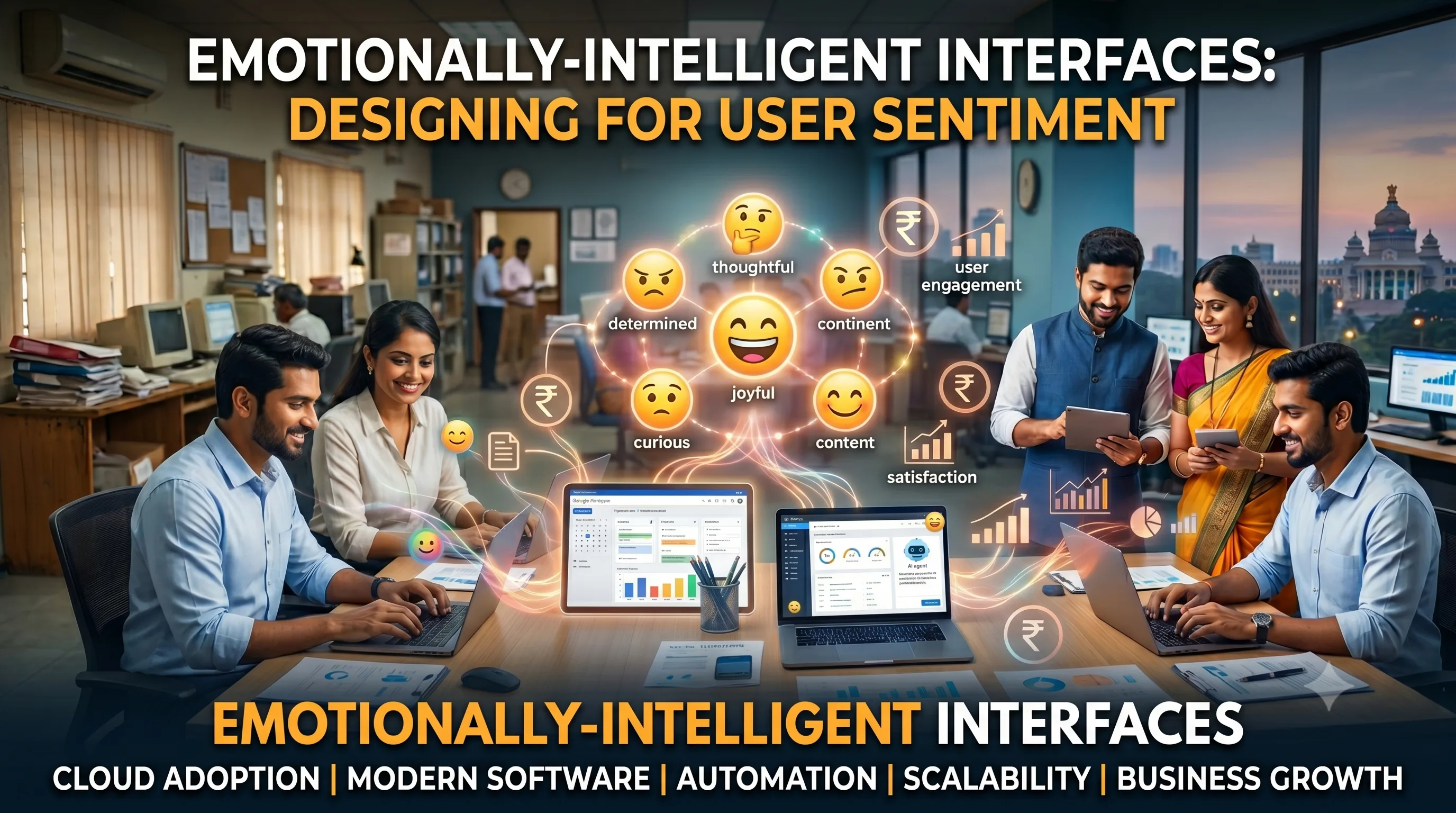
Emotionally Intelligent Interfaces: Designing for User Sentiment in Re
Published on: 13 Jun 2026
Emotionally Intelligent Interfaces: Designing for User Sentiment in Real-Time
Introduction
Imagine a website that knows when you're frustrated—and offers help before you click away. Or an app that celebrates your success with a subtle animation when you complete a task. This isn't science fiction; it's the next frontier in UX/UI design: emotionally intelligent interfaces.
Learn more about our Website services
In today's competitive digital landscape, Indian business owners, marketers, and professionals are constantly seeking ways to stand out. While most focus on functionality and aesthetics, the emotional layer often remains untapped. Yet, research shows that emotionally connected users are 52% more valuable than highly satisfied customers (Harvard Business Review). This statistic underscores a critical shift: user retention and loyalty are driven not just by utility, but by how a product makes people feel.
At EishwarITSolution, we believe the future of design lies in empathy—not just understanding what users do, but how they feel. In this guide, we'll explore how real-time sentiment analysis is reshaping UX/UI, share practical examples, and provide actionable steps to integrate emotional intelligence into your digital products. Whether you run a small e-commerce store in Jaipur or a fintech startup in Bengaluru, these insights can help you create more meaningful connections with your audience.
Main Section 1: What Are Emotionally Intelligent Interfaces?
Emotionally intelligent interfaces (EIIs) are digital systems that detect, interpret, and respond to human emotions in real time. They go beyond traditional usability to create adaptive experiences that feel personal and caring. Think of them as digital companions that adjust their behaviour based on your mood—like a friend who knows when to offer a joke or a quiet ear.
How They Work
EIIs leverage a combination of technologies:
- Facial expression analysis via webcam—detecting smiles, frowns, or confusion
- Voice tone analysis through microphone input—measuring pitch, speed, and emphasis
- Behavioural cues like mouse movements, scrolling speed, and click patterns—indicating hesitation or urgency
- Text sentiment analysis from chat or feedback—identifying positive, negative, or neutral language
- Biometric sensors (heart rate, skin conductance) on wearables—providing physiological data
For example, if a user is repeatedly hovering over the same button without clicking, the interface might interpret indecision and display a tooltip or live chat prompt. Similarly, if a user's typing speed slows down on a form, the system could offer a progress indicator or simplify the next step. These micro-interactions, though subtle, can significantly reduce friction and improve user satisfaction.
Why It Matters for Indian Businesses
India's digital economy is booming, with over 700 million internet users. Yet, many websites still treat users as data points rather than human beings. Emotionally intelligent interfaces can help you:
- Reduce bounce rates by detecting frustration early—for instance, if a user lingers on an error message, the system can offer immediate guidance
- Increase conversions by aligning with user mood—a calm, reassuring tone during checkout can reduce cart abandonment
- Build brand loyalty through personalised experiences—users remember how you made them feel
- Gain deeper insights from user behaviour analytics—combining emotional data with clickstreams reveals the 'why' behind actions
Take the example of an e-commerce site in Mumbai. During peak traffic, a user might feel overwhelmed by choices. An EII could detect this via rapid scrolling and offer a curated 'quick pick' section, simplifying the decision process. This not only improves the user experience but also boosts average order value by guiding users to relevant products.
👉 Don't wait for the perfect moment; turn your vision into reality today.
Free ConsultationMain Section 2: Real-Time Sentiment Analysis in Action
Real-time sentiment analysis is the engine behind emotionally intelligent interfaces. Let's look at how it's being used today across different sectors in India.
Case Study: Customer Support Chatbots
Many Indian startups now use sentiment-aware chatbots. Instead of scripted responses, the bot adjusts its tone based on the user's emotional state. If a customer types angrily, the bot might apologise and escalate to a human agent. If the user is happy, the bot might share a discount code as a reward. For example, a travel booking platform in Delhi implemented this and saw a 25% reduction in support tickets, as issues were resolved before they escalated.
Case Study: Adaptive Learning Platforms
Edtech platforms like BYJU's use sentiment analysis to gauge student engagement. If a learner is struggling (detected via slow progress or repeated errors), the system offers simpler explanations or breaks down the topic. This personalised approach improves retention and satisfaction. A practical tip: use emoji-based feedback buttons after each lesson to train your sentiment model, making it more accurate over time.
Case Study: Healthcare Apps
Telemedicine apps in India are incorporating voice sentiment analysis. When a patient sounds anxious during a consultation, the app might suggest calming breathing exercises or provide additional reassurance from the doctor. One app in Chennai reported a 40% increase in patient follow-ups after adding this feature, as patients felt more supported.
Actionable Tips for Implementation
- Start small: Integrate basic text sentiment analysis in your feedback forms or live chat. Tools like MonkeyLearn or TextBlob are free and easy to use.
- Use existing tools: Platforms like Google's Natural Language API or IBM Watson can get you started without heavy investment. They offer pre-trained models for multiple languages, including Hindi and Tamil.
- Test with a subset of users: Run A/B tests to see how adaptive responses affect key metrics like conversion rate or time on page. For example, show a help prompt to one group and not the other, then compare outcomes.
- Respect privacy: Always seek consent and anonymise data. Transparency builds trust. Display a clear message like 'We use your feedback to improve your experience' with an opt-in option.
Main Section 3: Designing for Emotion—Principles and Best Practices
Creating emotionally intelligent interfaces isn't just about technology; it's about design philosophy. Here are core principles to guide you.
1. Empathy First
Understand your users' emotional journey. Map out not just their actions but their feelings at each touchpoint. A user filling a loan application might feel anxious; a user browsing holiday packages might feel excited. Design accordingly. For instance, use calming colours and simple language for financial services, and vibrant imagery for travel sites.
2. Responsive, Not Reactive
Don't overreact to every emotional cue. Subtlety is key. If a user is frustrated, a gentle nudge is better than an intrusive pop-up. Think of it as a good friend who knows when to speak and when to listen. A practical example: instead of a loud alert, use a subtle colour change in the navigation bar to indicate support is available.
👉 Free Website Audit
Get Free Audit3. Consistency Across Channels
Emotional intelligence should be omnichannel. If a user is frustrated on mobile, the desktop experience should recognise that context. Use unified behaviour analytics to maintain a coherent emotional narrative. For example, if a user abandons a cart on mobile due to confusion, show a simplified checkout on desktop with pre-filled details.
4. Test with Real Users
Emotions are culturally nuanced. What signals frustration in Delhi might differ from Chennai. Test your sentiment models with diverse Indian user groups to avoid misinterpretation. For instance, a slow scroll might indicate careful reading in one culture but confusion in another. Conduct user interviews to validate your assumptions.
5. Combine Quantitative and Qualitative Data
Behavioural analytics tell you what users do; sentiment analysis tells you how they feel. Combine both for a holistic view. For example, high click-through rates with negative sentiment might indicate misleading design (a dark pattern). Use heatmaps alongside sentiment scores to identify problem areas.
Expert Tips
We asked leading UX professionals for their advice on building emotionally intelligent interfaces. Here's what they shared:
- Ravi Sharma, UX Lead at a Bengaluru-based fintech: "Start with the emotional pain points. In our app, users were stressed about investments. We added a 'calm mode' with simpler language and soothing colours. Engagement increased by 30%." His tip: use A/B testing to measure the impact of emotional design changes.
- Priya Mehta, Behavioural Design Consultant: "Don't rely solely on AI. Human oversight is critical. Our sentiment analysis flagged a user as 'angry' when they were actually using sarcasm. Always validate." She recommends regular audits of sentiment data by a human team.
- Ankit Patel, CTO of a health-tech startup: "Focus on micro-interactions. A small animation when a user achieves a goal can boost dopamine and reinforce positive behaviour." For example, a confetti effect after completing a health goal can increase daily active usage by 15%.
Common Mistakes
Avoid these pitfalls when implementing emotionally intelligent design:
- Over-personalisation: Too much adaptation can feel creepy. Strike a balance between helpful and invasive. For instance, avoid using webcam data without explicit consent.
- Ignoring cultural context: Emotional expressions vary across India's diverse regions. A thumbs-up might not mean the same everywhere. Train your models on local data.
- Neglecting data privacy: Collecting emotional data requires explicit consent. Failure to do so can damage trust and invite legal issues under India's Digital Personal Data Protection Act.
- Assuming one-size-fits-all: Different user segments (age, gender, location) may respond differently. Segment your sentiment models by demographics for better accuracy.
- Forgetting the baseline: Always compare emotional responses against a neutral baseline to avoid misinterpretation. For example, a user might be naturally fast typists, not necessarily anxious.
Future Trends
The future of emotionally intelligent interfaces is exciting. Here's what to watch for:
- AI-Powered Emotion Prediction: Systems will anticipate user emotions before they occur, based on past behaviour and contextual data. For example, predicting frustration during a complex form and offering help preemptively.
- Biometric Integration: Wearables like smartwatches will feed real-time heart rate and stress levels into interfaces, enabling dynamic adjustments. Imagine a fitness app that adjusts workout intensity based on your stress levels.
- Voice-First Emotional Design: As voice assistants grow in India, understanding tone and pitch will become standard. For instance, a voice assistant that detects sadness and offers comforting music.
- Ethical Frameworks: Expect stricter regulations around emotional data, pushing companies to adopt transparent practices. This includes clear opt-in mechanisms and data deletion options.
- Emotionally Intelligent AR/VR: In immersive environments, detecting user emotions will enhance training, therapy, and entertainment experiences. For example, a VR therapy app that adjusts scenarios based on user anxiety levels.
FAQs
1. What is an emotionally intelligent interface?
An emotionally intelligent interface is a digital system that detects, interprets, and responds to human emotions in real time, creating adaptive and personalised user experiences. It uses technologies like facial recognition, voice analysis, and behavioural cues to adjust the interface dynamically.
👉 Free Homepage Demo
Book Demo2. How does real-time sentiment analysis work in UX/UI?
It uses technologies like facial recognition, voice analysis, behavioural cues (e.g., mouse movements, typing speed), and text analysis to gauge user emotions. The system then adjusts the interface—for example, by offering help, simplifying content, or changing visual elements—based on the detected sentiment.
3. Is emotionally intelligent design expensive to implement?
Not necessarily. You can start with affordable tools like Google Natural Language API or open-source sentiment libraries like TextBlob. Even small changes, like adaptive micro-interactions or sentiment-aware chatbots, can be implemented with minimal investment. Many low-code platforms also offer pre-built modules.
4. What are the privacy concerns with emotional data?
Collecting emotional data raises privacy issues. Always obtain explicit user consent, anonymise data, and follow local regulations like India's Digital Personal Data Protection Act. Transparency helps build trust. Avoid storing raw biometric data; use aggregated sentiment scores instead.
5. Can small businesses in India benefit from emotionally intelligent interfaces?
Absolutely. Even basic sentiment analysis on a contact form or chatbot can improve customer satisfaction. Small businesses can use low-code platforms like ManyChat or Tidio to add emotional intelligence without a large team. For example, a local restaurant could use a sentiment-aware chatbot to handle reservations and feedback.
6. How do I measure the success of an emotionally intelligent interface?
Track metrics like user engagement (time on page, pages per session), task completion rate, bounce rate, and Net Promoter Score (NPS). Compare these against baseline data before implementing emotional features. Also monitor sentiment trends over time to see if user satisfaction improves.
7. What are the best tools for implementing sentiment analysis in India?
Popular tools include Google Natural Language API (supports Hindi), IBM Watson Tone Analyzer, and open-source libraries like VADER for social media text. For Indian languages, consider Indic NLP Library or Bhashini for regional language support. Always test with local data for accuracy.
Conclusion
Emotionally intelligent interfaces represent a paradigm shift in UX/UI design. By moving beyond clicks and scrolls to understand the human behind the screen, you can create experiences that resonate deeply with your audience. For Indian businesses, this is not just a trend—it's a competitive advantage. As the digital landscape becomes more crowded, the brands that succeed will be those that connect on an emotional level.
Remember, the goal is not to manipulate emotions but to serve users better. When you design with empathy, you build trust, loyalty, and long-term value. Start small, test often, and always keep the user's feelings at the centre of your decisions. The future of UX is emotional—are you ready to embrace it?
CTA
Ready to make your digital products more emotionally intelligent? At EishwarITSolution, we specialise in data-driven UX/UI design that puts users first. Our team of experts can help you integrate real-time sentiment analysis, design adaptive interfaces, and measure emotional impact. Contact us today for a free consultation and discover how we can help you build interfaces that truly understand your customers. Let's create experiences that matter.