
Web Performance Optimization for Indian Businesses: Speed Up Your Webs
Published on: 17 Jun 2026
Web Performance Optimization for Indian Businesses: Speed Up Your Website in 2026
Introduction
In 2026, a fast website is no longer a luxury—it's a necessity for Indian businesses. With mobile-first users expecting pages to load in under two seconds, every millisecond of delay can cost you a customer. Web performance optimization (WPO) is the practice of improving the speed and responsiveness of your website, directly impacting user experience, search engine rankings, and conversion rates. For Indian businesses, where internet penetration is skyrocketing but network conditions vary widely, WPO becomes a strategic differentiator.
Learn more about our Website services
Indian internet users are among the most impatient globally. A study by Google found that 53% of mobile site visitors leave a page that takes longer than three seconds to load. For businesses targeting Indian audiences, optimizing web performance is critical to staying competitive. This guide will walk you through proven strategies to speed up your website in 2026, tailored for the Indian market. We'll cover everything from image optimization to advanced techniques like HTTP/3 and edge computing, ensuring your site not only loads fast but also delivers a seamless experience across devices and networks.
Main Section 1: Why Web Performance Matters for Indian Businesses
Web performance directly influences key business metrics. A one-second delay in page load time can reduce conversions by 7% and customer satisfaction by 16%. For e-commerce sites, this translates to significant revenue loss. With India's growing digital economy, even small improvements in speed can lead to substantial gains. For example, an e-commerce store selling handmade crafts could see a 10% increase in sales just by improving load time from 4 seconds to 2 seconds.
Search engines like Google use Core Web Vitals as ranking factors. Google's Page Experience update prioritizes sites that load quickly, are visually stable, and respond immediately to user interactions. Indian businesses that ignore performance risk falling behind in search results. A local restaurant in Mumbai that optimizes its site could outrank competitors simply because its menu loads faster on mobile.
Additionally, mobile performance is crucial. Over 75% of Indian web traffic comes from mobile devices, and many users rely on slower 4G or even 3G connections. Optimizing for these conditions ensures your site is accessible to a broader audience, reducing bounce rates and increasing engagement. For instance, a travel booking site that optimizes for 3G can capture users in rural areas who are planning trips, expanding its customer base significantly.
Main Section 2: Key Web Performance Optimization Techniques for 2026
Here are the most effective techniques to boost your website's speed, with practical examples for Indian businesses:
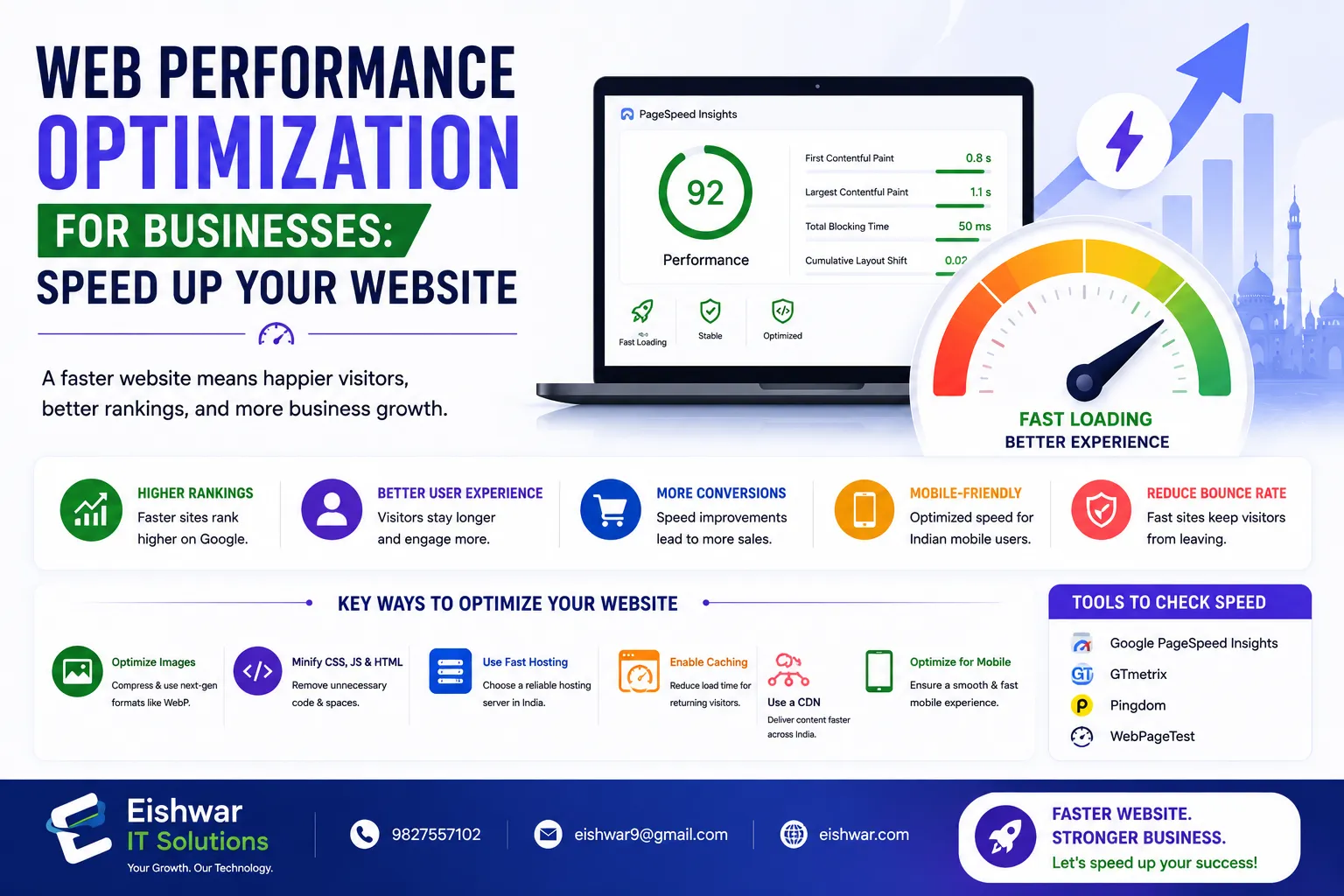
1. Optimize Images and Media: Images often account for the largest file sizes on a page. Use modern formats like WebP or AVIF, compress images without losing quality, and implement lazy loading so images load only when they come into the viewport. Tools like TinyPNG or ShortPixel can help. For example, a fashion retailer in Delhi can reduce image sizes by 60% using WebP, cutting load time from 5 seconds to 2 seconds on mobile.
2. Minimize HTTP Requests: Reduce the number of elements on your page (scripts, images, CSS files) by combining them or using CSS sprites. Fewer requests mean faster load times. A news portal in Bangalore can combine multiple CSS files into one, reducing requests from 20 to 5, which speeds up rendering.
👉 Don't wait for the perfect moment; turn your vision into reality today.
Free Consultation3. Enable Browser Caching: Set expiry dates for static resources like images, CSS, and JavaScript. Returning visitors will load your site much faster as their browser caches these files. For a local bakery in Chennai, caching can reduce repeat visit load times by 80%, encouraging customers to order again.
4. Use a Content Delivery Network (CDN): A CDN distributes your site's content across multiple servers worldwide, delivering it from the server closest to the user. For Indian audiences, choose a CDN with strong local presence, such as Cloudflare or Akamai. A fintech startup in Hyderabad can use a CDN to serve content from servers in Mumbai, reducing latency for users across India by 50%.
5. Optimize CSS and JavaScript: Minify CSS and JavaScript files by removing unnecessary characters, comments, and whitespace. Defer non-critical JavaScript to load after the main content, and use async loading where possible. A SaaS company in Pune can defer analytics scripts, ensuring the main page loads in 1.5 seconds instead of 3 seconds.
6. Improve Server Response Time: Choose a reliable hosting provider with data centers in or near India. Use server-side caching (e.g., Varnish, Redis) and optimize your database queries. For example, a real estate portal in Mumbai can use Redis to cache property listings, reducing server response time from 500ms to 50ms.
7. Implement Core Web Vitals Improvements: Focus on Largest Contentful Paint (LCP), First Input Delay (FID), and Cumulative Layout Shift (CLS). Optimize LCP by preloading key resources, reduce FID by breaking up long tasks, and minimize CLS by setting explicit dimensions for images and ads. A travel blog in Goa can preload its hero image, achieving an LCP of 1.8 seconds, well under the 2.5-second target.
Main Section 3: Tools and Metrics to Measure Performance
To optimize effectively, you need to measure. Here are essential tools and metrics, with tips on how to use them:
Google PageSpeed Insights: Provides lab and field data on your site's performance, including Core Web Vitals scores. It offers actionable recommendations for improvement. For a local business in Kolkata, use this tool to identify that images need compression, then apply it directly.
GTmetrix: Gives a detailed breakdown of page speed, waterfall charts, and suggestions. Useful for monitoring performance over time. A digital agency in Delhi can schedule monthly GTmetrix tests to track improvements after each optimization.
WebPageTest: Allows you to test from different locations and devices. Simulate Indian network conditions to see real-world performance. For an e-commerce site in Bengaluru, test from a 3G connection in rural Karnataka to ensure the site loads within 5 seconds.
Chrome DevTools: Built into Chrome, it lets you audit performance, analyze network activity, and identify bottlenecks. A developer in Chennai can use the Performance tab to find that a third-party script is blocking rendering, then defer it.
Key metrics to track: Time to First Byte (TTFB), First Contentful Paint (FCP), Largest Contentful Paint (LCP), Cumulative Layout Shift (CLS), and Total Blocking Time (TBT). Aim for LCP under 2.5 seconds, FID under 100ms, and CLS under 0.1. For Indian businesses, also monitor metrics like 'Time to Interactive' on slow connections.
👉 Free Website Audit
Get Free AuditExpert Tips
We spoke with leading web performance experts to get their top tips for Indian businesses:
Tip 1: Prioritize mobile performance. Design your site with a mobile-first approach. Use responsive design, avoid heavy scripts, and test on real devices. Expert Rajesh Kumar, a performance consultant in Mumbai, says: 'Many Indian users access the web on low-end phones. Test on devices like the Redmi Note 10 to ensure smooth performance.'
Tip 2: Leverage browser hints. Use rel='preload' for critical resources like fonts and hero images, and rel='preconnect' to establish early connections to third-party origins. For example, a food delivery app in Delhi can preload its logo and connect to its API server early, shaving off 200ms.
Tip 3: Regularly audit your site. Performance degrades over time due to added plugins, scripts, or content. Schedule monthly audits to catch issues early. Expert Priya Sharma, a web developer in Bengaluru, recommends: 'Set up automated alerts in Google Search Console for Core Web Vitals issues.'
Tip 4: Use a lightweight CMS. Platforms like WordPress can be slow if bloated. Opt for a minimal theme and only necessary plugins. Consider static site generators for content-heavy sites. For a blog in Jaipur, using Hugo instead of WordPress can reduce load time from 4 seconds to 1 second.
Common Mistakes
Avoid these pitfalls that many Indian businesses make:
Mistake 1: Ignoring mobile users. Building a desktop-only experience and then scaling down leads to poor mobile performance. Start with mobile. A local gym in Pune that designs for desktop first sees a 70% bounce rate on mobile.
Mistake 2: Overusing third-party scripts. Analytics, chatbots, and social media widgets can significantly slow your site. Only use what's essential and load them asynchronously. A restaurant in Hyderabad that removes unused chat widgets reduces load time by 30%.
Mistake 3: Not optimizing for local networks. Many Indian users have slow or unreliable connections. Test your site under 3G conditions to ensure it still performs. An online tutoring platform in Chennai that tests on 3G finds that its video previews are too heavy, then compresses them.
Mistake 4: Skipping image optimization. Uploading high-resolution images without compression is a common speed killer. Always optimize before uploading. A real estate agent in Bangalore who compresses property images sees a 40% improvement in page load time.
Future Trends
Web performance in 2026 and beyond will be shaped by emerging technologies:
AI-driven optimization: Machine learning algorithms will automatically adjust resources based on user behavior and network conditions, delivering personalized speed improvements. For example, an e-commerce site in Mumbai can use AI to serve lower-quality images to users on slow connections, improving load time by 50%.
HTTP/3 and QUIC: These protocols reduce latency and improve connection reliability, especially on mobile networks. Adoption will grow, making web performance even faster. A streaming service in Delhi that adopts HTTP/3 sees a 20% reduction in buffering for mobile users.
👉 Free Homepage Demo
Book DemoEdge computing: Processing data closer to the user reduces server response times. Indian businesses can benefit from edge functions for dynamic content. A news portal in Kolkata can use edge computing to personalize news feeds without slowing down the server.
WebAssembly (Wasm): Allows running high-performance code in the browser, enabling complex applications without sacrificing speed. A gaming startup in Bengaluru can use Wasm to run physics simulations in the browser, achieving 60fps on low-end devices.
FAQs
What is web performance optimization?
Web performance optimization (WPO) is the process of improving the speed and responsiveness of a website. It involves techniques like image compression, caching, minifying code, and using CDNs to ensure fast loading times and a smooth user experience. For Indian businesses, it also includes optimizing for mobile networks and local hosting.
Why is website speed important for Indian businesses?
Indian users are mobile-first and expect fast loading times. Slow websites lead to high bounce rates, lower conversions, and poor search engine rankings. With growing competition, a fast website is a key differentiator. For example, a 1-second delay can reduce conversions by 7%, which is critical for small businesses.
How can I test my website's speed?
Use tools like Google PageSpeed Insights, GTmetrix, or WebPageTest. These provide detailed reports on load times, Core Web Vitals, and specific recommendations for improvement. For Indian audiences, test from locations like Mumbai or Delhi using WebPageTest to simulate local conditions.
What are Core Web Vitals?
Core Web Vitals are a set of metrics by Google that measure user experience: Largest Contentful Paint (loading), First Input Delay (interactivity), and Cumulative Layout Shift (visual stability). They are ranking signals for search engines. Aim for LCP under 2.5 seconds, FID under 100ms, and CLS under 0.1.
What is a CDN and why do I need one?
A Content Delivery Network (CDN) is a network of servers that deliver your site's content from the location closest to the user. It reduces latency and improves load times, especially for users far from your origin server. For Indian businesses, a CDN with local nodes can cut load times by 50% or more.
How often should I optimize my website?
Performance optimization should be an ongoing process. Conduct a full audit at least quarterly, and monitor performance monthly using tools like Google Search Console or GTmetrix. Regular checks help catch issues from new plugins or content updates.
What is the best hosting for Indian websites?
Choose a hosting provider with data centers in India, such as Bluehost India, HostGator India, or AWS Mumbai. Local hosting reduces latency and improves server response times. For high-traffic sites, consider cloud hosting with auto-scaling.
Conclusion
Web performance optimization is a continuous investment that pays off in better user experience, higher search rankings, and increased conversions. For Indian businesses in 2026, a fast website is not just about technology—it's about respecting your users' time and delivering value instantly. Start with the basics: optimize images, use a CDN, and improve server response. Then, dive deeper into Core Web Vitals and advanced techniques like HTTP/3 and edge computing. Remember, every second counts. By prioritizing performance, you position your business for long-term success in India's digital landscape. The journey may seem daunting, but with the right tools and strategies, you can achieve significant improvements that directly impact your bottom line.
CTA
Ready to supercharge your website's speed? Contact EishwarITSolution today for a free website performance audit. Our experts will identify bottlenecks and implement proven optimization strategies tailored for Indian audiences. Get in touch now and give your business the speed advantage it deserves. Don't let slow load times cost you customers—act now to stay ahead in 2026.