
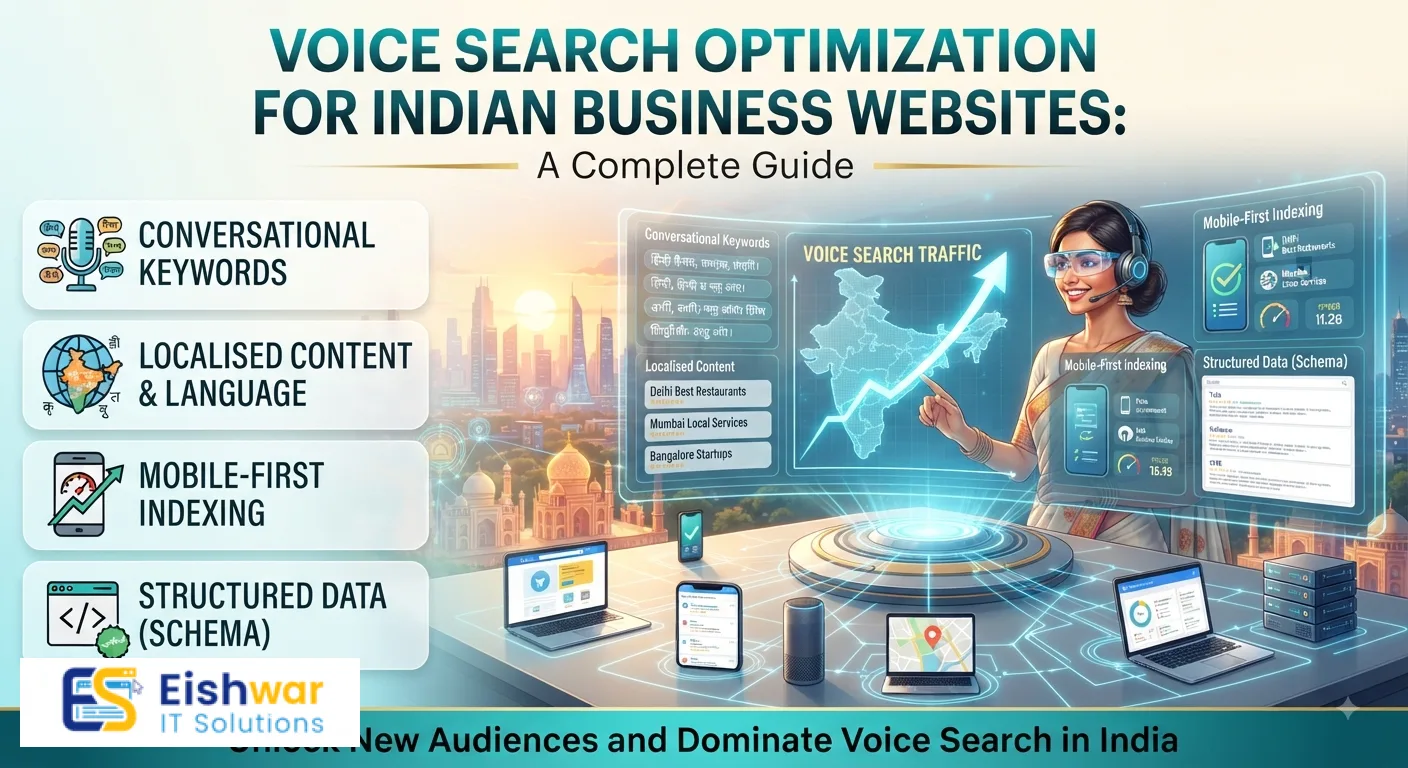
Voice Search Optimization for Indian Business Websites: A Complete Gui
Published on: 01 Aug 2026
Voice Search Optimization for Indian Business Websites: A Complete Guide for 2026
Introduction
Imagine a customer in Mumbai asking their phone, "Where can I find the best Italian restaurant nearby?" Or a shop owner in Delhi saying, "Hey Google, what's the best web development company for small business?" This is the reality of voice search—and it's growing rapidly in India. By 2026, voice search is expected to drive a significant portion of online searches, especially on mobile devices. For Indian business owners, marketers, and professionals, this means you can't afford to ignore voice search optimization. In this guide, we'll walk you through everything you need to know to make your website voice-search ready, attract more customers, and stay ahead of the competition.
Learn more about our Website services
Main Section 1: Understanding Voice Search and Its Rise in India
Voice search allows users to speak their queries instead of typing them. It's powered by AI assistants like Google Assistant, Alexa, Siri, and even in-app voice commands. In India, the adoption of voice search has been phenomenal due to the proliferation of affordable smartphones and cheap data plans. According to a Google report, Indian users are among the highest users of voice search globally, with a large portion using it in regional languages. This trend is set to grow even more by 2026.
Why Voice Search Matters for Your Business
- Convenience: Users can search hands-free while driving, cooking, or shopping.
- Local Intent: Many voice searches are local, like "near me" queries, which are crucial for businesses with physical locations.
- Mobile-First: India is a mobile-first market, and voice search is naturally mobile-friendly.
- Conversational: Voice queries are longer and more natural, which changes how you optimize content.
How Voice Search Works
When a user speaks a query, the assistant converts it to text, processes the intent, and returns the best possible answer—often as a featured snippet or a spoken response. To be that answer, your website needs to be structured in a way that search engines can easily parse and extract relevant information.
Main Section 2: Key Strategies to Optimize Your Website for Voice Search
Now that you understand the importance, let's dive into actionable strategies to make your website voice-search friendly.
1. Focus on Conversational Keywords and Long-Tail Phrases
Voice searches are conversational. Instead of typing "best web development company", a user might say, "Which is the best web development company in Pune for a small business?" So, you need to target long-tail keywords that mimic natural speech. Use tools like Google Keyword Planner, AnswerThePublic, or even Google's autocomplete suggestions to find these phrases. Include them naturally in your content, headings, and FAQs.
2. Optimize for Local SEO
A large percentage of voice searches are local. To capture this traffic:
- Claim and optimize your Google Business Profile.
- Ensure your name, address, and phone number (NAP) are consistent across the web.
- Add local keywords (e.g., "web development in Bangalore") to your content.
- Include testimonials and reviews, as they can appear in local voice results.
3. Improve Page Speed and Mobile Responsiveness
Voice search users are often on mobile devices. If your website loads slowly or isn't mobile-friendly, you'll lose them. Use Google's PageSpeed Insights to check your site's performance and make necessary improvements. Compress images, leverage browser caching, and use a reliable hosting provider like EishwarITSolution to ensure fast load times.
👉 Don't wait for the perfect moment; turn your vision into reality today.
Free Consultation4. Use Schema Markup for Enhanced SERP Features
Schema markup (structured data) helps search engines understand your content better. For voice search, the most important types are:
- FAQPage: Mark up your FAQ section to increase chances of appearing as a featured snippet.
- LocalBusiness: Provide details like address, hours, and geo-coordinates.
- Product and Service schemas.
By implementing schema, you make it easier for search engines to extract and present your information in voice results.
5. Create Content That Answers Questions
Voice search queries often start with who, what, where, when, why, and how. Create content that directly answers these questions. For example, if you're a web development company, you could write a blog post titled "How to Choose the Right Web Development Company in India" and answer it thoroughly. Use concise, direct answers (around 40-50 words) that can be easily picked up as featured snippets.
6. Optimize for Featured Snippets
Featured snippets are the boxes that appear at the top of Google search results. They are prime real estate for voice search. To optimize:
- Structure your content with clear headings (H2, H3).
- Provide bulleted or numbered lists for steps.
- Keep paragraphs short and to the point.
- Answer the question in a paragraph right after the heading.
Main Section 3: Tools and Technologies to Leverage Voice Search
Several tools can help you analyze and optimize for voice search:
- Google Search Console: See which queries bring users to your site and identify voice-like queries.
- AnswerThePublic: Visualizes questions people ask about your keywords.
- SEMrush or Ahrefs: Offer keyword research features that include question-based keywords.
- Google's Natural Language API: Analyze your content for entities and sentiment.
Additionally, consider integrating voice assistants into your business processes. For example, if you have a customer support section, you could create a voice assistant that answers common queries. But for most businesses, the focus should be on making your website voice-search ready.
Expert Tips
- Use Natural Language in Your Copy: Write as you speak, but keep it professional. Avoid overly formal or robotic language.
- Optimize for Regional Languages: India is multilingual. Consider creating content in Hindi, Tamil, or other local languages to capture a wider audience.
- Leverage Google My Business Posts: These can appear in local voice results, so update them regularly.
- Monitor Voice Search Analytics: Use tools like Google Analytics to track voice search traffic (often identified by longer, conversational queries).
- Test Your Site with Voice Assistants: Use Google Assistant, Siri, or Alexa to ask questions about your business and see if your website provides the answer.
Common Mistakes
- Ignoring Mobile Experience: If your site isn't mobile-optimized, you're losing voice search traffic.
- Keyword Stuffing: Stuffing your content with keywords makes it sound unnatural and hurts readability.
- Not Using Schema Markup: Without it, you miss out on rich results.
- Focusing Only on English: India is a multilingual country; ignoring regional languages limits your reach.
- Skipping Local SEO: If you have a physical business, not optimizing for local search is a huge miss.
Future Trends
By 2026, voice search will become even more integrated into daily life. We can expect:
👉 Free Website Audit
Get Free Audit- Multilingual Voice Search: Improved AI will handle multiple languages and code-switching (e.g., Hinglish) seamlessly.
- Visual Voice Search: Combining voice with visual elements, like showing product images in response to voice queries.
- Voice Commerce: Users will make purchases via voice commands, so e-commerce sites need to be voice-order ready.
- Hyperlocal and Context-Aware Results: Search assistants will use more context (location, time, preferences) to deliver highly personalized results.
To stay ahead, keep your website updated with the latest SEO practices and embrace new technologies as they emerge.
FAQs
Q1: What is voice search optimization?
Voice search optimization (VSO) is the process of optimizing your website and content to appear in voice search results. It involves using conversational keywords, improving local SEO, implementing schema markup, and providing clear, concise answers to common questions.
Q2: Why is voice search important for Indian businesses?
India has a massive mobile-first user base, and voice search is growing rapidly due to the convenience of speaking queries. Many Indian users prefer voice search, especially in regional languages. By optimizing for voice, businesses can reach a larger audience and improve their online visibility.
Q3: How long does it take to see results from voice search optimization?
Results can vary based on your current website authority and the competitiveness of your niche. Generally, you may start seeing improvements in organic traffic within 3-6 months, but it takes consistent effort to fully capitalize on voice search.
Q4: Do I need to create separate content for voice search?
No, you don't need separate content. Instead, optimize your existing content by adding FAQ sections, using natural language, and targeting long-tail keywords. This helps your content rank for both text and voice searches.
Q5: Can voice search optimization help with local customers?
Absolutely. Voice search is heavily used for local queries like "near me" or "best [service] in [city]". By optimizing your local SEO and Google Business Profile, you can attract more local customers through voice search.
Q6: What are the best tools for voice search optimization?
Some top tools include Google Search Console, Google Keyword Planner, AnswerThePublic, SEMrush, Ahrefs, and Google's Natural Language API. These help you find voice-friendly keywords, analyze your content, and track performance.
Q7: How does voice search affect my website's SEO strategy?
Voice search shifts the focus from short, typed keywords to longer, conversational phrases. This means your SEO strategy should include more natural language, question-based content, and a stronger emphasis on local and mobile optimization.
Q8: Is voice search optimization different from traditional SEO?
While the core principles of SEO (quality content, backlinks, user experience) remain, voice search optimization adds specific tactics like targeting featured snippets, using schema markup, and optimizing for local intent. It's an evolution of traditional SEO, not a replacement.
👉 Free Homepage Demo
Book DemoConclusion
Voice search is not just a passing trend—it's a fundamental shift in how people find information online. For Indian businesses, embracing voice search optimization is a smart investment that can lead to increased visibility, more traffic, and ultimately more customers. By following the strategies outlined in this guide—focusing on conversational keywords, local SEO, schema markup, and mobile optimization—you can position your business at the forefront of this change. Remember, the key is to be helpful and provide clear, concise answers to your customers' questions. Start optimizing today, and you'll be well-prepared for the voice-first future of 2026.
CTA
Ready to make your website voice-search ready? EishwarITSolution specializes in web development and SEO strategies that help Indian businesses thrive online. Contact us today for a free consultation and see how we can boost your voice search presence!