
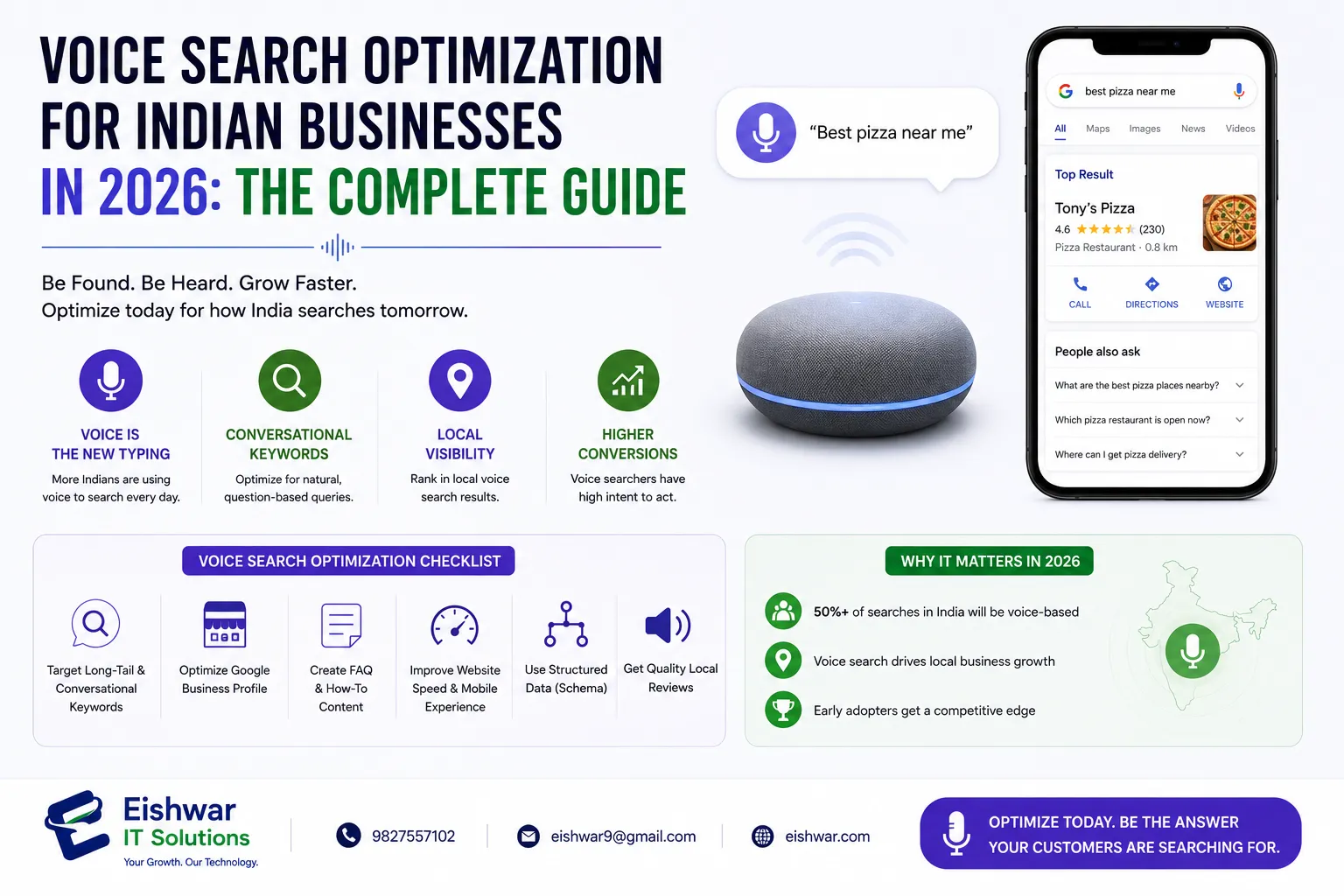
Voice Search Optimization for Indian Businesses in 2026: The Complete
Published on: 17 Jun 2026
Voice Search Optimization for Indian Businesses in 2026: The Complete Guide to Dominate Conversational Queries
Introduction
Imagine a busy morning in Mumbai. A small business owner asks her phone, "Where can I get the best chai near me?" Within seconds, a list of nearby cafes appears. This is voice search—and it's booming in India. By 2026, voice search is expected to account for over 50% of all online searches in the country, driven by affordable smartphones, cheap data, and the rise of regional language assistants like Google Assistant in Hindi, Tamil, and Bengali.
Learn more about our Website services
For Indian businesses, this shift is a golden opportunity. Traditional SEO focused on typing keywords. Voice search optimization is about understanding how people speak—naturally, conversationally, and often with local intent. If you're not optimizing for voice, you're leaving money on the table. Consider this: a local restaurant in Delhi that optimizes for "best butter chicken near Connaught Place" can capture customers who would otherwise type a generic query and scroll past.
In this guide, we'll walk you through everything you need to know: why voice search matters for Indian businesses, how to optimize your content, common pitfalls, and what the future holds. Let's dive in.
Main Section 1: Why Voice Search is a Game-Changer for Indian Businesses
The Rise of Voice Assistants in India
India has over 750 million internet users, and a growing number rely on voice assistants like Google Assistant, Alexa, and Siri. In fact, India is one of the fastest-growing markets for voice search, with over 200 million monthly active voice users. The reasons are clear: typing in Hindi, Tamil, or other regional languages can be cumbersome, but speaking is effortless. For example, a user in Chennai might say, "Alexa, find a plumber near T Nagar," rather than typing a query. This behavior is especially prevalent among younger demographics and in tier-2 and tier-3 cities, where smartphone penetration is rising.
Voice Search Behavior in 2026
Users don't type "best restaurant Delhi"; they say, "Hey Google, what's the best restaurant near me for dinner?" This shift means your content must answer questions directly, concisely, and with local context. Voice queries are 3x more likely to be local than text searches, making local SEO a cornerstone of voice optimization. For instance, a query like "Where can I buy organic vegetables in Bangalore?" requires your business to have a strong local presence and structured data that highlights your offerings.
Impact on Small and Medium Businesses
For a local bakery in Pune or a salon in Bangalore, voice search can be a direct line to customers. When someone asks for "affordable salon near me," only businesses with optimized Google Business Profiles and conversational content will show up. It levels the playing field—small businesses can compete with big brands by focusing on local voice queries. Take the example of a small bookstore in Jaipur: by optimizing for "bookstore near Hawa Mahal," they can attract tourists and locals alike, without needing a massive ad budget.
Main Section 2: How to Optimize Your Website for Voice Search
1. Target Natural Language and Long-Tail Keywords
Voice queries are longer and more conversational. Instead of "SEO services India," target phrases like "Which is the best SEO company in India for small businesses?" Use tools like AnswerThePublic or Google's "People also ask" to find natural language questions. For example, if you run a travel agency, optimize for "What are the best hill stations to visit in India in June?" Then, create a blog post that directly answers that question with a list and brief descriptions. This increases your chances of appearing in voice search results.
👉 Don't wait for the perfect moment; turn your vision into reality today.
Free Consultation2. Optimize for Featured Snippets and Position Zero
Voice assistants often read from featured snippets—the boxed answer at the top of Google search results. To win this spot, structure your content with clear headings, bullet points, and direct answers. For instance, if you're writing about "digital marketing tips," include a section that starts with "Here are the top digital marketing tips for 2026..." followed by a concise list. Use H2 or H3 tags for each tip, and keep the answer under 50 words. For example, a snippet for "How to improve website speed?" could be: "Compress images, enable caching, and minimize JavaScript to improve website speed."
3. Improve Page Speed and Mobile Experience
Voice search is primarily mobile. Google prioritizes fast, mobile-friendly pages. Use tools like Google PageSpeed Insights to check your site. Compress images, enable caching, and minimize JavaScript. A delay of even one second can reduce conversions by 20%—and hurt your voice search ranking. For example, a local e-commerce site selling handmade crafts saw a 15% increase in voice traffic after reducing load time from 4 seconds to 2 seconds. Also, ensure your site is responsive and buttons are easy to tap on mobile.
4. Leverage Structured Data (Schema Markup)
Schema helps search engines understand your content. For voice search, use LocalBusiness schema, FAQ schema, and HowTo schema. For example, if you're a restaurant, add schema for your menu, hours, and location. This increases the chance of being featured in voice answers. A practical tip: use Google's Structured Data Markup Helper to generate code. For a clinic in Mumbai, adding schema for services like "dentist" and "root canal" can help voice assistants provide precise answers.
5. Create FAQ Pages and Conversational Content
Voice users ask questions. Create dedicated FAQ pages that address common queries in a natural tone. For example, "How do I choose a digital marketing agency in India?" should be answered in a friendly, direct manner. Use H2 or H3 for each question, and keep answers under 50 words for snippet potential. Additionally, write blog posts that mimic conversation—start with a question, then provide the answer. For instance, a post titled "What is the best time to visit Goa?" can directly answer with "The best time is from November to February, when the weather is pleasant."
Main Section 3: Local Voice Search Strategies for Indian Markets
Optimize Your Google Business Profile (GBP)
Your GBP is your voice search best friend. Ensure your business name, address, phone number, and hours are accurate. Add photos, respond to reviews, and post updates. When someone asks, "Where can I get home delivery of groceries near me?" a well-optimized GBP can put you on the map. For example, a grocery store in Kolkata that updates its GBP with "home delivery available" and includes photos of products is more likely to be selected by voice assistants.
👉 Free Website Audit
Get Free AuditInclude Location-Specific Keywords
Use phrases like "best digital marketing agency in Jaipur" or "affordable wedding planners in Chennai." These long-tail, location-rich phrases match voice queries perfectly. Also, mention landmarks or neighborhoods—e.g., "near MG Road" or "in Indiranagar." For instance, a cafe in Bangalore could optimize for "cafe near MG Road with Wi-Fi" to attract remote workers. This specificity helps you stand out in voice search results.
Encourage Customer Reviews
Positive reviews boost your local ranking and voice visibility. Ask happy customers to leave reviews on Google. Respond to all reviews—good and bad—to show you care. Voice assistants often pull businesses with high ratings and recent reviews. For example, a salon in Delhi with a 4.8 rating and 50 reviews is more likely to be recommended for "best haircut near me" than one with fewer reviews. Make it easy by sending a direct link to your Google review page after a purchase.
Use Regional Language Optimization
India's diversity means voice search in Hindi, Tamil, Bengali, and other languages is growing. If your audience speaks a regional language, create content in that language. For example, a local clinic in Hyderabad can optimize for "Telugu voice search" by including Telugu phrases and using Hreflang tags. A practical example: a dentist in Chennai could create a page titled "பல் மருத்துவர் சென்னை" (Dentist Chennai in Tamil) with content in Tamil, targeting voice queries like "சென்னையில் சிறந்த பல் மருத்துவர்" (best dentist in Chennai).
Expert Tips
- Think like a user: Ask yourself what questions your customers would ask out loud. Write content that answers those questions immediately. For example, if you sell organic soaps, optimize for "Where can I buy organic soap in Mumbai?"
- Focus on "near me" queries: These are high-intent and often lead to conversions. Ensure your GBP and content are optimized for location. Use phrases like "near me" naturally in your content, but avoid overdoing it.
- Use conversational tone: Write as if you're talking to a friend. Avoid jargon unless your audience expects it. For instance, instead of "utilize our services," say "use our services."
- Monitor voice search analytics: Tools like Google Search Console can show you queries that trigger voice results. Use this data to refine your strategy. Look for queries with question words like "what," "where," and "how."
- Test your own site: Use a voice assistant to search for your business. Does it find you? If not, adjust your optimization. For example, ask "Hey Google, find a plumber in Pune" and see if your business appears.
Common Mistakes
- Ignoring mobile optimization: Voice search is mobile-first. If your site is slow or not responsive, you'll lose out. For example, a site that takes 5 seconds to load on mobile will be ignored by voice assistants.
- Keyword stuffing: Voice search penalizes unnatural language. Use keywords naturally within conversational phrases. Instead of "best SEO services India best," say "We offer the best SEO services in India."
- Neglecting local SEO: Many businesses focus only on general keywords and forget to optimize for local intent. For instance, a restaurant in Mumbai that targets "best Italian food" but not "best Italian food in Bandra" misses out on local voice traffic.
- Not updating GBP: An outdated profile with wrong hours or address can ruin your voice search chances. For example, a clinic that lists Sunday hours but is actually closed will frustrate customers and hurt rankings.
- Forgetting about regional languages: If your audience speaks Hindi or another language, ignoring it means missing a huge chunk of voice traffic. For example, a business in Varanasi that only optimizes for English will lose to competitors using Hindi.
Future Trends
By 2026, voice search in India will evolve further. We'll see more integration with IoT devices—think smart home speakers and cars. For example, a user might ask their car's voice assistant, "Find the nearest petrol pump in Gurgaon." Multilingual voice search will become the norm, with assistants understanding code-switching (e.g., mixing Hindi and English, like "Mujhe best pizza near me chahiye"). Businesses that invest in AI-driven chatbots and voice commerce will have an edge. For instance, a user could say, "Order my usual coffee from Cafe Coffee Day," and the assistant will complete the purchase. Also, visual voice search (combining voice with images) will emerge, so start thinking about image optimization now—use descriptive alt text and file names like "best-chai-mumbai.jpg."
👉 Free Homepage Demo
Book DemoFAQs
What is voice search optimization?
Why is voice search important for Indian businesses in 2026?
How do I optimize for voice search in Hindi or other regional languages?
Does voice search affect local SEO?
What tools can help with voice search optimization?
How long does it take to see results from voice search optimization?
Can voice search work for e-commerce businesses in India?
Conclusion
Voice search is not a distant trend—it's here, and it's reshaping how Indian customers find businesses. By optimizing for natural language, local intent, and mobile experience, you can capture a growing share of voice-driven traffic. Start small: update your Google Business Profile, add a few FAQ sections, and test your site with a voice assistant. The businesses that adapt now will dominate search in 2026 and beyond. Ready to make your business heard?
CTA
Ready to dominate voice search in India? Contact EishwarITSolution today for a free voice search audit. Our experts will help you craft a strategy that puts your business at the top of every voice query. Don't wait—your customers are already asking.