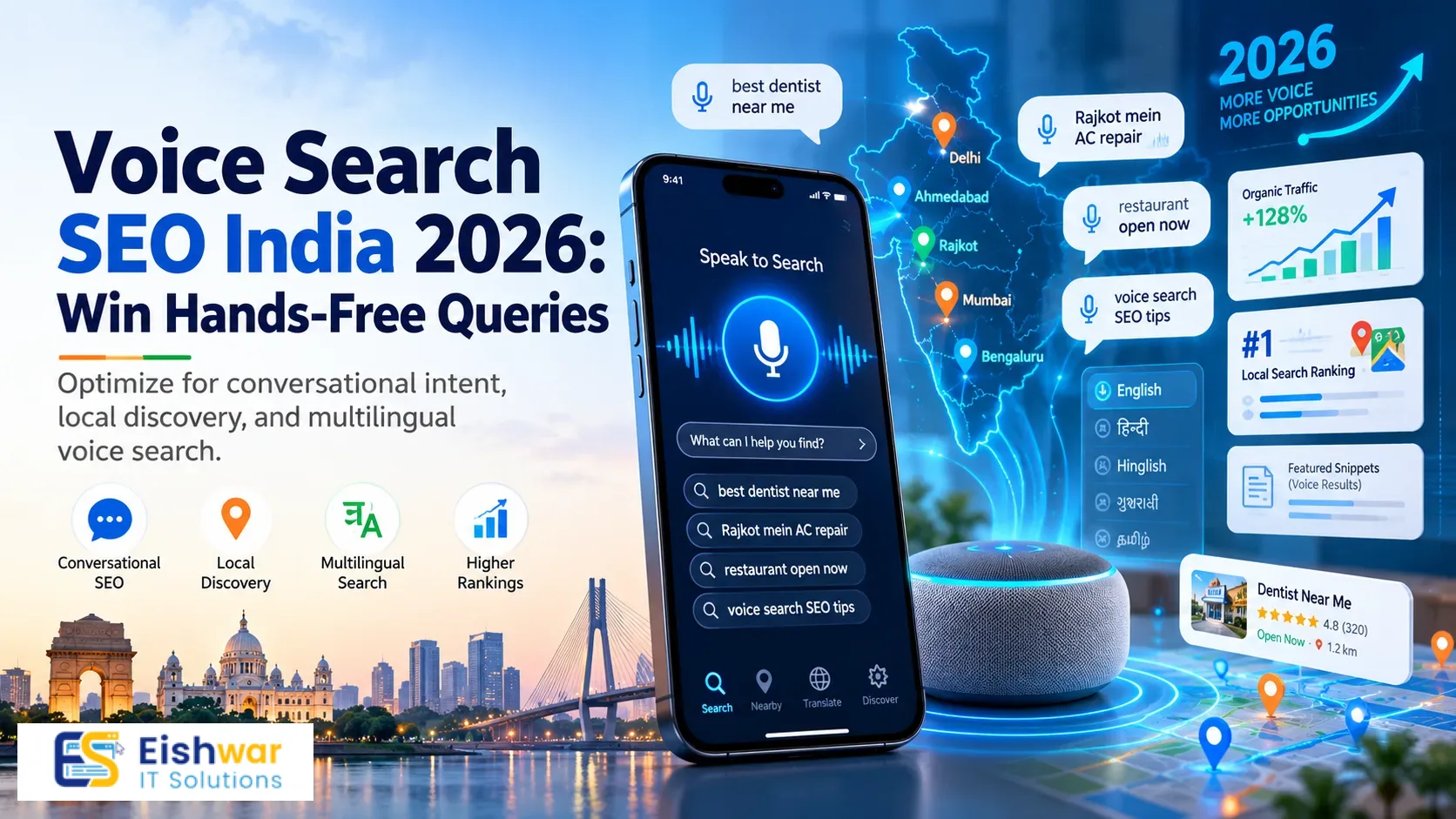
Voice Search SEO India 2026: Win Hands-Free Queries
\n# Voice Search SEO India 2026: Win Hands-Free Queries
## Introduction
Indian search behavior is changing fast. People are no longer only typing short keywords into a search box. They are asking full questions to their phones, smart speakers, car systems, and smartwatches. They say things like, ‘Which dentist near me is open now?’, ‘How much does SEO cost in India?’, or ‘Best interior designer in Hyderabad for a 3BHK’. This is voice search in action.
For Indian businesses, voice search SEO India is not about chasing a futuristic trend. It is about being the answer when a customer speaks naturally. That means your website, Google Business Profile, content, and technical setup must help search engines and voice assistants understand your business clearly.
In this guide, you will learn how voice search works in India, what to optimize first, how to handle Hindi and regional languages, and how to measure results in a practical way. The goal is simple: win more hands-free queries without stuffing keywords or sounding robotic.
## Main Section 1: Why Voice Search Matters for Indian Businesses
### Voice queries sound different from typed queries
Typed searches are often short and polished. Voice searches are conversational. Someone may type ‘SEO company Jaipur’ but ask, ‘Who is a good SEO company near me in Jaipur?’ They may also ask follow-up questions such as ‘What do they charge?’ or ‘Are they open on Saturday?’
This shift matters because voice queries usually carry clear intent. The user wants a direct answer, a local option, a price range, a comparison, or a next step. If your content only repeats keywords, it may not satisfy that intent.
### India’s language and device mix changes the game
India is not an English-only search market. Millions of users search in Hindi, Hinglish, Tamil, Telugu, Marathi, Bengali, Gujarati, and other languages. Many users mix English words with local languages. For example, ‘best SEO agency near me in Pune’ and ‘Pune mein best SEO agency kaun si hai’ may reflect the same intent.
This is why voice search optimization in India needs language research, not just translation. A direct translation can sound unnatural. A localized page that uses the way customers actually speak will perform better.
### What voice search means for local and mobile-first buyers
Many voice queries have local intent. People ask for directions, opening hours, reviews, service areas, and nearby options. They often act immediately by calling, tapping directions, or booking.
For business owners, this means your local signals matter. A complete Google Business Profile, consistent contact details, service-area pages, reviews, and mobile-friendly pages can influence whether your business gets mentioned or selected.
## Main Section 2: Voice Search SEO Playbook for Indian Businesses
### 1. Build conversational keyword clusters
Start with the questions your customers already ask. Listen to sales calls, WhatsApp enquiries, support tickets, and front-desk conversations. Then check Google autocomplete, People Also Ask, and Google Trends for patterns.
Group these questions by intent. For a dental clinic, clusters may include:
- Cost questions: How much does teeth cleaning cost in Pune?
- Local questions: Which dentist is open on Sunday near Kothrud?
- Comparison questions: Is teeth whitening safe for sensitive teeth?
- Action questions: How do I book a dental appointment online?
Use natural phrases in headings and answers. Avoid repeating the same keyword in every sentence. Voice search rewards clarity, not keyword density.
### 2. Answer questions with FAQ and HowTo content
Voice assistants prefer content that gives a clear answer quickly. Put a concise answer in the first 40–60 words, then add detail below. Use question-based headings such as ‘How much does SEO cost in India?’ or ‘How do I choose a local SEO agency?’
For process queries, use step-by-step HowTo content. For example, ‘How to claim a Google Business Profile in India’ should have numbered steps, required documents, and common verification issues.
Use FAQ schema where it accurately reflects visible page content. Do not add schema for questions hidden on the page or for answers you cannot support. Structured data helps machines understand your content, but it is not a replacement for useful content.
### 3. Optimize local voice discovery
Local voice search is often about proximity and trust. Claim and complete your Google Business Profile with accurate categories, services, hours, photos, phone number, and service areas. Add local proof such as landmarks, neighbourhood names, and customer reviews.
Create dedicated pages for the cities or service areas you serve. A page for ‘SEO services in Jaipur’ should not be a copy-paste version of your ‘SEO services in Delhi’ page. It should include local case studies, testimonials, serving areas, and FAQs relevant to that market.
Keep your name, address, and phone number consistent across your website, Google Business Profile, social profiles, and directories. Inconsistent details confuse customers and search engines.
### 4. Use speakable schema and clean technical SEO
Speakable schema can help identify content that is suitable for text-to-speech. It is useful for news, guides, and answer-focused sections, but it is not a magic ranking button. Use it carefully and only where it matches your content.
Technical basics still matter. Your pages should load fast on mobile, use HTTPS, avoid intrusive pop-ups, and keep important content easy to crawl. Voice assistants cannot recommend content they cannot read or trust.
Also use structured data for LocalBusiness, FAQ, HowTo, Product, and Review where relevant. Keep it accurate. Fake reviews or misleading markup can create risk instead of visibility.
### 5. Create Hindi and regional-language experiences
Do not rely on automatic translation for important pages. Use native writers or local reviewers to create content that sounds natural. A customer may ask, ‘Mere area mein best salon kaun sa hai?’ A literal translation may miss the tone and intent.
Decide whether to use separate language pages or sections within the same site. Use hreflang correctly if you create language or region variants. Research whether your audience searches in Devanagari, Roman Hindi, or a mix of English and local language. Often, the best approach is to include both natural phrasing and clear English terms where customers use them.
## Main Section 3: How to Measure and Improve Voice Search Performance
### Track question-based and long-tail queries
Google Search Console does not label voice search separately. But you can look for patterns. Filter for question words such as who, what, how, where, when, and why. Also look for phrases like near me, open now, best, cost, and directions. These often overlap with voice intent.
Review mobile impressions and click-through rates for long-tail question pages. If a page gets impressions but few clicks, improve the answer, title, and local proof.
### Connect visibility to calls and actions
Voice search often leads to calls, direction requests, bookings, or store visits rather than website clicks. Track calls from your Google Business Profile, form fills, WhatsApp enquiries, and direction clicks. Use call tracking where possible.
Set up conversion events for the actions that matter. A local service business may care most about calls and booked appointments. An ecommerce brand may care about product page visits, add-to-cart events, and purchases.
### Test with real assistants and devices
Ask Google Assistant, Siri, and Alexa the questions your customers ask. Test in English and in your target regional language. Check which sources are mentioned, how the answer is phrased, and whether your business appears in local results.
Test on mobile, smart speakers, and headphones. The experience can differ by device and language setting. Use these tests to improve content clarity, not to chase random one-off results.
### Improve pages that answer but do not convert
Some pages may get voice visibility but fail to drive action. Add a clear next step: call now, book a consultation, check service areas, view pricing factors, or request a quote. Keep the call to action relevant to the question. A user asking about opening hours should not land on a page that only asks them to download a brochure.
## Expert Tips
- Write the answer first, then add context. Voice users want a quick, clear response.
- Use the language your customers actually speak, including natural Hinglish where it fits your audience.
- Create separate pages for high-value local services and locations instead of one broad page.
- Keep your Google Business Profile updated with fresh photos, services, and review responses.
- Build topic clusters so your site becomes a trusted source for related questions.
- Use schema to clarify content, not to exaggerate or misrepresent your business.
## Common Mistakes
- Stuffing unnatural phrases like ‘best voice search SEO India service near me’ into every paragraph.
- Translating English pages automatically without local review or cultural context.
- Ignoring Google Business Profile while focusing only on website content.
- Hiding direct answers below long introductions and pop-ups.
- Adding FAQ schema to content that users cannot see on the page.
- Tracking only desktop rankings and ignoring mobile calls, directions, and bookings.
- Forgetting page speed, accessibility, and mobile usability.
## Future Trends
- Multimodal search will grow. Users will combine voice, images, and camera-based search to find products and local services.
- AI assistants will summarise and recommend businesses. Strong brand mentions, reviews, and structured information will matter more.
- Regional language voice usage will increase as more users become comfortable speaking to devices.
- Voice commerce will expand for repeat purchases, local bookings, and simple transactions.
- Entity and brand consistency will become more important as assistants connect information across the web.
## FAQs
### What is voice search SEO?
Voice search SEO is the practice of optimizing your website, local listings, and content so voice assistants can understand your business and use your content as an answer. It focuses on natural language, question-based content, local signals, and technical clarity.
### How is voice search different from traditional SEO?
Traditional SEO often targets short keywords, while voice search usually involves full questions and conversational intent. Voice results are often answer-first and may lead to calls or directions instead of website clicks.
### Can Indian businesses rank for Hindi voice queries?
Yes. Create natural Hindi or Hinglish content based on real customer questions. Use local reviewers, avoid machine translation for key pages, and ensure your business information is consistent across the web.
### Do I need schema markup for voice search?
Schema markup is helpful but not mandatory. FAQ, LocalBusiness, HowTo, and speakable schema can improve understanding when used accurately. Focus first on clear answers, fast pages, and complete local profiles.
### How do I measure voice search traffic?
There is no perfect voice search report in Google Search Console. Look for question-based queries, long-tail mobile searches, calls, direction requests, bookings, and assisted conversions. Test assistants manually to see how your content appears.
### Is voice search only useful for local businesses?
No. Local businesses benefit strongly because of near-me intent, but ecommerce brands, educators, SaaS companies, and service providers can also win featured answers and AI assistant recommendations with clear, useful content.
## Conclusion
Voice search SEO in India is practical, not mysterious. Start with the questions customers already ask. Answer them clearly. Keep your local business information accurate. Make your mobile pages fast. Use natural language, including Hindi and regional phrases where relevant. Then track calls, bookings, and enquiries instead of only rankings.
Businesses that treat voice search as part of their overall SEO and content strategy will be better placed to win hands-free queries in 2026 and beyond. The earlier you build answer-ready content and strong local signals, the easier it becomes to stay visible as search becomes more conversational.
## CTA
Want to know how your business appears in voice search and AI-powered answers? Get a practical voice search SEO audit from EishwarITSolution. We will review your website, Google Business Profile, content gaps, and local visibility opportunities. Visit http://eishwar.com to start the conversation.
CTA
Want to know how your business appears in voice search and AI-powered answers? Get a practical voice search SEO audit from EishwarITSolution. We will review your website, Google Business Profile, content gaps, and local visibility opportunities. Visit http://eishwar.com to start the conversation.
Learn more about our Website services
👉 Don't wait for the perfect moment; turn your vision into reality today.
Free Consultation👉 Free Website Audit
Get Free Audit👉 Free Homepage Demo
Book Demo