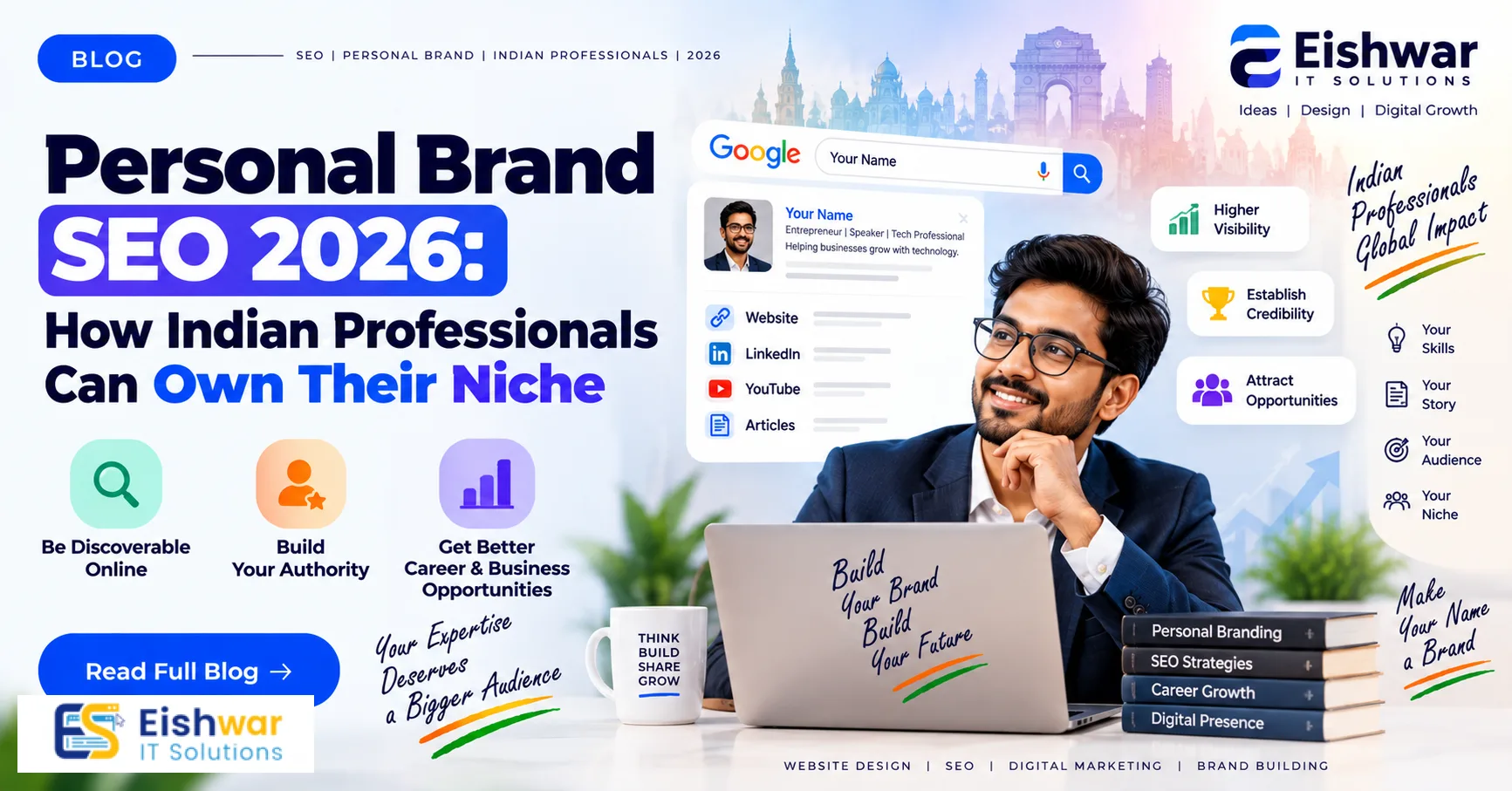
Personal Brand SEO 2026: How Indian Professionals Can Own Their Niche
Published on: 31 Aug 2026
Personal Brand SEO 2026: How Indian Professionals Can Own Their Niche
Introduction
In the digital age, your name is more than just an identity—it's a searchable asset. When a potential client in Mumbai, Bengaluru, or Jaipur searches for your name on Google, what do they find? A polished, authoritative profile that showcases your expertise? Or a scattered collection of outdated listings and unrecognized mentions?
Learn more about our Website services
Welcome to the world of Personal Brand SEO. As India's professional ecosystem rapidly shifts toward freelancing, consulting, coaching, and independent expertise, your personal brand has become the new resume. In 2026, it's no longer enough to say you're good at what you do; you need to prove it to Google first.
For business owners, marketers, and professionals across India, personal brand SEO is an untapped advantage. While most focus on ranking their business websites, the smartest professionals are also owning the search results for their own name. Why does this matter? Because people buy from people. A strong personal brand builds trust, positions you as an authority, and leads to better business opportunities.
In this guide, we'll cover everything you need to know about Personal Brand SEO in the Indian context—from the basics to advanced strategies, common pitfalls, and future trends. By the end, you'll have a playbook to make your name synonymous with your niche.
Main Section 1: Why Personal Brand SEO Matters in India in 2026
India is witnessing an unparalleled surge in independent professionals. According to industry estimates, the country has one of the largest freelance and consulting workforces in the world. With this growth, the 'Google test' has become a standard vetting process. Whether you are a financial advisor in Pune, a digital marketing consultant in Delhi, or a fitness coach in Bangalore, your online visibility determines your credibility.
Search engines, especially Google, are increasingly prioritizing E-E-A-T (Experience, Expertise, Authoritativeness, and Trust) in their ranking algorithms. This is not just for YMYL (Your Money or Your Life) topics like health or finance—it applies to any content where the user is looking for professional advice. When Google evaluates your personal brand, it looks for consistent, authoritative signals across your website, social profiles, and external mentions.
In 2026, the competition is intense. Generic personal branding advice floods LinkedIn and YouTube, yet very few professionals actually understand how search engines work. By applying SEO principles to your personal brand, you can outshine even well-known industry voices in your local or niche market.
Consider this scenario: Dr. Ananya Rao, a child psychologist in Chennai, has a thriving clinic. She regularly posts on Instagram and LinkedIn, but her old blog from 2018 ranks for her name, showing an outdated photo and wrong contact number. Meanwhile, another psychologist in the same city has a polished website, a Google Business Profile, and a series of authoritative articles on parenting forums. When a worried parent searches for 'child psychologist in Chennai', the second professional gets the call. That is personal brand SEO at work.
Moreover, with the rise of AI search and voice assistants, your personal brand needs to be structured in a way that search engines can easily understand. If you are consistently cited as an industry expert across trusted platforms, Google may feature you in knowledge panels, answer boxes, or AI-generated summaries. This is the new currency of trust.
👉 Don't wait for the perfect moment; turn your vision into reality today.
Free ConsultationMain Section 2: Step-by-Step Personal Brand SEO Strategy for Indian Professionals
Step 1: Define Your Brand Keywords
Start by identifying the exact phrases your potential clients might use to find you. These typically fall into three categories: your name, your target niche keywords, and long-tail question-based queries. For example, if you are a business coach in Mumbai, your keywords might be 'business coach Mumbai', 'startup growth consultant', 'how to grow a small business in India', and of course, your full name.
Do not stop at one set. Use tools like Google Autocomplete, Google Trends, and Ubersuggest to discover what Indian audiences are searching for. Create a simple spreadsheet to map these keywords to different pages of your personal site or sections of your LinkedIn profile.
Step 2: Build Your Personal Website Hub
In Personal Brand SEO, your website serves as the foundation. It is the one asset you fully control. Platforms like LinkedIn or Instagram can change algorithms or even shut down; your website remains your digital home.
Here's how to optimize your personal website:
- Use your real name as the domain or a brandable variation. A .com or .in domain is preferable.
- Create a clear homepage with a compelling headline that includes your niche keywords.
- Add an 'About' page that tells your professional story while weaving in expertise keywords naturally.
- Start a blog or resources section and publish long-form content addressing common client questions.
- Ensure your site is mobile-friendly and fast-loading—Core Web Vitals remain important for user experience.
- Add basic schema markup for 'Person' or 'Professional Service' to help search engines understand who you are.
Your website is also the perfect place to showcase testimonials, case studies, media mentions, and conference talks. Each of these is a trust signal that both users and search engines appreciate.
Step 3: Optimize Your Social Profiles for Search
In parallel, your social profiles—especially LinkedIn, Twitter, and Instagram—must be fully optimized. Use a consistent profile photo and handle across all platforms. Write a keyword-rich bio that clearly states what you do, for whom, and how you help. Include links back to your website.
For LinkedIn, treat your profile as a mini-website. Use the headline space to include your primary keyword, not just your job title. The 'Featured' section can display your best articles, videos, and client wins. Do not underestimate the power of LinkedIn's own SEO; many professionals have witnessed high-profile opportunities arriving purely from a well-optimized profile.
Step 4: Leverage Local Search and Google Business Profile
If your personal brand serves a local audience, setting up Google Business Profile is non-negotiable. Even freelancers can create a service-area business profile. This increases your chances of appearing in the local pack when someone searches for your name or your niche location-specific keywords.
👉 Free Website Audit
Get Free AuditEncourage clients to leave reviews on Google. Actively respond to every review, whether positive or negative, in a professional manner. Your response is publicly visible and contributes to your reputation and local ranking.
Step 5: Create Content That Lands on Page One
Content is the engine that powers personal brand SEO. Create content that answers real questions, provides deep insights, and positions you as a thought leader. This could include blog posts, videos, podcasts, webinars, or even LinkedIn carousels.
When optimizing content, remember to:
- Use primary and secondary keywords naturally in headings, paragraphs, and image alt text.
- Address the top five questions your clients ask.
- Structured data, such as FAQ and HowTo schema, can also boost your visibility in rich results.
- Update old content to keep it fresh and relevant—Google rewards regular maintenance.
Consistency matters more than volume. Publishing one high-quality article every two weeks is better than seven hurried posts followed by silence.
Main Section 3: Building Authority and Off-Page Personal Brand SEO
On-page optimization is just the base. To truly outrank competitors, you need to build authority through external signals—more commonly known as off-page SEO. For personal brands, this involves earning mentions, backlinks, and recognition from credible websites and platforms.
Be Featured on Niche and Mainstream Platforms
Pitch guest articles to industry blogs, business newspapers, and online magazines popular in your domain. In India, platforms like YourStory, Entrepreneur India, The Better India, and industry-specific portals often accept expert contributions. A well-placed guest post with a bio link can drive targeted traffic and send powerful trust signals to Google.
Podcast and Show Appearances
Indian podcast ecosystem has exploded, with countless shows in every niche. Appearing on a popular podcast near your industry can put your name in front of thousands. Ensure the podcast host includes links to your website and social channels in the show notes. That backlink is valuable, but so is the association with a trusted media property.
Speak at Conferences and Webinars
When you speak at an event, your speaker bio usually gets published on the event website. These are often high-authority domains with relevant audiences. Similarly, record your sessions and repurpose them as video content or embed them on your website. Each mention increases your digital footprint and makes it harder for irrelevant results to dominate your name search.
Collaborate and Co-create Content
Team up with other professionals, industry bodies, or even complementary businesses. Co-authoring reports, hosting joint webinars, and doing Instagram Lives together introduces you to new audiences and builds business relationships. These collaborations often result in credible backlinks from the partner's site or social channels.
Reputation Management: Monitor and Control
Set up Google Alerts for your name and monitor your search appearance regularly. Use tools like Google Search Console to track branded queries and see which pages appear. If you notice negative or outdated content, work on creating positive, authoritative content that can outrank it, or contact the platform to address any inaccuracies.
Expert Tips
- Own multiple variations of your name: Register a domain that includes your full name and perhaps your profession. Even if you don't use one, buying it prevents others from misrepresenting you online.
- Use 'People Also Ask' to find content ideas: The 'People Also Ask' (PAA) boxes on Google are a goldmine for question-based content. Target these exact questions in your articles and LinkedIn posts.
- Optimize your LinkedIn Profile for search: Use your name as-is, with your headline including your niche keywords. Add skills, certifications, and a strong 'About' section full of relevant words.
- Add video content to your strategy: YouTube is the second-largest search engine. Create video testimonials, explainer clips, or day-in-the-life content to appear in video search results and diversify your search real estate.
- Request testimonials on third-party platforms: Ask happy clients to leave reviews not only on Google but also on Justdial, Practo, Urban Company, or whichever platform your industry uses. These external reviews boost your local and personal brand authority.
- Create a Wikipedia-like 'About' page on your site: Write an extensive profile that covers your education, career, achievements, and contact details. It acts as an authoritative base for your name.
Common Mistakes
- Relying solely on social media: Your Instagram and LinkedIn are rented land. If they disappear, so does your online presence. Always have your own website as the anchor.
- Ignoring the first page of your own name search: A common mistake is assuming you don't control what appears. Actively monitor and curate search results by producing consistent content and building your domain authority.
- Using different names or handles: If your handle is @thebizmentor on one platform and @rajeshgupta_india on another, search engines struggle to connect the dots. Retain a consistent NAP (Name, Address, Phone) and handle everywhere.
- Keyword-stuffing your name: Repeating your name excessively across headings and paragraphs looks spammy and unprofessional. Use it naturally and focus on providing value.
- Forgetting to update content: An old blog post that says your office has moved or your services changed can damage credibility. Keep your website and social bios current.
Future Trends
SEO never stands still, and personal brand SEO will also evolve. Here are the trends Indian professionals should watch in 2026.
👉 Free Homepage Demo
Book DemoFirst, the rise of AI overviews and generative search experiences. Google and other platforms increasingly summarize answers from multiple sources. To appear in these summaries, you need to be an authoritative source for niche topics. Consistently publishing high-quality, referenced content and getting cited by reputable domains will become even more critical.
Second, multi-search results. Users search with images, voice, and video, not just typed text. For personal brands, this means optimizing your visual presence: high-quality profile photos, consistent headshots, and video scripts that answer conversational queries. Appearing in Google Lens results or YouTube search can become a new source of leads.
Third, the growth of niche search platforms. In India, many professionals get found on health platforms, legal directories, education portals, or freelancing marketplaces. Your personal brand strategy must include presence on these platforms, as they often rank well on Google for targeted queries.
Finally, zero-click searches will continue to limit clicks to websites. However, the more your name appears in rich snippets, knowledge panels, and AI answers, the more your credibility rises—even if the user never visits your site. The goal is to be the source everyone references.
FAQs
1. What is Personal Brand SEO?
Personal Brand SEO is the practice of optimizing your digital footprint so that your name, and the topics associated with it, rank highly in search engine results. It includes building a personal website, optimizing social profiles, creating authoritative content, and earning positive mentions and backlinks.
2. How long does it take to see results from Personal Brand SEO?
Results can start showing in 3 to 6 months with consistent effort. Since your name is often a unique query, ranking page one can be faster than ranking for commercial keywords. However, building a strong, authoritative brand takes continuous work over years.
3. Can I do Personal Brand SEO myself or should I hire an agency?
It depends on your time and expertise. A professional SEO agency in India, like EishwarITSolution, can accelerate the process by handling technical SEO, content creation, and link building. If you have technical know-how and time, you can start yourself, but for maximum impact, hiring experts is advisable.
4. Should I focus on my name or my industry keywords?
Both. Your name gets you recognized when people already know you; industry keywords help you get discovered by new prospects. A balanced strategy works best: create content that targets your name naturally while also answering high-opportunity niche queries.
5. How do I handle negative or irrelevant results about my name on Google?
Start by creating and promoting positive content that outranks the negative pages. Publish guest posts, update your website, and get high-quality reviews. In some cases, you can request removal of outdated or content that violates Google's guidelines. An SEO expert can help with manual penalties and reputation cleanup.
6. Is Personal Brand SEO valuable for small business owners?
Absolutely. When you are the face of your business, your personal brand credibility directly impacts customer acquisition. Many small-business owners own a local service business; a strong personal brand on Google and social media builds trust and encourages referrals.
7. What metrics should I track to measure Personal Brand SEO progress?
Track your name mentions in Google Search Console, branded search impressions, website clicks, profile views on LinkedIn, and new contact form submissions or client leads. Also monitor the pages that rank on the first page of Google for your name—make sure they are all positive and accurate.
Conclusion
Your name is one of the most powerful, yet underutilized, digital assets you own. In 2026, as Indian professionals face increasing competition and trust barriers, personal brand SEO offers a clear path to visibility, credibility, and growth. By optimizing your website, building a word-of-mouth-worthy digital footprint, and consistently delivering value, you can own not only your name but also your niche.
Think of personal brand SEO as an investment in your professional future. The earlier you start, the harder it becomes for competitors to overtake you in search results. Start by auditing your own name today, and then build a strategy to make it shine.
CTA
Ready to take your personal brand to the next level? At EishwarITSolution, we specialize in crafting and executing SEO strategies that help Indian professionals and businesses dominate search results. Contact us today to get a free personal brand audit and start owning your digital presence in 2026!