
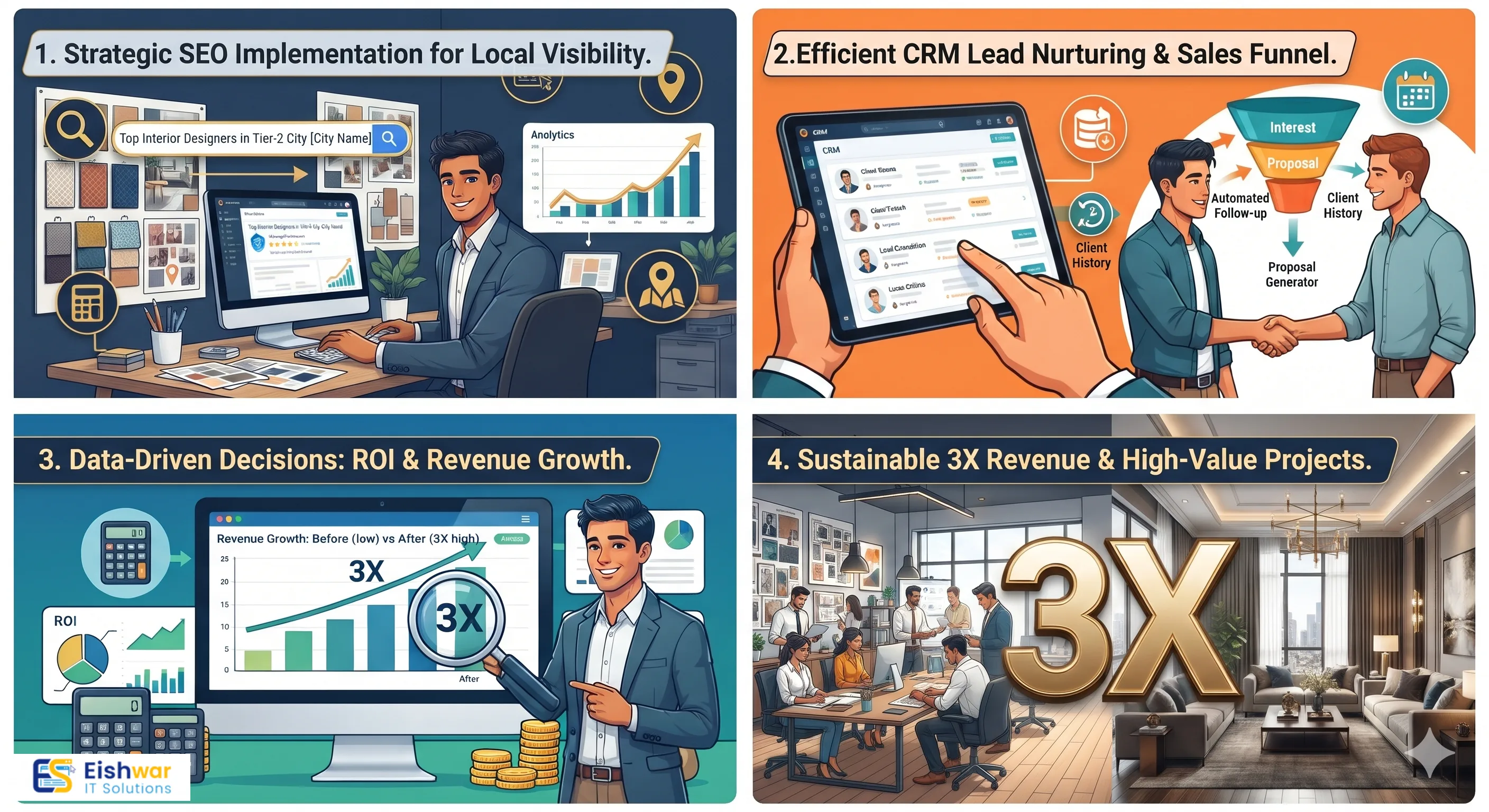
How a Tier-2 Interior Design Firm Hit 3X Revenue with SEO & CRM
Published on: 09 Nov 2026
How a Tier-2 Interior Design Firm Hit 3X Revenue with SEO & CRM
Introduction
Most interior design firms in Tier-2 India grow through word of mouth. That works until it doesn't. Referrals slow down, enquiries get buried in WhatsApp, and the firm has no reliable way to measure what is working. This case study breaks down how a realistic Tier-2 interior design firm, let's call it DesignCraft Interiors, moved from a referral-only pipeline to a predictable growth engine using a portfolio website, local SEO, and CRM automation. The result was 3X revenue in 12 months without hiring a large sales team.
Learn more about our Website services
If you run a service business in India, you will find practical ideas here. You will see the audit process, the digital blueprint, the execution timeline, and the metrics that mattered. More importantly, you will see what to avoid so you don't waste money on a pretty website that brings no enquiries.
The Starting Point: Referrals, Spreadsheets, and Missed Leads
DesignCraft Interiors is based in a Tier-2 city in central India. Before the transformation, the firm had 11 employees, including four designers and two site supervisors. Annual revenue was around ₹1.7 crore. About 80% of projects came from referrals and repeat clients. The founders knew they needed a more predictable pipeline, but they were not sure where to start.
The firm had a basic one-page website that had not been updated in three years. The Google Business Profile had no photos, no reviews, and an incomplete address. Enquiries arrived through phone calls, WhatsApp messages, and the occasional Instagram DM. There was no CRM. The team tracked leads in a notebook and a shared spreadsheet. Follow-ups depended on memory.
What the Audit Found
- Lead leakage: The firm received about 15 enquiries per month, but only 30% converted into a site visit. Many enquiries were never followed up after the first call.
- Weak online presence: The website had no project gallery, no pricing guidance, and no clear next step. It ranked for zero search terms in the local market.
- No review engine: The firm had completed over 60 projects but had only 4 Google reviews. Competitors with lower-quality work had 40+ reviews.
- Response time gaps: The average response time to a new enquiry was 9 hours. In a high-consideration category like interior design, that is too slow.
- No pipeline visibility: The founders could not answer basic questions like how many leads were in the pipeline, what the conversion rate was, or which marketing channel produced the best projects.
The Real Cost of Leaks
With an average project value of ₹3.3 lakh and a 22% close rate, every 10 missed enquiries represented roughly ₹7.2 lakh in lost revenue. The firm was not short on demand. It was short on systems. The audit made one thing clear: the fastest path to growth was not spending more on ads. It was capturing, following up, and converting the leads that were already coming in.
The Digital Blueprint: Website, Local SEO, and CRM
The transformation was built on five pillars. Each pillar had a clear owner, a deadline, and a measurable outcome. This is the same framework you can adapt for your service business.
👉 Don't wait for the perfect moment; turn your vision into reality today.
Free Consultation1. A Portfolio Website That Sells
The old website was a digital brochure. The new website was built as a sales asset. It included a filterable project gallery with before-and-after photos, three detailed case studies with budget ranges, a transparent pricing guide, video testimonials, and a project enquiry form that asked the right qualifying questions. The website also included a free downloadable guide titled 7 Interior Design Mistakes to Avoid in Your New Home. That guide became the top-of-funnel lead magnet.
The key improvement was the enquiry form. Instead of asking only for name and phone number, the form asked for project type, approximate budget, location, and timeline. This allowed the team to prioritise high-intent leads. The form was connected to the CRM, so no lead was left in an inbox.
2. Hyperlocal SEO for a Tier-2 City
Tier-2 cities have less competition than metros, which makes local SEO a high-return channel. The firm optimised its Google Business Profile with professional photos of completed projects, a complete list of services, and a booking link. The team also created locality-specific service pages for the top six neighbourhoods in the city. Each page included local project examples, client testimonials, and a map embed.
Reviews became a system. After every project handover, the team sent a WhatsApp message with a short review link. The goal was simple: collect 30 reviews in 90 days. The firm reached 38 reviews by day 75. That single change improved trust and click-through rates from Google Maps.
3. CRM and WhatsApp Automation
The firm adopted a simple CRM with WhatsApp integration. Every enquiry from the website, Google Business Profile, Instagram, and phone calls was automatically logged. The CRM assigned leads to designers based on location and project type. It also triggered a five-message follow-up sequence over 14 days.
The follow-up sequence was not spammy. It included a welcome message, a case study relevant to the lead's budget, a video walkthrough of a similar project, an invitation to a free 30-minute consultation, and a final check-in. If the lead replied, the sequence stopped and the designer took over. This single automation reduced response time from 9 hours to 18 minutes and increased site visit bookings by 65%.
4. Content and Trust Engine
Trust is the currency of interior design. The firm started publishing one blog post every two weeks on topics like how to budget for a 3BHK interior, modular kitchen cost in Tier-2 cities, and how to choose the right false ceiling design. Each post included a call-to-action to download the pricing guide. The firm also posted three Instagram reels per week showing behind-the-scenes site progress and before-and-after transformations.
The content did two jobs. It improved organic visibility for long-tail keywords, and it gave the sales team useful assets to share during follow-ups. Instead of saying trust us, the team could share a relevant case study or a short video.
5. Sales Process and Reporting
The firm introduced a simple sales process with five stages: new lead, qualified, site visit scheduled, proposal sent, and won or lost. Each stage had a clear definition and a follow-up checklist. The founders reviewed the pipeline every Monday for 30 minutes. They tracked four numbers: new leads, site visits, proposals sent, and closed projects. That weekly review made it easy to spot bottlenecks.
👉 Free Website Audit
Get Free AuditProposals also got an upgrade. Instead of a plain PDF with a price, the proposal included a mood board, a 3D visual, a timeline, and a payment schedule. The close rate improved because clients could visualise the outcome and understand the process.
Execution Timeline and Results
90-Day Sprints
The transformation was executed in three sprints. In the first 30 days, the team completed the audit, built the new website, and optimised the Google Business Profile. In days 31 to 60, they set up the CRM, WhatsApp automation, and the review collection system. In days 61 to 90, they launched the content engine and trained the sales team on the new process.
The firm did not run paid ads for the first six months. The focus was on organic and referral channels. Once the CRM showed which keywords and content pieces produced the best leads, the firm added a small Google Ads budget of ₹25,000 per month to amplify the winning pages.
The Numbers After 12 Months
| Metric | Before | After 12 Months | Change |
|---|---|---|---|
| Annual revenue | ₹1.7 crore | ₹5.1 crore | 3X |
| Monthly qualified leads | 15 | 60 | 4X |
| Average response time | 9 hours | 18 minutes | 97% faster |
| Site visit conversion rate | 30% | 52% | +22 points |
| Project close rate | 22% | 38% | +16 points |
| Google reviews | 4 | 61 | 15X |
| Organic share of pipeline | 0% | 42% | New channel |
The revenue growth came from three sources. First, more qualified leads entered the pipeline. Second, the close rate improved because follow-up was consistent and proposals were stronger. Third, the average project value increased by 18% because the website and content attracted clients with larger budgets.
The firm also reduced its dependence on referrals. Referrals still accounted for 45% of revenue, but they were no longer the only source. That balance made the business more resilient and easier to scale.
Expert Tips
- Start with the leak audit. Before you spend on ads, calculate how many leads you receive, how many you follow up with, and how many convert. Most service businesses lose more revenue from poor follow-up than from a weak market.
- Make your website a salesperson. A portfolio is not enough. Add case studies, pricing guidance, testimonials, and a clear next step. The website should answer the top five questions a client asks before booking a call.
- Use WhatsApp for follow-up, not just chat. Automate the first five follow-up messages, but keep them useful. Share a relevant project, a video, or a pricing guide. Do not send only reminders.
- Collect reviews systematically. Ask every client at handover. Make it easy with a direct link. A steady flow of recent reviews is one of the strongest local SEO signals for service businesses.
- Track four numbers weekly. New leads, site visits, proposals, and closed projects. If you cannot measure these, you cannot improve them.
- Train the team on the CRM. A CRM fails when the sales team sees it as extra work. Show them how it saves time and helps them close more projects.
Common Mistakes
- Building a website without a lead capture system. A beautiful website without forms, WhatsApp buttons, and a CRM is a digital brochure. It will not grow the business.
- Ignoring Google Business Profile. For local service businesses, the Google Maps listing is often the first touchpoint. Incomplete profiles and few reviews kill trust.
- Over-automating the sales process. Automation should support human conversations, not replace them. High-ticket services still need a real person to build trust.
- Publishing content without a strategy. Random blog posts do not generate leads. Focus on the questions clients ask before they buy.
- Not tracking lead sources. If you do not know which channel produces the best projects, you will waste budget on the wrong ones.
- Treating SEO as a one-time project. Local SEO requires ongoing reviews, content updates, and profile maintenance. It is a habit, not a task.
Future Trends
Interior design marketing in Tier-2 India is changing quickly. Here are the trends worth watching.
👉 Free Homepage Demo
Book Demo- AI-powered design visualisers: Clients will expect instant 3D visualisations. Firms that offer quick, personalised visual previews will win more enquiries.
- Voice and visual search: More clients will search using voice and images. Optimising project photos with descriptive alt text and location tags will become more important.
- WhatsApp Business API: Automated catalogues, payment links, and appointment booking inside WhatsApp will become standard for service businesses.
- Hyperlocal content: Neighbourhood-level pages and local case studies will outperform generic city pages in Tier-2 markets.
- Video-first portfolios: Short-form video walkthroughs will replace static galleries as the first thing clients review before contacting a firm.
FAQs
1. How long does it take to see results from local SEO for an interior design firm?
Most firms see early improvements in Google Business Profile views and calls within 60 to 90 days. Significant organic lead growth usually takes 4 to 6 months, depending on competition and content consistency. The case study firm saw 42% of its pipeline from organic channels by month 12.
2. Do I need an expensive CRM to grow my interior design business?
No. A simple CRM with WhatsApp integration and pipeline tracking is enough to start. The key is consistent use, not the number of features. You can upgrade later when your lead volume and team size demand it.
3. How many Google reviews do I need to compete in a Tier-2 city?
There is no fixed number, but consistency matters. Aim for at least 25 to 40 recent reviews. In many Tier-2 markets, that is enough to outperform competitors. Keep collecting reviews after every project.
4. Should I run Google Ads for my interior design firm?
Consider Google Ads after your website and CRM are in place. Ads amplify a working system. If your follow-up is weak, ads will only waste money. Start with a small budget and track which keywords produce qualified leads.
5. How do I capture leads from WhatsApp effectively?
Use a CRM with WhatsApp integration so every chat becomes a lead record. Set up a simple follow-up sequence, assign leads to designers, and log the outcome of each conversation. Avoid leaving important details buried in personal chat histories.
6. What content works best for interior design lead generation?
Local project case studies, budget guides, before-and-after transformations, and short video walkthroughs work well. Focus on questions clients ask before they enquire, such as cost, timeline, materials, and design options.
Conclusion
DesignCraft Interiors did not grow 3X by spending more on ads. It grew by fixing the leaks in its lead capture and follow-up process, building a website that sells, dominating local search in its city, and using CRM automation to respond faster. The same principles apply to most service businesses in Tier-2 India.
If you take one lesson from this case study, let it be this: growth is often hiding in the leads you already have. Fix the system before you increase the traffic.
CTA
Want to build a similar growth engine for your business? EishwarITSolution helps Indian businesses with portfolio websites, local SEO, and CRM automation. Book a free 30-minute growth audit and get a practical roadmap for your next 90 days.