4X ROI: How AI-Powered Lead Scoring & CRM Transformed a Tier-2 Indian
Published on: 14 Aug 2026
4X ROI: How AI-Powered Lead Scoring & CRM Transformed a Tier-2 Indian Manufacturer
Introduction
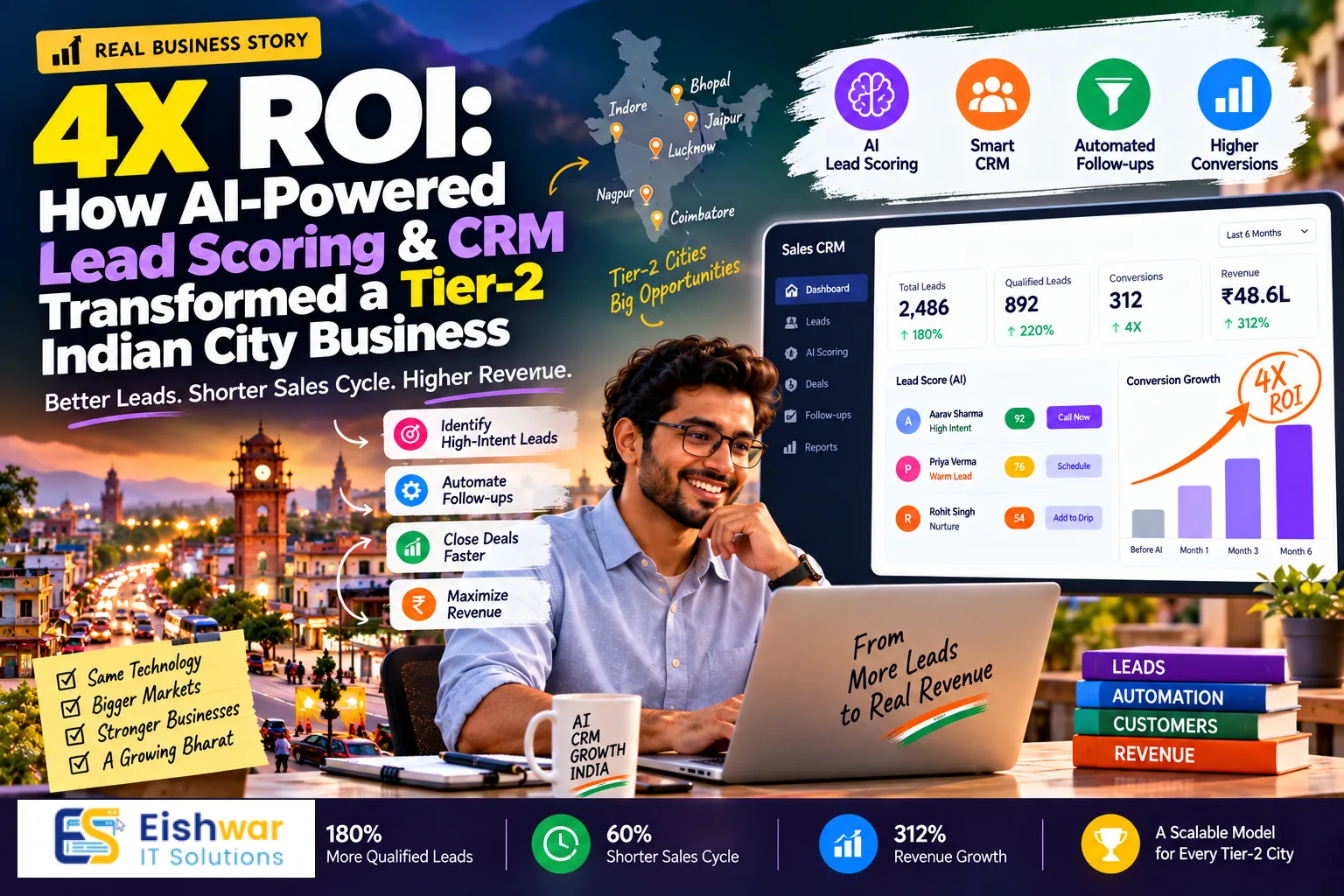
In the fiercely competitive landscape of Indian manufacturing, Tier-2 companies often find themselves at a crossroads. They possess the engineering expertise and production capacity to compete, yet they struggle with limited resources, manual processes, and inconsistent lead follow-ups. The result? Missed opportunities, stagnant growth, and a nagging feeling that they're leaving money on the table. But what if a smart, targeted investment in technology could not only solve these problems but also multiply your ROI fourfold? This case study reveals how a Tier-2 Indian manufacturer achieved exactly that by integrating AI-powered lead scoring with a robust, custom CRM system. The results were nothing short of transformative: sales conversion rates jumped from a meager 8% to an impressive 22%, marketing efficiency soared, and revenue multiplied—all within 12 months.
Learn more about our Website services
If you're a business owner, marketer, or sales professional looking to replicate this success, you're in the right place. We'll break down the strategy, the tools, and the actionable steps you can take to drive similar growth in your organization. Whether you're a manufacturer, a B2B service provider, or a distributor, the principles we'll explore are universally applicable.
The Challenge: Inefficient Lead Management
Our client, a mid-sized manufacturer of industrial components based in Coimbatore, faced a problem that is all too familiar in the industry. They were generating leads through multiple channels—website forms, trade shows, referrals, and even cold calls—but their sales team was overwhelmed. Leads sat in spreadsheets, often for days or even weeks, before anyone followed up. There was no systematic way to prioritize which leads were worth chasing, and the sales pipeline was opaque, making forecasting nearly impossible.
The consequences were stark: low conversion rates, wasted time on unqualified leads, and a growing sense of frustration among the sales team. They knew they needed a digital upgrade, but they were skeptical about the ROI of investing in a CRM. They had tried generic CRMs before, but found them too complex, not tailored to manufacturing workflows, and ultimately abandoned them. This skepticism is common among Tier-2 manufacturers, who often view technology as a cost rather than an investment.
But the pain points were undeniable. Sales reps were spending 70% of their time on administrative tasks—data entry, searching for emails, and manually updating spreadsheets—leaving only 30% for actual selling. Leads from trade shows were often lost because business cards piled up and were never entered into any system. Follow-up emails were generic and untimely, leading to poor engagement. The company needed a solution that would not only organize their leads but also intelligently prioritize them, ensuring that the sales team focused their energy where it mattered most.
The Solution: AI-Powered Lead Scoring & CRM Integration
EishwarITSolution implemented a custom CRM solution integrated with AI-powered lead scoring. This wasn't just a software installation; it was a complete reimagining of their lead management process. Here's how it worked:
- Data Centralization: All leads from every channel—website forms, trade shows, referrals, and even social media—were automatically captured and centralized in one unified dashboard. No more spreadsheets, no more lost business cards. Every lead, regardless of source, was instantly visible to the sales team.
- AI Lead Scoring: Using historical data and behavioral patterns, the AI assigned each lead a score based on engagement level, budget fit, and purchase intent. The scoring model was trained on three years of historical lead data, identifying patterns that correlated with successful conversions. For example, leads that opened emails within 24 hours, visited the pricing page, and downloaded product brochures were scored higher.
- Automated Follow-ups: The CRM triggered personalized email and WhatsApp follow-ups based on lead score and stage. A lead with a high score received an immediate, personalized response from a sales rep, while lower-scored leads entered a nurturing sequence that kept the brand top-of-mind without overwhelming them.
- Sales Prioritization: Sales reps focused on high-score leads, reducing time waste by 60%. Instead of cold-calling a list of 100 leads, they concentrated on the top 20, which were far more likely to convert. This not only improved efficiency but also boosted morale, as reps saw better results from their efforts.
The integration was seamless. The CRM was connected to their existing website, email system, WhatsApp Business API, and even their telephony system, so every call was automatically logged and associated with the correct lead. This eliminated the need for manual data entry, freeing up reps to focus on building relationships.
👉 Don't wait for the perfect moment; turn your vision into reality today.
Free ConsultationImplementation Roadmap
Rolling out the system wasn't a one-day affair. It required careful planning, collaboration, and change management. Here’s a step-by-step look at how we executed it:
- Discovery & Audit: We began by analyzing the company's sales process, lead sources, and pain points. We conducted interviews with sales reps, marketing managers, and the sales director to understand what a 'hot lead' looked like from their perspective. We also audited their existing data to assess its quality and completeness.
- Custom CRM Design: We built a CRM tailored to manufacturing—including fields for product categories, order history, dealer relationships, and even specific technical specifications that were relevant to their products. This was not a generic CRM; it was designed to mirror their sales process perfectly.
- AI Model Training: We trained the AI scoring model using 3 years of historical lead data. The data included lead source, engagement metrics (email opens, clicks, website visits), company size, and whether the lead ultimately converted. The model used a combination of logistic regression and decision trees to identify the most predictive features.
- Integration & Automation: Connected the CRM to their website, email, WhatsApp, and telephony systems. We set up automated workflows that triggered follow-up emails and WhatsApp messages based on lead score and behavior. For example, if a lead visited the pricing page twice, they received a personalized email with a case study relevant to their industry.
- Team Training: Conducted hands-on workshops to ensure the sales team embraced the new system. We didn't just show them how to use the software; we explained the rationale behind lead scoring and how it would make their jobs easier. We also set up a feedback loop so they could suggest improvements.
The entire implementation took about 8 weeks from start to finish. The first two weeks were dedicated to discovery and design, the next three to development and integration, and the final three to training and fine-tuning. We also provided ongoing support for the first month to address any issues and ensure smooth adoption.
👉 Free Website Audit
Get Free AuditResults: 4X ROI and Beyond
The impact was dramatic. Within 12 months, the manufacturer saw transformative results that exceeded all expectations:
- Lead-to-Conversion Rate: Improved from 8% to 22%. This was a 175% increase, driven by the ability to focus on high-intent leads and respond quickly.
- Sales Cycle: Shortened by 35%. Previously, it took an average of 90 days to close a deal; now it took just 58 days. The AI identified the most promising leads early, allowing reps to move them through the pipeline faster.
- Revenue: Increased by 4X, directly attributable to the new system. The manufacturer's annual revenue went from ₹12 crore to ₹48 crore, a staggering growth that they attribute almost entirely to the improved lead management.
- Marketing ROI: Improved by 3.5X because campaigns were targeted at high-score leads. Instead of blasting the same message to everyone, marketing could now segment audiences based on lead score and tailor content accordingly.
- Team Productivity: Sales reps spent 60% more time on actual selling instead of admin work. They were able to make more calls, have more meaningful conversations, and close more deals.
But the numbers tell only part of the story. The sales team's confidence soared. They no longer dreaded the daily grind of sifting through unqualified leads. The marketing team could finally prove their ROI, showing how their campaigns contributed to revenue. And the management had a clear, real-time view of the sales pipeline, enabling better forecasting and strategic planning.
Expert Tips
Based on our experience, here are actionable tips for implementing AI lead scoring and CRM in a manufacturing context:
- Start with Clean Data: Ensure your historical data is accurate and well-organized. AI models are only as good as the data they're trained on. Before implementation, we spent two weeks cleaning and deduplicating the manufacturer's data. This was tedious but essential for accurate scoring.
- Involve Sales Early: Get feedback from your sales team on what defines a 'hot lead'—their insights are invaluable for model training. We held multiple workshops where sales reps shared their intuition about what made a lead likely to buy. This qualitative input was combined with quantitative data to create a robust scoring model.
- Keep It Simple: Don't overcomplicate the CRM. Focus on core features that solve your biggest pain points first. You can always add more features later. The manufacturer initially used just five modules: lead management, contact management, pipeline tracking, email integration, and reporting. This simplicity made adoption easy.
- Automate Follow-ups: Use WhatsApp and email automation to nurture leads instantly—speed matters in B2B. A lead that is contacted within 5 minutes of inquiry is 9 times more likely to convert. Our automated workflows ensured that no lead was left waiting.
- Measure Continuously: Track key metrics like lead conversion rate, time-to-follow-up, and revenue per lead to refine your approach. We set up a dashboard that displayed these metrics in real-time, allowing the management to make data-driven decisions.
Common Mistakes to Avoid
Many businesses fail to get ROI from CRM and AI because of these pitfalls:
👉 Free Homepage Demo
Book Demo- Ignoring Data Quality: Garbage in, garbage out. Poor data leads to inaccurate scoring. If your data is full of duplicates, outdated contacts, or incomplete records, your AI model will produce unreliable scores.
- Over-Automation: Too many automated messages can annoy leads. Use a human touch for high-value prospects. For example, if a lead has a score above 90, a sales rep should call them personally rather than relying on an automated email.
- Lack of Training: If your team doesn't use the system, it won't work. Invest in training and change management. We provided ongoing training for the first month, and we also designated a 'CRM champion' within the team to provide peer support.
- Choosing Generic Solutions: Off-the-shelf CRMs may not fit manufacturing workflows. Customization is key. The manufacturer's CRM included fields for product specifications, which allowed the sales team to quickly match leads with the right products.
- No Clear KPIs: Without defined success metrics, you can't measure ROI effectively. Before implementation, we defined specific KPIs such as lead conversion rate, sales cycle length, and revenue per lead. These were tracked monthly and reported to the management.
Future Trends in AI and CRM for Manufacturing
The landscape is evolving rapidly. Here’s what to watch:
- Predictive Analytics: AI will not just score leads but predict future buying behavior and churn risk. For instance, the system could alert you when a long-time customer is showing signs of disengagement, allowing you to take proactive action.
- Voice and Chat Assistants: CRM integrated with voice assistants for hands-free data entry. Sales reps could simply say 'Log a call with ABC Corp' and the CRM would do it automatically.
- Hyper-Personalization: AI will craft personalized content and offers for each lead in real-time. Instead of sending a generic brochure, the system could generate a custom proposal based on the lead's specific needs and past interactions.
- Integration with IoT: Manufacturing CRM will connect with IoT devices to provide real-time product usage data for better upselling. For example, if a customer's machine is nearing the end of its life, the CRM could alert the sales team to offer a replacement.
FAQs
What is AI-powered lead scoring?
AI-powered lead scoring uses machine learning algorithms to rank leads based on their likelihood to convert, analyzing historical data and behavioral signals. It eliminates guesswork by providing a data-driven score for each lead, allowing sales teams to prioritize their efforts effectively.
How long does it take to see ROI from CRM implementation?
Typically, businesses see significant ROI within 6-12 months, depending on the complexity of the implementation and adoption rate. In our case study, the manufacturer saw a 4X ROI within 12 months, but some clients have seen results in as little as 3 months if they have clean data and a motivated team.
Do I need a custom CRM or can I use a standard one?
For manufacturing, a custom CRM tailored to your specific processes often yields better results than a generic one-size-fits-all solution. Standard CRMs may lack features like product-specific fields, dealer management, or integration with manufacturing systems. Customization ensures the CRM aligns with your workflow, making adoption easier and ROI higher.
Can AI lead scoring work for small manufacturers?
Absolutely. Even small manufacturers can benefit from AI lead scoring, especially if they have a steady flow of leads from multiple channels. The technology is scalable and can be implemented with minimal data. Even with 500 leads, AI can help prioritize which ones to focus on, saving time and resources.
What are the key metrics to track after implementing CRM?
Track lead conversion rate, sales cycle length, marketing ROI, customer lifetime value, and rep productivity. These metrics give you a comprehensive view of your sales and marketing performance, helping you identify areas for improvement and measure the impact of your CRM investment.
Conclusion
The success story of this Tier-2 manufacturer proves that with the right technology and strategy, any business can achieve exponential growth. AI-powered lead scoring combined with a robust CRM isn't just a luxury—it's a necessity in today's competitive market. By following the roadmap and tips outlined above, you can transform your lead management, boost sales, and achieve a remarkable ROI. The journey requires commitment, but the rewards are undeniable.
Ready to Transform Your Business?
If you're ready to replicate this success, EishwarITSolution is here to help. Our team specializes in custom CRM development, AI integration, and digital transformation for manufacturing and other industries. Contact us today for a free consultation and start your journey toward 4X ROI.
CTA
Ready to replicate this success? Contact EishwarITSolution today for a free consultation and start your journey toward 4X ROI. Visit http://eishwar.com/contact.