
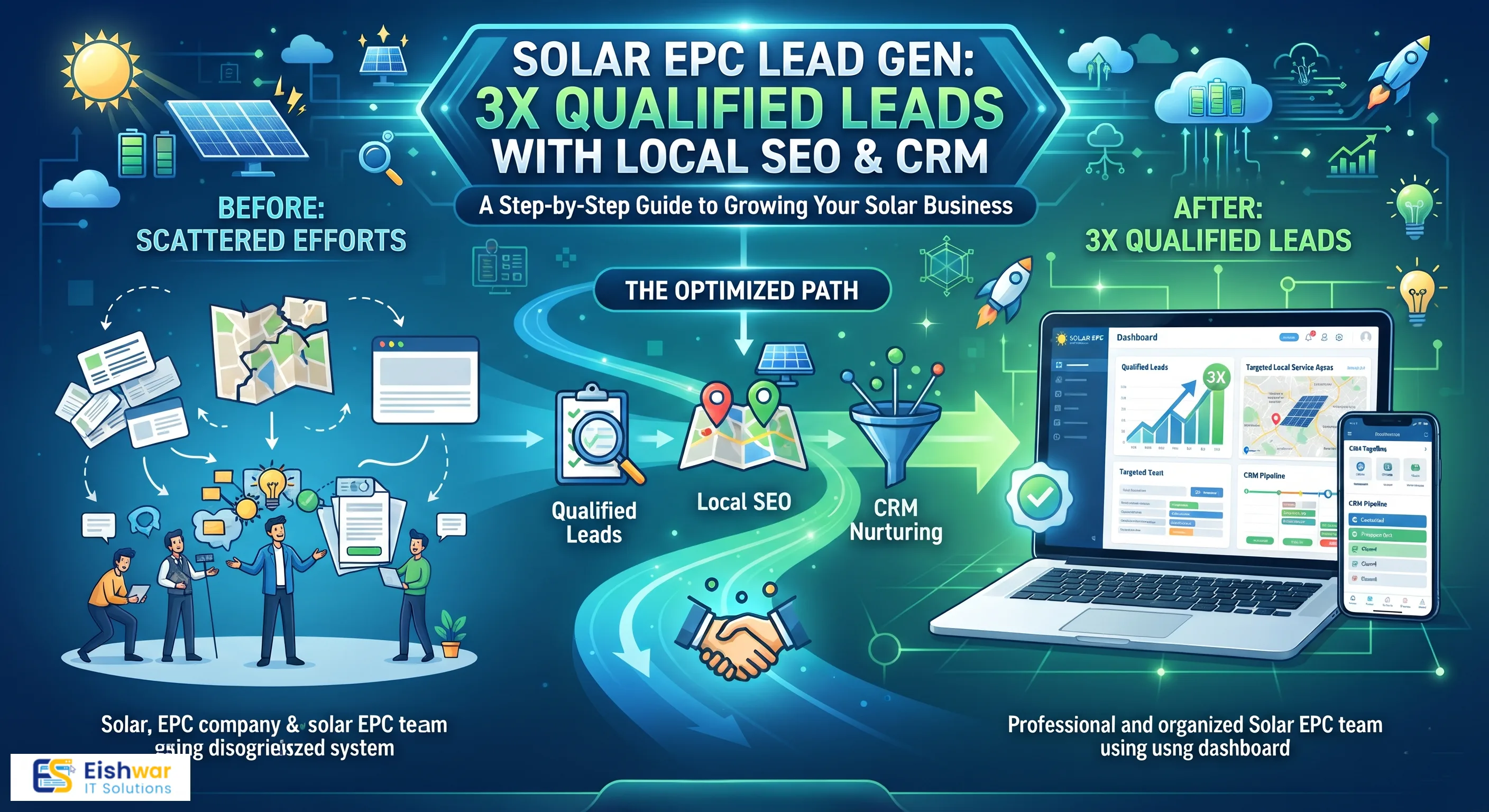
Solar EPC Lead Gen: 3X Qualified Leads with Local SEO & CRM
Published on: 16 Nov 2026
Solar EPC Lead Gen: 3X Qualified Leads with Local SEO & CRM
Introduction
India’s rooftop solar market is growing fast, and not just in metros. Tier-3 cities and towns are seeing steady demand from homeowners, shop owners, small factories and housing societies. But for a solar EPC company, demand is not the same as profit. Many businesses get plenty of enquiries and still struggle to close projects because the leads are unqualified, response times are slow and follow-ups depend on WhatsApp memory.
Learn more about our Website services
This case study looks at how a Tier-3 Indian solar EPC company — let us call it SuryaGrid Solar Solutions — rebuilt its lead generation engine with local SEO, a solar quote calculator, WhatsApp Business API and a simple CRM. The names and some details are anonymised, but the challenges and the process are very common among solar businesses in India.
The goal was clear: generate more qualified leads without simply buying more leads. In nine months, the company moved from about 8 qualified leads a month to 27, while reducing cost per qualified lead by 44%. More importantly, the sales team stopped chasing every enquiry and started focusing on buyers who were ready for a site survey.
Main Section 1: The Challenge — High Enquiries, Low Quality
SuryaGrid is based in a Tier-3 city in Maharashtra and serves nearby towns within a 90 km radius. It installs residential rooftop systems, commercial solar plants and small industrial systems. Before the project, the company relied on Google Ads, IndiaMART and word of mouth.
On paper, the business was getting leads. In reality, the sales team was frustrated.
- Raw enquiries were around 22 per month, but only 8 were qualified.
- Most leads asked for a price and disappeared after the first call.
- Quotes took two to four days because site details were incomplete.
- WhatsApp chats were scattered across three phones.
- No one knew which lead source produced closed projects.
- The Google Business Profile had no updated photos, services or reviews.
- The website had one generic contact form and no city-specific pages.
The average project value was around ₹4.8 lakh, so even a small improvement in lead quality mattered. The company did not need more traffic alone. It needed a system that could filter serious buyers, build local trust and give the sales team a clear follow-up process.
We set three practical goals for the first nine months:
- Grow qualified leads by at least 3X.
- Reduce cost per qualified lead by 30% or more.
- Shorten the average sales cycle from 46 days to under 35 days.
The budget was not doubled. The focus was on using the existing spend better and fixing the gaps between marketing, sales and follow-up.
Main Section 2: The Rebuild — Local SEO, Quote Calculator, WhatsApp and CRM
The project was rolled out in phases. Instead of trying every tactic at once, the team focused on a simple principle: qualify the lead before the sales team spends time on it.
Phase 1: Build a CRM pipeline the sales team would actually use
The first step was not SEO or ads. It was a CRM. The company needed one place to track every enquiry, conversation, site survey, proposal and follow-up.
👉 Don't wait for the perfect moment; turn your vision into reality today.
Free ConsultationWe set up a simple pipeline with these stages:
- New enquiry
- Contacted
- Site survey scheduled
- Proposal sent
- Negotiation
- Won
- Lost
Every lead record captured the source, city, property type, monthly electricity bill, roof area, budget range, timeline and decision-maker. The CRM also stored the next follow-up date and the reason for losing a deal.
This sounds basic, but it changed the conversation. The team could see that many leads came from towns where the company had no strong local proof. It could also see that leads with a monthly bill above ₹4,000 and a clear roof area were far more likely to convert.
Phase 2: Add a solar quote calculator that pre-qualifies buyers
The website had a contact form. That was not enough. Most buyers wanted an approximate answer before they would speak to a salesperson. So we built a solar savings and quote calculator.
The calculator asked for:
- City or pin code
- Property type: home, shop, factory, housing society
- Average monthly electricity bill
- Roof area available
- Roof type: concrete, metal, asbestos
- Ownership: owned or rented
It then showed an estimated system size, approximate subsidy range, expected monthly savings and a ballpark investment range. The user could request a detailed quote on WhatsApp or schedule a site survey.
This one step improved lead quality significantly. People who completed the calculator had already shared enough information for the team to understand whether the project was realistic. The sales team stopped wasting calls on buyers with no roof space, rented premises or unrealistic budgets.
The calculator page was also optimised for searches like solar panel cost calculator India, rooftop solar subsidy calculator and solar installation cost in [city].
Phase 3: Fix local SEO and build city-level trust
Solar is a local purchase. Buyers want to know if the company has installed projects nearby, whether it can service the area and what local customers say. We rebuilt the local SEO foundation.
- Updated the Google Business Profile with services, service areas, project photos and weekly posts.
- Created six city and service landing pages, such as solar panel installation in [city] and commercial solar EPC in [city].
- Added local project photos, customer testimonials, subsidy notes and a simple FAQ section to each page.
- Used FAQ schema where relevant and kept NAP details consistent across directories.
- Started a systematic review request process on WhatsApp after installation.
- Linked city pages to relevant case studies, calculator pages and service pages.
The key was avoiding thin duplicate pages. Each city page had to answer why SuryaGrid was credible in that area, what projects it had completed and how the installation process worked locally.
Phase 4: Use WhatsApp Business API for speed and follow-up
The company already used WhatsApp, but without structure. Customer conversations lived on personal phones. We moved the main business number to WhatsApp Business API and connected it to the CRM.
The setup included:
- An auto-reply that acknowledged every enquiry within seconds.
- Quick replies for subsidy questions, site survey booking and document checklists.
- Template messages for quote reminders, follow-ups and review requests.
- Lead assignment based on city and lead score.
- An SLA of first human response within 15 minutes during business hours.
The team also created a small library of approved responses for common objections: price concerns, subsidy confusion, loan options and installation timelines. Automation handled the first response. A human handled the sales conversation.
👉 Free Website Audit
Get Free AuditPhase 5: Spend smarter on ads and content
After tracking improved, the company paused broad lead-generation ads and focused on high-intent search terms. It also ran remarketing to people who used the calculator but did not submit a quote request.
On the content side, the team created practical resources:
- A rooftop solar subsidy guide for homeowners.
- A commercial solar ROI explainer for factories and shops.
- Short project videos from nearby towns.
- Customer stories with before-and-after electricity bill savings.
These assets were not written for keywords alone. They were built to answer the questions the sales team heard every day.
Main Section 3: Results After Nine Months
The results came gradually. The first two months were mostly cleanup and tracking. By month four, qualified leads started rising. By month nine, the sales team had a very different workflow.
| Metric | Before | After 9 Months |
|---|---|---|
| Raw enquiries per month | 22 | 54 |
| Qualified leads per month | 8 | 27 |
| Qualified lead rate | 36% | 50% |
| Cost per qualified lead | ₹3,900 | ₹2,180 |
| Proposal-to-close rate | 17% | 26% |
| Average sales cycle | 46 days | 33 days |
| Google Business Profile calls | 31 per month | 88 per month |
| Calculator completions | 0 | 140 per month |
Booked project value grew 2.6X over the same period. Organic website sessions increased by 162%. The review count on Google grew from 11 to 47, and the average rating stayed above 4.6.
The biggest win was not a single channel. It was the handoff. Marketing generated better-qualified enquiries, WhatsApp responded quickly, and the CRM made sure no lead was forgotten.
Three things made the biggest difference:
- Lead definition: The company stopped calling every form fill a qualified lead.
- Speed to response: 68% of leads were contacted within 15 minutes, compared with less than 20% earlier.
- Local proof: City pages, reviews and project photos reduced trust friction before the first call.
Expert Tips
If you run a solar EPC company or any local B2B service business, these lessons are practical and repeatable.
1. Define a qualified lead before you spend on ads
For a solar EPC company, a qualified lead usually has a real roof, a reasonable electricity bill, ownership clarity and a timeline within three to six months. Write this down. Share it with the sales team. Track it in the CRM.
2. Put a calculator before the sales call
A calculator is a soft qualification tool. It helps the buyer get an approximate answer and helps your team collect the data it needs. Keep it simple. Ask only what changes the quote or the qualification.
3. Build city pages with proof, not filler
Local SEO for solar companies works when each page shows local projects, reviews, service details and clear next steps. Do not publish ten city pages with the same paragraph. Publish fewer pages that genuinely help the buyer.
👉 Free Homepage Demo
Book Demo4. Automate the first response, not the relationship
WhatsApp automation should acknowledge, collect basic details and route the lead. It should not try to replace a salesperson. Buyers still want a human to explain subsidy, net metering and installation timelines.
5. Track lead source to booked revenue
If your CRM only records enquiries, you cannot improve marketing. Track source, city, project value, lost reason and sales cycle. Review the dashboard weekly, not once a quarter.
6. Use reviews as a sales asset
Solar buyers trust nearby installations. Ask for reviews after commissioning. Add review snippets to city pages. Share short videos of real installations whenever possible.
Common Mistakes
Many solar businesses make the same avoidable mistakes. Watch out for these.
- Treating CRM as a contact book: A CRM without stages, lead scores and follow-ups is just a list. It will not improve conversion.
- Buying more leads before fixing follow-up: If response time is slow, extra leads only create more chaos.
- Publishing duplicate city pages: Local SEO needs genuinely local information, proof and service details.
- Ignoring Google Business Profile: For local solar companies, the profile is often the first touchpoint. Keep it active and accurate.
- Over-automating WhatsApp: Too many templates and menu options frustrate buyers. Keep automation helpful and short.
- No response SLA: A lead that waits six hours is often a lead that has already spoken to a competitor.
- Not asking for lost reasons: Lost deals are data. Track whether the buyer chose a cheaper vendor, deferred the project or did not get finance.
Future Trends
Solar EPC lead generation in India is becoming more data-driven and more local.
- AI-assisted lead scoring: CRM systems will rank leads based on bill size, property type, calculator behaviour and response speed.
- WhatsApp Flows and richer messaging: Buyers will complete surveys, upload electricity bills and book site visits inside WhatsApp.
- Vernacular content: Tier-2 and Tier-3 buyers often prefer content in Hindi, Marathi, Gujarati, Tamil or other regional languages.
- Calculator-led landing pages: More solar websites will use savings and subsidy calculators as the main conversion tool.
- CRM and project management integration: Sales pipelines will connect directly to site surveys, installation schedules and service tickets.
- Review-led local SEO: Google Business Profile, local reviews and installation videos will matter more than generic blog traffic.
The businesses that win will not necessarily be the ones with the biggest ad budgets. They will be the ones that respond fast, qualify honestly and prove local credibility.
FAQs
How long does it take to see results from local SEO and CRM for a solar EPC company?
Expect early improvements in response time and lead tracking within four to six weeks. Local SEO and content usually show stronger results in three to six months. In this case study, qualified leads grew 3X over nine months.
Does local SEO work for solar companies in Tier-3 India?
Yes, if it is done properly. Solar buyers search for installers near them, compare reviews and look for local project proof. A well-optimised Google Business Profile and city-specific service pages can generate high-intent enquiries.
What should a solar lead score include?
A practical lead score can include monthly electricity bill, roof area, property type, ownership status, budget range, project timeline and engagement level. Leads with a clear roof, owned premises and a near-term timeline should rank higher.
Do we need WhatsApp Business API from day one?
Not necessarily. If you handle fewer than 20 to 30 enquiries a month, WhatsApp Business app with clear processes may be enough. Once volume grows or multiple salespeople need access, WhatsApp Business API connected to CRM becomes more useful.
How much should a solar EPC company spend on lead generation?
There is no fixed number. Start with a controlled pilot: fix the website, Google Business Profile, CRM and calculator first. Then add paid ads once tracking and follow-up are reliable. Measure cost per qualified lead, not cost per form fill.
Which metrics matter most?
Track qualified leads, cost per qualified lead, first response time, site survey rate, proposal-to-close rate, sales cycle length, customer acquisition cost and booked project value. These metrics show whether marketing and sales are working together.
Conclusion
SuryaGrid did not need a magic growth hack. It needed a cleaner system. The company used local SEO to build trust, a solar quote calculator to qualify buyers, WhatsApp Business API to respond faster and a CRM to keep the pipeline visible. The result was 3X qualified leads, a lower cost per qualified lead and a shorter sales cycle.
For solar EPC companies in India, the opportunity is clear. Buyers are searching, comparing and asking questions online. The businesses that answer quickly, show local proof and follow up consistently will win more projects.
CTA
Want to build a similar lead generation and CRM system for your solar EPC business? Talk to EishwarITSolution for a practical audit of your website, local SEO, WhatsApp follow-up and CRM pipeline. We will help you identify the fastest improvements and build a system that turns more enquiries into site surveys and booked projects.