Quantum-Resistant Blockchain: Securing Indian Web Solutions in 2026
Published on: 15 Jun 2026
Quantum-Resistant Blockchain: Securing Indian Web Solutions in 2026
Introduction
Imagine a world where the cryptographic locks protecting your business data, customer transactions, and digital identity can be cracked in seconds by a quantum computer. That future is closer than you think. By 2026, quantum computing advancements are expected to challenge the very foundations of blockchain security. For Indian business owners, marketers, and professionals relying on web solutions, this isn’t just a tech concern—it’s a business risk. Quantum-resistant blockchain offers a way to future-proof your digital assets. In this guide, we’ll explore what quantum-resistant blockchain is, why it matters for Indian web solutions, and how you can start preparing today.
Learn more about our Website services
Consider this: a small e-commerce platform in Jaipur using blockchain for supply chain tracking might think quantum threats are irrelevant. But if a competitor or malicious actor harvests encrypted transaction data now, they could decrypt it later when quantum computers mature—exposing trade secrets and customer details. The Indian digital ecosystem, with over 900 million internet users and a booming fintech sector, is particularly vulnerable. The National Quantum Mission, backed by ₹6,000 crore in funding, signals that India is racing toward quantum capabilities, but it also means threats will emerge sooner. Proactive adoption of quantum-resistant blockchain isn’t just about defense; it’s about positioning your business as a trusted, forward-thinking leader in a competitive market.
Main Section 1: What Is Quantum-Resistant Blockchain and Why Does It Matter for India?
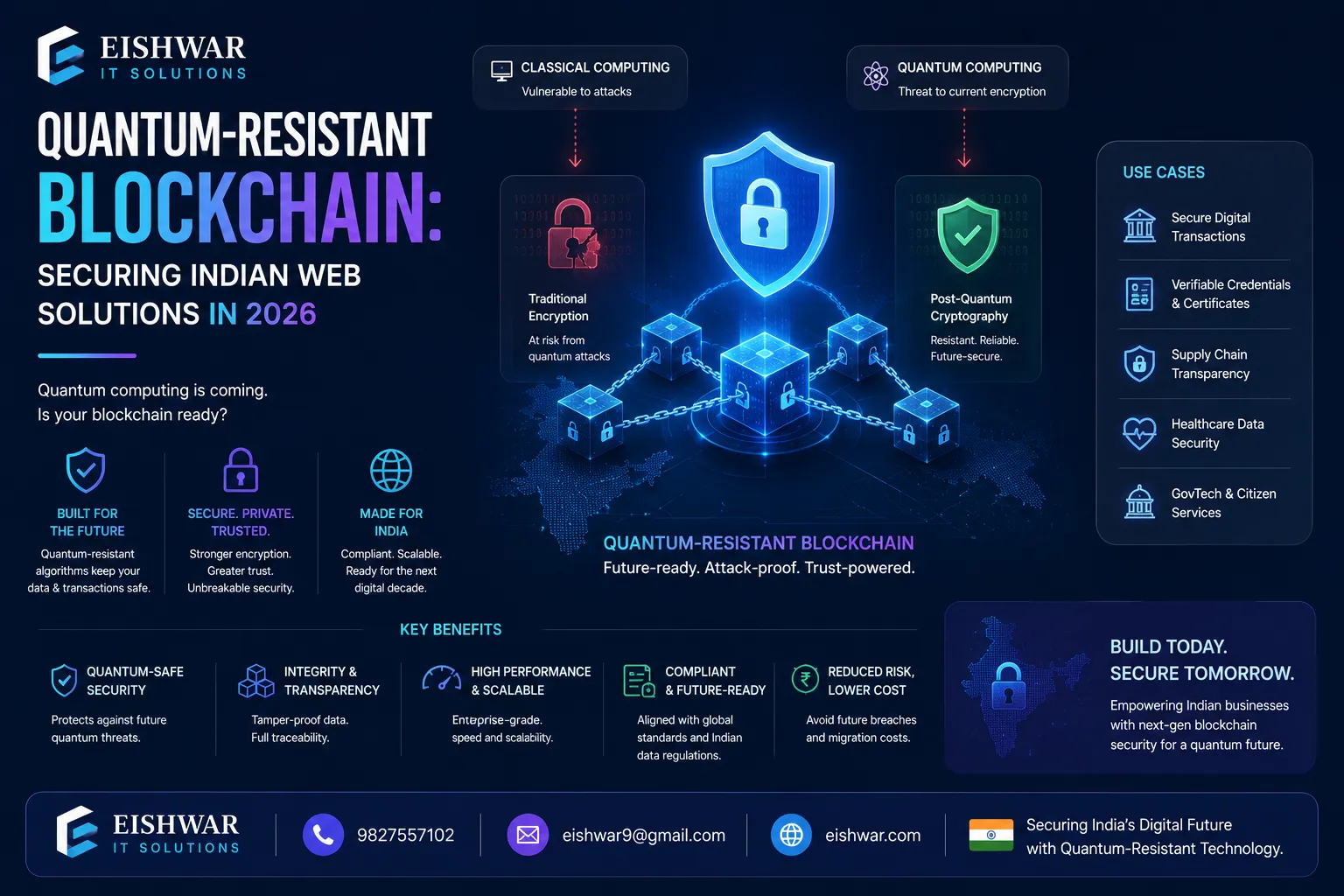
Quantum-resistant blockchain, also known as post-quantum blockchain, refers to blockchain networks that use cryptographic algorithms immune to attacks from quantum computers. Traditional blockchains rely on algorithms like ECDSA (Elliptic Curve Digital Signature Algorithm) and RSA, which quantum computers could break using Shor’s algorithm. Quantum-resistant blockchains employ lattice-based, hash-based, or multivariate cryptography to withstand quantum attacks.
For Indian businesses, the stakes are high. India’s digital economy is booming—UPI transactions alone crossed ₹17 lakh crore in early 2025. As web solutions integrate blockchain for payments, supply chain, and identity, a quantum breach could compromise millions of users. The Indian government’s National Quantum Mission, launched in 2023, aims to accelerate quantum R&D, making it imperative for businesses to align with post-quantum standards. By adopting quantum-resistant blockchain now, you not only protect your assets but also build trust with tech-savvy Indian customers.
To put it in perspective, consider the 2023 ransomware attack on a major Indian healthcare provider that exposed 40 million patient records. While not quantum-related, it highlighted the fragility of digital infrastructure. A quantum-capable attacker could target similar systems, decrypting encrypted data retroactively. For example, a bank in Mumbai using blockchain for interbank settlements might store encrypted transaction histories. If those are harvested today, a quantum computer in 2028 could break the encryption, revealing sensitive financial flows. Quantum-resistant blockchain prevents this by using algorithms like CRYSTALS-Kyber (lattice-based) or SPHINCS+ (hash-based), which are designed to resist both classical and quantum attacks. The Indian government’s push for digital public infrastructure—like Aadhaar and DigiLocker—further amplifies the need, as these systems rely on cryptographic integrity that quantum computers could undermine.
👉 Don't wait for the perfect moment; turn your vision into reality today.
Free ConsultationMain Section 2: How Quantum-Resistant Blockchain Works in Web Solutions
Quantum-resistant blockchains use several advanced cryptographic techniques:
- Lattice-based cryptography: Relies on the hardness of lattice problems (e.g., Learning With Errors). It offers strong security and efficiency, making it suitable for smart contracts and dApps.
- Hash-based signatures: Use one-time signature schemes like XMSS and SPHINCS+. These are simple but produce larger signatures, impacting transaction speed.
- Multivariate cryptography: Based on solving systems of multivariate equations. It’s fast but requires larger keys.
For Indian web solutions, integrating quantum-resistant blockchain can happen at multiple layers. For example, a fintech startup in Bangalore could use a quantum-resistant layer-1 blockchain like QANplatform or a hybrid approach that combines classical and post-quantum algorithms. A supply chain solution for a Mumbai-based logistics firm could implement quantum-resistant smart contracts to ensure tamper-proof records even against future quantum attacks. Practical steps include auditing your current blockchain stack, choosing quantum-resistant libraries (e.g., liboqs), and testing on testnets like the Ethereum Sepolia with post-quantum upgrades.
Let’s dive deeper into a practical example. Imagine a Bengaluru-based DeFi platform offering crypto lending. It currently uses ECDSA for wallet signatures. To transition, the team can implement a hybrid signature scheme: each transaction includes both an ECDSA signature (for backward compatibility) and a CRYSTALS-Dilithium signature (post-quantum). This requires updating the node software and wallet clients. Using the Open Quantum Safe (OQS) library, developers can integrate this with minimal code changes. On the testnet, they might notice a 20% increase in transaction size, but optimizations like signature aggregation can mitigate this. Similarly, a supply chain solution for a Delhi-based organic food exporter can use hash-based signatures for product provenance. Each batch of produce gets a unique XMSS signature that verifies its origin. Even if a quantum computer later tries to forge a signature, the hash-based scheme remains secure because it relies on one-time keys. The key management system must handle larger keys (e.g., 64 bytes for XMSS vs. 32 bytes for ECDSA), but this is manageable with modern databases.
Main Section 3: Real-World Use Cases for Indian Businesses
Here are three scenarios where quantum-resistant blockchain adds immediate value:
- Digital Payments: A payment gateway in Delhi processing high-value B2B transactions can integrate quantum-resistant signatures to prevent future replay attacks. This ensures that payment records remain verifiable for decades.
- Healthcare Records: A hospital chain in Chennai using blockchain for patient data can adopt quantum-resistant encryption to comply with India’s Digital Personal Data Protection Act, 2023, and protect against quantum-era data breaches.
- Government e-Governance: State-level land registry systems on blockchain (like those in Andhra Pradesh) can migrate to quantum-resistant hashing to secure property titles against quantum forgery.
These examples show that quantum-resistant blockchain isn’t just theoretical—it’s actionable today with careful planning.
Let’s expand on the healthcare use case. A hospital chain in Chennai with 15 branches uses a private blockchain to store patient consent records and treatment histories. Under the Digital Personal Data Protection Act, 2023, they must ensure data integrity for at least 10 years. Current SHA-256 hashing is quantum-vulnerable. By migrating to a quantum-resistant hash like SHA-3 (which has some resistance) or using a lattice-based commitment scheme, they can future-proof compliance. The migration involves updating the blockchain’s consensus algorithm to support post-quantum hashing and training staff on new key management. A pilot on a testnet shows that transaction throughput drops by 15%, but this is acceptable given the security gain. Similarly, a government land registry in Andhra Pradesh, which already uses blockchain for 10 million property records, can adopt quantum-resistant signatures for new registrations. This prevents a scenario where a quantum computer forges a title deed, potentially causing massive legal disputes. The cost of migration is offset by the avoided risk of litigation and loss of public trust.
👉 Free Website Audit
Get Free AuditExpert Tips
- Start with a crypto-agility audit: Identify all cryptographic algorithms used in your web solutions. Map them to NIST’s post-quantum standardization timeline (expected 2024-2026).
- Adopt hybrid signatures: Use classical + post-quantum signatures during transition. This maintains backward compatibility while adding quantum resistance.
- Educate your team: Train developers on post-quantum cryptography basics. Use open-source tools like Open Quantum Safe (OQS) to experiment.
- Partner with Indian blockchain labs: Collaborate with institutes like IIT Bombay’s blockchain lab or startups like QNu Labs for quantum-safe solutions tailored to Indian regulations.
- Plan for key migration: Quantum-resistant keys are larger. Update your key management systems to handle increased storage and bandwidth.
To make these tips actionable, consider a step-by-step approach for a small business. First, conduct a crypto-agility audit using a checklist: list all cryptographic primitives (e.g., signing, hashing, encryption) in your web stack, note their quantum vulnerability (e.g., RSA-2048 is vulnerable, SHA-256 is partially vulnerable), and prioritize based on data sensitivity. For a typical e-commerce site, the payment signing key is most critical. Second, implement hybrid signatures in a staging environment. Use the liboqs library to add CRYSTALS-Dilithium alongside ECDSA. Test for performance—expect a 10-30% increase in signature size. Third, train your developers through free online courses from NIST or IIT Bombay’s blockchain lab. Fourth, partner with a local lab like QNu Labs for a pilot project; they offer quantum-safe VPNs and key management solutions compliant with Indian standards. Finally, update your key management system to store larger keys (e.g., 1.5 KB for Dilithium vs. 64 bytes for ECDSA). Use a cloud-based HSM that supports post-quantum algorithms, like those from AWS or Azure, which are rolling out support in 2025.
Common Mistakes
- Waiting too long: Many businesses think quantum threats are decades away. But ‘harvest now, decrypt later’ attacks mean encrypted data today can be decrypted later. Start now.
- Assuming all blockchains are equal: Not all quantum-resistant blockchains are secure. Evaluate against NIST standards and peer-reviewed research.
- Ignoring performance impact: Post-quantum algorithms can be slower. Benchmark your use case before full deployment.
- Overlooking regulatory compliance: Indian regulators may mandate quantum-resistant standards for critical infrastructure. Stay ahead of guidelines.
- Relying solely on quantum key distribution (QKD): QKD is hardware-based and expensive. Software-based quantum-resistant cryptography is more scalable for web solutions.
Let’s elaborate on the first mistake. A common counterargument is that quantum computers powerful enough to break RSA-2048 are 10-15 years away. However, the ‘harvest now, decrypt later’ threat is real: adversaries can collect encrypted data today and store it until quantum decryption is feasible. For example, a legal firm in Delhi storing client contracts on a blockchain might think they’re safe, but if a nation-state actor harvests the encrypted data, they could decrypt it in 2030, revealing sensitive negotiations. This is especially critical for industries with long data retention requirements, like healthcare (10 years) or finance (7 years). Starting now means you can phase in quantum-resistant upgrades without disrupting operations. The second mistake—assuming all quantum-resistant blockchains are equal—is dangerous. Some projects claim quantum resistance but use unproven algorithms. Always check if the blockchain uses NIST-standardized algorithms (e.g., CRYSTALS-Kyber, CRYSTALS-Dilithium, SPHINCS+). For instance, a blockchain using a proprietary lattice scheme without peer review might have hidden vulnerabilities. Stick to open-source, audited implementations.
👉 Free Homepage Demo
Book DemoFuture Trends
- NIST standardization completion: By late 2026, NIST will finalize post-quantum algorithms. Expect rapid adoption in blockchain platforms.
- Government mandates in India: The Indian Computer Emergency Response Team (CERT-In) may issue guidelines for quantum-resistant cryptography in financial and government systems by 2027.
- Quantum-resistant DeFi: Decentralized finance protocols will integrate post-quantum security to protect liquidity pools and smart contracts.
- AI-driven quantum resilience: AI will help optimize post-quantum algorithm selection and detect quantum attack patterns in real time.
- Cross-chain quantum resistance: Interoperability protocols will adopt quantum-resistant bridges to secure multi-chain ecosystems.
These trends are already shaping the industry. For example, NIST’s finalization of algorithms like CRYSTALS-Kyber for encryption and CRYSTALS-Dilithium for signatures will provide a clear standard for Indian businesses to adopt. By 2026, major blockchain platforms like Ethereum and Hyperledger Fabric are expected to integrate these algorithms as optional upgrades. In India, CERT-In might mandate quantum-resistant cryptography for critical sectors like banking and telecom, similar to their 2022 guidelines on cybersecurity. DeFi protocols, which handle billions in assets, will be early adopters. For instance, a DeFi lending platform in Mumbai could use quantum-resistant smart contracts to protect against attacks that exploit quantum vulnerabilities in signature schemes. AI will play a role by automatically selecting the best post-quantum algorithm based on transaction type and network conditions, reducing manual overhead. Cross-chain bridges, which are frequent targets for hacks, will adopt quantum-resistant signatures to secure asset transfers between blockchains, ensuring that a quantum attack on one chain doesn’t compromise the entire ecosystem.
FAQs
- What is quantum-resistant blockchain? It’s a blockchain that uses cryptographic algorithms resistant to quantum computer attacks, ensuring long-term security.
- Why should Indian businesses care about quantum threats now? Quantum computers can break current encryption, and data harvested today can be decrypted later. Early preparation prevents future breaches.
- How can I make my existing blockchain quantum-resistant? Upgrade your nodes to support hybrid signatures, use quantum-resistant wallets, and migrate to post-quantum algorithms via hard forks or layer-2 solutions.
- Are there quantum-resistant blockchains already live? Yes, examples include QANplatform, IOTA (with quantum-resistant signatures), and some Ethereum-based testnets experimenting with post-quantum upgrades.
- Will quantum-resistant blockchain affect transaction speed? Initially yes, due to larger key sizes. However, optimizations like lattice-based algorithms are becoming faster.
- Is quantum-resistant blockchain legal in India? Yes, as long as it complies with existing IT laws and data protection regulations. No specific ban exists.
- What is the cost of transitioning to quantum-resistant blockchain? Costs vary based on complexity. For small web apps, it may involve library updates; for large systems, a phased migration could cost ₹5-50 lakhs.
- Can quantum-resistant blockchain integrate with AI? Absolutely. AI can optimize cryptographic parameter selection and monitor for quantum attacks.
To add depth to the FAQs, consider the following expanded answers. For question 3, a practical example: a supply chain blockchain using Hyperledger Fabric can upgrade by replacing the default ECDSA signing with a hybrid scheme using CRYSTALS-Dilithium. This requires updating the Fabric CA (Certificate Authority) to issue post-quantum certificates and modifying the peer nodes to verify hybrid signatures. The process can be tested on a separate channel before full deployment. For question 5, benchmarks show that CRYSTALS-Kyber encryption is about 2-3 times slower than RSA-2048 for key generation, but decryption is comparable. For signing, CRYSTALS-Dilithium is about 10-20% slower than ECDSA, but signature verification is faster. These trade-offs are acceptable for most web solutions, especially with hardware acceleration. For question 7, a detailed cost breakdown: for a small web app with 10,000 users, library updates and testing might cost ₹5-10 lakhs. For a large enterprise with multiple nodes and custom smart contracts, a phased migration over 6 months could cost ₹20-50 lakhs, including training and consulting. Government subsidies under the National Quantum Mission may offset some costs.
Conclusion
Quantum-resistant blockchain is not a distant possibility—it’s a necessity for Indian web solutions aiming for long-term security and trust. By understanding the technology, taking incremental steps, and avoiding common pitfalls, your business can stay ahead of the quantum curve. The time to act is now, while quantum computers are still emerging. Future-proof your digital presence with quantum-resistant blockchain, and turn a potential threat into a competitive advantage.
CTA
Ready to future-proof your web solutions with quantum-resistant blockchain? Contact EishwarITSolution today for a free quantum security audit. Our experts will help you assess your current blockchain stack and recommend a tailored migration plan. Don’t wait until quantum computers knock on your door—secure your business now.