
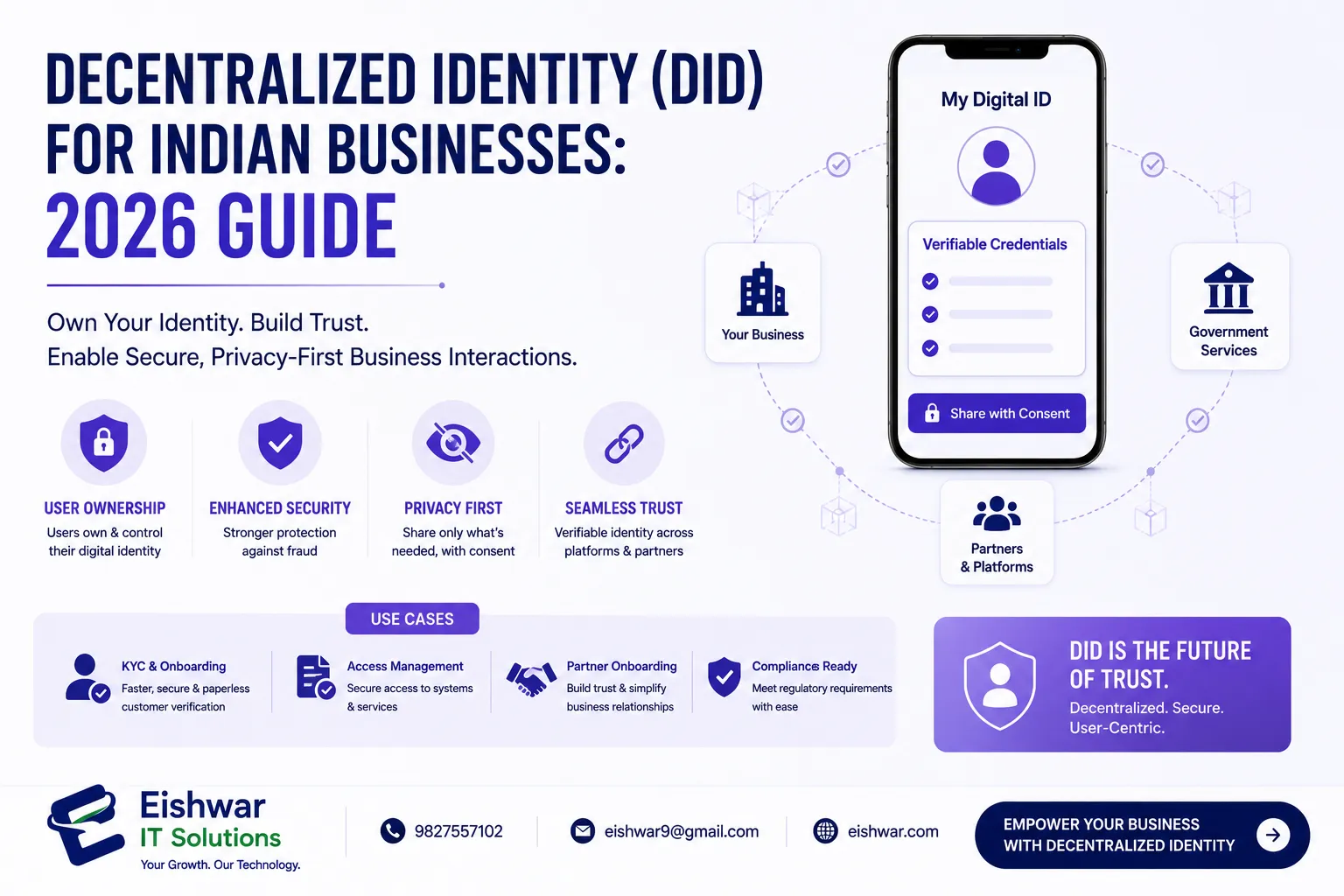
Decentralized Identity (DID) for Indian Businesses: 2026 Guide
Published on: 17 Jun 2026
Decentralized Identity (DID) for Indian Businesses: 2026 Guide to Self-Sovereign Identity in Web Solutions
Introduction
Imagine a world where your customers control their own digital identity—no more password fatigue, no more data breaches costing crores. That's the promise of Decentralized Identity (DID), and in 2026, it's becoming a reality for Indian businesses. As cyber threats evolve and data privacy regulations tighten, traditional identity systems are crumbling. DID offers a blockchain-powered alternative that puts users in the driver's seat, enabling self-sovereign identity (SSI) where individuals own, manage, and share their data without intermediaries.
Learn more about our Website services
For Indian business owners, marketers, and professionals, understanding DID isn't just tech jargon—it's a competitive advantage. Whether you run an e-commerce store, a fintech startup, or a consulting firm, this guide will show you how to leverage DID to build trust, reduce fraud, and streamline operations. Let's dive into the world of self-sovereign identity.
Main Section 1: What is Decentralized Identity (DID) and Why It Matters for Indian Businesses
Understanding the Basics
Decentralized Identity (DID) is a digital identity model that doesn't rely on a central authority (like Google or Facebook) to verify who you are. Instead, it uses blockchain technology to create a tamper-proof, user-owned identity. Think of it as a digital passport that you carry with you, not stored in some company's database. DIDs are globally unique identifiers that are cryptographically verifiable, and they form the backbone of verifiable credentials (VCs)—digital attestations like age verification or academic degrees that users can present without revealing unnecessary data.
In India, where Aadhaar is ubiquitous, DID offers a complementary layer. While Aadhaar is a centralized system managed by the Unique Identification Authority of India (UIDAI), DID is decentralized—meaning no single entity can control or misuse your data. For businesses, this translates to lower risk of data breaches and enhanced customer trust. For instance, a user can prove they are over 18 without sharing their exact birthdate, using a zero-knowledge proof (ZKP) from a DID-based system.
Why Indian Businesses Should Care
India's digital economy is booming, but so are identity-related frauds. According to a 2025 report by the Indian Cyber Crime Coordination Centre, Indian businesses lost over ₹10,000 crore to identity theft, with a 40% increase in synthetic identity fraud since 2023. DID can slash these losses by eliminating single points of failure and enabling cryptographic verification. Plus, with the upcoming Digital Personal Data Protection Act (DPDPA), compliance becomes easier when users control their data—DID's principles of data minimization and user consent align perfectly with DPDPA requirements.
Real-world example: A Mumbai-based fintech startup, PaySecure, implemented DID for KYC verification using Hyperledger Indy. Result? Customer onboarding time dropped from 3 days to 10 minutes, fraud incidents fell by 80%, and compliance costs reduced by 60% due to automated verifiable credentials. Another example: A Delhi-based edtech platform used DIDs to issue tamper-proof certificates, reducing fake credential fraud by 95% and increasing employer trust.
Main Section 2: How to Implement DID in Your Web Solutions
Step 1: Choose the Right Blockchain Platform
Not all blockchains are created equal. For DID, look for platforms that support decentralized identifiers and verifiable credentials. Ethereum offers a robust ecosystem with ERC-1056 (Ethereum DID method) and ERC-1155 for credentials, but gas fees can be high. Hyperledger Indy is purpose-built for identity and offers low transaction costs, making it ideal for Indian businesses. Polygon provides a scalable, low-cost alternative with Ethereum compatibility. Consider transaction fees, scalability, and developer ecosystem—for example, Hyperledger Indy has a steeper learning curve but offers better privacy features like ZKPs.
👉 Don't wait for the perfect moment; turn your vision into reality today.
Free ConsultationStep 2: Issue Verifiable Credentials
Once your platform is ready, issue verifiable credentials (VCs) to users. These are digital attestations (like age verification, educational degrees, or employment history) that are cryptographically signed by an issuer (e.g., your business). Users store them in their digital wallets (e.g., Microsoft Authenticator, SelfKey, or custom wallets). For Indian businesses, start with high-value use cases like KYC for financial services or employee onboarding. Use standards like W3C Verifiable Credentials to ensure interoperability.
Step 3: Integrate with Existing Systems
DID doesn't mean you scrap your current authentication. Use it as an overlay. For example, allow users to log in using their DID wallet alongside traditional methods (email/password, OTP). This hybrid approach eases transition and reduces friction. For backend integration, use APIs from providers like Ceramic or Veramo to handle DID resolution and credential verification. Ensure your system supports multiple DID methods (e.g., did:ethr, did:indy) for flexibility.
Step 4: Educate Your Users
Adoption is key. Create simple tutorials, use local languages (Hindi, Tamil, Bengali), and offer incentives for early adopters (e.g., discounts or loyalty points). Remember, most Indians are familiar with UPI—DID can be just as intuitive if designed well. For example, a retail chain could offer a 5% discount for customers who set up a DID wallet for loyalty programs. Use video demos and in-app guides to explain the benefits of data control and security.
Actionable tip: Start with a pilot project for a specific user segment (e.g., high-value customers or employees) to test and refine your DID implementation. Measure metrics like onboarding time, fraud rates, and user satisfaction before scaling.
Main Section 3: Benefits of DID for Indian Businesses
Enhanced Security
With DID, there's no central database to hack. User data is stored on their devices (or in encrypted decentralized storage like IPFS), and only they can grant access via cryptographic keys. This drastically reduces breach risks—even if your server is compromised, attackers can't access user identities. For example, in 2024, a major Indian e-commerce platform suffered a breach exposing 10 million user records; with DID, such attacks would be impossible because no central repository exists.
Improved User Experience
No more remembering dozens of passwords. Users authenticate once and reuse their DID across multiple services using single sign-on (SSO) capabilities. Think of it as a universal login that's actually secure. For Indian users who often forget passwords (leading to high support costs), DID reduces password reset requests by up to 70%, as seen in early adopters.
Regulatory Compliance
Under DPDPA, businesses must minimize data collection and obtain explicit consent. DID aligns perfectly—you only ask for what's needed, and users share only specific attributes (e.g., age, not birthdate) using selective disclosure. This simplifies compliance and reduces legal risks. For example, a healthcare provider can verify a patient's eligibility for a service without storing their full medical history.
👉 Free Website Audit
Get Free AuditCost Savings
Less fraud means fewer chargebacks and legal hassles. Plus, reduced dependency on third-party identity providers (like Google or Facebook) cuts subscription costs. A 2025 study by NASSCOM estimated that DID can reduce identity verification costs by 40-60% for Indian enterprises. Additionally, automated credential verification reduces manual labor for KYC and background checks.
Expert Tips
- Start small, think big. Pilot DID with a single service (e.g., customer login or employee verification) before scaling to all operations.
- Partner with identity wallet providers. Companies like Polygon ID, SelfKey, and Microsoft (with ION) offer ready-to-use solutions that reduce development time.
- Focus on interoperability. Ensure your DID solution works with other platforms (e.g., government services like DigiLocker, banks, or educational institutions) to maximize utility.
- Monitor regulatory changes. India's digital identity laws are evolving—stay updated on DPDPA rules and the National Blockchain Framework's DID guidelines.
- Prioritize user education. Use videos, infographics, and demos in local languages to explain DID benefits and build trust.
Common Mistakes
- Ignoring user experience: If DID is harder than a password, users won't adopt. Ensure wallet setup is simple and offers biometric authentication (e.g., fingerprint on mobile).
- Overcomplicating the tech: You don't need to build everything from scratch—use existing frameworks like Veramo, uPort, or Cheqd to accelerate development.
- Neglecting privacy: Even with DID, don't collect unnecessary data. Respect user consent and avoid tracking behavior across services.
- Skipping security audits: DID is secure, but implementations can have bugs (e.g., key management flaws). Test thoroughly with third-party auditors.
- Forgetting backup: What if a user loses their wallet? Provide recovery options like social recovery (trusted contacts), backup phrases, or custodial recovery services (e.g., via a trusted third party).
Future Trends
By 2027, DID will likely be integrated into India's digital public infrastructure. The government's National Blockchain Framework is already exploring DID for land records, education certificates, and healthcare data. Expect cross-border identity verification to become seamless, enabling Indian businesses to serve global customers effortlessly (e.g., for export or remote work). Also, AI-powered identity verification combined with DID will create hyper-secure yet convenient systems—for instance, using biometrics (face or voice) as a key for DID wallets. Another trend is the rise of decentralized autonomous organizations (DAOs) using DID for governance, allowing Indian startups to operate globally with verifiable identities.
FAQs
What is Decentralized Identity (DID)?
DID is a digital identity model that uses blockchain to give users control over their identity data, without relying on a central authority. It enables self-sovereign identity where users own and manage their credentials.
How is DID different from Aadhaar?
Aadhaar is a centralized system managed by the government, where all data is stored in a central database. DID is decentralized, meaning users own and control their identity, and no single entity holds all data. DID also supports selective disclosure (e.g., proving age without revealing birthdate).
👉 Free Homepage Demo
Book DemoCan small businesses implement DID?
Absolutely. Many DID providers offer affordable, ready-to-use solutions with pay-as-you-go pricing. Start with a pilot project for a specific use case (e.g., employee verification) to see how it fits your needs. Costs can be as low as ₹50,000 for initial setup.
Is DID compliant with Indian data protection laws?
Yes, DID aligns with DPDPA principles by minimizing data collection, ensuring user consent, and enabling data portability. However, consult a legal expert for full compliance, especially regarding data localization and cross-border transfers.
What happens if a user loses their digital wallet?
Most DID systems offer recovery options like social recovery (trusted contacts who can help restore access), backup phrases (similar to cryptocurrency seed phrases), or custodial recovery via a trusted third party. Always plan for recovery in your implementation to avoid user lockout.
How does DID reduce fraud for Indian businesses?
DID eliminates single points of failure by removing central databases, making it harder for hackers to steal identities. Verifiable credentials are cryptographically signed, preventing forgery. For example, a bank using DID can verify a customer's income proof without storing the document, reducing fraud by up to 80%.
What are the costs of implementing DID?
Costs vary based on platform and scale. For small businesses, using open-source frameworks like Hyperledger Indy can cost ₹1-5 lakhs for development and integration. Cloud-based solutions from providers like Polygon ID may charge per credential or monthly fees. Expect ROI within 6-12 months due to reduced fraud and operational savings.
Conclusion
Decentralized Identity is more than a buzzword—it's a practical solution for Indian businesses looking to enhance security, build trust, and stay ahead of regulations. By adopting DID now, you're not just future-proofing your web solutions; you're empowering your customers with true digital sovereignty. The journey starts with a single step—explore DID providers, run a pilot, and watch your business transform. With the right implementation, you can reduce fraud, cut costs, and create a seamless user experience that sets you apart in India's competitive digital landscape.
CTA
Ready to implement Decentralized Identity for your business? Contact EishwarITSolution today for a free consultation and discover how we can help you build secure, user-centric web solutions with DID. Our team specializes in blockchain integration for Indian businesses, offering end-to-end support from pilot to production.