
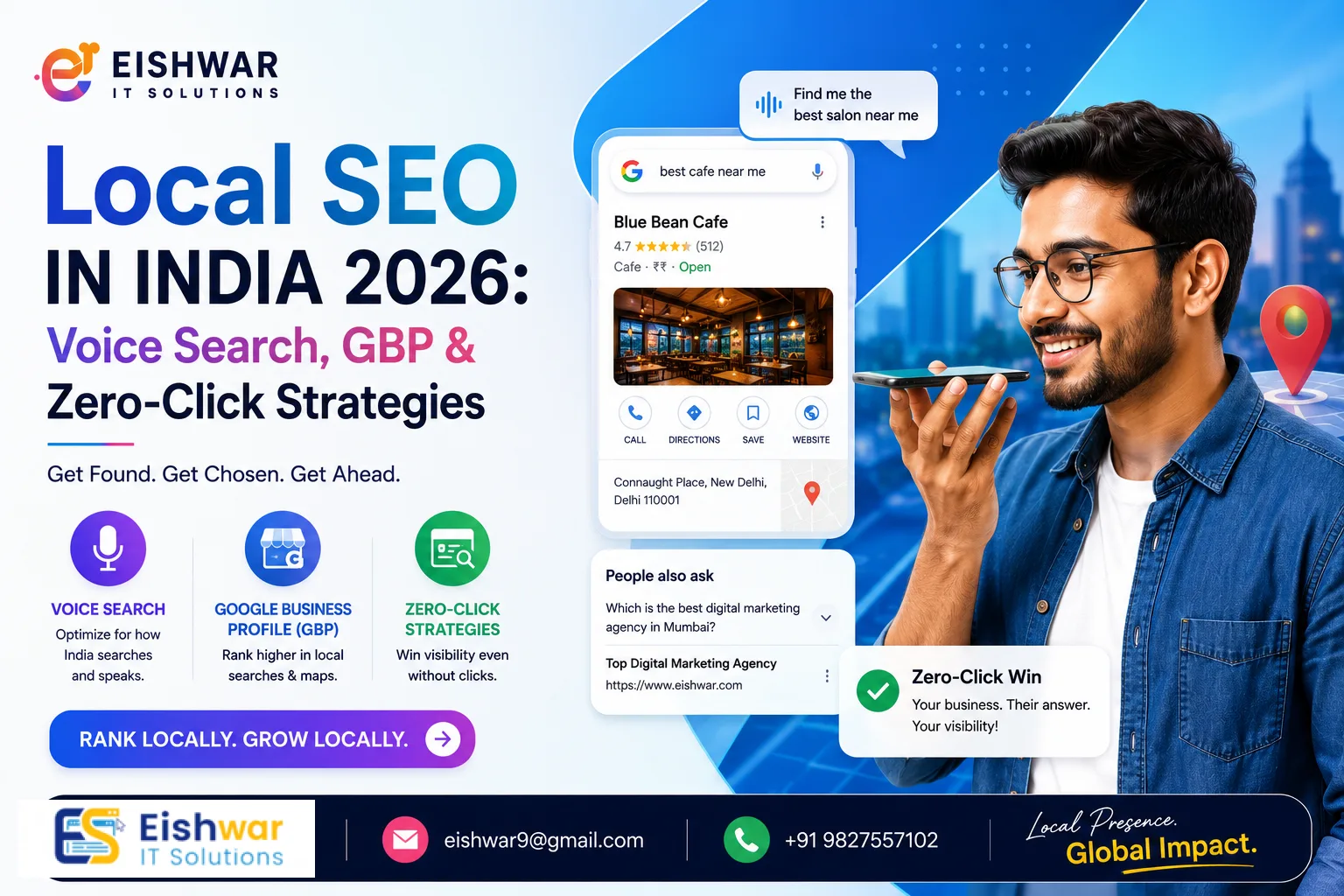
Local SEO in India 2026: Voice Search, GBP & Zero-Click Strategies
Published on: 10 Jun 2026
Local SEO in India 2026: Voice Search, GBP & Zero-Click Strategies
Introduction
Imagine a potential customer in Mumbai asking their phone, "Where's the best digital marketing agency near me?" and your business appearing as the top result—without them even clicking a link. That's the power of local SEO in 2026. As search evolves, local businesses in India must adapt to voice search, Google Business Profile (GBP) updates, and zero-click searches. This guide will walk you through actionable strategies to stay ahead. With over 70% of Indian consumers using voice assistants regularly and Google's increasing focus on hyperlocal results, the landscape is shifting rapidly. In this expanded guide, we'll dive deep into each strategy, providing practical examples, tips, and details to help you dominate local search in India.
Learn more about our Website services
Main Section 1: Voice Search Optimization for Local Businesses
Voice search is no longer a novelty—it's a daily habit. By 2026, over 50% of searches in India will be voice-based, driven by affordable smartphones and regional language support. To optimize:
- Use natural language keywords: Instead of "digital marketing agency Delhi," target "best digital marketing agency near me in Delhi for small businesses." Think about how your customers actually speak. For example, a customer might say, "Hey Google, find a good plumber in Pune who can fix a leaky tap today." Incorporate such phrases into your content.
- Focus on long-tail, conversational phrases: People ask full questions like "How can I improve my website SEO?" or "What's the best restaurant in Bangalore for biryani?" Create content that answers these questions directly. Use tools like AnswerThePublic to find common questions in your niche.
- Optimize for "near me" and local intent: Include city and neighborhood names in your content. For instance, a salon in Delhi should target "best hair salon in Hauz Khas" or "affordable haircut near Connaught Place." Also, use phrases like "nearby," "close to," and "within 5 km."
- Leverage Google's NLP: Structure your content to answer specific questions directly. Use clear headings (H2, H3) and short paragraphs. Google's Natural Language Processing (NLP) favors content that is well-organized and directly answers user queries. Include a FAQ section with schema markup to increase chances of being featured in voice search results.
- Optimize for regional languages: India's voice search is multilingual. If your business serves a region where Hindi, Tamil, Telugu, or other languages are common, create content in those languages. For example, a clinic in Chennai can target "சென்னையில் சிறந்த மருத்துவர்" (best doctor in Chennai). Use tools like Google Translate or hire a native speaker to ensure accuracy.
Example: A restaurant in Bangalore can target "best dosa near Indiranagar" and include a FAQ section answering "Where can I get authentic South Indian breakfast in Bangalore?" Additionally, they can create a blog post titled "Top 5 Breakfast Spots in Indiranagar for Dosa Lovers" and optimize it for voice search by including questions like "What's the best time to visit for fresh dosas?"
Practical Tip: Test your voice search optimization by using Google Assistant or Siri to search for your business. Note the results and adjust your content accordingly. Also, ensure your website loads in under 2 seconds on mobile, as voice search users expect instant answers.
👉 Don't wait for the perfect moment; turn your vision into reality today.
Free ConsultationMain Section 2: Google Business Profile Updates & Best Practices
Your GBP is the cornerstone of local SEO. In 2026, Google continues to add features that boost visibility:
- Enhanced posts and offers: Share weekly updates, discounts, and events directly in GBP. For example, a gym in Mumbai can post "Free trial week for new members!" with a link to book. Use high-quality images and videos in your posts to increase engagement. Google's algorithm favors profiles with regular activity.
- Q&A optimization: Actively monitor and answer questions with keywords. For instance, if someone asks "Do you offer home delivery?" respond with "Yes, we offer home delivery within 5 km of our location in Andheri West." This not only helps the user but also signals relevance to Google. Encourage customers to ask questions by adding a note in your profile description.
- Product and service menus: Add detailed lists with prices. A salon can list services like "Haircut - ₹500, Hair Color - ₹1500, Facial - ₹800." This helps users make quick decisions and improves your chances of appearing in local searches with price filters. Update prices regularly to avoid customer dissatisfaction.
- Review management: Respond to every review (positive or negative) within 24 hours. For negative reviews, apologize and offer a solution. For example, "Thank you for your feedback. We're sorry you had a bad experience. Please contact us at 9876543210 so we can make it right." This shows Google that you're engaged and care about customer satisfaction.
- Local guides and photos: Encourage customers to upload photos and tag your business. You can also add photos of your team, products, and behind-the-scenes activities. Google's algorithm prioritizes profiles with fresh, high-quality images. Use Google's photo guidelines: minimum 720px width, clear and well-lit, and relevant to your business.
- Attributes and categories: Use all relevant attributes like "Free Wi-Fi," "Outdoor seating," "Wheelchair accessible." Choose the most specific primary category (e.g., "Indian Restaurant" instead of just "Restaurant"). This helps Google match your business with user queries.
Actionable tip: Claim and verify your GBP, then complete every section—hours, attributes, services, and description. Use high-quality images and post at least once a week. Also, monitor your GBP insights to see how customers find you (e.g., search vs. maps) and adjust your strategy accordingly.
Example: A dental clinic in Delhi can use GBP posts to share "Free dental checkup camp on 15th March" and include a link to book an appointment. They can also add a Q&A like "Do you accept insurance?" with a detailed response. This not only drives appointments but also improves local rankings.
Main Section 3: Capturing Zero-Click Searches
Zero-click searches occur when users get answers directly on the search results page—featured snippets, knowledge panels, or local packs. To capture these:
- Target featured snippets: Structure content with clear headings and bullet points. Answer common questions concisely in 40-50 words. For example, a question like "What are the symptoms of a clogged drain?" can be answered in a bullet list. Use tools like Ahrefs or SEMrush to find snippet opportunities in your niche.
- Optimize for local packs: Ensure your GBP is fully optimized and your website includes local schema markup. The local pack shows three businesses near the user. To get in, you need high ratings (4.0+), consistent NAP (Name, Address, Phone) across the web, and positive reviews. Also, use local keywords in your website content.
- Use schema markup: Implement LocalBusiness, FAQ, and Review schema to increase chances of rich results. For example, a hotel in Goa can use schema to show star ratings, price range, and availability directly in search results. Use Google's Structured Data Testing Tool to validate your markup.
- Create location-specific landing pages: Each page should target a specific city or neighborhood with unique content. For example, a real estate agent in Mumbai can create pages like "Best 2BHK apartments in Bandra" and "Affordable flats in Andheri East." Avoid duplicate content; each page should have unique descriptions, testimonials, and local information.
- Optimize for "near me" and "open now": Use phrases like "open now" and "near me" in your content. For example, a coffee shop can target "coffee shop near me open now" and ensure their GBP hours are accurate. Google's algorithm prioritizes businesses that are open when the user searches.
Example: A plumber in Pune can create a page titled "Emergency Plumber in Kothrud, Pune" with a clear answer to "How fast can you fix a burst pipe?" to win the snippet. They can also use FAQ schema to answer related questions like "What is the cost of pipe repair in Pune?" This increases the chances of appearing in zero-click results.
👉 Free Website Audit
Get Free AuditPractical Tip: Use Google Search Console to identify queries that trigger impressions but not clicks. These are zero-click opportunities. Optimize those pages by adding more direct answers and schema markup.
Expert Tips
- Monitor local rankings weekly: Use tools like BrightLocal or Google Search Console to track your rankings for local keywords. Set up alerts for any significant drops. For example, if you notice a drop for "best cafe in Delhi," check your GBP for any issues like incorrect hours or negative reviews.
- Build local citations: Ensure NAP consistency across directories like Justdial, Sulekha, and IndiaMART. Use a tool like Moz Local to manage citations. Inconsistent NAP can confuse Google and hurt your rankings. For example, if your address is "123, MG Road" on one site and "123 MG Road" on another, it can cause issues.
- Leverage local influencers: Partner with local bloggers for backlinks and reviews. For example, a restaurant can invite a food blogger for a free meal in exchange for a review and backlink. This not only improves SEO but also drives local traffic. Ensure the influencer's audience aligns with your target market.
- Optimize for voice on mobile: Ensure your site loads fast (under 2 seconds) and is mobile-friendly. Use Google's PageSpeed Insights to check. Voice search users are often on mobile and expect instant answers. Compress images, use a CDN, and minimize JavaScript to improve speed.
- Use local keywords in meta tags: Include city and neighborhood names in your title tags, meta descriptions, and headers. For example, "Best Pizza in Koramangala, Bangalore | Delivery & Takeout." This helps Google understand your local relevance.
Common Mistakes
- Ignoring negative reviews: Not responding can hurt your reputation and rankings. Always respond professionally. For example, "Thank you for your feedback. We apologize for the inconvenience. Please contact us to resolve this." This shows you care and can turn a negative into a positive.
- Duplicate GBP listings: Merge or remove duplicates to avoid confusion. Use Google's support to merge listings. Duplicate listings can split reviews and confuse customers. For example, if you have two listings for the same business, customers might leave reviews on the wrong one.
- Keyword stuffing in GBP description: Keep it natural and informative. For example, instead of "best best best plumber in Pune," write "Reliable plumber in Pune with 10 years of experience." Google's algorithm can detect keyword stuffing and may penalize you.
- Neglecting local link building: Focus on quality over quantity—links from local newspapers or business associations. For example, a link from a local news article about your business is more valuable than a low-quality directory link. Reach out to local media for coverage of events or achievements.
- Not updating GBP hours: If your hours change, update your GBP immediately. Customers who arrive to find you closed may leave negative reviews. For example, during holidays, update your hours in advance.
Future Trends
- AI-driven personalization: Search results will become hyper-personalized based on user behavior. For example, a user who frequently searches for vegan food might see vegan restaurants first. To prepare, create content that caters to different user segments (e.g., "Best vegan restaurants in Delhi").
- Augmented reality (AR) in local search: Google Lens integration for visual searches. Users can point their camera at a storefront to see reviews, hours, and offers. Ensure your business has high-quality images and is easily identifiable. For example, a clothing store can use AR to show how clothes look on a model.
- Voice commerce: Users will order products or book services via voice assistants. For example, "Alexa, order pizza from Domino's near me." To prepare, ensure your business is listed on voice commerce platforms like Amazon Alexa or Google Assistant. Also, optimize your GBP for booking and ordering features.
- Hyperlocal targeting: Micro-moments will dominate—think "coffee shop near me open now." Use real-time data to target users in specific locations. For example, a food truck can use geofencing to send offers to users within 1 km. Google's local inventory ads will also become more prevalent.
- Video content in local search: Google is increasingly showing video results in local searches. Create short videos showcasing your products, services, or customer testimonials. For example, a gym can post a 30-second video of a workout session. Upload these videos to your GBP and YouTube channel.
FAQs
What is local SEO and why is it important for Indian businesses?
How does voice search affect local SEO?
What are the key elements of a Google Business Profile in 2026?
How can I capture zero-click searches for my business?
What tools can help me track local SEO performance?
How often should I post on Google Business Profile?
What is the role of schema markup in local SEO?
Conclusion
Local SEO in 2026 is about being everywhere your customers search—voice, visual, and zero-click. By optimizing for voice search, mastering your Google Business Profile, and capturing zero-click opportunities, you can dominate local search in India. Start implementing these strategies today to future-proof your business. Remember, the key is to stay updated with the latest trends and continuously refine your approach. With the right strategies, you can ensure your business is the top choice for local customers in India.
👉 Free Homepage Demo
Book DemoCTA
Ready to boost your local presence? Contact EishwarITSolution today for a free local SEO audit. Let's make your business the top choice in your area. Get Started Now