Headless CMS vs Traditional CMS: Why Indian Businesses Are Switching i
Published on: 11 Jun 2026
Headless CMS vs Traditional CMS: Why Indian Businesses Are Switching in 2026
Introduction
Imagine your website loads in under two seconds, your content updates instantly across your website, mobile app, and even a smart kiosk—all from a single dashboard. That's the promise of a headless CMS. In 2026, Indian businesses are rapidly moving away from clunky traditional CMS platforms like WordPress (when used as a monolith) toward headless and decoupled architectures. Why? Because customers expect seamless experiences everywhere, and traditional systems struggle to deliver. In this guide, we'll break down what headless CMS is, how it compares to traditional CMS, and why it might be the smartest investment for your business this year. We'll also explore practical examples from Indian startups and enterprises that have already made the switch, and provide actionable advice to help you decide.
Learn more about our Website services
What Is a Headless CMS? (And Why It's Not Just Tech Jargon)
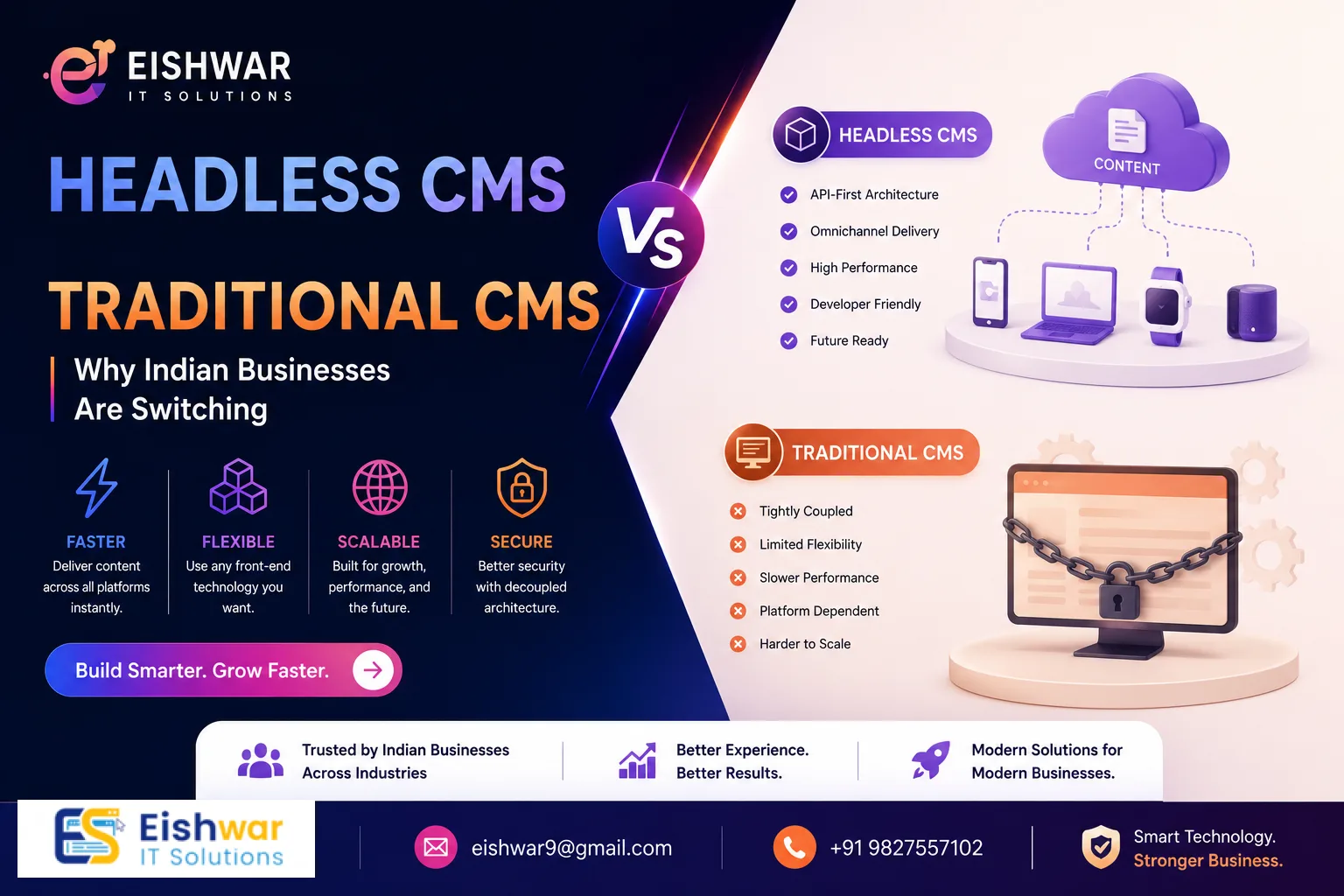
A headless CMS separates the backend (where you manage content) from the frontend (where users see it). Unlike traditional CMS platforms that tightly couple content and presentation, a headless CMS stores content as structured data and delivers it via APIs to any device or channel—website, mobile app, smartwatch, or even a digital billboard. Think of it as a content hub that speaks every language: REST, GraphQL, or webhooks. For Indian businesses, this means you can build a lightning-fast website with React, Next.js, or Nuxt.js while still using a familiar editor interface for your team. For example, a popular Indian e-commerce brand, 'ShopIndia,' uses Strapi as a headless CMS to manage product descriptions, images, and pricing, which are then pushed to their React-based website, Android app, and even WhatsApp Business API. This decoupling allows their marketing team to update content in real-time without waiting for developers, reducing time-to-market by 40%.
Traditional CMS: The Old Guard
Traditional CMS platforms like WordPress, Joomla, and Drupal have powered millions of websites. They offer an all-in-one solution: database, admin panel, themes, and plugins. For small blogs or simple brochure sites, they still work. But as your business grows, limitations appear—slow page loads due to monolithic code, security vulnerabilities from plugins, and difficulty delivering content to mobile apps or IoT devices. In India, where mobile-first users dominate, these bottlenecks can cost you customers. A traditional CMS might feel like a jack of all trades, but it's master of none in 2026. For instance, a typical WordPress site with heavy plugins can take 5-7 seconds to load on a 4G network, leading to a 50% bounce rate. In contrast, a headless setup can achieve sub-second loads, directly impacting revenue. Many Indian businesses are also finding that traditional CMS platforms require frequent updates and security patches, which can be a drain on limited IT resources.
Main Section 1: Performance and Speed—The Indian Mobile Advantage
India has over 800 million internet users, most accessing the web via smartphones on 4G/5G networks. Speed isn't a luxury; it's a necessity. Headless CMS, combined with a static site generator (SSG) or server-side rendering (SSR), can deliver sub-second load times. For example, an e-commerce store using Strapi (headless) and Next.js can achieve a Lighthouse score of 95+ on mobile. Traditional CMS often requires heavy caching plugins and still struggles with dynamic content. In a headless setup, the frontend is pure HTML, CSS, and JavaScript—no database queries per request. This dramatically improves Time to Interactive (TTI), directly boosting conversions. According to Google, a one-second delay reduces mobile conversions by up to 20%. For Indian businesses, that's real revenue lost. Consider a case study: 'FreshMart,' a grocery delivery startup in Bangalore, switched from a WordPress site to a headless CMS with Gatsby. Their page load time dropped from 4.2 seconds to 1.1 seconds, resulting in a 25% increase in order completions. They also saw a 15% improvement in SEO rankings due to faster Core Web Vitals scores.
👉 Don't wait for the perfect moment; turn your vision into reality today.
Free ConsultationMain Section 2: Omnichannel Content Delivery—Reach Customers Everywhere
Your customers interact with your brand on websites, WhatsApp, Instagram, email, and even voice assistants. A headless CMS lets you publish content once and distribute it everywhere via APIs. Imagine updating a product description in your CMS and seeing it change on your website, mobile app, and Google Shopping feed simultaneously. Traditional CMS can't do that without custom hacks. For Indian businesses with limited tech teams, headless platforms like Contentful, Strapi, or Sanity offer intuitive dashboards and pre-built integrations. Your marketing team can manage content without developer handholding, while developers build custom frontends as needed. This decoupling also means you can redesign your website without touching the backend—a huge time and cost saver. For example, 'TravelEase,' a travel booking platform, uses Contentful to manage travel guides, which are then served via API to their website, a React Native app, and even a chatbot on WhatsApp. This unified content strategy reduced content duplication by 60% and improved customer engagement across channels.
Main Section 3: Security and Scalability—Grow Without Growing Pains
Security is a major concern for Indian businesses, especially with rising cyber threats. Traditional CMS platforms are frequent targets because of plugin vulnerabilities and outdated core files. A headless CMS reduces attack surface: the backend is isolated, and the frontend is static or server-rendered with minimal server-side logic. Plus, you can host the backend on a secure cloud service (AWS, Vercel, Netlify) and the frontend on a CDN. Scaling is easier too—traffic spikes don't crash your admin panel. For example, a news website using a headless CMS can handle Diwali traffic surges without slowdowns. Many Indian startups have adopted this architecture for its cost-effectiveness: you only pay for what you use, and auto-scaling is built-in. A practical tip: use a headless CMS like Strapi with a cloud provider that offers auto-scaling, such as AWS Lambda or Google Cloud Run. This ensures your site remains responsive even during peak hours, like flash sales or festival seasons.
Expert Tips
- Start small, think big: Migrate one section of your website (like a blog) to a headless CMS first. Learn the workflow before moving core pages. For instance, 'TechBlog India' started by migrating their blog to Strapi and Next.js, and within three months, they saw a 30% increase in organic traffic due to faster load times.
- Choose an API-first CMS: Look for platforms with robust REST and GraphQL APIs. Strapi (open-source) is great for Indian businesses on a budget; Contentful offers enterprise features. Sanity is excellent for real-time collaboration, especially if you have a distributed content team.
- Use a modern frontend framework: Next.js or Nuxt.js are ideal for SEO and performance. They pre-render pages and hydrate only when needed. For example, 'EduLearn,' an edtech platform, uses Next.js with a headless CMS to serve personalized learning paths, achieving a 98% Lighthouse score.
- Invest in a good CDN: Cloudflare or Akamai can cache your static pages globally, reducing latency for users in tier-2 and tier-3 cities. This is crucial for Indian audiences, where network conditions vary widely.
- Train your content team: Headless CMS editors look different. Provide clear guidelines on structured content and reusable components. Create a style guide and conduct workshops to ensure your team is comfortable with the new system.
- Monitor API usage: Headless CMS can generate many API calls. Implement caching at the frontend level to reduce costs. Use tools like Redis or Vercel's Edge Cache to minimize server load.
Common Mistakes
- Over-engineering: Don't go headless for a simple 5-page site. Traditional CMS is faster and cheaper for basic needs. Assess your requirements first—if you only need a blog, WordPress might still be the best choice.
- Ignoring preview functionality: Content editors need to see changes before publishing. Choose a headless CMS with a live preview feature or build one. For example, Sanity offers built-in previews, while Strapi can be integrated with a custom preview server.
- Neglecting SEO: Some headless setups can harm SEO if not configured properly. Use SSR or SSG, and ensure meta tags are dynamically generated. Test your site with tools like Google Search Console to verify that search engines can crawl your content.
- Underestimating learning curve: Your team may need training on new tools. Plan for a phased rollout and provide documentation. Consider hiring a consultant or using a platform with strong community support, like Strapi's active forum.
- Forgetting about media management: Headless CMS often handles images differently. Use an image CDN like Cloudinary or Imgix to optimize delivery. For instance, 'FashionHub' uses Cloudinary to automatically resize and compress images, reducing page weight by 40%.
Future Trends
By 2026, headless CMS will become the default for new web projects. Expect deeper integration with AI—automated content tagging, personalized content blocks, and predictive analytics. Edge computing will further reduce latency, with content served from CDN nodes near users. Voice and conversational interfaces will rely on headless CMS for structured data. In India, the rise of regional language content will drive adoption of headless systems that support Unicode and multilingual workflows seamlessly. We also foresee more open-source headless solutions tailored for Indian businesses, with built-in support for UPI payments, GST invoices, and local e-commerce platforms. For example, 'BharatCMS,' an upcoming open-source headless CMS, is designed specifically for Indian businesses, offering pre-built integrations with Paytm, Razorpay, and Zoho. Additionally, the use of JAMstack (JavaScript, APIs, and Markup) will become mainstream, enabling faster development cycles and better performance.
👉 Free Website Audit
Get Free Audit👉 Free Homepage Demo
Book DemoFAQs
What is the main difference between headless CMS and traditional CMS?
Traditional CMS couples content management and presentation in one system. Headless CMS separates them, delivering content via APIs to any frontend. This gives more flexibility, better performance, and omnichannel reach. For example, with a headless CMS, you can update a product description once and have it appear on your website, mobile app, and a digital kiosk simultaneously.
Is headless CMS suitable for small Indian businesses?
Yes, but only if you plan to scale or need omnichannel presence. For a simple brochure site, traditional CMS is faster and cheaper. For an e-commerce store or content-heavy site with mobile apps, headless is worth the investment. Many small businesses start with a free tier of Strapi and Vercel, which costs nothing for low traffic.
Which headless CMS is best for Indian businesses?
Strapi (open-source, self-hosted) is cost-effective and customizable. Contentful offers a generous free tier and user-friendly interface. Sanity provides real-time collaboration. Choose based on your team's technical expertise and budget. For example, a startup with a small dev team might prefer Strapi for its flexibility, while a larger enterprise might opt for Contentful's managed services.
Will headless CMS affect my SEO?
Not if implemented correctly. Use server-side rendering (SSR) or static site generation (SSG) to ensure search engines see fully rendered HTML. Headless CMS can actually improve SEO through faster load times and structured data. For instance, a Next.js site with a headless CMS can achieve perfect Core Web Vitals scores, boosting rankings.
How much does it cost to migrate to a headless CMS?
Costs vary widely. For a small site, you can use free tiers of Strapi and Vercel. Larger projects may require developer time (₹50,000-₹2,00,000) and monthly SaaS fees (₹5,000-₹50,000). The long-term savings in performance and maintenance often offset the initial investment. For example, a mid-sized e-commerce site might spend ₹1,00,000 on migration but save ₹20,000 per month on hosting and plugin costs.
Can I use a headless CMS with my existing website?
Yes, you can adopt a hybrid approach. Keep your existing site and add a headless CMS for new sections like a blog or product catalog. Over time, you can migrate more content. This minimizes risk. For instance, many businesses start by using a headless CMS for their blog while keeping their main site on WordPress, then gradually migrate other sections.
What are the hosting requirements for a headless CMS?
Headless CMS can be hosted on any cloud provider. For the backend, you can use AWS, Google Cloud, or a managed service like Strapi Cloud. The frontend is often hosted on a CDN like Vercel or Netlify. This setup is highly scalable and cost-effective, as you only pay for the resources you use.
Conclusion
Headless CMS is not just a trend—it's a strategic move for Indian businesses that want to stay competitive in 2026. By decoupling content from presentation, you gain speed, flexibility, and the ability to reach customers on any device. While the initial learning curve and cost may seem daunting, the long-term benefits in performance, security, and omnichannel delivery are undeniable. Start small, choose the right platform, and watch your digital presence transform. Remember, the key is to align your technology choice with your business goals—whether that's improving mobile performance, expanding to new channels, or future-proofing your content strategy.
Ready to Future-Proof Your Website?
At EishwarITSolution, we specialize in building high-performance, headless websites tailored for Indian businesses. Whether you're starting fresh or migrating from a traditional CMS, our team can guide you every step of the way. Contact us today for a free consultation and discover how headless architecture can supercharge your online presence. We'll help you assess your needs, choose the right tools, and implement a solution that drives real results.
CTA
At EishwarITSolution, we specialize in building high-performance, headless websites tailored for Indian businesses. Whether you're starting fresh or migrating from a traditional CMS, our team can guide you every step of the way. <a href="/contact">Contact us today</a> for a free consultation and discover how headless architecture can supercharge your online presence. We'll help you assess your needs, choose the right tools, and implement a solution that drives real results.