AI-Powered Personalization for Business Websites: Boost Engagement in
Published on: 16 Jun 2026
AI-Powered Personalization for Business Websites: Boost Engagement in 2026
Introduction
In 2026, a generic website is like a handshake that never adapts—it feels cold, impersonal, and forgettable. Today's customers, especially in India's hyper-competitive digital landscape, expect tailored experiences that speak directly to their needs, preferences, and even their mood. AI-powered personalization delivers exactly that: a dynamic, intelligent interface that evolves with each visitor. For Indian businesses, leveraging AI on your website is no longer a luxury reserved for tech giants—it's a necessity for survival and growth. This comprehensive guide walks you through how to use AI to create a unique, engaging experience for every visitor, boosting conversions, customer loyalty, and long-term revenue. We'll cover practical implementation steps, real-world examples from Indian businesses, expert tips, and common pitfalls to avoid, all while keeping a human, ethical approach.
Learn more about our Website services
Main Section 1: What is AI-Powered Personalization?
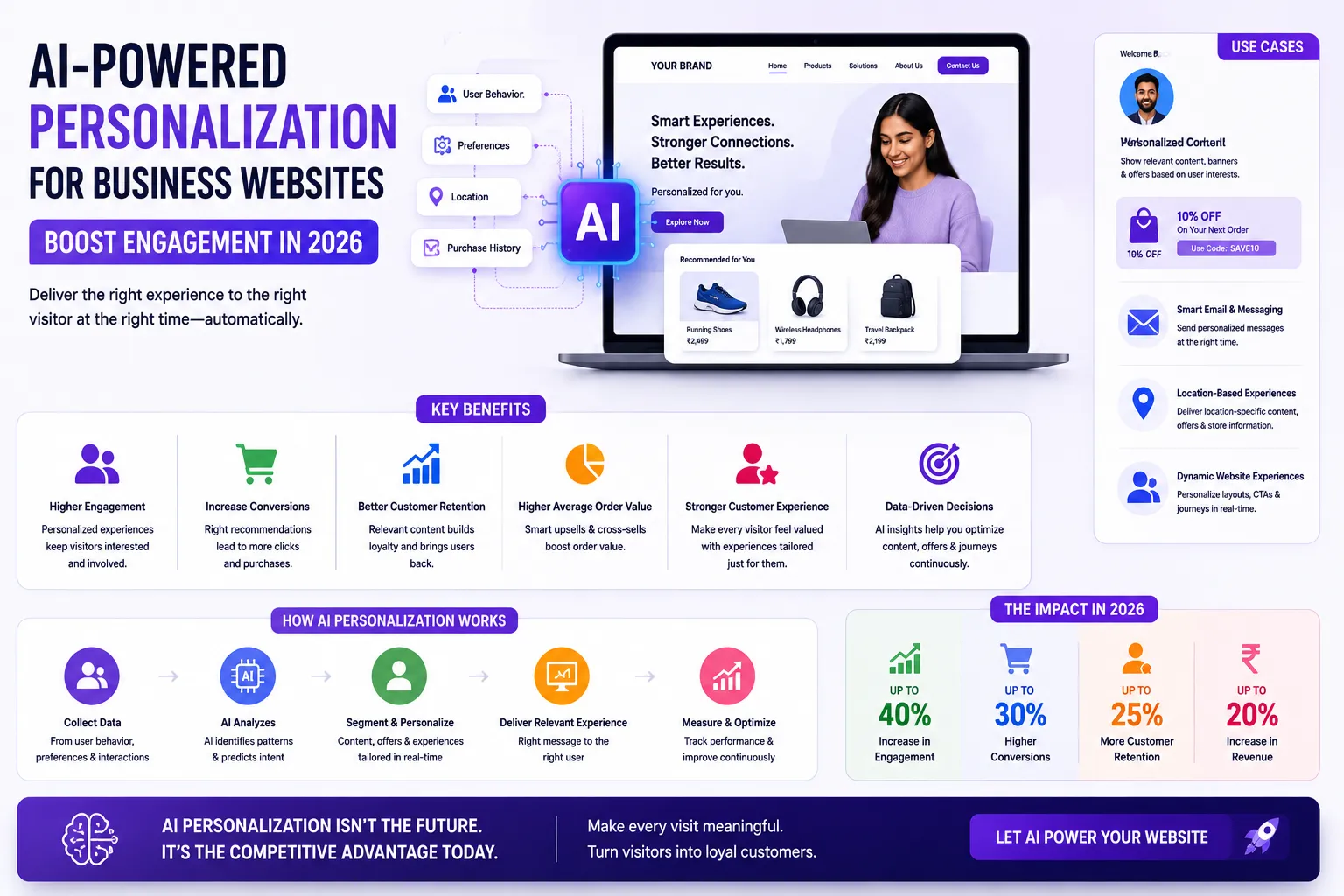
AI-powered personalization uses machine learning algorithms to analyze vast amounts of user data—including behavior, preferences, demographics, browsing history, and even real-time context like location or time of day—to deliver customized content, product recommendations, offers, and experiences in real time. Imagine a visitor from Mumbai landing on your e-commerce site and seeing products relevant to local trends (like monsoon-friendly apparel or festive deals for Ganesh Chaturthi), while a visitor from Delhi sees a different set based on their past purchases or search history. That's AI at work, silently orchestrating a bespoke journey for each user.
Key technologies powering this include natural language processing (NLP) for intelligent chatbots that understand regional languages like Hindi or Tamil, predictive analytics for forecasting what a user might want next, and dynamic content delivery systems that swap out banners, headlines, and CTAs in milliseconds. For example, an Indian e-commerce store selling electronics can use AI to show "You might also like" items based on past purchases and browsing patterns—such as recommending a compatible phone case after someone buys a smartphone. According to industry studies, this approach can increase average order value by up to 30%. Another example: a travel booking site can personalize hotel and flight suggestions based on a user's previous trips, budget, and even the device they're using (mobile vs. desktop).
Practical tip: Start by identifying the most impactful personalization use case for your business. For a local grocery delivery service in Chennai, this could be suggesting weekly staples based on past orders. For a SaaS company in Hyderabad, it might be showing case studies relevant to the visitor's industry. The key is to begin with a focused, measurable goal.
Main Section 2: Why Indian Businesses Need AI Personalization in 2026
The Indian digital market is booming, with over 900 million internet users by 2026, according to recent projections. This massive audience is diverse, multilingual, and increasingly discerning. Competition is fierce across every sector—from e-commerce and fintech to education and healthcare. AI personalization helps you stand out by delivering experiences that feel one-on-one, even at scale. Here's why it's critical:
- Improving customer experience: Studies show that 80% of users are more likely to buy from a brand that offers personalized experiences. In a market where attention spans are shrinking, a tailored interface can be the difference between a bounce and a conversion.
- Increasing conversion rates: Personalized calls-to-action (CTAs) convert 42% more often than generic ones. For example, a user who has browsed fitness equipment multiple times might see a CTA like "Get 20% off on Treadmills Today" instead of a generic "Shop Now."
- Building loyalty: Repeat customers spend 67% more than new ones, and personalization fosters that loyalty by making users feel understood and valued.
- Optimizing ad spend: By targeting high-intent users with tailored messages across channels, you reduce wasted ad spend and improve ROI. AI can also predict which users are likely to churn and trigger retention offers.
For example, a local restaurant chain in Pune used AI to analyze order history and suggest dishes based on weather (e.g., hot soups on rainy days) and time of day (lunch combos vs. dinner specials). This resulted in a 25% increase in online orders within two months. Similarly, a fintech startup in Mumbai personalized loan offers based on users' transaction history, leading to a 35% higher approval rate and reduced default risk.
👉 Don't wait for the perfect moment; turn your vision into reality today.
Free ConsultationPractical tip: Use AI to segment your audience not just by demographics but by behavioral patterns. For instance, group users who abandon carts frequently and send them personalized reminders with discounts on the items they left behind.
Main Section 3: How to Implement AI Personalization on Your Website
Implementing AI personalization doesn't require a massive budget or a team of data scientists. Start small and scale as you learn. Here's a step-by-step approach tailored for Indian businesses:
- Collect data ethically: Use cookies, login data, browsing behavior, and purchase history. Ensure compliance with India's IT Act and the upcoming Digital Personal Data Protection Act (DPDPA). Be transparent about data collection and obtain explicit consent. For example, display a clear cookie consent banner that explains how data will be used.
- Choose the right tools: Platforms like Google Analytics 4 (with its AI-driven insights), Adobe Target, or open-source solutions like Apache Mahout or TensorFlow can help. For small businesses, affordable options include AI-powered email marketing tools like Mailchimp or chatbots like Tidio. For larger enterprises, consider enterprise-grade solutions like Salesforce Einstein or Dynamic Yield.
- Segment your audience: Group users by location (city, state), device (mobile vs. desktop), past behavior (frequent buyer vs. first-time visitor), or purchase history. For example, a user from Kolkata might see content in Bengali, while a user from Bangalore sees it in Kannada or English.
- Personalize key elements: Start with high-impact areas like homepage banners (e.g., show festive offers for Diwali to users who have previously shopped during festivals), product recommendations (use collaborative filtering to suggest items similar to what others bought), email content (personalize subject lines and product suggestions based on past opens), and chatbot responses (train your NLP model to handle common queries in regional languages).
- Test and optimize: A/B test different personalization strategies to see what resonates. For instance, test whether showing personalized product recommendations on the homepage vs. on the cart page leads to higher conversions. Use analytics to track metrics like click-through rate, time on page, and conversion rate.
For instance, a B2B software company in Bangalore personalized its landing page for different visitor personas: IT managers saw technical specs and integration details, while CEOs saw ROI metrics and case studies. This led to a 40% increase in demo requests. Another example: a health food brand in Delhi used AI to recommend recipes based on users' dietary preferences (vegan, gluten-free, etc.), resulting in a 20% increase in average session duration.
👉 Free Website Audit
Get Free AuditPractical tip: Don't try to personalize everything at once. Pick one or two elements (e.g., product recommendations and email subject lines) and iterate. Use tools like Google Optimize for easy A/B testing without coding.
Expert Tips
- Focus on privacy: Be transparent about data usage and offer easy opt-out options. In India, where trust is a key factor in online transactions, respecting privacy builds long-term loyalty. Avoid collecting sensitive data like Aadhaar numbers unless absolutely necessary.
- Start with one channel: Begin with email personalization before expanding to full-site personalization. Email is easier to implement and measure, and it provides a controlled environment to test AI models.
- Use AI to predict churn: Identify users who are about to leave (e.g., those who haven't visited in 30 days or have reduced engagement) and offer them a discount, helpful content, or a personalized re-engagement email.
- Combine AI with human touch: Personalization should feel helpful, not creepy. For example, if a user has browsed baby products, don't immediately show ads for diapers—instead, offer a guide on baby care or a loyalty program for new parents.
- Monitor performance metrics: Track key indicators like time on page, bounce rate, conversion rate, and customer lifetime value (CLV). Use dashboards to visualize trends and adjust strategies accordingly.
- Leverage local context: Indian users respond well to regional festivals, local languages, and culturally relevant content. Use AI to detect and adapt to these nuances. For example, a travel site could promote domestic destinations during holiday seasons like Dussehra or Pongal.
Common Mistakes
- Over-personalization: Bombarding users with too many recommendations or overly specific content can overwhelm them and feel intrusive. For example, showing 20 product suggestions on a single page can lead to decision paralysis. Stick to 3-5 relevant recommendations.
- Ignoring mobile: Over 70% of Indian users browse on mobile devices, and many have limited data plans. Ensure personalization works seamlessly on mobile—optimize images, reduce load times, and use responsive design. A slow, cluttered mobile experience can undo all personalization efforts.
- Using outdated data: AI models need fresh data to stay relevant. If you're using purchase data from six months ago, your recommendations may be irrelevant. Set up automated data refreshes and retrain models quarterly.
- Not testing: Personalization without A/B testing can lead to poor results or even negative user experiences. Always test variations to confirm that your personalization is actually improving metrics.
- Neglecting user control: Always allow users to adjust their preferences or opt out of personalization. For example, include a "Manage Preferences" link in emails or a settings page on your website. This builds trust and reduces complaints.
- Assuming one-size-fits-all: Personalization strategies that work for a global audience may not work in India due to cultural, linguistic, and economic diversity. Tailor your approach to local nuances.
Future Trends
By 2027, AI personalization will become even more predictive and proactive, moving beyond reactive recommendations to anticipating user needs before they even express them. Expect hyper-personalization using real-time location data (e.g., offering discounts at nearby stores), voice search integration (with AI understanding regional accents and languages), and even emotional AI that detects user sentiment through tone of voice or facial expressions (for video interactions). Indian businesses that adopt these trends early—such as using AI to personalize for voice-first users or integrating with popular platforms like WhatsApp for conversational commerce—will gain a significant competitive edge. Additionally, the rise of edge AI will enable personalization to happen directly on user devices, reducing latency and enhancing privacy. For example, a user's smartphone could locally process browsing data to recommend products without sending sensitive data to the cloud.
👉 Free Homepage Demo
Book DemoPractical tip: Start experimenting with voice and chat-based personalization now. Train your AI models on regional language data to prepare for the voice-first future. Also, invest in privacy-preserving technologies like federated learning to stay ahead of regulations.
FAQs
What is AI-powered website personalization?
It's the use of artificial intelligence to tailor website content, offers, and experiences to individual users based on their behavior, preferences, and demographics, enhancing engagement and conversions. For example, an AI system might show different homepage banners to a first-time visitor vs. a returning customer, or recommend products based on past purchases.
How much does AI personalization cost for a small business in India?
Costs vary widely. Free tools like Google Analytics 4 offer basic personalization features, while enterprise solutions like Adobe Target can cost upwards of ₹50,000 per month. For small businesses, starting with AI-powered email marketing (e.g., Mailchimp at ₹5,000-₹15,000/month) or chatbots (e.g., Tidio at ₹2,000-₹10,000/month) is affordable. Open-source options like Apache Mahout are free but require technical expertise.
Is AI personalization safe for user privacy under Indian laws?
Yes, if you follow the Digital Personal Data Protection Act (DPDPA) and other relevant laws. Key practices include obtaining explicit user consent, anonymizing personal data, providing clear opt-out options, and storing data securely. Transparency about how data is used builds trust and reduces legal risks.
Can AI personalization work for non-ecommerce websites like blogs or service portals?
Absolutely. Service providers, blogs, educational sites, and even government portals can benefit. For example, a blog can personalize article recommendations based on a user's reading history, a service portal can show relevant FAQs or case studies, and an educational site can suggest courses based on a learner's progress and interests.
How long does it take to see results from AI personalization?
Initial improvements in engagement (e.g., higher click-through rates or longer session durations) can be seen within weeks, especially if you start with simple personalization like email subject lines. However, significant ROI—such as a 20-30% increase in conversions—typically takes 3-6 months as the AI model collects enough data to learn patterns and refine recommendations.
What are the best AI personalization tools for Indian businesses?
Top tools include Google Analytics 4 (free, with AI insights), Adobe Target (enterprise, robust), Dynamic Yield (omnichannel), and Salesforce Einstein (CRM-integrated). For small businesses, consider HubSpot (marketing automation), Mailchimp (email), or Tidio (chatbots). Open-source options like TensorFlow or scikit-learn are great for custom solutions but require technical skills.
How do I ensure AI personalization doesn't feel creepy to users?
Strike a balance by being transparent about data use, offering control (e.g., preference centers), and avoiding overly intrusive recommendations. For example, instead of showing "We know you were looking at X," frame it as "Based on your interests, you might like Y." Use contextual cues like time of day or location to make recommendations feel natural.
Conclusion
AI-powered personalization is transforming how Indian businesses connect with their audiences in 2026 and beyond. By delivering tailored experiences that respect user privacy and leverage local context, you can boost engagement, increase conversions, and build lasting customer relationships. The key is to start small—perhaps with personalized email campaigns or a chatbot—and scale as you learn. Stay ethical, transparent, and focused on adding genuine value to your users. With the right tools and a human-centered approach, your website can become a powerful engine for growth in India's dynamic digital economy.
CTA
Ready to personalize your website with AI and stay ahead of the competition? Contact EishwarITSolution today for a free consultation. Our experts will help you implement AI personalization that drives real results for your business—from boosting conversions to building customer loyalty. Let's create a website that truly understands your audience.