Edge Computing in Cross-Platform Apps: 2026 Performance Revolution for
Published on: 16 Jun 2026
Edge Computing in Cross-Platform Apps: 2026 Performance Revolution for Indian Businesses
Introduction
Imagine your mobile app responding instantly, even in a crowded metro station in Mumbai or a remote village in Bihar. No buffering, no lag, no dependency on shaky internet. That's the promise of edge computing—a technology that's no longer futuristic but a practical necessity for Indian businesses in 2026.
Learn more about our Website services
Cross-platform mobile apps, built with frameworks like Flutter or React Native, already help you save time and money. But when you combine them with edge computing, you unlock a new level of performance. Data is processed closer to the user—on a local server, a nearby data center, or even the user's device—instead of traveling all the way to a central cloud server. This reduces latency, improves speed, and enhances user experience.
For Indian businesses, where internet connectivity can be inconsistent and data costs matter, edge computing is a game-changer. Whether you're running a food delivery app, a fintech platform, or a healthcare service, your app needs to be fast, reliable, and secure. This guide will show you how edge computing in cross-platform apps can give you that edge.
Main Section 1: What is Edge Computing and Why It Matters for Cross-Platform Apps
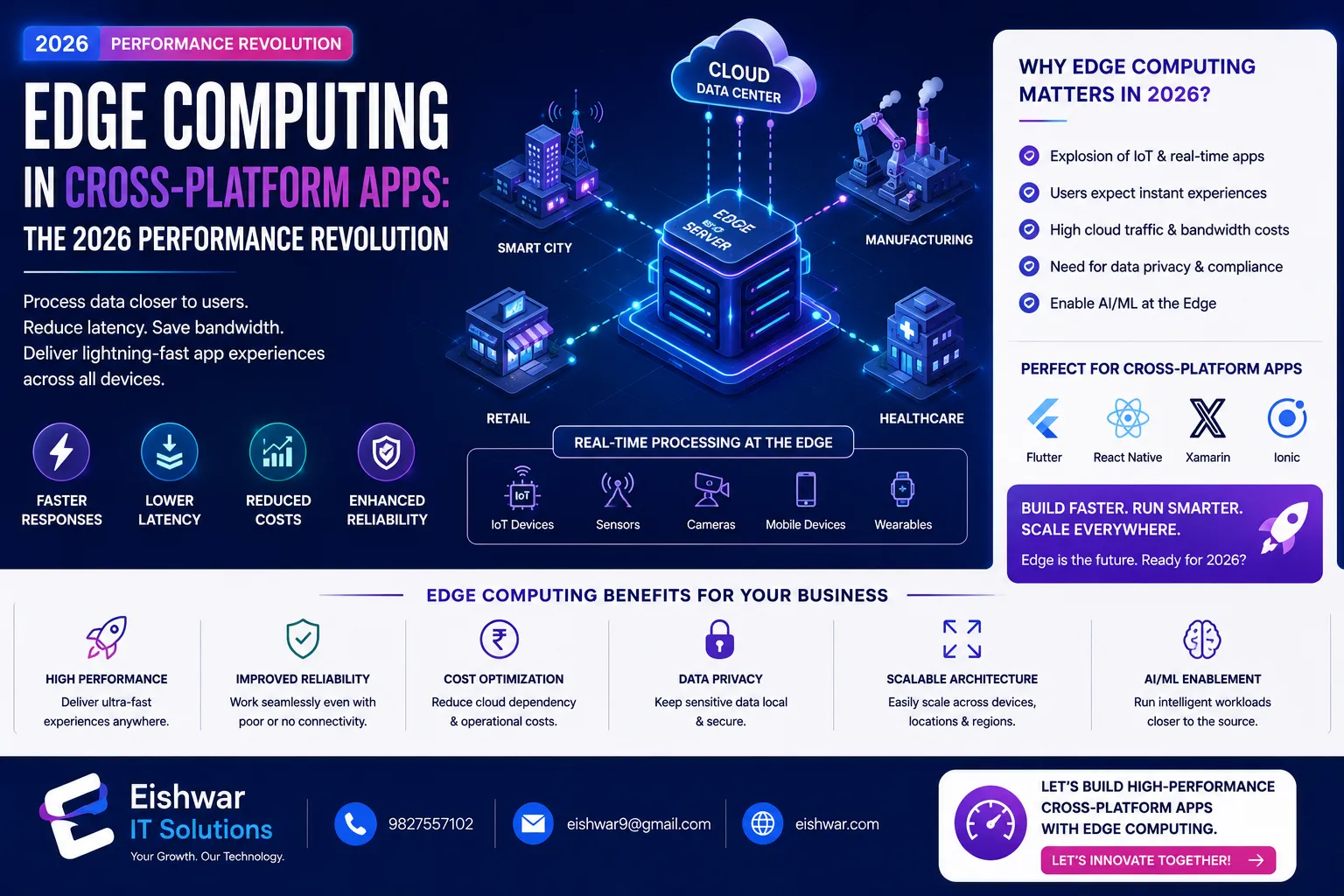
Edge computing refers to the practice of processing data near the source of data generation rather than relying solely on a centralized cloud. Think of it as bringing computation and storage closer to the user—at the “edge” of the network. For mobile apps, this means faster response times, reduced bandwidth usage, and improved privacy.
In a cross-platform context, edge computing works seamlessly with frameworks like Flutter, React Native, or Kotlin Multiplatform. You can deploy edge functions using services like AWS Wavelength, Cloudflare Workers, or Azure Edge Zones. These edge nodes handle tasks like image processing, real-time analytics, or AI inference, reducing the load on the user's device and the central server.
For example, a retail app using Flutter can process a customer's image search for products on an edge server in Delhi instead of sending the request to a server in the US. The result is near-instant feedback, even on a 4G connection. This is critical for Indian users who expect speed and reliability.
Why does this matter for your business? Lower latency leads to higher user retention. A 100-millisecond delay can cost you 7% in conversions. Edge computing slashes that delay dramatically. Also, by processing sensitive data locally, you comply with India's Data Protection Act more easily. And with 5G expanding across Indian cities, edge computing becomes even more powerful, enabling real-time applications like AR/VR, live streaming, and IoT.
Main Section 2: How to Implement Edge Computing in Your Cross-Platform App (2026 Guide)
Implementing edge computing doesn't require a complete rewrite. Start by identifying the parts of your app that need ultra-low latency. Examples: real-time chat, live video, location-based services, or AI-driven recommendations. Then, choose an edge platform that integrates with your cross-platform framework.
Step 1: Choose an edge computing provider. For Indian businesses, consider AWS Wavelength (available in Mumbai), Azure Edge Zones (coming to Indian cities), or Cloudflare Workers (global edge with good India coverage). These services let you run serverless functions at the edge without managing infrastructure.
👉 Don't wait for the perfect moment; turn your vision into reality today.
Free ConsultationStep 2: Modify your app architecture. Use a pattern like “offline-first” or “local-first.” For instance, in a React Native app, use Redux Offline or WatermelonDB to cache data locally and sync with edge nodes when connectivity is available. For Flutter apps, use Hive or Isar for local storage and Riverpod for state management with edge sync.
Step 3: Deploy edge functions for specific tasks. Example: a food delivery app can run its recommendation engine on an edge node near the user, so suggestions update instantly as the user scrolls. Use AWS Lambda@Edge or Cloudflare Workers to write these functions in JavaScript, Python, or Rust.
Step 4: Optimize data transfer. Use GraphQL or REST APIs with efficient payloads. Compress images and use WebP format. Leverage CDN caching for static assets. Edge computing works best when you minimize data movement.
Step 5: Test rigorously. Use tools like Lighthouse and WebPageTest to measure latency improvements. Simulate poor network conditions using Network Link Conditioner. Test in different Indian cities—Mumbai, Delhi, Bangalore, and rural areas—to ensure consistency.
Here's an actionable tip: Start small. Pick one feature (like user authentication or push notifications) and move its processing to the edge. Measure the performance gain. Then scale. This incremental approach reduces risk and proves ROI quickly.
Main Section 3: Real-World Use Cases for Indian Businesses
Edge computing in cross-platform apps is not just theory. Indian startups and enterprises are already using it to gain a competitive edge. Let's look at three scenarios:
Fintech Apps: A UPI payment app needs to process transactions in milliseconds. By running fraud detection models on edge servers, the app can flag suspicious activity instantly without sending data to a distant cloud. This reduces latency and improves security. For cross-platform apps built with React Native, edge functions can handle biometric verification locally, speeding up login.
Healthcare Apps: Telemedicine platforms like Practo or 1mg can use edge computing to process patient images (X-rays, skin photos) on local servers, providing instant preliminary analysis. This is crucial for rural India where internet speeds are low. A Flutter app can cache patient records on the device and sync with edge nodes during off-peak hours, ensuring data availability even offline.
E-commerce & Retail: Imagine a shopping app that uses AR to let users try on clothes. Edge computing renders the AR models on a nearby server, so the experience is smooth and realistic. For a cross-platform app using Flutter or React Native, this means higher engagement and conversion. Also, edge nodes can personalize product recommendations based on real-time behavior, increasing average order value.
These examples show that edge computing isn't just for tech giants. Small and medium businesses in India can adopt it through affordable edge services. The key is to identify use cases where latency matters most and start there.
Expert Tips
- Prioritize offline-first: Design your app to work offline and sync data when connectivity is available. Edge nodes can act as intermediaries, syncing with the cloud when bandwidth is cheap.
- Use edge for AI inference: Deploy lightweight ML models on edge nodes for tasks like image recognition or natural language processing. Tools like TensorFlow Lite and ONNX Runtime run efficiently on edge hardware.
- Monitor edge performance: Use observability platforms like Datadog or New Relic to track latency, error rates, and data transfer costs across edge nodes. Adjust your strategy based on real metrics.
- Consider data residency: With India's data localization laws, edge computing helps you keep sensitive data within state or city boundaries, simplifying compliance.
- Combine with 5G: As 5G rolls out in Indian cities, edge computing becomes even more powerful. 5G's low latency (1-10 ms) plus edge processing enables real-time apps like autonomous delivery robots or live AR events.
Common Mistakes
- Over-engineering: Don't try to move everything to the edge. Only edge-compute features that truly need low latency. The cloud is still great for heavy processing and storage.
- Ignoring security: Edge nodes are more exposed than centralized clouds. Use encryption, secure APIs, and regular security audits. Don't store sensitive user data on edge servers without proper protection.
- Poor caching strategy: Edge computing relies on caching. If your cache invalidation logic is flawed, users may see stale data. Implement cache-busting techniques and use versioning for APIs.
- Neglecting testing: Edge environments vary across providers and locations. Test your app on multiple edge nodes and network conditions. A failure in one region can hurt user trust.
- Skipping cost analysis: Edge services can be cost-effective, but they are not free. Monitor your usage and set budget alerts. Optimize by reducing data transfer and using efficient code.
Future Trends
Edge computing in mobile apps is evolving rapidly. Here's what to watch for in the next 1-2 years:
👉 Free Website Audit
Get Free Audit- AI at the edge: More apps will run AI models directly on users' devices or on nearby edge servers. This enables real-time language translation, voice assistants, and personalized content without cloud dependency.
- Edge-native cross-platform frameworks: Expect frameworks like Flutter and React Native to offer built-in support for edge computing, making it easier to deploy and manage edge functions.
- Federated edge networks: Multiple edge providers will interconnect, allowing seamless handoff as users move. This is critical for apps like ride-hailing or fleet management.
- Green edge computing: As sustainability becomes a priority, edge nodes will use energy-efficient hardware and renewable energy. Apps can optimize data processing to reduce carbon footprint.
- Edge for IoT and wearables: With the rise of smart devices, edge computing will process data from sensors and wearables locally, enabling real-time health monitoring or industrial automation.
For Indian businesses, these trends mean more opportunities to innovate. Early adopters will gain a significant competitive advantage. At EishwarITSolution, we help you stay ahead by integrating edge computing into your cross-platform apps strategically.
FAQs
What is edge computing in simple terms?
Edge computing means processing data closer to where it is generated (like on a local server or device) instead of sending it to a faraway cloud. This makes apps faster and more responsive.
👉 Free Homepage Demo
Book DemoHow does edge computing benefit cross-platform mobile apps?
It reduces latency, improves offline capabilities, enhances data privacy, and lowers bandwidth costs. For cross-platform apps built with Flutter or React Native, edge computing makes them perform like native apps.
Is edge computing expensive for small businesses in India?
Not necessarily. Edge services like Cloudflare Workers or AWS Lambda@Edge have pay-as-you-go pricing. Many offer free tiers. Start with one feature and scale as you see ROI.
Can I use edge computing with my existing cross-platform app?
Yes. You don't need to rebuild your app. Add edge functions for specific tasks (like image processing or real-time data sync) using APIs. Most cross-platform frameworks support this integration easily.
What are the best edge computing platforms for Indian businesses?
AWS Wavelength (available in Mumbai), Azure Edge Zones, Cloudflare Workers, and Google Distributed Cloud are excellent choices. They offer edge nodes in multiple Indian cities and integrate with popular cross-platform tools.
How does edge computing help with data privacy in India?
By processing sensitive data locally (on the user's device or a nearby edge server), you reduce the risk of data breaches during transmission. This helps comply with India's Digital Personal Data Protection Act, 2023.
Conclusion
Edge computing is not a passing trend—it's a fundamental shift in how mobile apps deliver performance. For Indian businesses, combining edge computing with cross-platform development offers a powerful way to create fast, reliable, and secure apps that users love. Whether you're a startup or an enterprise, the time to act is now.
By following the steps outlined in this guide, you can start small, measure results, and scale confidently. Remember, the goal is not to adopt technology for its own sake, but to solve real problems for your users—faster checkouts, smoother videos, instant recommendations. Edge computing makes that possible.
At EishwarITSolution, we specialize in building cross-platform apps that leverage the latest technologies like edge computing. Our team can help you design a strategy that fits your budget and goals. Let's create an app that performs brilliantly, even at the edge.
CTA
Ready to build a cross-platform app that harnesses the power of edge computing? Contact EishwarITSolution today for a free consultation. Let's discuss how we can make your app faster, smarter, and more reliable for your Indian audience.