
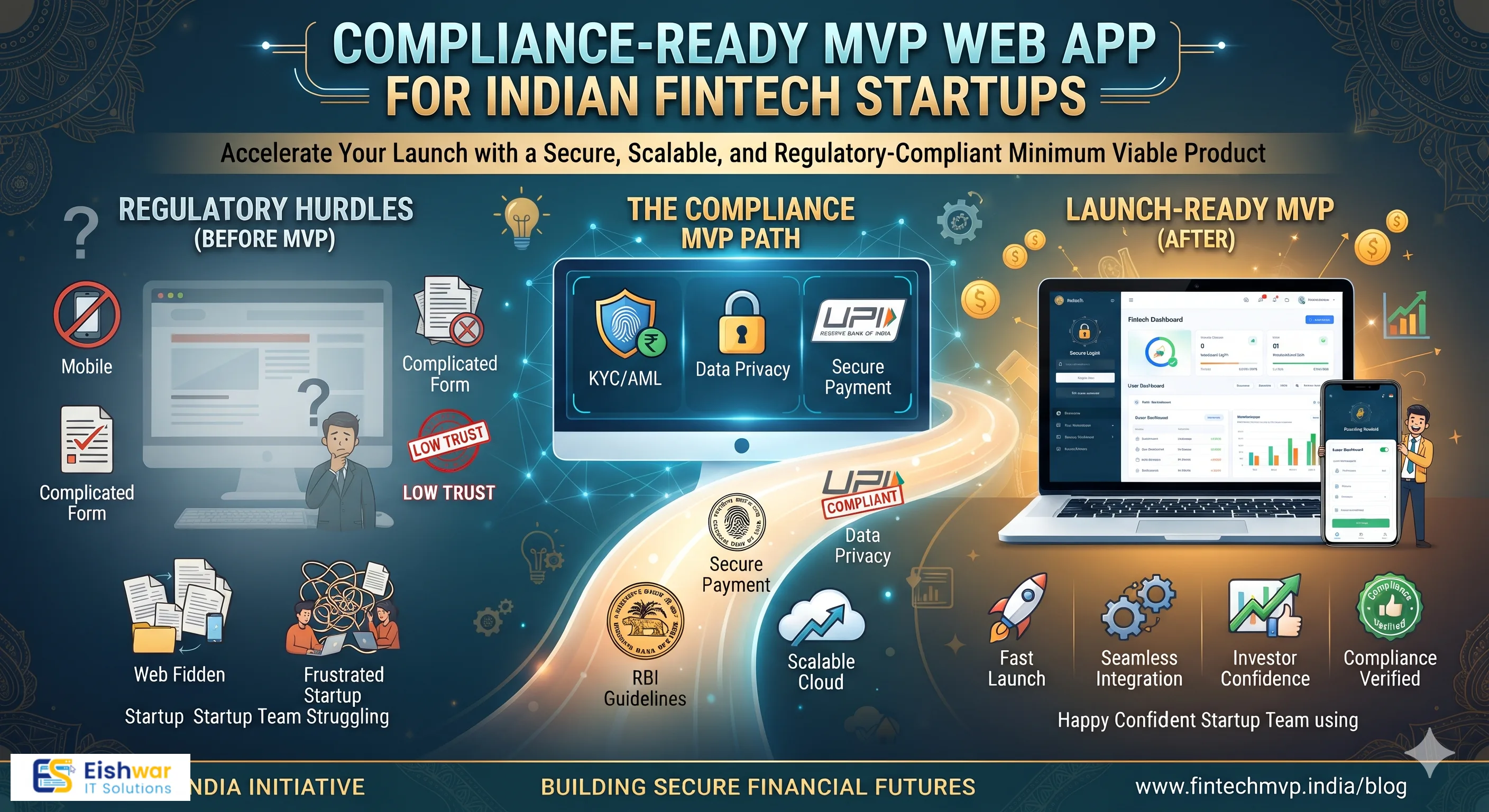
Compliance-Ready MVP Web App for Indian Fintech Startups
Published on: 09 Nov 2026
Compliance-Ready MVP Web App for Indian Fintech Startups
Introduction
Building a fintech MVP in India is not just a product race. It is a trust race. A web app that touches payments, identity verification, credit, insurance, investments or personal finance data must show users, partners and regulators that it can handle information responsibly.
Learn more about our Website services
In 2026, Indian users are more aware of data privacy. Banks, payment partners and investors ask tougher questions. A beautiful MVP that cannot explain where customer data sits or how consent is captured will struggle to launch, integrate and scale.
The good news is that compliance does not have to slow your startup to a crawl. With the right scope, licensed partners and documented decisions, you can build a compliance-ready MVP web app that is lean enough to launch and strong enough to grow. This guide gives founders, business owners and product teams a practical roadmap.
A quick note: this article is educational, not legal advice. Fintech rules depend on your exact model. Always validate your plan with a qualified fintech lawyer and your integration partners.
Main Section 1: Map Compliance Before You Write Code
Most fintech MVP mistakes begin before the first line of code. Teams pick a stack, design screens and then discover that a regulated step needs a different flow, extra evidence or a partner approval. Map compliance early and your build becomes smoother.
1. Define your fintech category clearly
Your obligations change based on what you do. A payments app, a lending marketplace, a wealth platform, an insurtech distributor and a personal finance manager are not the same.
- Payments: check Payment Aggregator and payment gateway rules, KYC, settlement and grievance redressal.
- Lending: review digital lending guidelines, disclosure, recovery practices, data storage and partner responsibilities.
- Investments: consider SEBI requirements, risk disclosures and suitability checks.
- Insurance: consider IRDAI distribution norms, commissions and customer consent.
- Data-led finance: review the DPDP Act 2023, consent, purpose limitation and security expectations.
2. Build a simple compliance matrix
Create a spreadsheet with five columns: user journey, regulation or partner rule, MVP requirement, evidence needed and owner. For example, if your MVP offers credit lines, the onboarding journey may need consent capture, KYC status, fee disclosure, grievance officer details and an audit log.
This matrix becomes your product backlog filter. If a feature does not help users or satisfy a must-have compliance rule, move it to the next phase.
3. Use licensed partners wherever possible
You do not need to become a bank or a payment aggregator to launch a fintech MVP web app. Many Indian startups launch faster by integrating with licensed entities for KYC, payments, account aggregation, lending or insurance distribution.
For example, a lending MVP can use a regulated partner for credit disbursement while your web app focuses on lead qualification, document collection, consent and customer communication. A payments MVP can integrate a licensed payment gateway and avoid handling sensitive card data directly.
Partner APIs reduce licensing burden, but they do not remove responsibility. Read the partner agreement. Understand data ownership, consent sharing, incident reporting and customer support responsibilities.
👉 Don't wait for the perfect moment; turn your vision into reality today.
Free Consultation4. Decide what must be in the MVP
A compliance-ready MVP is not a full compliance management system. It is the smallest responsible version of your product. Include must-have controls such as secure login, consent, KYC status, transaction records, privacy notices, refund or grievance flow and basic audit logs. Defer advanced analytics, rewards, social features and non-essential personalization.
5. Document key decisions
Write short records for decisions like why you store a document, which partner verifies identity, how long data is retained and who can access admin panels. Auditors, banks and investors appreciate clean evidence. Future team members appreciate it too.
Main Section 2: Design the MVP Web App for Trust and Auditability
Compliance is not only a legal checklist. It shows up in product design. Indian users need clear language, predictable flows and visible support. Partners need reliable records. Your MVP web app should make both happen.
1. Secure onboarding and KYC flow
Keep onboarding short but complete. Explain why PAN, Aadhaar-based verification or bank details are needed. Show what is mandatory and what is optional. If you use a KYC partner, display status clearly: pending, verified, rejected or re-submission needed.
Do not store raw identity documents unless your model truly requires it. Many teams store files they never use. Prefer storing verification results, reference IDs and only the minimum data needed for customer support or audit.
2. Consent, privacy and data minimization
Use plain-language consent screens. Separate consent for marketing from consent for core service delivery. Log the version of the privacy policy and terms the user accepted. If you share data with partners, explain that in the consent journey.
Collect less. A fintech MVP web app does not need every data point on day one. If your analytics tool captures sensitive fields or session recordings, disable it for KYC and payment pages.
3. Audit logs and admin controls
Every regulated action should leave a trail: user login, consent accepted, KYC status change, document upload, admin access and transaction status update. Use role-based access so support, operations and finance teams see only what they need.
For the MVP, a simple admin dashboard with timestamps, actor IDs and action history is enough. Avoid shared admin passwords. Avoid editing transaction records directly in the database.
4. Payments, reconciliation and communication
If your MVP collects payments, integrate a licensed payment partner and keep transaction references. Show users the amount, fees, refund policy and support contact before they pay. For lending or insurance, disclose partner names, charges and complaint channels clearly.
Build a basic reconciliation view for your operations team. Even a daily CSV export is better than no process. If a user pays but the app does not show success, you need a safe way to investigate without exposing full payment credentials.
5. Transparent interface copy
Fintech users are cautious, and rightly so. Replace vague buttons like Continue with specific labels like Verify PAN or Agree and continue. Explain what happens after submission. Include a visible grievance officer or support route. Good copy reduces support tickets and builds trust.
👉 Free Website Audit
Get Free Audit6. Choose a practical tech stack and hosting setup
Your stack should support security, backups and monitoring. Use HTTPS everywhere, encrypted storage, environment separation and secure secrets management. If your partner requires data localization, host data in an Indian region and document where backups are stored.
Do not choose tools only because they are popular. Choose tools your team can operate safely. A simple, well-monitored stack is better than a complex stack with no ownership.
Main Section 3: Launch, Test, and Scale Without Breaking Compliance
A compliance-ready MVP web app is not finished when the screens look good. It is finished when you have tested real journeys, reviewed security and prepared the team for incidents. Launch with evidence, not hope.
1. Use partner sandboxes and certification steps
Payment, KYC and account aggregation partners usually provide sandbox environments. Test success, failure, timeout and retry cases. Build clear user messages for each state. Complete the partner certification or go-live checklist before you announce the launch.
2. Test real Indian user journeys
Test on common Android devices, low-bandwidth connections and older browsers. Check whether users understand consent screens. Run sessions with five to ten target users and ask them to explain what happens to their data. If they cannot, simplify the copy.
3. Run security and privacy reviews
Before a public launch, complete a basic vulnerability assessment and penetration test for your web app and APIs. Review access controls, logging, rate limits and error messages. Make sure customer data is not exposed in URLs, logs or third-party analytics.
Create a simple incident response plan. Who will investigate? How will you inform users and partners? Who is the legal contact? Even a one-page plan helps during a stressful event.
4. Create a launch gate
Use a go or no-go checklist. Example items: partner agreements signed, privacy policy published, consent logging live, KYC failure handling tested, refund or grievance process active, admin roles reviewed, backups enabled, support email monitored and legal sign-off received.
5. Scale with monitoring and vendor reviews
After launch, review compliance health monthly. Track failed KYC rates, consent drop-offs, support complaints, API errors and admin access logs. Review vendors when their role changes or when regulations update. Keep your compliance matrix alive; do not let it become a forgotten document.
Expert Tips
- Engage fintech counsel early. A short review before build is cheaper than rebuilding a regulated flow after launch.
- Build a compliance dashboard, not a compliance novel. Show KYC pending cases, consent versions, failed transactions and open complaints in one view.
- Do not store what you cannot protect. Data minimization is a product feature and a risk reducer.
- Use feature flags for regulated journeys. If a partner changes a rule, you can pause or update one flow without redeploying the whole app.
- Keep audit evidence simple. Store signed agreements, partner certificates, test reports and release approvals in one shared folder.
- Design grievance redressal from day one. A visible complaint route improves trust and helps you spot product issues early.
Common Mistakes
- Copying a foreign fintech MVP without local context. KYC, consent, payments and data rules in India need local review.
- Treating KYC as a checkbox. Status handling, rejects and re-submissions matter for user experience and compliance.
- Putting sensitive data into analytics. Session recordings and event tools can accidentally capture personal information.
- Ignoring vendor contracts. Partner APIs bring obligations around data sharing, reporting and customer support.
- Launching before security testing. A quick penetration test often finds basic issues that are cheaper to fix before users arrive.
- Missing audit trails. If you cannot show who changed a status or when consent was accepted, investigations become painful.
- Overbuilding before validation. Do not build a full compliance department inside your MVP. Solve the must-haves, then expand.
Future Trends
Fintech compliance in India is becoming more digital, more data-aware and more integrated into product design. Here is what startups should watch.
👉 Free Homepage Demo
Book Demo- DPDP-ready product design: clearer consent, data purpose mapping and user rights workflows will become standard.
- Account Aggregator adoption: consent-based financial data sharing can reduce friction for lending and wealth MVPs.
- Embedded finance: more startups will launch through licensed partners, making partner due diligence a core product skill.
- Continuous KYC: periodic re-verification and risk-based checks will move from enterprise systems to startup MVPs.
- RegTech APIs: monitoring, consent management and audit logging tools will become more affordable for early-stage teams.
- AI governance: if you use AI for credit, fraud or support, expect questions about explainability, bias and data use.
FAQs
What does compliance-ready mean for a fintech MVP?
It means your MVP includes the must-have controls needed to operate responsibly: clear consent, secure onboarding, a KYC flow, transaction records, basic audit logs, privacy notices, support access and vendor agreements. It does not mean you have every enterprise control on day one.
Do I need an RBI license to launch a fintech MVP in India?
Not always. It depends on your product. Many startups launch by partnering with licensed banks, payment aggregators, lenders or insurance entities. You need to confirm your model with legal counsel and your partners before launch.
How long does a compliance-ready fintech MVP take?
A focused MVP can take 8 to 16 weeks, depending on integrations, partner approvals and legal review. Complex lending or investment flows can take longer. The compliance mapping and partner onboarding stages often decide the timeline.
Can I use third-party KYC and payment APIs?
Yes, in most cases. Use reputable licensed providers, review their data handling terms and test failure cases carefully. Third-party APIs reduce build effort but do not remove your responsibility to protect user data and maintain records.
What should be in my MVP before launch?
At minimum: secure authentication, consent logging, KYC status handling, privacy policy, terms of use, transaction references, admin access controls, support or grievance contact, monitoring and backups. Add partner-specific requirements before go-live.
Is the DPDP Act relevant to a small fintech MVP?
Yes, if you collect personal data from Indian users. Even early-stage startups should practice data minimization, purpose-based consent, secure storage and clear privacy communication. Ask legal counsel about your specific obligations.
Conclusion
A fintech MVP web app in India has to earn trust before it can scale. Compliance is not a separate workstream that starts after design. It belongs in your scope, your screens, your data model, your partner agreements and your launch checklist.
Start with a clear product category. Build a compliance matrix. Use licensed partners. Design for consent, auditability and transparency. Test security before launch. Then keep reviewing as you grow. That approach helps you launch faster with fewer surprises and stronger credibility with users, partners and investors.
CTA
Planning a fintech MVP in India? EishwarITSolution helps startups scope, design and build secure MVP web solutions that are ready for real users and partner reviews. Visit http://eishwar.com to discuss your compliance-ready fintech MVP roadmap.