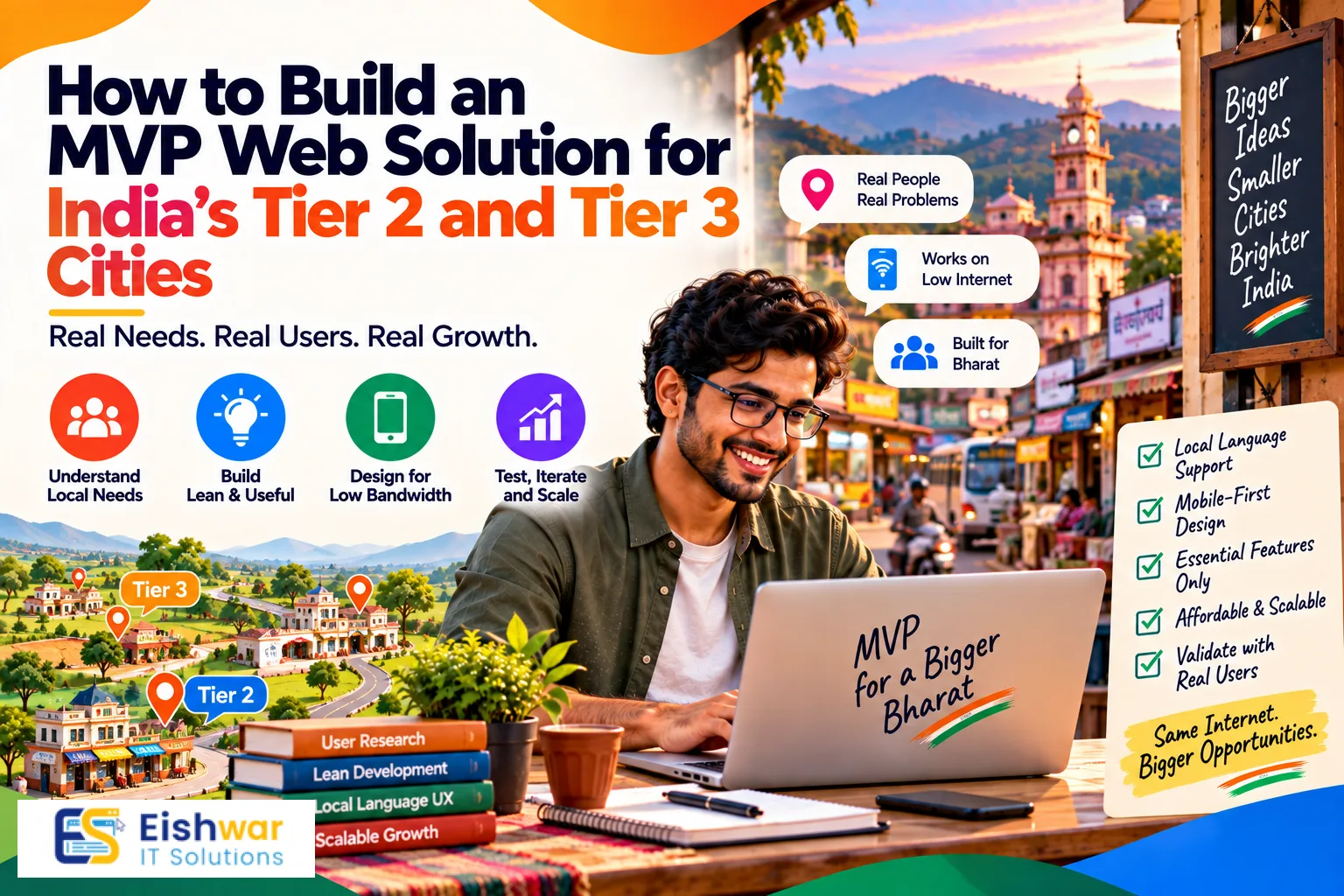
How to Build an MVP Web Solution for India's Tier 2 and Tier 3 Cities
Published on: 14 Aug 2026
How to Build an MVP Web Solution for India's Tier 2 and Tier 3 Cities
Introduction
India's startup ecosystem is no longer confined to metros like Bengaluru, Mumbai, or Delhi. Tier 2 and Tier 3 cities—from Jaipur to Indore, Coimbatore to Guwahati—are witnessing a digital revolution. With affordable internet, smartphone penetration, and a young population, these cities offer immense opportunities for entrepreneurs. However, building a successful Minimum Viable Product (MVP) for these markets requires a different approach than a metro-centric one. In this guide, we'll explore how to create an MVP web solution that truly resonates with users in Tier 2 and Tier 3 India, and why it's a strategic goldmine for startups.
Learn more about our Website services
Main Section 1: Understanding the Tier 2 and Tier 3 Landscape
Before you write a line of code, you need to understand who you're building for. Tier 2 and Tier 3 cities are not just smaller versions of metros—they have unique characteristics:
- Internet behavior: Mobile-first, with a heavy reliance on vernacular languages. According to a 2025 report, over 70% of new internet users in India are from non-metro areas, and most prefer local language content.
- Price sensitivity: Affordability is paramount. Users are more likely to try a free or low-cost solution that delivers immediate value.
- Trust deficit: Digital trust is lower. They rely on word-of-mouth, local influencers, and familiar brands.
- Connectivity issues: While improving, internet speeds can be inconsistent. Your MVP must work smoothly on slower connections.
- Local nuances: Payment preferences, cultural norms, and even festival seasons affect usage.
For example, a hyperlocal services app in a Tier 3 city might need to support cash-on-delivery or UPI, but also integrate with local WhatsApp groups for customer support. Ignoring these nuances is a recipe for failure.
Main Section 2: Key Strategies for Building a Localized MVP
Building an MVP for Tier 2/3 markets involves a mix of lean principles and localization. Here are the critical strategies:
1. Prioritize Mobile-First and Low-Bandwidth Design
Most users in these cities access the internet via budget smartphones on 4G (or even 3G) networks. Your MVP should be a responsive web app, not a heavy native app. Optimize images, use lazy loading, and minimize JavaScript. Consider a Progressive Web App (PWA) that works offline and loads quickly. For instance, a local grocery delivery service can use a PWA to allow users to browse products even with intermittent connectivity, ensuring a seamless experience.
2. Embrace Vernacular and Voice
English might be the official language, but your users think in Hindi, Tamil, Telugu, or Marathi. Incorporate vernacular language options in your MVP. Even a simple toggle can increase engagement. Voice search is also rising—integrating voice input can make your product more accessible. For example, a healthcare appointment booking app could offer voice commands in Hindi to help elderly users book slots without typing.
3. Simplify Payments and Trust
UPI (like Google Pay and PhonePe) is ubiquitous, but not everyone is comfortable with digital payments. Offer multiple options: UPI, cash on delivery, and even local payment methods. Display trust badges, clear return policies, and local customer support numbers. A practical example is an e-commerce platform that shows 'Cash on Delivery available' prominently, which significantly boosts conversion in smaller cities.
👉 Don't wait for the perfect moment; turn your vision into reality today.
Free Consultation4. Solve a Hyperlocal Problem
Instead of a generic solution, focus on a problem that is specific to these cities. E.g., a platform for local tutors, a booking system for small clinics, or a marketplace for local artisans. The more local, the more relevant. For instance, a startup in Indore created a platform connecting local tiffin services with office workers, addressing a specific need that metro-centric apps missed.
5. Use a Cost-Effective Tech Stack
You don't need a $50,000 MVP. Use low-code/no-code tools, open-source frameworks, or hire a development partner like EishwarITSolution that specializes in affordable MVP development. Keep your initial build lean—just enough to test your core hypothesis. For example, using WordPress with a custom theme or Bubble.io can cut development time by half, allowing you to launch quickly and iterate based on feedback.
Main Section 3: Real-World Examples and Case Studies
Let's look at some successful examples:
- Chingari: A short-video app that gained traction in Tier 2/3 cities by supporting multiple Indian languages and rewarding users with tokens. They understood the local content need.
- DealShare: A social commerce platform that uses a network of local resellers to offer groceries at low prices. Their MVP started with a simple WhatsApp-based ordering system.
- Vernacular AI chatbots: Many startups are using AI-powered chatbots that converse in Hindi and other languages to assist users in booking services or ordering products.
These examples show that the key is to start small, focus on a single pain point, and iterate based on feedback.
Expert Tips
- Start with a landing page MVP: Before building a full product, create a landing page with a waitlist form. Run ads on Facebook/Instagram to gauge interest. This costs almost nothing.
- Use WhatsApp as a support channel: Many users are already comfortable with WhatsApp. Use it for customer support, order updates, and even feedback collection.
- Leverage local influencers: Partner with micro-influencers in the city to spread the word. They have a loyal local following.
- Test with a pilot group: Recruit 50-100 beta users from your target city. Get them to use your MVP and provide feedback. Iterate quickly.
- Monitor analytics religiously: Use tools like Google Analytics, Hotjar, or Mixpanel to understand user behavior. But also do manual user interviews.
Common Mistakes
- Ignoring local languages: If you only offer English, you're excluding a huge portion of your potential users.
- Over-engineering: Building complex features that users don't need. Stick to the core value proposition.
- Assuming metro behavior applies: Don't copy-paste a metro-centric strategy. Understand the local context.
- Neglecting offline events: In Tier 2/3 cities, offline events and word-of-mouth are powerful. Invest in local meetups and community building.
- Not focusing on trust: Without trust, users won't transact. Add reviews, ratings, and transparent policies.
Future Trends
By 2026 and beyond, we expect:
- AI-driven localization: Real-time translation and voice assistants will make products more accessible.
- Rise of regional ONDC: The Open Network for Digital Commerce will enable small local businesses to join e-commerce platforms.
- Increased internet penetration: With 5G expanding, richer web experiences will be possible, but still keep low-bandwidth options.
- Focus on sustainability: Users are becoming more conscious; products that support local artisans or eco-friendly practices will win.
FAQs
1. What is an MVP web solution?
An MVP (Minimum Viable Product) is a basic version of your web app with just enough features to satisfy early customers and provide feedback for future development. It's about testing your core idea with minimal resources.
👉 Free Website Audit
Get Free Audit2. How much does it cost to build an MVP in India for Tier 2/3 markets?
Costs vary, but a simple MVP can range from ₹2 lakh to ₹10 lakh depending on complexity. Using low-code tools or partnering with a local development agency can reduce costs.
3. How long does it take to build an MVP?
A basic MVP can be built in 4-8 weeks with a focused team. However, if you're using no-code platforms, it could be even faster—around 2-4 weeks.
4. Should I build a mobile app or a web app for Tier 2/3 users?
Start with a mobile-first web app (PWA) because it's cheaper and doesn't require app store approvals. It also works better on low-end devices.
5. How do I validate my MVP idea for these cities?
Conduct surveys, use social media polls, and run a landing page with a 'Notify Me' button. Also, talk to potential users in local markets or via community groups.
6. What are the best ways to market an MVP in Tier 2/3 cities?
Use Facebook and Instagram ads, WhatsApp marketing, local influencer partnerships, and participate in local events or trade shows.
7. What are the common pitfalls to avoid?
Ignoring local languages, overcomplicating features, not building trust, and underestimating the importance of customer support.
Conclusion
Building an MVP web solution for India's Tier 2 and Tier 3 cities is not just about scaling a product—it's about understanding a diverse, dynamic, and digitally-empowered population. By focusing on mobile-first design, vernacular support, affordability, and local trust, you can create a product that truly resonates. The future of Indian startups lies beyond the metros, and those who act now will lead the way.
CTA
Ready to turn your idea into an MVP that captures the heart of India? At EishwarITSolution, we specialize in building affordable, scalable MVP web solutions tailored for the Indian market. Contact us today for a free consultation and take the first step towards your startup success.