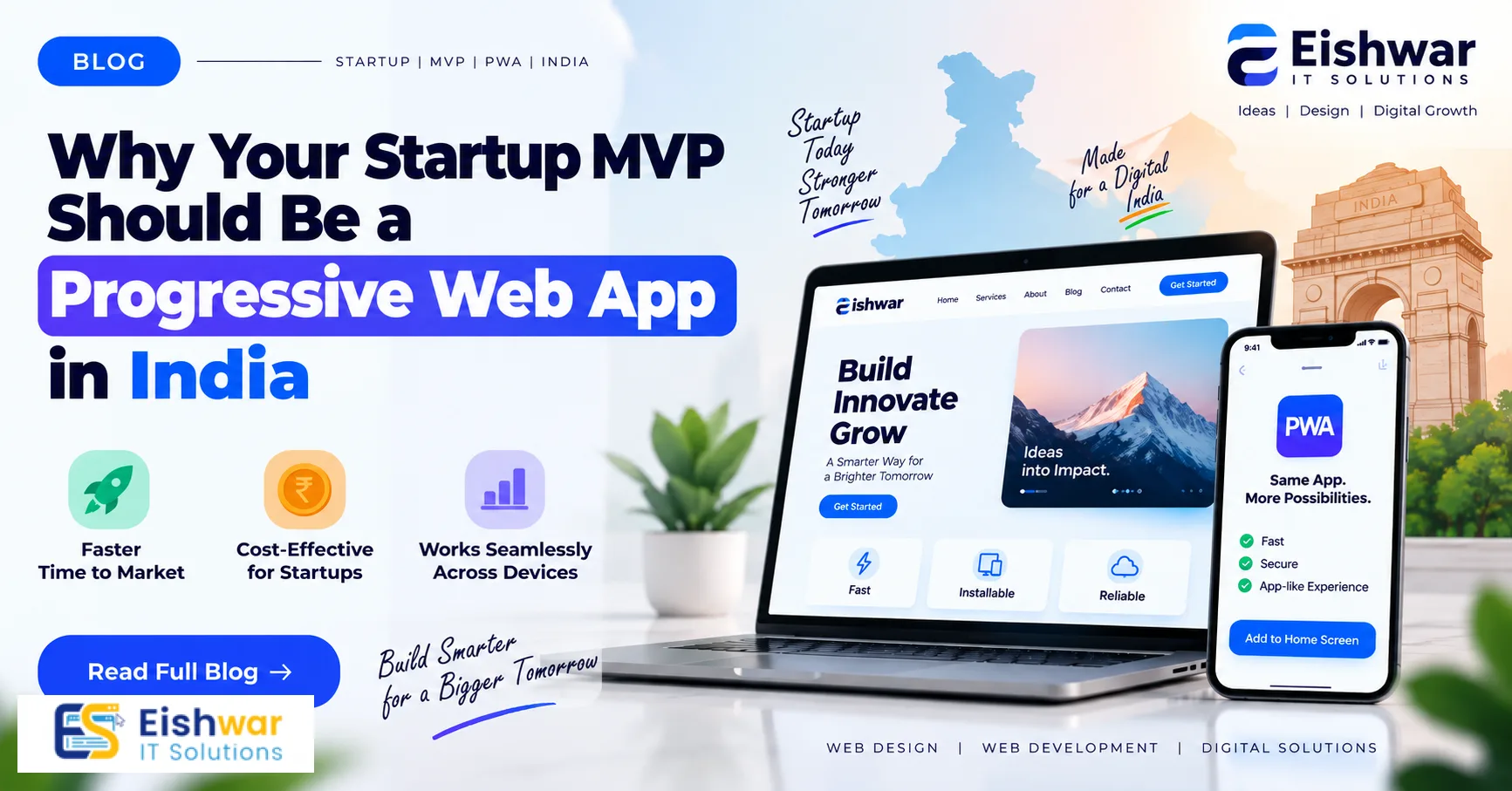
Why Your Startup MVP Should Be a Progressive Web App in India
Published on: 31 Aug 2026
Why Your Startup MVP Should Be a Progressive Web App in India
\nIntroduction
India is a mobile-first country. Over 80% of internet users in India access the web through their smartphones, and the majority of them rely on mobile data connections that can be patchy, slow, or expensive. For a startup, that changes how you build your first product. You can't afford to create an app that takes forever to load, eats up huge bandwidth, or gets uninstalled after one use. You need a lean, fast, and reliable web experience that feels native without the app-store hassle. That's exactly where a Progressive Web App (PWA) enters the picture.
Learn more about our Website services
A PWA is not a new technology. It's a set of web capabilities that make your website behave like an app — installable, offline-ready, and lightning fast. For Indian startups, a PWA is arguably the smartest MVP web solution because it lets you validate your idea quickly, reach more users, and spend less. In this guide, we'll explore why PWAs are a game-changer for Indian startups, how to build one step by step, and what mistakes to avoid.
Main Section 1: What Is a PWA and Why It Matters for Indian Startups
A Progressive Web App is a normal website that you enhance using modern web technologies. Users can "install" it on their phone's home screen, launch it full-screen, and use it even when offline. It loads quickly, sends push notifications, and updates automatically — almost like a native app, but without needing to visit the Play Store or App Store.
For Indian startups, this matters for several reasons:
Mobile-Only Users Are Your Biggest Audience
Most of your target users in India will come from mobile devices. Many of them may have budget smartphones with limited storage and RAM. A PWA is lightweight — typically under 1 MB compared to native apps that often exceed 50 MB. This makes it more accessible for users in Tier 2 and Tier 3 cities, where low-end devices dominate.
Network Resilience Is Critical
India has made immense progress in internet connectivity, but 4G reception isn't always consistent. Travelers, commuters, and users in rural areas often face slow or interrupted connections. A PWA's service worker caches content locally, so your app works smoothly even on bad networks or offline. This builds trust and keeps users engaged.
The App Store Barrier Is Real
Many Indian users are skeptical about downloading apps — they worry about permissions, storage hogging, and data privacy. A PWA eliminates these concerns. There's no app store listing to manage, no download friction, and no approval delay. You simply share a link, and the user can add it to their home screen in one tap.
In short, PWAs let you serve a native-like experience to every Indian user with just a URL. That's a huge advantage when you're trying to validate a startup idea with minimal resources.
Main Section 2: Top Benefits of Building a PWA MVP for India
1. Lower Development and Maintenance Costs
Building a native app for Android and iOS means two codebases, two teams, and twice the ongoing maintenance. A PWA only requires one codebase. For an Indian startup with a tight budget, this is a no-brainer. You save significantly on development costs and can invest those savings into product discovery and marketing.
👉 Don't wait for the perfect moment; turn your vision into reality today.
Free Consultation2. Instant Loading, Even on Slow 4G
Speed matters — especially in India, where every second of load time impacts user attention. Google research shows that 53% of mobile users abandon sites that take over three seconds to load. PWAs load instantly thanks to cached assets and fast local rendering. This means your MVP doesn't just feel faster; it converts better too.
3. No App Store Approval Delays
When you're testing a hypothesis, you want to launch as soon as possible. App stores have review guidelines, human approvals, and rejection risks. A PWA can be live on your domain in hours. You can push new features and fixes instantly, without anyone's permission. This agility is essential for lean startups.
4. Better SEO and Sharable Links
Native apps aren't crawlable by Google. Your app won't show up in search results. A PWA, on the other hand, is a website at its core — meaning SEO, backlinks, and social sharing all work in your favor. For Indian startups targeting Google traffic, a PWA MVP doubles as a powerful marketing channel.
5. Higher User Engagement
PWAs support push notifications, home screen installation, and offline access. These features are traditionally associated with native apps but now available on the web.
Flipkart Lite, one of India's first PWA success stories, saw a 70% higher conversion rate and 3x longer time-on-site after switching their mobile site to a PWA. The lesson? Users respond when you give them a hassle-free, app-like experience.
6. Lower Data Consumption
Data costs are a concern for many Indians. PWAs are designed to minimize server requests and payload sizes. This means your users will appreciate that your product doesn't eat up their monthly data quota. That's a subtle but powerful trust signal.
Main Section 3: How to Build a PWA MVP: A Step-by-Step Approach for Indian Startups
Step 1: Define Your Core Value Proposition
Your MVP must solve one problem exceptionally well. Resist the urge to add multiple features. For example, if you're building a local grocery delivery MVP, focus on one thing: allowing users to quickly reorder previously bought items. Leave ratings, reviews, and referral programs for later.
Step 2: Choose the Right Tech Stack
For a PWA, choose a web framework you're comfortable with. Popular choices include React (with Next.js or Vite), Vue.js with Nuxt, or Svelte with SvelteKit. These frameworks handle routing and server-side rendering gracefully, which helps SEO. Pair it with a backend like Node.js, Firebase, or Supabase for fast iteration.
Step 3: Implement an App Shell Architecture
An app shell is the minimal HTML, CSS, and JavaScript that powers the UI shell of your PWA. It should load instantly and be cached. This gives your app the native-like feel — the same UI appears immediately, and only the content changes. Google's App Shell pattern is a great starting point.
👉 Free Website Audit
Get Free AuditStep 4: Set Up a Service Worker
Service workers are the secret sauce behind offline support. You need to register a service worker, cache your app's assets, and decide your caching strategy. For an MVP, a cache-first strategy for static assets and a network-first strategy for dynamic content works well. Use Workbox to simplify the process.
Step 5: Add a Web App Manifest
The web app manifest is a JSON file that tells the browser how your PWA should appear when installed. Include the app name, icons, theme color, and background color. Make sure your PWA passes the installability criteria in Chrome DevTools's Lighthouse audit.
Step 6: Test on Real Devices
India has an incredibly diverse device ecosystem. Don't just test on your iPhone or high-end Android. Test on budget Android devices like Xiaomi or Realme. Use remote device labs or ask friends and colleagues to test. Make sure your PWA handles poor network quality gracefully.
Step 7: Optimize Performance and SEO
Use Google Lighthouse to measure performance, accessibility, best practices, and SEO. Aim for good-to-excellent scores before launch. Add a meta description, title tags, and proper Open Graph tags so that when people share your link on WhatsApp and Instagram, it looks polished.
Step 8: Launch, Measure, and Iterate
Get your PWA out there. Track key metrics like user acquisition, activation, retention, and referrals using analytics. Set up crash-free browsing, monitor error rates, and listen to user feedback. Use those insights to build your next iteration.
Expert Tips
- Think Mobile-Light First: Always optimize images and use
srcsetfor responsive images. Every kilobyte matters. - Use WhatsApp Integration: Since WhatsApp is the most popular app in India, make sharing your PWA link as easy as possible. Add WhatsApp sharing buttons to your product pages.
- Leverage Google Analytics: Set up analytics from day one. You don't want to wonder which features users actually use in your MVP. Use event tracking to understand real behavior.
- Localize Your Content: India is multilingual. If your MVP can support English and two or three Indian languages (Hindi, Tamil, Telugu, Bengali), you'll stand out significantly.
- Focus on Security: PWAs require HTTPS to function. Ensure your hosting provider supports free SSL certificates like Let's Encrypt. Your users' trust depends on it.
- Keep an Eye on File Size: Budget your PWA's initial load to under 200KB of critical resources. This lets you load fast even on 3G connections.
Common Mistakes
- Ignoring Lower-End Devices: Your high-end smartphone will load things quickly. Your user's budget phone might not. Test on low-cost devices from day one.
- Making a PWA Just for Checklist's Sake: Some startups claim they have a PWA but miss the offline support or installability requirements. Users will notice the broken experience.
- Overcomplicating the MVP: Don't try to replicate an entire native app experience in your PWA. Focus on the core job-to-be-done. Add more later.
- Neglecting Browser Compatibility: While modern browsers support PWA features, some WebViews (like embedded browsers in Instagram or Facebook) may not work perfectly. Provide clear fallback messages.
- Skipping the Marketing Plan: A PWA MVP still needs user acquisition. Don't assume the product sells itself. Plan for SEO, social media, and referral strategies.
- Forgetting Push Notification Permissions: Ask for permission at the right moment — after users see value, not on the first visit. Irrelevant notifications will drive users away.
Future Trends
The PWA ecosystem is evolving fast, and Indian startups should watch these trends:
👉 Free Homepage Demo
Book DemoWeb Auth and Payments: The Web Authentication API (WebAuthn) and powerful payment APIs are making it easier to build secure, native-like financial experiences in browsers. Expect more fintech startups to launch PWAs, especially for digital wallets and UPI-based payment flows.
AI-Enhanced PWAs: Edge computing and client-side AI models will soon let PWAs offer smart features like real-time translation, on-device recommendations, and predictive text — even offline.
Voice Search and Navigation: As Hindi and other Indian-language voice queries grow, PWAs that integrate voice recognition will serve local audiences better. Google already supports voice search in multiple Indian languages.
PWA + Accelerated Mobile Pages (AMP): While AMP's popularity has shifted, the idea of optimizing content for speed remains critical. Combining fast-loading PWAs with progressive enhancements will become the standard.
App Store Optimisation for PWAs: Google Play Store already accepts PWA-based apps through Trusted Web Activities. This means you can get an app store presence with a PWA codebase — the best of both worlds.
FAQs
1. Is a PWA as good as a native app?
For most MVP use-cases, yes. A PWA covers the core features users expect: push notifications, offline access, home-screen installation, and fast loading. For complex features requiring heavy device hardware (e.g., advanced AR filters), native might still be necessary. But for validating a product idea in India, a PWA is more than enough.
2. How much does it cost to build a PWA MVP in India?
A simple PWA MVP can cost anywhere between ₹1.5 lakh and ₹5 lakh, depending on your feature set and design requirements. This is significantly less than a native app, which can start from ₹3 lakh per platform.
3. Can a PWA rank on Google compared to native apps?
Yes, PWAs are fully indexed by Google. A well-optimized PWA can rank strongly in search results, unlike native apps that have almost no SEO value. For Indian startups, this organic visibility is a decisive advantage.
4. How do I market my PWA if it's not on the App Store?
Focus on SEO, WhatsApp sharing, QR codes on business cards, Instagram bio links, and digital ads. Once users visit your PWA, send push notifications (after permission) to bring them back. All these channels work directly with web links.
5. Can I convert a PWA into a native app later?
Yes. You can wrap your PWA in a native shell using frameworks like Capacitor or convert specific features to native code as your startup grows. Many startups start with a PWA for validation and move to hybrid or full native based on user demand.
Conclusion
India's mobile-first ecosystem is tailor-made for Progressive Web Apps. They offer the speed, low cost, and accessibility startups need to test ideas, win users, and grow sustainably. As we've seen, PWAs aren't just a technical choice — they're a strategic business decision for Indian startups. They respect users' data budgets at home, load quickly on patchy networks, and install instantly without store friction.
So, if you're planning an MVP, ask yourself: do you really need a native app, or would a PWA deliver more value with less money and faster speed? The smart answer for most founders in 2026 is clear: launch a PWA MVP, measure real user behavior, and scale with confidence.
CTA
Ready to transform your idea into a lightning-fast Progressive Web App MVP? At EishwarITSolution, we specialise in building affordable, scalable, and beautifully designed PWA MVPs for Indian startups. Let's discuss your project today. Contact our team and get a free quote within 48 hours.