
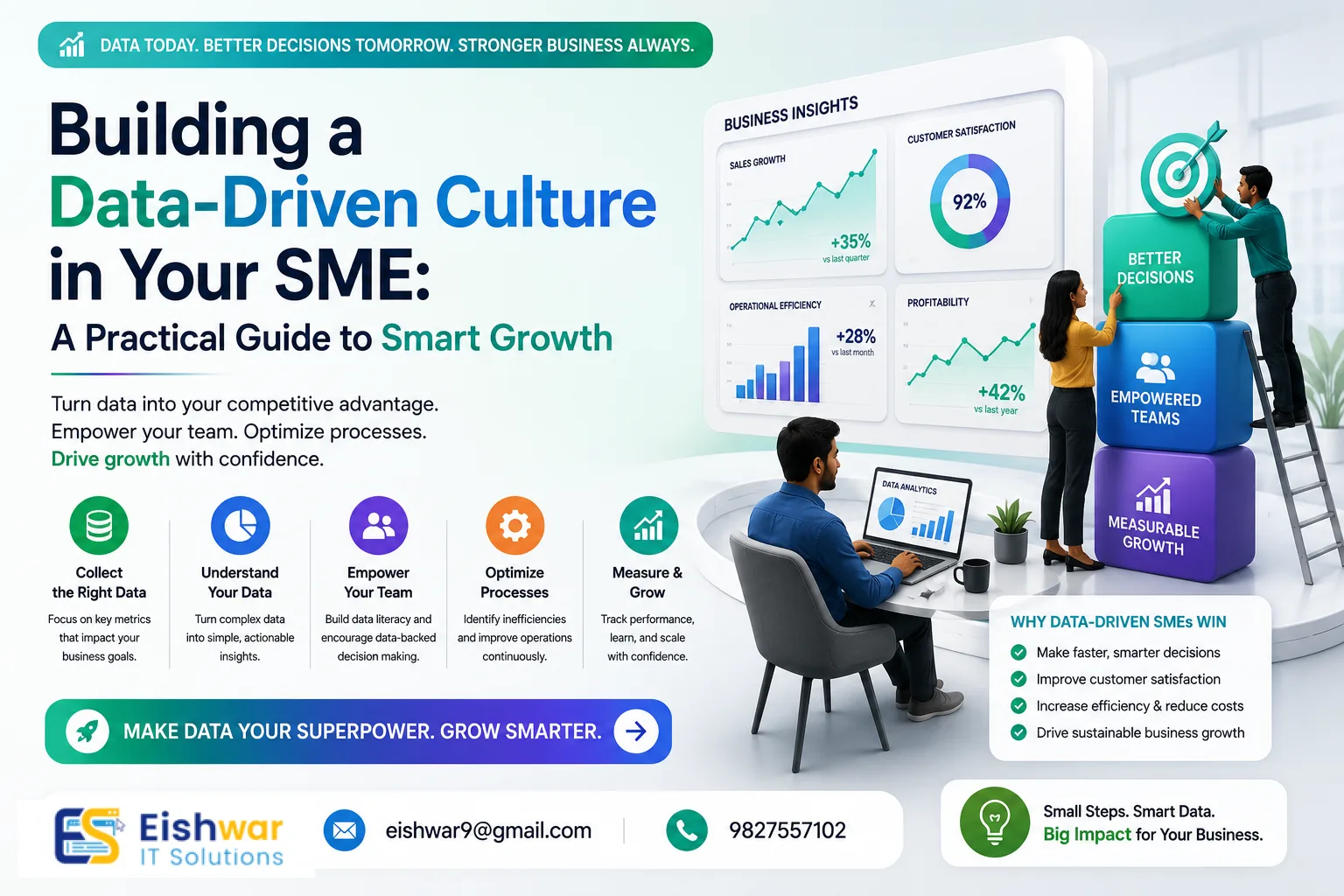
Building a Data-Driven Culture in Your SME: A Practical Guide to Smart
Published on: 11 Jun 2026
Building a Data-Driven Culture in Your SME: A Practical Guide to Smarter Decisions
Introduction
Imagine running your small or medium enterprise (SME) with the same confidence as a tech giant—where every decision is backed by real numbers, not gut feelings. That’s the promise of a data-driven culture. But for many Indian SMEs, the idea feels daunting, expensive, or reserved for big corporations. The truth? You don’t need a massive IT team or a seven-figure budget. You just need the right mindset, a few affordable tools, and a step-by-step approach.
Learn more about our Website services
In this guide, we’ll walk you through exactly how to build a data-driven culture in your SME—from getting your team on board to choosing the right tools and avoiding common pitfalls. Whether you’re a business owner in Mumbai, a marketer in Bangalore, or a professional in Delhi, these actionable tips will help you turn data into your most valuable asset.
Main Section 1: Why Data-Driven Culture Matters for SMEs
The Shift from Gut to Data
For years, SMEs have relied on intuition, experience, and word-of-mouth to make decisions. While these have their place, they often lead to missed opportunities or costly mistakes. A data-driven culture means using facts, metrics, and insights to guide your choices—whether it’s pricing, inventory, marketing, or hiring.
Consider a small textile manufacturer in Surat that used to set production quotas based on last year’s sales. After switching to real-time demand data from wholesalers, they reduced overproduction by 30% and saved ₹2 lakhs in storage costs. This shift from gut to data isn’t just a trend; it’s a survival strategy in today’s competitive landscape.
Real Benefits You Can Expect
- Better Decisions: Data reduces bias and guesswork. For example, a small retail store in Pune used sales data to identify which products sold best during monsoon, then optimized their stock—reducing waste by 20%.
- Faster Problem-Solving: When a customer complaint spikes, data helps you pinpoint the root cause (e.g., a specific product batch or delivery route) instead of guessing. A Jaipur-based restaurant chain used order data to discover that a particular delivery partner was consistently late, leading to a 15% drop in satisfaction. They switched partners and saw ratings recover within a month.
- Cost Savings: Tracking expenses and ROI on marketing campaigns helps you cut what doesn’t work and double down on what does. A small software firm in Bangalore saved ₹50,000 per month by reallocating ad spend from low-performing channels to high-ROI ones, based on conversion data.
- Competitive Edge: Many SMEs still ignore data. By embracing it, you gain an advantage over competitors who rely on intuition alone. A recent study showed that data-driven SMEs grow 30% faster than their peers.
The Indian SME Context
India has over 63 million SMEs, contributing nearly 30% to the GDP. Yet, a 2023 survey found that only 12% of Indian SMEs use data analytics regularly. That’s a huge gap—and a huge opportunity. With affordable internet, cloud tools, and government initiatives like Digital India, there’s never been a better time to start. For instance, a small logistics company in Chennai used free Google tools to track delivery times, reducing delays by 25% within three months. The key is to start small and scale smart.
👉 Don't wait for the perfect moment; turn your vision into reality today.
Free ConsultationMain Section 2: Steps to Build a Data-Driven Culture
Step 1: Start Small with a Clear Goal
Don’t try to boil the ocean. Pick one area where data can make an immediate impact. For example:
- Sales: Track which products or services are most profitable.
- Marketing: Measure conversion rates from social media ads.
- Customer Service: Monitor response times and satisfaction scores.
Actionable Tip: Set a simple KPI (Key Performance Indicator) like “increase repeat customer rate by 10% in 3 months.” Then collect the data needed to measure it. For instance, a bakery in Delhi used a loyalty program to track repeat purchases and found that offering a free cookie after five visits boosted repeat rates by 15%.
Step 2: Democratize Data Access
Data shouldn’t be locked in a spreadsheet that only the owner sees. Use cloud-based tools that let your team access dashboards and reports. Tools like Google Data Studio (free), Zoho Analytics (affordable), or even Microsoft Power BI (low-cost plans) allow you to create visual dashboards that anyone can understand.
Example: A small logistics company in Chennai used a shared Google Sheet with simple charts to track delivery times. Within weeks, drivers started improving their routes because they could see their own performance. This transparency fostered accountability and reduced delays by 20%.
Step 3: Invest in Data Literacy
Your team needs to understand basic data concepts—like averages, trends, and outliers—to make sense of the numbers. You don’t need a PhD; just regular, short training sessions.
Actionable Tip: Conduct monthly “Data Huddles” where you review one key metric together. Ask questions like: “What does this number tell us? What should we do differently?” Over time, this builds a habit. A small e-commerce store in Mumbai used these huddles to teach staff how to interpret bounce rates, leading to a 10% increase in conversions after optimizing product pages.
Step 4: Lead by Example
If you, as a leader, make decisions based on data, your team will follow. Share your own data-backed decisions during meetings. For instance, “I saw our website traffic dropped 15% last week, so we’re testing a new headline. Let’s see what the data says next week.”
Actionable Tip: Create a “Data Wall” in your office (physical or virtual) where you post one key metric every week. Discuss it briefly in team stand-ups. A manufacturing SME in Pune did this with production efficiency data, and within two months, line workers suggested improvements that boosted output by 12%.
Step 5: Use Affordable Tools
You don’t need expensive enterprise software. Here are budget-friendly options for Indian SMEs:
- Google Analytics: Free for website and app data.
- HubSpot CRM: Free tier for managing customer interactions.
- Zoho Analytics: Starts at ₹1,500/month for small teams.
- Tableau Public: Free for basic visualizations.
- Simple Excel/Google Sheets: Surprisingly powerful for tracking and analysis.
Pro Tip: Start with free tools. Upgrade only when you outgrow them. A small consultancy in Bangalore used Google Sheets to track client acquisition costs, saving ₹20,000 per month by focusing on the most profitable channels.
👉 Free Website Audit
Get Free AuditMain Section 3: Overcoming Common Challenges
Challenge 1: Data Overload
Many SMEs collect too much data and don’t know what to do with it. The result: analysis paralysis.
Solution: Focus on the “One Metric That Matters” (OMTM) for each department. For sales, it might be monthly revenue. For marketing, cost per lead. Ignore the rest until you master that metric. A retail chain in Hyderabad reduced decision time by 40% by focusing only on inventory turnover rates.
Challenge 2: Lack of Skills
Your team may not have data analysis skills. That’s okay.
Solution: Use tools that do the heavy lifting. For example, Google Analytics automatically calculates bounce rates and conversion paths. You just need to interpret the results. Also, consider hiring a freelance data analyst for a few hours to set up your first dashboard. A small clinic in Delhi hired a freelancer for ₹5,000 to set up a patient booking dashboard, which reduced no-shows by 30%.
Challenge 3: Resistance to Change
Some employees may fear that data will expose their mistakes or replace their judgment.
Solution: Frame data as a tool to help them, not judge them. Celebrate wins that come from data-driven decisions. For instance, if a salesperson uses data to close a deal, highlight their success in a team meeting. A B2B service firm in Mumbai saw a 20% increase in team morale after implementing a “Data Hero” award for employees who used insights effectively.
Challenge 4: Cost Concerns
“Data tools are expensive.” This is a common myth.
Solution: As mentioned, many powerful tools are free or low-cost. Plus, the ROI from better decisions often far outweighs the investment. A small restaurant in Jaipur saved ₹50,000/month by using free Google Analytics to optimize their online ordering system. The key is to start with what you have and reinvest savings into better tools later.
Expert Tips
- Start with a Data Inventory: List all the data you already have (sales receipts, website stats, customer feedback). You might be surprised how much you already own. For example, a salon chain in Chennai discovered they had years of appointment data that could predict peak hours, allowing better staff scheduling.
- Use Visuals: Humans process visuals 60,000 times faster than text. Use charts, graphs, and color-coded dashboards. A logistics firm in Kolkata used a simple red-yellow-green dashboard for on-time deliveries, improving performance by 18% in three months.
- Set a Regular Review Rhythm: Weekly 15-minute data reviews are more effective than monthly hour-long meetings. A small IT company in Noida used Monday morning stand-ups to review weekly sales data, leading to a 25% increase in pipeline velocity.
- Celebrate Small Wins: When a data-driven decision leads to a positive outcome, share it company-wide. This reinforces the culture. A manufacturing unit in Coimbatore celebrated when data helped reduce material waste by 10%, inspiring other departments to adopt similar practices.
- Don’t Ignore Qualitative Data: Numbers tell you “what,” but customer interviews and feedback tell you “why.” Combine both for richer insights. A service firm in Bangalore used survey data alongside analytics to understand why churn rates were high, leading to a 15% retention improvement.
Common Mistakes
- Trying to Do Everything at Once: Start with one metric, one team, one tool. Expand gradually. A startup in Gurgaon failed initially by tracking 50 metrics; after narrowing to three, they saw a 40% improvement in focus.
- Ignoring Data Quality: Garbage in, garbage out. Ensure your data is accurate, complete, and up-to-date. A retailer in Indore lost ₹1 lakh due to incorrect inventory data; they now validate data weekly.
- Overcomplicating Dashboards: A dashboard with 50 charts is confusing. Keep it simple: 3-5 key metrics per view. A marketing agency in Pune simplified their dashboard and saw a 30% increase in team adoption.
- Not Acting on Insights: Collecting data without taking action is pointless. Always ask: “What will we do differently based on this?” A restaurant chain in Delhi that ignored data on slow-moving items continued to lose money until they acted.
- Forgetting the Human Element: Data guides decisions, but people execute them. Involve your team in the process. A logistics firm in Mumbai included drivers in route optimization discussions, leading to a 20% reduction in fuel costs.
Future Trends
- AI-Powered Analytics: Tools like ChatGPT and Google’s Gemini are making data analysis conversational. Soon, you’ll just ask “What’s our best-selling product this month?” and get an instant answer. A small e-commerce store in Pune already uses AI chatbots to analyze customer queries, reducing response time by 50%.
- Predictive Analytics: SMEs will use historical data to forecast demand, cash flow, and customer behavior—without needing data scientists. A bakery in Mumbai used predictive models to anticipate weekend demand, reducing waste by 25%.
- Real-Time Dashboards: With cloud computing, you’ll see live data on your phone, enabling faster responses. A delivery service in Bangalore uses real-time tracking to reroute drivers during traffic, improving on-time delivery by 30%.
- Data Privacy Regulations: India’s Digital Personal Data Protection Act will require SMEs to handle customer data responsibly. Building a data-driven culture now will prepare you for compliance. A healthcare SME in Chennai started anonymizing patient data early, avoiding potential fines.
FAQs
1. What is a data-driven culture?
A data-driven culture means making decisions based on data and evidence rather than intuition or tradition. It involves collecting, analyzing, and acting on data at all levels of the organization. For example, a small retailer might use sales data to decide which products to stock, rather than relying on what they think customers want.
👉 Free Homepage Demo
Book Demo2. Do I need a data scientist to start?
No. Many affordable tools (like Google Analytics, Zoho, or Excel) are user-friendly. Start with basic metrics and build skills gradually. A small restaurant in Jaipur used free tools to track customer preferences and saw a 20% increase in repeat visits without any specialized hire.
3. How long does it take to build a data-driven culture?
It depends on your starting point. With consistent effort, you can see noticeable changes in 3-6 months. Full cultural shift may take 1-2 years. A logistics firm in Chennai saw a 15% improvement in delivery times within six months of starting their data journey.
4. What if my data shows something I don’t like?
That’s actually great! Data that challenges your assumptions is valuable because it reveals blind spots. Use it to improve, not to defend old habits. A manufacturer in Surat discovered that their best-selling product had low margins; they adjusted pricing and increased profitability by 10%.
5. Can a small team with limited budget adopt this?
Absolutely. Start with free tools like Google Analytics and Google Sheets. Focus on one key metric. As you see results, you can invest in paid tools. A boutique in Mumbai started with a free CRM and saw a 30% increase in customer retention within three months.
6. How do I get my team excited about data?
Make it fun. Use gamification—like a leaderboard for sales targets. Show them how data makes their job easier (e.g., less manual reporting). Celebrate wins. A call center in Bangalore used a data-driven leaderboard to reduce average call handling time by 15%.
7. What’s the biggest mistake SMEs make?
Trying to implement too many metrics at once. Start with one, master it, then expand. A tech startup in Hyderabad failed initially by tracking 20 metrics; after focusing on customer acquisition cost, they reduced it by 25% within a quarter.
8. How do I ensure data accuracy?
Regularly audit your data sources. Use automated tools to reduce manual errors. For instance, a retail chain in Delhi implemented automated inventory tracking, reducing stock discrepancies by 40%.
9. Can data-driven culture help with employee retention?
Yes. By using data to understand employee satisfaction and performance, you can address issues proactively. A software firm in Bangalore used engagement survey data to improve work-life balance, reducing turnover by 20%.
10. What if I don’t have any data yet?
Start collecting it today. Even simple data like customer feedback forms or sales receipts can provide insights. A new café in Pune started tracking customer preferences from day one and used that data to refine their menu, leading to a 50% increase in repeat customers within six months.
Conclusion
Building a data-driven culture in your SME isn’t just for tech companies or big corporations. It’s a practical, achievable goal that can transform how you make decisions, serve customers, and grow your business. Start small, use affordable tools, involve your team, and celebrate every win. The journey may take time, but the payoff—smarter decisions, cost savings, and a competitive edge—is worth it.
Remember: You don’t need to be perfect. You just need to start. Your first data-backed decision is the most important one. Whether it’s tracking a single metric or setting up a simple dashboard, every step forward builds momentum. The Indian SME landscape is ripe for change, and with the right approach, you can lead the way.
CTA
Ready to take the first step? Contact EishwarITSolution for a free consultation on affordable data tools and strategies tailored for your SME. Let’s turn your data into growth—together.