Digital Payments & E-Invoicing: A Growth Hack for Indian SMEs in 2026
Published on: 15 Jun 2026
Digital Payments & E-Invoicing: A Growth Hack for Indian SMEs in 2026
\nIntroduction
Imagine this: It's June 2026, and your SME is thriving. Orders are pouring in, but you're still drowning in paper invoices, chasing payments, and reconciling bank statements manually. Sound familiar? You're not alone. Many Indian SMEs lose precious time and money on outdated payment and invoicing processes. But here's the good news: digital payments and e-invoicing are now easier, cheaper, and more powerful than ever. In fact, according to a 2025 report by the Reserve Bank of India, digital transactions in the SME sector grew by 40% year-on-year. This isn't just a trend—it's a transformation that can unlock growth, improve cash flow, and give you a competitive edge. In this guide, we'll walk you through everything you need to know about leveraging digital payments and e-invoicing for your SME in 2026. No jargon, just practical steps you can start using today.
Learn more about our Website services
Main Section 1: Why Digital Payments and E-Invoicing Matter for Your SME
The Cash Flow Revolution
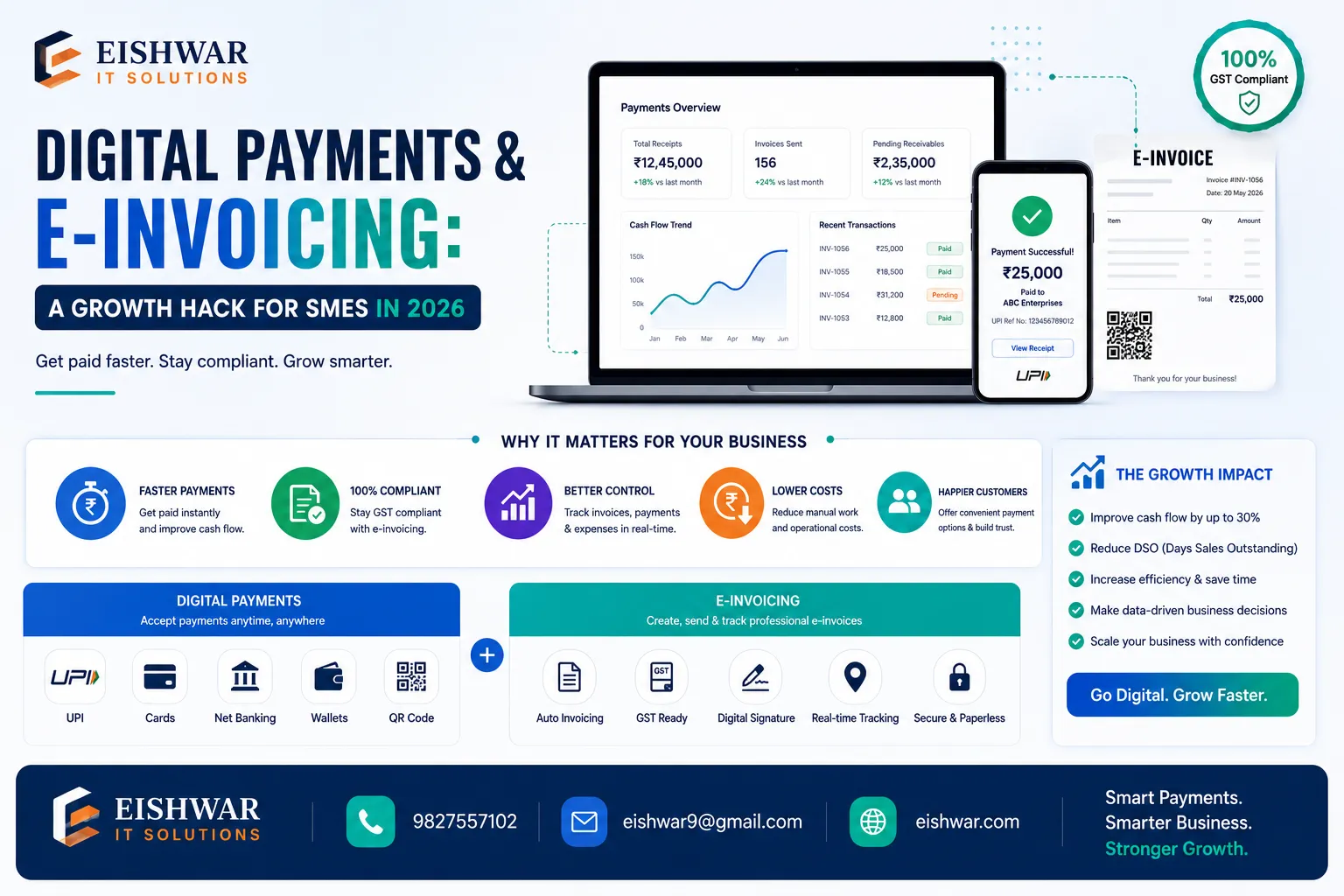
Cash flow is the lifeblood of any small business. Yet, many SMEs in India still rely on cheques, cash, or bank transfers that take days to clear. Digital payment solutions like UPI, QR codes, and payment gateways can slash settlement times from days to seconds. For example, a small retail store in Mumbai switched to UPI-based payments and reduced its average payment collection time from 3 days to 2 hours. That's real money working for you faster.
Cost Savings and Efficiency
Paper invoices cost money—printing, postage, and manual processing. E-invoicing, mandated by the GST Council for businesses with turnover above ₹5 crore, is now a best practice for all SMEs. It eliminates errors, speeds up approvals, and integrates directly with accounting software. A study by the Institute of Chartered Accountants of India found that SMEs using e-invoicing saved up to 30% on administrative costs. Plus, digital payments reduce the risk of theft and fraud associated with cash handling.
Customer Expectations
Your customers expect convenience. Whether you're a B2B supplier or a B2C retailer, offering digital payment options and instant invoices builds trust and loyalty. A recent survey by LocalCircles revealed that 78% of Indian consumers prefer businesses that accept digital payments. By not offering them, you're leaving money on the table.
Main Section 2: How to Implement Digital Payments and E-Invoicing in Your SME
Step 1: Choose the Right Payment Tools
Start with a simple, low-cost solution. For most SMEs, UPI-based QR codes (like PhonePe, Google Pay, or Paytm) are a no-brainer. They're free to set up and accepted everywhere. For online payments, consider Razorpay or Instamojo—they offer easy integration with your website and invoicing software. If you deal with large B2B transactions, look into payment gateways that support net banking and credit cards. The key is to pick tools that integrate with your existing accounting software (like Tally, Zoho Books, or QuickBooks) to automate reconciliation.
Step 2: Set Up E-Invoicing
E-invoicing doesn't have to be complex. Start by registering on the GST portal's e-invoice system. Then, choose an e-invoicing software that fits your business size—options include ClearTax, TallyPrime, or Zoho Invoice. These tools generate IRNs (Invoice Reference Numbers) automatically and sync with your accounting system. For micro-businesses, even a simple Excel template with QR codes can work initially, but automate as soon as you can.
👉 Don't wait for the perfect moment; turn your vision into reality today.
Free ConsultationStep 3: Train Your Team and Customers
Your staff needs to know how to process digital payments and generate e-invoices. Run a short training session—it can be as simple as a 30-minute demo. For customers, put up clear signage about payment options and send them a quick guide on how to pay via UPI or link. Most people already know how, but a gentle reminder helps.
Step 4: Monitor and Optimize
Use the data from your payment and invoicing tools to track cash flow, identify late payers, and spot trends. For example, if you notice a customer always pays late via bank transfer, offer them a discount for switching to UPI. Many tools offer dashboards that show your payment success rates and average settlement time.
Main Section 3: Real-World Success Stories from Indian SMEs
Case Study 1: A Jaipur Handicraft Exporter
Rohan, owner of a handicraft export business in Jaipur, used to send paper invoices and wait weeks for international payments. After switching to e-invoicing integrated with PayPal and a local payment gateway, his payment collection time dropped from 21 days to 5 days. He also saved ₹50,000 a year on courier and printing costs. His advice? "Start small—just digitize one payment method first."
Case Study 2: A Bangalore Tech Startup
Priya runs a SaaS startup with 50 clients. She implemented automated e-invoicing through Zoho Books and enabled UPI and credit card payments. Within three months, her late payments reduced by 60%, and she could focus on product development instead of chasing invoices. Her tip: "Integrate your invoicing with your CRM so you get a 360-degree view of your client."
Case Study 3: A Chennai Retail Chain
Arun owns three grocery stores in Chennai. He introduced UPI QR codes at all counters and linked them to his inventory system. Now, he can track sales in real time and reorder stock automatically. His monthly accounting time reduced from 40 hours to just 5 hours. He also noticed a 15% increase in repeat customers because they appreciated the speed of checkout.
Expert Tips
- Start with one payment method. Don't try to implement everything at once. Pick UPI first, then add cards and net banking as you grow.
- Automate reconciliation. Use software that automatically matches payments with invoices. This saves hours of manual work and reduces errors.
- Offer incentives for digital payments. For B2B, offer a small discount (like 2%) for early payment via digital methods. For B2C, run a monthly lucky draw for digital payers.
- Secure your systems. Use two-factor authentication, keep software updated, and train staff to spot phishing attempts. Digital payments are safe, but only if you follow basic security practices.
- Leverage government schemes. The Indian government offers subsidies and tax benefits for digital adoption. Check the 'Digital India' portal for current schemes available to SMEs.
Common Mistakes
- Ignoring integration. Using separate tools for payments and invoicing leads to data silos and extra work. Always choose tools that talk to each other.
- Neglecting customer communication. Don't assume customers know how to use digital payments. Send a simple guide or put up posters in your store.
- Forgetting about data backup. Digital records are great, but only if you back them up. Use cloud storage or an external drive to keep copies of invoices and payment records.
- Overcomplicating the process. Some SMEs try to implement complex ERP systems before they're ready. Start with simple, user-friendly tools and upgrade later.
- Ignoring GST compliance. E-invoicing is mandatory for many SMEs. Non-compliance can lead to penalties. Stay updated with GST rules and use software that automatically updates with regulatory changes.
Future Trends
Looking ahead to 2027 and beyond, the landscape for digital payments and e-invoicing in India will continue to evolve. We can expect deeper integration with AI and machine learning to predict cash flow issues and automate follow-ups. Blockchain-based invoicing could become mainstream, offering immutable records and reducing disputes. The government is also likely to expand the mandatory e-invoicing threshold to include more SMEs. Another trend is 'buy now, pay later' (BNPL) options for B2B transactions, which can help SMEs manage their own cash flow better. Finally, voice-activated payments and invoices via smart speakers might become common, especially for micro-businesses. Staying ahead of these trends will give your SME a first-mover advantage.
👉 Free Website Audit
Get Free AuditFAQs
1. What is the difference between digital payments and e-invoicing?
Digital payments refer to any electronic method of transferring money, such as UPI, credit cards, or net banking. E-invoicing is the process of generating invoices in a standard electronic format that can be automatically processed by the GST system. Both are complementary—digital payments handle the transaction, while e-invoicing handles the documentation.
2. Is e-invoicing mandatory for all SMEs in India?
As of 2026, e-invoicing is mandatory for businesses with an aggregate turnover exceeding ₹5 crore in any financial year. However, even if your turnover is below this threshold, adopting e-invoicing is highly recommended for its efficiency and compliance benefits. Many SMEs voluntarily use it to streamline operations.
3. Which digital payment method is best for a small retail shop?
For a small retail shop, UPI QR codes are the best choice. They are free, fast, and widely accepted. You can use apps like PhonePe, Google Pay, or Paytm. If you also sell online, consider adding a payment gateway like Razorpay. The key is to offer at least one digital option that your customers prefer.
4. How can I ensure the security of digital payments in my SME?
Start by using a secure internet connection and keeping all software updated. Train your staff to recognize phishing attempts and never share sensitive information. Use two-factor authentication for payment accounts. Regularly review your transaction history for any unauthorized activity. Most payment platforms also offer fraud detection features—enable them.
5. Can e-invoicing help me with GST compliance?
Absolutely. E-invoicing automatically generates an Invoice Reference Number (IRN) and syncs with the GST portal. This reduces errors, ensures timely filing, and makes audits smoother. Many e-invoicing software also auto-populate your GST returns, saving you hours of manual work.
👉 Free Homepage Demo
Book Demo6. What if my customers prefer cash or cheques?
While you can't force customers to switch, you can encourage them by offering small discounts for digital payments, highlighting the convenience, and educating them about security. Over time, most customers will see the benefits. You can also accept cash or cheques as a fallback, but gradually reduce reliance on them.
7. How much does it cost to implement digital payments and e-invoicing?
The cost can be very low to start. UPI QR codes are free. Basic e-invoicing software starts at around ₹500 per month. Payment gateways charge a small transaction fee (typically 1-2%). Overall, the savings in time, paper, and improved cash flow far outweigh the initial costs. Many tools also offer free trials.
Conclusion
Digital payments and e-invoicing are no longer optional for Indian SMEs—they are essential tools for growth, efficiency, and customer satisfaction. By adopting even one digital payment method and moving to e-invoicing, you can improve cash flow, reduce costs, and free up time to focus on what matters: growing your business. The journey doesn't have to be overwhelming. Start small, choose the right tools, and train your team. As you see the benefits, you'll wonder why you didn't make the switch sooner. Remember, every transaction you digitize is a step toward a more resilient and profitable future.
CTA
Ready to transform your SME's payment and invoicing processes? Book a free 30-minute consultation with our digital transformation experts at EishwarITSolution. We'll help you choose the right tools, set them up, and train your team. Click here to schedule your session and take the first step toward a smarter, faster, and more profitable business.