
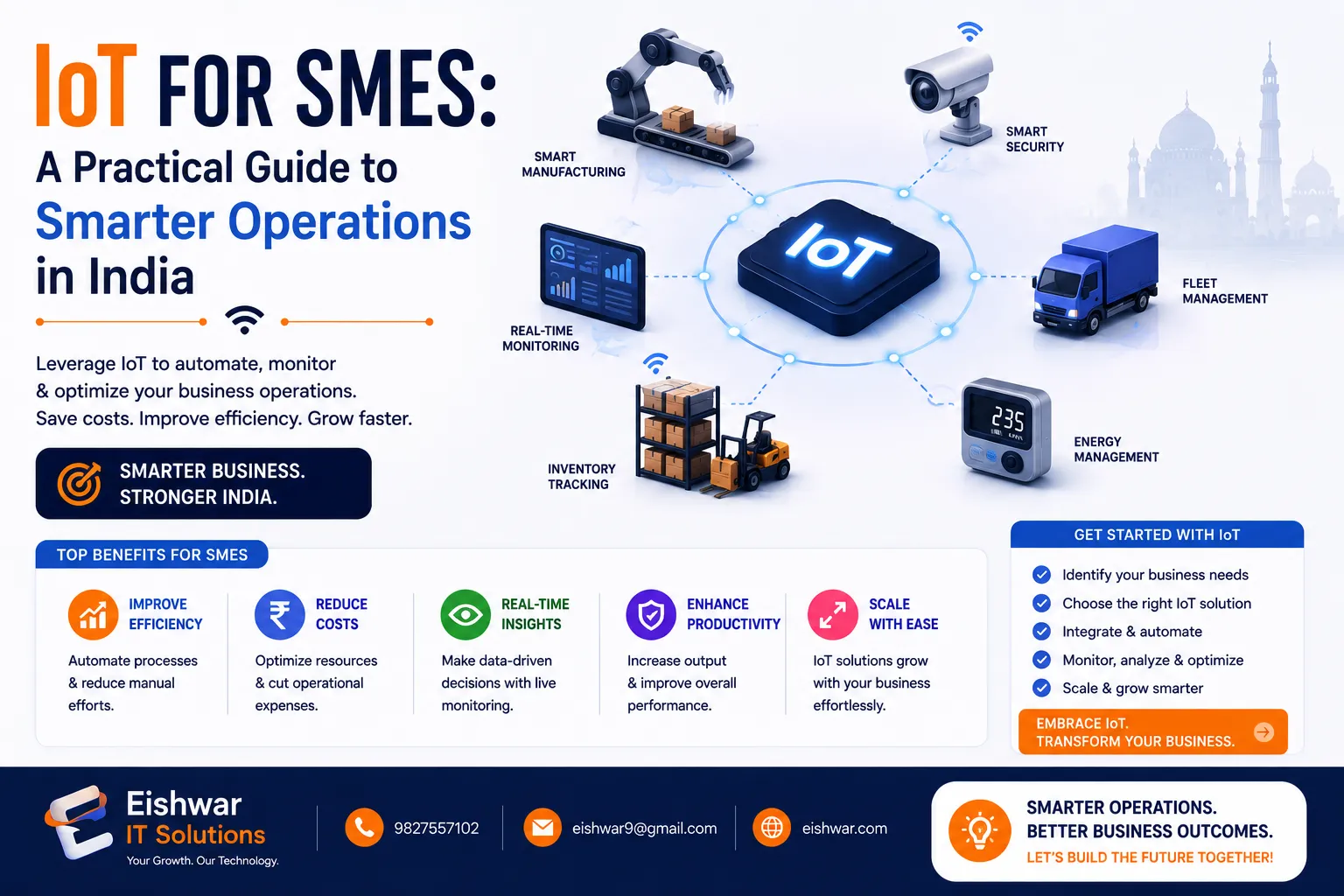
IoT for SMEs: A Practical Guide to Smarter Operations in India
Published on: 16 Jun 2026
IoT for SMEs: A Practical Guide to Smarter Operations in India
Introduction
Imagine your small factory in Pune—machines automatically reporting when they need maintenance, inventory updating in real time, and energy usage optimized without manual intervention. That’s the power of the Internet of Things (IoT). Once considered a luxury reserved for large enterprises with deep pockets, IoT is now accessible and transformative for Indian SMEs. In 2026, with affordable sensors, cloud platforms, and government initiatives like Digital India, even a small business can adopt smart operations and compete with industry giants.
Learn more about our Website services
This guide will walk you through practical IoT applications for Indian SMEs, real-world examples, expert tips, and common pitfalls to avoid. Whether you run a manufacturing unit, a logistics company, or a retail chain, you’ll find actionable insights to start your IoT journey today. We’ll cover everything from budget-friendly sensor kits to scaling strategies, ensuring you have a clear roadmap to smarter operations.
Main Section 1: Why IoT Matters for Indian SMEs Now
The Indian SME sector contributes nearly 30% to GDP and employs over 110 million people. Yet, many still rely on manual processes, leading to inefficiencies, waste, and missed opportunities. IoT bridges this gap by connecting physical assets to the digital world, enabling real-time monitoring, predictive analytics, and automation. The timing couldn’t be better—with digital infrastructure expanding rapidly and costs plummeting, SMEs can now leverage IoT to level the playing field.
Key benefits for SMEs:
- Cost reduction: Predictive maintenance reduces downtime by up to 50%. For example, a small textile unit in Surat saved ₹2 lakh annually by monitoring machine vibration and scheduling repairs proactively.
- Improved quality: Sensors detect anomalies in production, reducing defects by 20-30%. A metal fabrication shop in Coimbatore used IoT to monitor welding parameters, cutting scrap by 25%.
- Energy efficiency: Smart meters and lighting cut electricity bills by 15-25%. A bakery in Bengaluru saved ₹50,000 per month by automating oven schedules based on real-time demand.
- Inventory accuracy: RFID tags and weight sensors ensure stock levels are always correct, reducing overstocking and stockouts. A small pharma distributor in Delhi reduced inventory discrepancies by 90%.
- Customer satisfaction: Real-time tracking for logistics SMEs improves delivery reliability. A courier service in Jaipur used IoT-enabled GPS trackers to provide live updates, boosting customer retention by 30%.
With the cost of IoT sensors dropping below ₹500 and cloud platforms offering pay-as-you-grow models, the barrier to entry has never been lower. Government subsidies under the MSME Digital Transformation Scheme further sweeten the deal, covering up to 50% of project costs. Additionally, initiatives like the Startup India Seed Fund Scheme provide grants for tech adoption, making IoT a viable investment for even the smallest businesses.
Main Section 2: Practical IoT Applications for Indian SMEs
Here are three high-impact areas where IoT can transform your operations without breaking the bank. Each application is tailored to common SME challenges and offers clear, measurable benefits.
2.1 Smart Manufacturing and Predictive Maintenance
For manufacturing SMEs, unplanned downtime is a nightmare—it can cost thousands of rupees per hour in lost production. IoT sensors attached to motors, conveyors, and pumps can monitor temperature, vibration, and usage. When anomalies are detected, the system alerts you via SMS or app, allowing you to schedule maintenance before a breakdown occurs. This proactive approach extends equipment life and reduces emergency repair costs.
👉 Don't wait for the perfect moment; turn your vision into reality today.
Free ConsultationExample: A small auto parts manufacturer in Chennai installed vibration sensors on three critical machines. Within six months, unplanned downtime dropped by 40%, saving ₹1.5 lakh in lost production and repair costs. The sensors, costing ₹3,000 each, paid for themselves in two months.
Actionable tip: Start with one critical machine. Use a low-cost sensor kit (₹2,000-5,000) and a free tier of a cloud platform like AWS IoT Core or ThingsBoard. For connectivity, opt for Wi-Fi modules like ESP8266 if you have stable internet, or cellular modules like SIM800L for remote areas. Monitor data daily for the first month to set baseline thresholds.
2.2 Cold Chain and Inventory Monitoring
If your SME deals with perishable goods—food, pharmaceuticals, flowers—temperature and humidity control is vital. IoT temperature loggers and humidity sensors can send real-time alerts if a cold storage unit fails, preventing spoilage and compliance issues. This is especially critical for businesses exporting to regulated markets like Europe, where temperature logs are mandatory.
Example: A dairy cooperative in Gujarat used IoT-enabled temperature sensors across its supply chain, from collection centers to retail outlets. Spoilage reduced by 25%, and they gained FSSAI compliance effortlessly. The system also generated automated reports for audits, saving hours of manual paperwork.
Actionable tip: Deploy battery-powered temperature sensors (₹1,000 each) that transmit data via cellular networks. Set thresholds and get alerts on your phone. For larger operations, consider integrating with a cloud-based dashboard that tracks historical trends. Use LoRaWAN sensors for long-range, low-power monitoring in rural areas.
2.3 Energy Management and Smart Lighting
Electricity is a major operational cost for SMEs, often accounting for 10-20% of expenses. IoT-based energy monitoring systems track consumption per machine, shift, or zone, helping you identify waste. Smart lighting systems with motion sensors automatically turn off lights in unoccupied areas, while smart plugs schedule equipment shutdowns during non-peak hours.
Example: A packaging unit in Mumbai installed smart meters on its top three energy-consuming machines. By shifting high-load operations to off-peak hours, they reduced the electricity bill by 18% in three months. The ₹15,000 investment was recovered in four months.
Actionable tip: Use a plug-and-play energy monitor (₹3,000-7,000) that clamps onto your main panel. Analyze data weekly to identify waste, such as machines left on during breaks. Pair with smart plugs (₹500 each) to automate shutdowns. For retail spaces, install motion-sensor lights (₹1,000 per unit) to cut lighting costs by 30%.
Main Section 3: How to Start Your IoT Journey (Step-by-Step)
Implementing IoT doesn’t require a huge team or budget. Follow these five steps to ensure a smooth, cost-effective rollout:
- Identify a pain point: Choose one area where manual tracking is causing losses—e.g., machine downtime, inventory errors, or high energy bills. Conduct a simple cost-benefit analysis to estimate potential savings.
- Select low-cost sensors: Look for Indian vendors like IoTfy, Cytron, or local electronics shops. Start with 2-5 sensors to keep the pilot manageable. For example, a temperature sensor for cold storage or a vibration sensor for a motor.
- Choose a platform: Free tiers of AWS IoT, Microsoft Azure IoT Central, or open-source solutions like Node-RED are great for beginners. These platforms offer pre-built dashboards and alerting features.
- Connect and test: Use Wi-Fi or cellular modules (SIM800L, ESP32). Test for a week to calibrate thresholds and ensure data accuracy. Involve your team in the testing phase to gather feedback.
- Scale gradually: Once you see ROI, expand to other machines or processes. Aim for a 10-15% improvement in the first quarter. Document lessons learned to refine your approach.
Don’t forget to train your team. A simple dashboard on a mobile phone or tablet is often enough to get started. Conduct a 2-hour workshop to explain how to interpret alerts and take corrective actions. Consider appointing a “IoT champion” within your team to oversee the project.
👉 Free Website Audit
Get Free AuditExpert Tips
We spoke with Ravi Sharma, IoT consultant and founder of SmartOps India, who shared these insights based on his experience with over 50 SME projects:
- “Start with a pilot project on a single machine or process. Prove ROI before scaling. Many SMEs fail by trying to do too much at once.”
- “Security is often overlooked. Change default passwords, segment IoT devices on a separate network, and update firmware regularly. Use VPNs for remote access.”
- “Focus on data that drives decisions. Don’t collect everything—collect what matters. For example, if you’re monitoring temperature, don’t also log humidity unless it’s critical.”
- “Partner with local system integrators who understand your industry. They can customize solutions at a fraction of the cost of big consultancies. Look for integrators certified by platforms like AWS or Azure.”
- “Invest in a simple visualization tool like Grafana or Google Data Studio to make data accessible to non-technical staff. A picture is worth a thousand data points.”
Common Mistakes
Avoid these pitfalls that can derail your IoT project:
- Over-engineering: Buying expensive sensors and complex platforms for a simple need. Keep it minimal. A ₹500 temperature sensor with a free cloud tier is often sufficient.
- Ignoring connectivity: In rural or factory settings, Wi-Fi may be unreliable. Use cellular (2G/4G) or LoRaWAN instead. Test connectivity before deploying sensors.
- No data analysis plan: Collecting data without a plan to act on it is useless. Decide who will review dashboards and how often. Set up automated alerts for critical thresholds.
- Underestimating training: If your team can’t interpret alerts, the system becomes shelfware. Invest in 2-3 hours of training and create a simple user manual.
- Neglecting maintenance: IoT devices need firmware updates and battery replacements. Schedule quarterly checks to ensure everything is working.
Future Trends
IoT for SMEs in India is evolving rapidly. Here’s what to watch by 2027:
- AI-driven analytics: Machine learning models will predict failures and suggest optimal maintenance schedules automatically, reducing human intervention.
- Blockchain for supply chain: Immutable records from IoT sensors will enhance trust in food and pharma supply chains, enabling traceability from farm to fork.
- 5G and edge computing: Faster, low-latency networks will enable real-time control of remote machinery, opening up new use cases like autonomous forklifts in warehouses.
- Government-backed IoT hubs: More incubation centers and subsidies will make IoT even more affordable for SMEs. For example, the Ministry of Electronics and IT (MeitY) is setting up IoT centers of excellence in tier-2 cities.
- Integration with ERP: IoT data will seamlessly feed into enterprise resource planning (ERP) systems, automating inventory updates and purchase orders.
FAQs
1. What is the minimum budget needed for IoT in an SME?
2. Do I need technical staff to implement IoT?
3. How secure is IoT for small businesses?
4. Can IoT work in rural areas with poor internet?
5. What is the typical ROI timeline for IoT in SMEs?
6. Are there government schemes to support IoT adoption for SMEs?
7. How do I choose the right IoT platform for my SME?
Conclusion
IoT is no longer a futuristic concept—it’s a practical tool that Indian SMEs can use today to become smarter, more efficient, and more competitive. By starting small, focusing on a specific pain point, and leveraging affordable technology, you can achieve significant improvements in cost, quality, and customer satisfaction. The journey of a thousand miles begins with a single sensor. Take that step now, and watch your operations transform.
👉 Free Homepage Demo
Book DemoCTA
Ready to transform your SME with IoT? Contact EishwarITSolution for a free consultation and pilot project assessment. Our team of experts will help you identify the right IoT applications, select cost-effective sensors, and build a roadmap for success. Let’s build your smart operations together.