
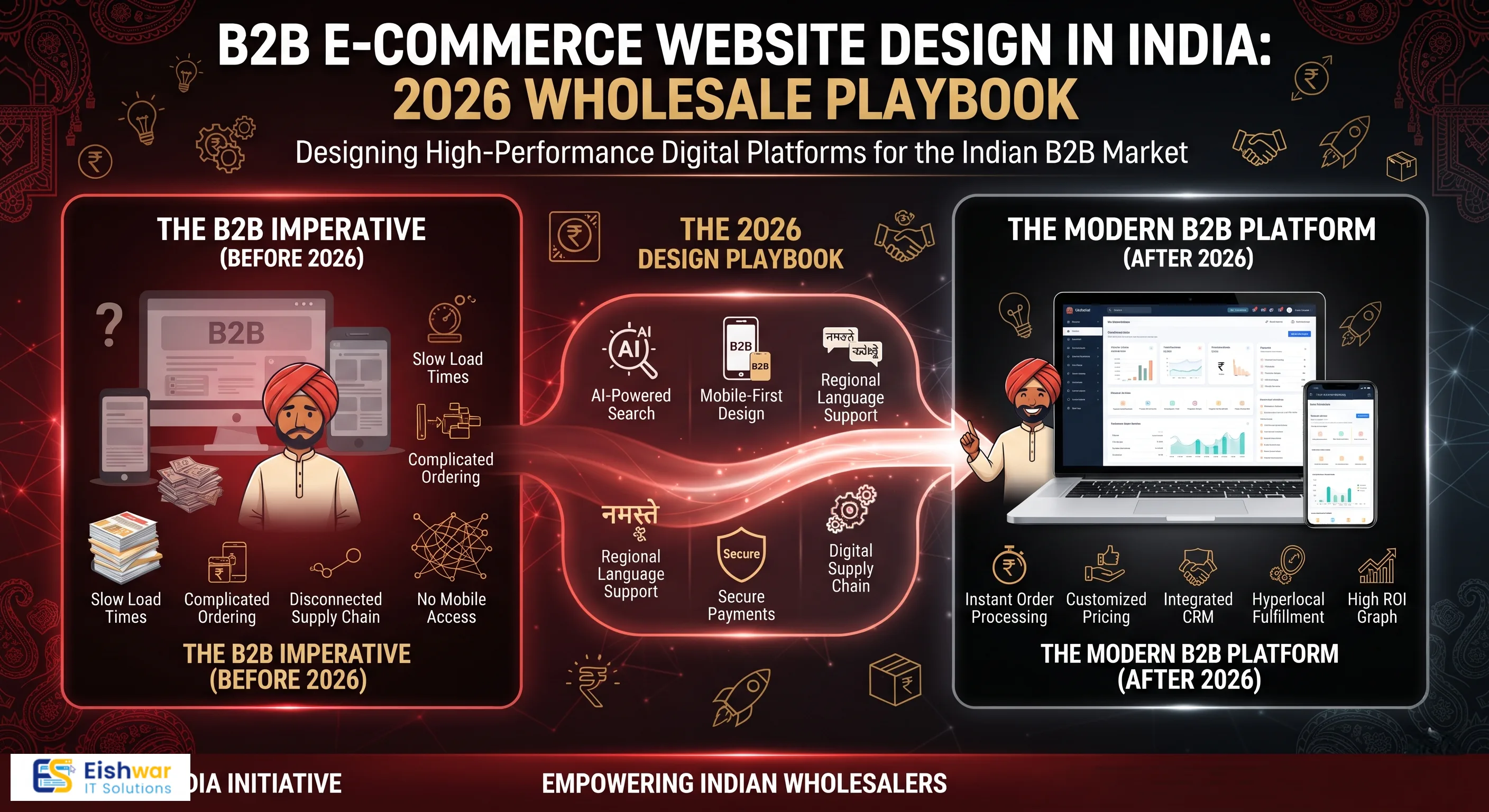
B2B E-commerce Website Design in India: 2027 Wholesale Playbook
Published on: 16 Nov 2026
B2B E-commerce Website Design in India: 2027 Wholesale Playbook
India’s B2B buyers are changing fast. Wholesalers, distributors, manufacturers, and procurement teams now expect the convenience of online ordering. They want to check stock, compare bulk prices, download GST invoices, and repeat last month’s order without calling a sales rep. But a B2B buyer is not a consumer shopper. The purchase is driven by business needs, credit terms, approval layers, and long-term supplier relationships.
Learn more about our Website services
That is why B2B e-commerce website design in India needs a different playbook. A copy of a D2C store will look modern but may fail the moment a buyer asks for 500 units, a quote, or 30-day credit. This guide breaks down the practical design choices that help Indian businesses turn their website into a reliable sales channel.
Introduction
B2B e-commerce is no longer a nice-to-have website with a catalog PDF. Buyers expect to browse products, understand specifications, request quotes, and place repeat orders online. At the same time, B2B sales teams still need control over negotiated pricing, credit limits, and customer-specific terms.
The best B2B e-commerce website design in India connects both worlds. It gives buyers self-service convenience while giving internal teams visibility and control. For business owners, marketers, and professionals, the goal is simple: reduce manual order handling, speed up repeat purchases, and make it easier for buyers to trust your business online.
This playbook covers the design decisions that matter most in 2027, from catalog architecture and quote workflows to mobile usability and SEO.
Main Section 1: Why B2B E-commerce Website Design in India Is Different
A consumer store often wins with emotion, offers, and one-click buying. A B2B store wins with clarity, efficiency, and commercial confidence. The buyer may be a shop owner, purchase manager, accountant, or operations lead. Each person needs different information before saying yes.
For example, a textile wholesaler in Surat may sell to retailers across Gujarat and Maharashtra. A buyer logs in, sees volume-based pricing per meter, checks minimum order quantity, adds 500 meters to the cart, and requests 30-day credit. The buyer also wants a GST invoice and a dispatch date. A standard D2C checkout cannot handle that journey well.
Designing for B2B means planning for multiple roles, bulk quantities, negotiated rates, tax details, delivery schedules, and repeat orders. Before wireframes, map the buying journey. Ask your sales team which questions buyers ask most often. Ask your accounts team which details create order errors. Those answers should shape your website.
What B2B buyers expect online
- Clear product specifications and availability.
- Bulk pricing, MOQ, and volume discounts.
- Simple quote requests and fast follow-ups.
- GST invoice details and credit terms.
- Reorder options and order history.
- Access to a sales representative when needed.
Actionable tip: add a visible Request a Quote button on product and category pages. Show MOQ and dispatch time near the price. Let buyers upload a bulk order sheet if your catalog is large. These small design choices remove friction for serious buyers.
👉 Don't wait for the perfect moment; turn your vision into reality today.
Free ConsultationMain Section 2: Core Building Blocks of a High-Converting B2B Store
Catalog architecture for bulk buyers
B2B catalogs are often deep and technical. Organize products by application, industry, brand, grade, size, and availability. Use filters that match how buyers actually search. A construction materials buyer may filter by grade, load capacity, and warranty. A stationery distributor may filter by pack size, brand, and MOQ.
Do not force buyers through too many clicks. Add comparison tables, downloadable spec sheets, and clear related-product suggestions. If you sell spare parts, let buyers search by part number. If you sell custom products, explain the customization process and lead time on the category page itself.
Account-based pricing and quote workflows
Many B2B businesses have different prices for different customer groups. Design for logged-in pricing, customer-specific catalogs, and tiered slabs. A buyer should see their negotiated rate, not a generic retail price. If pricing must remain private, allow browsing but gate the price until login or quote approval.
Quote workflows matter. Give buyers a form that asks for quantity, delivery location, GST number, required date, and special instructions. Then route the request to the right salesperson. Show a confirmation message with expected response time. This builds confidence and reduces duplicate enquiries.
Product pages that answer procurement questions
B2B product pages should answer the questions a purchase manager asks before contacting you. Include specifications, HSN code, GST rate, MOQ, packaging details, lead time, warranty, bulk discounts, and return policy. Add a downloadable PDF for procurement teams that need internal approval.
Use clear microcopy. Instead of saying Price on request, explain why. For example: Log in to see your dealer price or Request a quote for bulk quantities. This reduces frustration and keeps buyers moving.
Checkout and payment options for B2B
A B2B checkout should support purchase order numbers, credit terms, bank transfer, UPI, net banking, partial payments, and multiple delivery addresses. Allow buyers to add shipping instructions. If your business uses credit limits, show available credit before the order is placed.
Do not force B2B buyers into a consumer-style checkout that assumes instant card payment. Many businesses need an invoice, approval, and payment against delivery. Design the checkout around your actual commercial process.
Sales-assisted design and reorder flows
Your website should support your sales team, not replace it. Add order history, repeat previous order, saved lists, and assigned sales representative details. A WhatsApp or call button on key pages can help buyers who prefer human contact. For repeat buyers, make the reorder path one of the fastest actions on the site.
Main Section 3: Designing Trust, Speed, and Mobile Usability for Indian Wholesale Buyers
Trust signals for Indian B2B buyers
Trust is the real currency in B2B. Show your GST number, registered business address, certifications, client logos, warehouse photos, and clear return or replacement policy. Add testimonials with company names and buyer roles where possible. Secure payment badges help, but business credibility matters more.
Make it easy to verify your business. A buyer should not have to search for your contact details or wonder whether the website belongs to a legitimate supplier. Put contact information, support hours, and response expectations in the footer and on product pages.
👉 Free Website Audit
Get Free AuditMobile usability for on-the-go buyers
Many Indian B2B buyers research products on mobile even when final ordering happens on desktop. Responsive design must do more than shrink the desktop layout. Test tables, filters, quote forms, and checkout on low-end Android phones. Use large tap targets, sticky call and WhatsApp buttons, and readable product specs.
If your catalog has complex tables, consider a mobile-friendly card view with expandable details. Let buyers save the cart and continue later. A mobile experience that feels slow or cramped will push buyers back to phone calls.
Speed, search, and SEO for wholesale queries
Speed affects both usability and search visibility. Compress images, clean up scripts, and use caching. Keep category pages fast and scannable. For SEO, target commercial-intent phrases such as bulk suppliers, wholesale dealer, and B2B distributor in your product and category pages.
Create helpful content around buyer questions. A page explaining how to choose the right grade or how GST invoicing works can attract qualified traffic. Use clean URLs, product schema, FAQ sections, and internal links between related categories. Mention B2B e-commerce website design India naturally in your service or resource pages, not in every paragraph.
Integrations that reduce manual work
The website should connect with your ERP, inventory system, CRM, payment gateway, GST invoice software, and logistics tools. Before design begins, audit how orders currently move through your business. If inventory is not synced, buyers may order out-of-stock items. If sales enquiries do not reach the right person, response time suffers.
Expert Tips
- Interview your sales team before designing the catalog. They know the exact questions buyers ask.
- Design for repeat orders first. Most B2B revenue comes from existing customers.
- Make Request a Quote visible on every product page and category page.
- Show MOQ, dispatch time, GST rate, and packaging information early.
- Allow guest browsing but gate negotiated pricing behind login.
- Test mobile tables and forms on budget Android devices.
- Use clear microcopy to explain credit terms, delivery schedules, and approval steps.
- Track quote requests, reorders, add-to-cart events, and checkout drop-offs in analytics.
- Keep forms short. Ask only for details needed to respond or generate a quote.
- Plan SEO content around buyer questions, not just product keywords.
Common Mistakes
- Copying a D2C template without adding B2B pricing, quote, and credit workflows.
- Hiding all information behind login, which stops first-time buyers from evaluating your catalog.
- Ignoring the sales team, then wondering why website enquiries are poorly followed up.
- Overloading product pages with every detail instead of organizing information in tabs and sections.
- Building a desktop-only experience for buyers who research on mobile.
- Forgetting trust signals such as GST details, business address, and clear return policy.
- Using consumer-style checkout that does not support purchase orders or credit terms.
- Not measuring quote requests, reorders, and sales-assisted conversions.
Future Trends
B2B e-commerce design in India will become more workflow-driven. Expect API-first storefronts that connect smoothly with ERP and CRM systems. AI-assisted catalog enrichment will help businesses generate specifications, descriptions, and translations faster. AI-assisted quoting may help sales teams respond to routine enquiries sooner.
👉 Free Homepage Demo
Book DemoUPI-linked B2B payments and credit options will continue to shape checkout expectations. WhatsApp-first reordering will matter for buyers who already use chat for business. Hyperlocal fulfillment visibility, such as dispatch and delivery tracking, will become a stronger trust signal. Businesses that design for these workflows now will be better prepared for the next wave of B2B buying.
FAQs
What is B2B e-commerce website design in India?
It is the design of an online store for business buyers such as wholesalers, distributors, manufacturers, and procurement teams. It usually includes bulk pricing, quote requests, GST invoicing, credit terms, account-based catalogs, and repeat-order features.
How is a B2B store different from a D2C store?
A D2C store focuses on individual shoppers and quick checkout. A B2B store focuses on business workflows such as minimum order quantities, negotiated pricing, purchase orders, approvals, credit limits, and sales team support.
Should we show prices to all website visitors?
You can allow visitors to browse the catalog and show standard prices publicly. For negotiated or dealer pricing, gate the price behind login or use a request-a-quote option. The right choice depends on your commercial policy and competition.
How long does a B2B e-commerce website take to build?
Timelines vary by catalog size, integrations, and custom workflows. A focused B2B store can take a few weeks, while a larger build with ERP integration and account-based pricing may take several months. Plan for discovery, design, development, testing, and training.
Do we need ERP integration?
If you manage stock, pricing, invoices, or orders in an ERP system, integration reduces manual work and order errors. Start with the most important sync: products, inventory, customer pricing, and order status.
How do we improve repeat orders?
Make reordering fast. Add order history, saved lists, repeat previous order, and clear pricing for logged-in buyers. Send timely reminders and keep the path to a sales representative visible when buyers need help.
Conclusion
B2B e-commerce website design in India is not about copying the latest D2C trend. It is about building a reliable commercial system for bulk buyers. Focus on clear catalogs, account-based pricing, quote workflows, trust signals, mobile usability, and integrations that reduce manual work. When buyers can self-serve with confidence, your sales team gets more time for high-value conversations.
CTA
Ready to turn your wholesale business into a faster online sales channel? EishwarITSolution can help you plan and build a B2B e-commerce website that fits Indian buying behaviour and your internal workflows. Start with a practical website audit and a clear 2027 roadmap.