
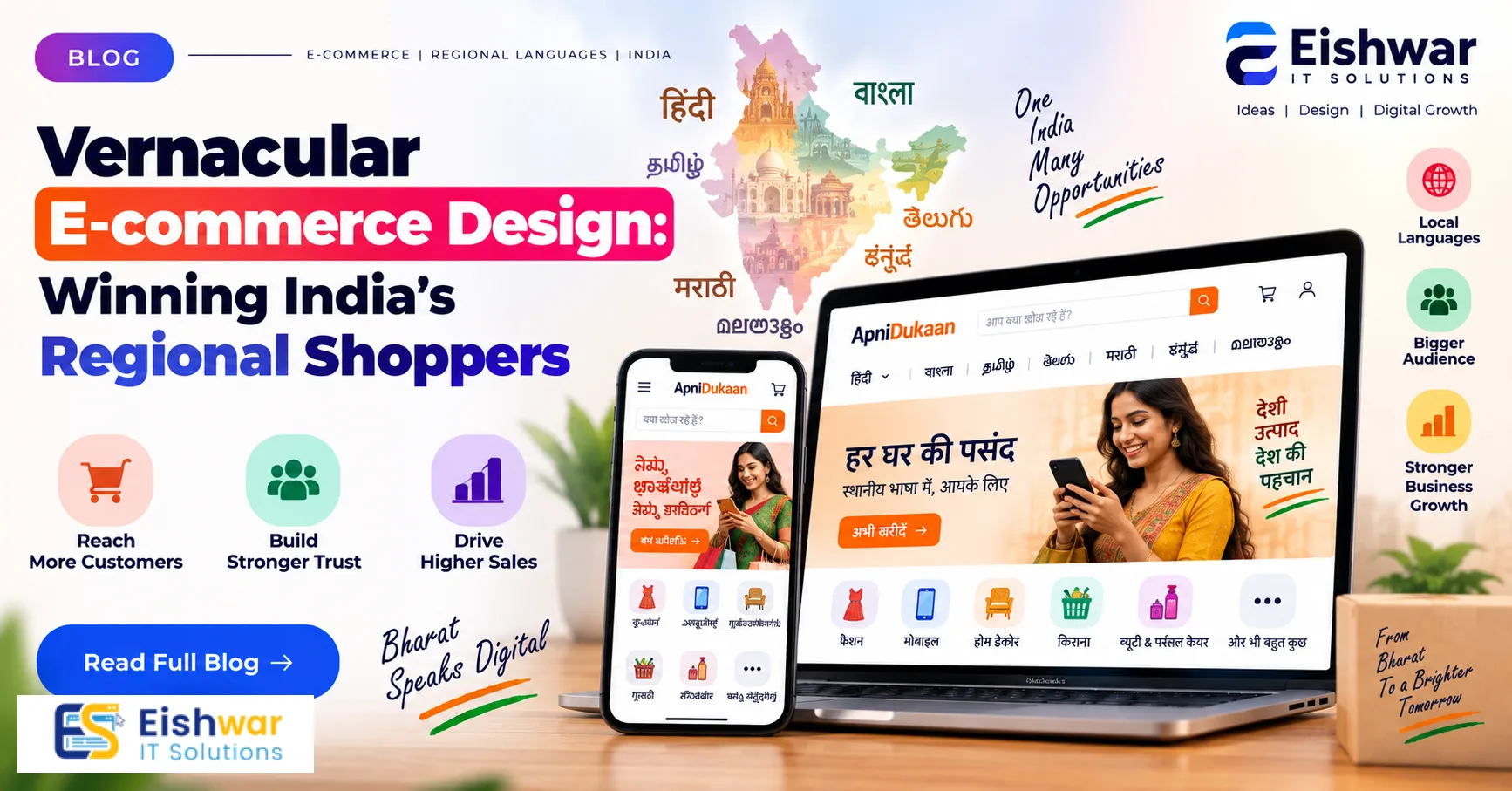
Vernacular E-commerce Design: Winning India's Regional Shoppers
Published on: 31 Aug 2026
Vernacular E-commerce Design: Winning India's Regional Shoppers
Introduction
India is a land of diversity, and nowhere is that diversity more visible than in its languages. While Hindi and English dominate conversations about digital business, the reality is that over 90% of Indians prefer interacting with digital content in their mother tongue. For e-commerce businesses, this is a wake-up call. If your website speaks only English, you are leaving millions of potential customers behind.
Learn more about our Website services
Vernacular e-commerce website design is no longer a luxury—it's a necessity. As internet penetration deepens in Tier-2 and Tier-3 towns, people are now shopping online in Hindi, Tamil, Telugu, Bangla, Marathi, and more. They want to read product details, compare prices, and make payments in a language they understand and trust. In this post, we'll explore why vernacular design matters, what it looks like in practice, and how you can implement it for your own online store with help from specialists like EishwarITSolution.
If you're a business owner, marketer, or digital professional in India, this guide is your roadmap to connecting with a vast, underserved audience. Let's dive in.
Main Section 1: Why Vernacular Commerce Matters for E-commerce Design
1. The Rapid Growth of Regional Language Internet Users
India has over 900 million internet users, and by 2026, the number is expected to cross 1 billion. But here's the catch: nearly 80% of new internet users prefer consuming content in their local language. According to a report by Google and KPMG, regional language internet users are expected to surpass English users by 2026. In fact, languages like Hindi, Tamil, and Telugu are growing at a much faster pace than English.
This shift is transforming the e-commerce landscape. A customer in Baroda or Coimbatore is more likely to complete a purchase if the product description is in Gujarati or Tamil. That's not just a preference—it's a deciding factor. Websites that offer a truly localized experience will win loyalty, while those that ignore this trend will struggle to grow beyond metro cities.
2. Trust and Credibility in the User's Language
Language is deeply tied to trust. When an e-commerce website displays product details, prices, shipping policies, and refund information in a user's mother tongue, it instantly reduces anxiety. Shoppers feel respected and understood. This trust translates into higher conversion rates, lower bounce rates, and fewer abandoned carts.
For example, imagine you're shopping on a site that shows "EMI available" in English, but the EMI explanation is unclear. A user with limited English proficiency might hesitate to proceed. However, if the site clearly explains "No-cost EMI available, pay in 6 monthly instalments" in their language, they feel confident. The result? More sales, happier customers, and fewer support tickets.
3. Unique Competitive Advantage for E-commerce Brands
The Indian e-commerce market is crowded. Big players like Amazon and Flipkart have historically dominated, but they too are now investing heavily in vernacular commerce. As a smaller player, you can stand out by designing your website for regional languages from day one. By doing so, you position yourself as a brand that genuinely cares about its diverse customer base.
👉 Don't wait for the perfect moment; turn your vision into reality today.
Free ConsultationIn a market where 71% of consumers are more likely to buy from a website in their own language, empowering your e-commerce design with vernacular options is a strategic moat. It can be the difference between a one-time visitor and a loyal, repeat customer.
Main Section 2: Core Elements of a Vernacular E-commerce Website Design
1. Seamless Language Switcher and Geolocation
A great vernacular e-commerce design starts with a highly visible, user-friendly language switcher. Users should be able to switch languages instantly without losing their cart, search history, or current page. Ideally, the site automatically detects the user's preferred language based on their browser settings or geolocation—and offers a gentle prompt to switch if they're browsing in a different language region.
For example, if someone in Tamil Nadu visits a site with geolocation in Chennai, the site could automatically suggest Tamil as the display language. The user can then accept or choose another language. The key is to make the switcher obvious and easy to find, usually in the top header or as a floating selector on mobile.
2. Native Script, Not Just Transliteration
One of the biggest mistakes in vernacular e-commerce is simply transliterating English text into regional scripts. Transliteration—writing "Hello" as "हेलो"—is not the same as translation. While sometimes useful for search queries, it often looks awkward and unnatural. Instead, you should invest in professional translation that respects linguistic subtleties, cultural tone, and context.
A Hindi-speaking customer should see product descriptions written in natural Hindi, not a word-for-word conversion from English. Similarly, a Tamil customer in Coimbatore should read clear, grammatically correct Tamil. This level of quality builds credibility and reduces misunderstandings. It's an investment that pays off.
3. Fonts, Typography, and Responsive Layouts
Many Indian scripts require special fonts and proper rendering. Your e-commerce design must ensure that all regional language fonts load seamlessly across devices. Use web-safe fonts that support Devanagari, Tamil, Telugu, Bangla, and other scripts. Also, be mindful of line length and spacing—regional language translations often take up more space than English. If your layout is rigid, long words may break awkwardly or overflow.
A responsive design that adapts to different text lengths is crucial. For example, English "Add to Cart" may become "कार्ट में जोड़ें" in Hindi, which is longer. Your buttons and labels should flex, or you should use shorter but effective translations. Testing on mobile is especially important, as most Indian users access e-commerce sites via smartphones.
4. Localized Payment and Shipping Details
Payment methods and shipping options play a huge role in the buying decision. Simply listing "UPI, Credit Card, Net Banking" is not enough. Explain how UPI works, what charges apply, and how refunds are processed—all in the user's language. Same for shipping: explain expected delivery times, cash-on-delivery availability, and return policies clearly.
Vernacular design is not just about the interface; it's about making the entire shopping experience effortless. For instance, a Bengali customer should understand the EMI options without having to call support. This reduces friction and makes your site feel genuinely local.
👉 Free Website Audit
Get Free Audit5. Regional Language Customer Support
E-commerce doesn't end at checkout. After-sales support is where loyal customers are made. If your website offers live chat or email support, make sure your support team can respond in the same regional language the customer used on your site. Even a basic chatbot with vernacular support can resolve issues quickly and reduce dropout.
Main Section 3: How to Implement a Vernacular-First E-commerce Design Strategy
Step 1: Identify Your Target Language-Clusters
Start by analyzing your current audience and business goals. Which states or regions are you targeting? Do you want to focus on Hindi first, or expand to Tamil, Telugu, and Kannada? You don't need to go from English to 10 languages overnight. Begin with the languages that align with your top traffic sources or your biggest growth opportunities.
Use data from Google Analytics to see which cities your visitors come from. Look at query patterns—are users searching for your product in Hindi or Tamil? Tools like Google Trends can reveal which regional languages have high demand for your niche. Prioritize accordingly.
Step 2: Choose the Right CMS and E-commerce Platform
Not all CMS platforms handle multilingual content easily. WordPress with WooCommerce, Shopify, or Magento all offer multilingual plugins, but you need to choose one that supports Indian scripts and locales effectively. Ensure the platform supports hreflang tags, language-specific URLs (e.g., /hi/, /ta/ or subdomains), and seamless translation workflows.
If you're building a custom site, work with a development team that understands the intricacies of Indic scripts. EishwarITSolution specializes in e-commerce website design and can help you implement a scalable vernacular architecture that grows with your business.
Step 3: Set Up Hreflang and SEO Best Practices
For search engines to correctly index your regional language pages, you must implement hreflang annotations. This tells Google which language and country version of a page is appropriate for different users. For example, the English page at "/product/shoes" and the Hindi version at "/hi/product/shoes" need mutual hreflang links.
Also, create localised URLs that contain keywords in local languages? While this can be powerful, it's not always practical. However, you should absolutely ensure meta titles, descriptions, alt text, and URLs are meaningful in each language. Avoid machine translation for SEO metadata—invest in human-like translation to rank authentically.
Step 4: Design the UI for Scalability
Your design system should include components that can handle variable text expansion. Use flexible grid layouts, fluid spacing, and scalable CSS. Test every UI component with the longest expected translation string. For example, "Kuccha Samaan" might be short, but "पूरे दिन की खरीदारी के लिए बेस्ट मूल्य" is longer. Your buttons, cards, and menus should still look clean.
Don't forget the mobile experience. Most vernacular users are mobile-first. Prioritise fast loading, simple navigation, and thumb-friendly hit areas. Large iconography and minimal clutter go a long way in making a regional language interface universal.
Step 5: Test with Native Speakers
Before launch, conduct usability testing with native speakers from your target regions. They will catch awkward phrasing, translation errors, and cultural nuances that you might miss. Ask them to perform key tasks: browsing, searching, adding to cart, and checking out. Use their feedback to refine the copy and layout. Continuous testing after launch is equally important—language trends and slang evolve, so keep your content fresh.
👉 Free Homepage Demo
Book DemoExpert Tips
- Invest in professional translation and transcreation. Avoid literal translations. Work with professional translators who understand e-commerce terminology and cultural tone. Transcreation—adapting the message rather than just translating—creates stronger emotional connections.
- Use language-first visual cues. Don't rely solely on dropdown menus. On mobile, show language options as quick chips or tiles at first visit—e.g., "हिंदी, English, தமிழ்". Make it a one-click change.
- Localise your product photos and videos. Vernacular design goes beyond text. If your marketing images feature models from different regions, your brand will feel more relatable. Add local language subtitles to product explainer videos.
- Monitor regional language search trends. Use tools like Google Keyword Planner to see what terms users are typing in Hindi, Tamil, or Bangla. Create content that directly answers those queries.
- Leverage engagement metrics per language. Track how users interact with each language version of your site. If Tamil users spend more time on product videos, create more video content in Tamil. Data-driven design refinement is key.
Common Mistakes
- Machine-only translations. Using Google Translate for your entire site may seem cost-effective, but poor grammar and wrong context confuse users and damage trust. Invest in human translation or high-quality AI solutions with human review.
- Ignoring mobile performance. A complex multilingual site that loads slowly on 4G networks will kill conversions. Optimise images, use a CDN, and keep the site lightweight.
- Poor hreflang implementation. Incorrect hreflang tags can lead to duplicate content issues or the wrong language ranking. Ensure every language page links to its counterparts correctly.
- Not offering localised customer support. If a user buys in Tamil but has to email a support team that only speaks English, the experience falls apart. Provide support in at least the languages you offer.
- Force-switching users to English. If a visitor selects Hindi, respect that choice. Don't show pages in English after a few clicks, and don't auto-redirect them to English unless they explicitly choose it.
Future Trends
Voice Commerce in Regional Languages
Voice search is exploding, and Indian users are increasingly using voice assistants in Hindi, Tamil, and other local languages. The future of e-commerce design will include voice-enabled shopping flows—searching, adding to cart, and even making payments through voice commands. Designing for voice-first interactions means structuring content in a way that voice assistants can easily interpret.
AI-Powered Hyperlocal Translation
Artificial intelligence will play a bigger role in delivering contextual, real-time translations and localised content. AI models can adapt to regional slang, local brand names, and even dialect variations. This will make vernacular commerce more scalable, reducing the cost of manual translation.
Regional Video Shopping Experiences
Video commerce is growing, especially in regional languages. E-commerce websites will incorporate video-based product demonstrations, tutorials, and live shopping in local languages. Design decisions will need to support these multimedia experiences without overwhelming users or slowing down the site.
Hyperlocal Delivery Integration
As same-day and next-day delivery expand beyond metros, e-commerce platforms will integrate hyperlocal logistics options. The user experience should display delivery deadlines clearly in local languages. For example, a buyer in Lucknow should see "आज ही डिलीवरी भोपाल में" based on their pin code, enhancing clarity and urgency.
FAQs
1. Why is vernacular e-commerce website design important for my business?
70% of online buyers are more comfortable purchasing in their local language. By offering a vernacular experience, you reach a wider audience, build trust, and increase conversion rates—especially in Tier-2 and Tier-3 cities where English penetration is low.
2. Which Indian languages should I target first?
Start with Hindi, as it has the largest user base. Then prioritize languages based on your target customer data, such as Tamil, Telugu, Kannada, Malayalam, Bengali, Marathi, or Gujarati. Analyze your website traffic and search demand to make an informed choice.
3. Can I use Google Translate for my e-commerce website's regional language pages?
Google Translate can help you get a quick draft, but it's not recommended for a professional e-commerce experience. Machine translations often produce awkward, unnatural sentences that confuse customers and harm your brand's credibility. Invest in a hybrid approach: AI-assisted translation with human-proofreading from native speakers.
4. How do I manage language-specific URLs for SEO?
Use language-specific directories like /hi/ for Hindi, /ta/ for Tamil, or subdomains like hi.yourwebsite.com. Implement hreflang tags to tell search engines which language version is appropriate for which region. Also ensure the URL structure is clean, crawlable, and doesn't create duplicate content.
5. What are some must-have features for a vernacular e-commerce website?
Must-haves include: an obvious language switcher, auto-detection with prompt, professional translations, localised currency and payment methods, vernacular customer support, and a responsive mobile-first layout. Also ensure your fonts and UI adapt to native scripts, and your product images reflect the cultural diversity of your audience.
6. How much does it cost to localize an e-commerce website?
Costs vary depending on the number of languages, the volume of content, and whether you require ongoing updates. You can start small with one additional language and scale up. Many businesses budget between ₹50,000 and ₹5 lakh for initial vernacular setup, but the ROI in customer trust and conversions often justifies the investment.
Conclusion
India's digital future is multilingual. As your business plans its e-commerce growth, vernacular design cannot be an afterthought. It must be a core part of your strategy from the very beginning—designing not just for visual appeal, but for the cultural and linguistic diversity of Bharat.
From Arabic-like RTL in Urdu to Devanagari, Tamil, and Bangla scripts, each language brings its own set of UX challenges. But with the right approach, vernacular e-commerce design yields incredible rewards: deeper trust, higher conversions, and a stronger emotional connection with your customers.
If you're ready to make your e-commerce website speak the language of your customers, start by auditing your current experience. Then partner with an expert team that understands both modern web standards and India's unique linguistic ecosystem. The time to act is now.
CTA
Ready to build a vernacular e-commerce website that truly connects with Indian shoppers? EishwarITSolution is a leading web design company in India that helps businesses create dynamic, multilingual, and conversion-focused online stores. Whether you need a complete e-commerce website or want to add regional language support to your existing platform, our team has the expertise to deliver exceptional results.
Get in touch today for a free consultation! Call us or visit eishwar.com to discuss your project. Let's design an e-commerce experience that speaks the language of your customers.