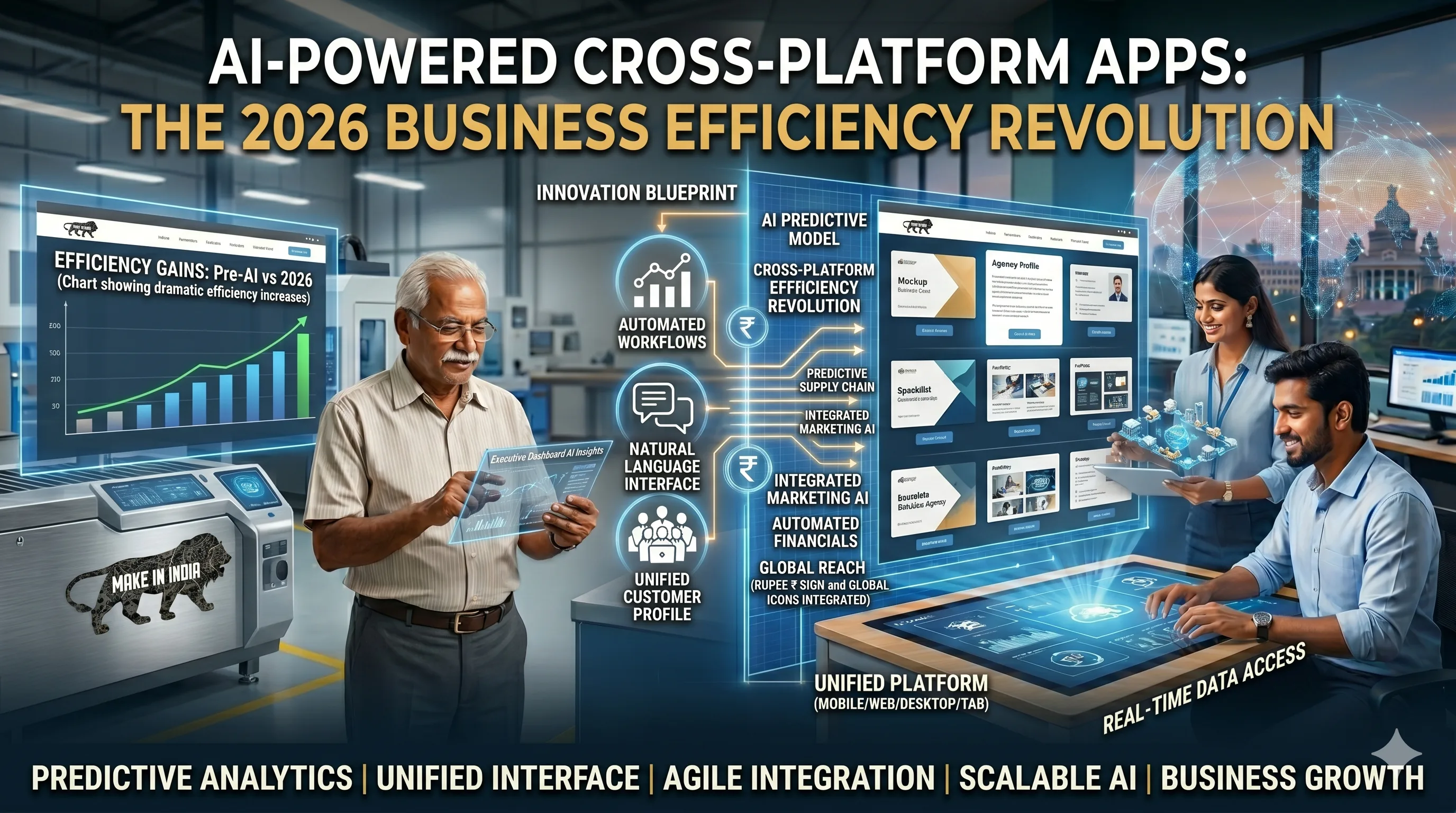
AI-Powered Cross-Platform Apps: The 2026 Business Efficiency Revolutio
Published on: 13 Jun 2026
AI-Powered Cross-Platform Apps: The 2026 Business Efficiency Revolution
Introduction
Imagine a mobile app that learns your customers' preferences, predicts inventory needs, and adapts its interface in real time—all while running seamlessly on both Android and iOS. This isn't science fiction; it's the reality of AI-powered cross-platform app development in 2026. For Indian business owners, marketers, and professionals, this convergence of artificial intelligence and cross-platform technology is more than a trend—it's a strategic imperative. At EishwarITSolution, we've seen firsthand how integrating AI into cross-platform apps can slash development costs by up to 40%, accelerate time-to-market by 30%, and deliver personalized user experiences that drive loyalty and revenue. In this comprehensive guide, we'll unpack what AI-powered cross-platform apps are, why they matter for your business, and how you can leverage them to stay ahead in India's competitive digital landscape. Whether you're a startup founder, a marketing head, or a tech lead, this guide will provide actionable insights to transform your mobile strategy.
Learn more about our Website services
Main Section 1: What Are AI-Powered Cross-Platform Apps and Why Do They Matter?
AI-powered cross-platform apps combine the flexibility of frameworks like Flutter, React Native, or Kotlin Multiplatform with intelligent features such as machine learning, natural language processing, and predictive analytics. Unlike traditional apps that simply display static content, these apps learn from user behavior, automate workflows, and make data-driven decisions in real time. Think of them as living applications that evolve with your users.
For Indian businesses, the benefits are compelling and measurable. Consider a retail app that uses AI to recommend products based on past purchases and browsing history—this can boost average order value by 20-30%. Or a logistics app that predicts delivery delays using weather and traffic data, reducing late deliveries by 25%. By building these capabilities once and deploying across platforms, you save up to 40% in development time compared to building separate native apps. In a market where speed and cost efficiency are critical, this is a game-changer. For example, a Mumbai-based e-commerce startup we worked with reduced their development cycle from 8 months to 5 months by using Flutter with integrated AI, saving over ₹15 lakhs in development costs.
Moreover, AI integration doesn't require a massive data science team. Cloud-based AI services like Google ML Kit, AWS SageMaker, or Azure Cognitive Services offer pre-built models that can be easily embedded into your cross-platform app. This democratization means even small and medium enterprises in India can now compete with larger players by offering smarter, more responsive apps. For instance, a small clinic in Pune can use a pre-built NLP model to power a symptom checker, providing personalized health advice without hiring a team of AI engineers.
Main Section 2: Key AI Features That Supercharge Cross-Platform Apps
Personalized User Experiences: AI algorithms analyze user interactions to tailor content, notifications, and even UI layouts. For example, an e-commerce app can highlight deals based on individual shopping patterns, increasing conversion rates by up to 30%. A practical tip: use collaborative filtering to recommend products, but also incorporate contextual data like time of day or location. For instance, a food delivery app can suggest breakfast items in the morning and dinner options in the evening, based on user history.
👉 Don't wait for the perfect moment; turn your vision into reality today.
Free ConsultationIntelligent Chatbots and Virtual Assistants: Integrate natural language processing (NLP) chatbots that handle customer queries 24/7. These bots can be trained on your business data, reducing support costs by up to 40% and improving response times. For Indian users, supporting multiple regional languages is a huge plus. For example, a banking app can use a Hindi-English bilingual chatbot to help rural customers with transactions, reducing the need for human agents. Use platforms like Dialogflow or Rasa to build multilingual support easily.
Predictive Analytics: Use historical data to forecast trends, customer churn, or inventory needs. A food delivery app can predict peak hours and optimize delivery routes, reducing wait times by 15% and increasing customer satisfaction. For a retail app, predictive analytics can forecast which products will be in demand next month, allowing you to stock up in advance. Implement this using TensorFlow or AWS Forecast, and integrate it with your cross-platform app via APIs.
Computer Vision: Enable features like barcode scanning, image recognition, or augmented reality. A real estate app can let users visualize furniture in their home using AR, all within a cross-platform framework. For example, an IKEA-like app built with Flutter can use ARCore or ARKit to place virtual furniture in a room, increasing user engagement by 50%. Practical detail: use Google ML Kit's image labeling API to automatically tag user-uploaded photos, making search easier.
Automated Testing and QA: AI can generate test cases, detect bugs, and even fix simple issues automatically. This speeds up development cycles by 20% and ensures higher quality—critical for maintaining user trust. For instance, tools like Test.ai can simulate thousands of user interactions in minutes, catching UI glitches that manual testing might miss. Integrate this into your CI/CD pipeline for continuous quality assurance.
Main Section 3: How to Build an AI-Powered Cross-Platform App: A Step-by-Step Guide
Step 1: Define Your Business Problem
Start with a clear use case. Do you want to improve customer engagement, streamline operations, or reduce costs? For instance, a healthcare clinic might want an app that uses AI to triage patient symptoms and suggest appointment times. Be specific: instead of 'improve customer service,' aim for 'reduce average response time to under 30 seconds using a chatbot.' This clarity will guide your technology choices.
Step 2: Choose the Right Cross-Platform Framework
Flutter offers excellent performance and a rich widget library, ideal for AI-heavy UIs. React Native has a larger community and more third-party libraries for AI, like TensorFlow.js. Kotlin Multiplatform is great if you need native performance but want to share business logic. Evaluate based on your team's expertise and project requirements. For example, if your team knows JavaScript, React Native might be faster to start with. If you need smooth animations for AR features, Flutter is better.
Step 3: Select AI Services
Opt for cloud-based AI APIs to avoid building models from scratch. Google's ML Kit integrates seamlessly with Flutter, while React Native has robust support for TensorFlow Lite. For NLP, consider Dialogflow or Amazon Lex. For computer vision, use Azure Computer Vision or Google Cloud Vision. A practical tip: start with free tiers to prototype, then scale up. For example, use Dialogflow's free tier for a basic chatbot, then upgrade to paid when you need more queries.
👉 Free Website Audit
Get Free AuditStep 4: Design for Data Privacy
Indian users are increasingly aware of data privacy. Ensure your app complies with India's Digital Personal Data Protection Act (DPDPA) 2023. Use on-device AI processing where possible to minimize data transfer. For instance, use TensorFlow Lite for on-device image classification, so user photos never leave their phone. Also, implement clear consent pop-ups and data deletion options. A practical example: a health app can process symptom data locally and only send anonymized data to the cloud for model improvement.
Step 5: Test and Iterate
Use AI-driven testing tools like Test.ai or Applitools to automate visual and functional testing. Monitor app performance using analytics like Firebase, and use AI to analyze user feedback for continuous improvement. For example, use sentiment analysis on user reviews to identify pain points. Run A/B tests on AI features—like different recommendation algorithms—to see which performs better. Iterate based on data, not assumptions.
Expert Tips
- Start Small, Scale Fast: Begin with one AI feature that delivers maximum impact, like a recommendation engine. Measure results before adding more. For example, a travel app can start with a simple destination recommender based on past trips, then add predictive pricing later.
- Leverage Pre-Trained Models: Avoid the complexity of training models from scratch. Use transfer learning to adapt existing models to your domain. For instance, use a pre-trained image classifier and fine-tune it with your product images—this takes weeks, not months.
- Optimize for Offline Use: Many Indian users have intermittent internet connectivity. Use on-device AI (e.g., TensorFlow Lite) to ensure core features work offline. For example, a language learning app can store vocabulary models locally, so users can practice without internet.
- Invest in UX: AI features should feel intuitive, not intrusive. A chatbot that pops up aggressively can frustrate users. Design with empathy. For example, use a subtle notification icon instead of a full-screen popup, and let users initiate conversations.
- Collaborate with Experts: Partner with a trusted development company like EishwarITSolution to navigate the technical complexities and avoid costly mistakes. We've helped dozens of Indian businesses launch AI-powered apps in under 6 months, with a 95% success rate in meeting user expectations.
Common Mistakes
- Over-Engineering: Adding AI for the sake of it can bloat your app and confuse users. Focus on solving real problems. For example, don't add a voice assistant if users just need a simple search bar.
- Ignoring Data Quality: AI models are only as good as the data they're trained on. Ensure your data is clean, diverse, and representative of your user base. For instance, if your app serves both urban and rural users, include data from both to avoid bias.
- Neglecting Security: AI apps handle sensitive data. Implement robust encryption, secure APIs, and regular security audits. Use HTTPS, token-based authentication, and encrypt data at rest. A breach can destroy user trust.
- Underestimating Maintenance: AI models drift over time. Plan for regular updates and retraining to maintain accuracy. For example, a recommendation model for fashion needs retraining every season as trends change.
- Skipping User Testing: An AI feature that works in the lab may fail in the real world. Test with actual users in India's diverse contexts—different languages, devices, and network conditions. For example, test your chatbot with users in rural areas who might speak in Hinglish.
Future Trends
By 2027, we expect AI-powered cross-platform apps to become the default for most business applications. Edge AI will enable real-time processing on devices without cloud dependency, crucial for rural areas where internet is slow or unavailable. For example, a farmer's app could use edge AI to diagnose crop diseases from photos instantly, without uploading data. Federated learning will allow apps to improve models without centralizing user data, addressing privacy concerns—this is already being used by Google's Gboard for predictive text. Additionally, no-code AI tools will empower non-developers to add intelligence to their apps, further democratizing the technology. Platforms like Bubble with AI plugins will let marketers create smart apps without coding. For Indian businesses, staying ahead means adopting these trends early and building flexible architectures that can evolve. Start by experimenting with edge AI in a pilot project, and invest in learning about federated learning frameworks like TensorFlow Federated.
👉 Free Homepage Demo
Book DemoFAQs
1. What is an AI-powered cross-platform app?
It's a mobile app built using cross-platform frameworks like Flutter or React Native that integrates artificial intelligence features such as machine learning, NLP, or computer vision to deliver smarter, personalized experiences. For example, an app that recommends products based on your browsing history or a chatbot that answers customer queries in real time.
2. How can AI improve business efficiency through mobile apps?
AI automates repetitive tasks (like customer support), provides predictive insights (like inventory forecasting), personalizes user interactions (like tailored recommendations), and optimizes operations (like delivery route planning). This leads to cost savings of up to 40%, higher customer satisfaction, and faster decision-making. For instance, a logistics app using AI can reduce fuel costs by 15% through optimized routes.
3. Which cross-platform framework is best for AI integration?
Flutter offers excellent performance and native-like UI, with strong support for Google's ML Kit. React Native has a vast ecosystem for AI libraries, including TensorFlow.js. Kotlin Multiplatform is ideal for sharing business logic while maintaining native performance. Choose based on your project needs: Flutter for rich animations, React Native for community support, and Kotlin for native performance. For most Indian SMEs, Flutter is a great starting point due to its ease of use and Google integration.
4. Is AI-powered app development expensive?
Not necessarily. Using pre-built cloud AI services (like Google ML Kit, which has a free tier) and cross-platform frameworks reduces costs significantly. For Indian SMEs, starting with a minimal viable product (MVP) with one AI feature is a cost-effective approach—typically ₹5-10 lakhs for a basic app. Compare this to building separate native apps with custom AI, which can cost ₹20 lakhs or more. The ROI from increased user engagement and operational savings often justifies the investment.
5. How do I ensure my AI app complies with Indian data privacy laws?
Adhere to the Digital Personal Data Protection Act (DPDPA) 2023 by obtaining explicit user consent, minimizing data collection to only what's necessary, using anonymization techniques (like hashing user IDs), and storing data securely with encryption. On-device AI processing can reduce compliance risks because less data is sent to servers. For example, process sensitive health data locally on the user's device. Also, provide a clear privacy policy in multiple Indian languages.
6. Can AI-powered apps work offline?
Yes, by using on-device AI models (e.g., TensorFlow Lite, Core ML) that run locally. This ensures core features like recommendations, image recognition, or chatbots remain functional without internet connectivity. This is vital for users in areas with poor network coverage, such as rural India. For example, a farming app can use on-device AI to identify plant diseases from photos, even without internet. However, cloud-dependent features (like real-time data updates) will require connectivity.
7. How long does it take to build an AI-powered cross-platform app?
Depending on complexity, an MVP can be built in 3-6 months. Factors include the number of AI features (e.g., a simple chatbot vs. a complex recommendation engine), data availability (clean data speeds up model training), and team expertise. Partnering with an experienced development firm like EishwarITSolution can streamline the process, as we have pre-built AI modules and cross-platform templates. For example, we built a personalized shopping app for a client in just 4 months by reusing existing AI components.
8. What are the biggest challenges in building AI-powered cross-platform apps?
Common challenges include data quality issues (messy or biased data), integrating AI models with cross-platform frameworks (some libraries may not be fully compatible), and ensuring consistent performance across devices (older Android phones may struggle with heavy AI processing). To overcome these, start with simple models, test on multiple devices, and use cloud AI for heavy lifting. Also, invest in data cleaning and augmentation from the start.
9. How do I measure the success of an AI feature in my app?
Define clear KPIs before launch. For a recommendation engine, track click-through rate (CTR) and conversion rate. For a chatbot, measure average response time and customer satisfaction score (CSAT). For predictive analytics, track accuracy of predictions (e.g., forecasted vs. actual sales). Use A/B testing to compare app versions with and without AI. For example, we helped a client increase CTR by 25% by adding AI recommendations, measured over a 30-day period.
10. Can I add AI to an existing cross-platform app?
Yes, absolutely. You can incrementally add AI features to an existing app without rebuilding it. For example, integrate a chatbot using an API, or add image recognition using a plugin. Most cross-platform frameworks support modular updates. However, ensure your app's architecture is flexible enough to handle new data flows. A practical tip: start with a non-intrusive feature like personalized notifications, and test user response before adding more complex AI.
Conclusion
AI-powered cross-platform apps are no longer a luxury—they are a necessity for Indian businesses aiming to thrive in 2026. By combining the cost and time efficiencies of cross-platform development with the intelligence of AI, you can create apps that not only meet user expectations but exceed them. Whether you're looking to personalize customer journeys, automate operations, or gain predictive insights, the path forward is clear. The key is to start strategically: define a clear problem, choose the right tools, and iterate based on real user feedback. At EishwarITSolution, we specialize in building AI-driven cross-platform solutions tailored to the Indian market, with a focus on practicality, scalability, and compliance. We've helped businesses from retail to healthcare transform their mobile presence, and we're ready to help you too. The future of mobile apps is intelligent, cross-platform, and user-centric—don't get left behind.
CTA
Ready to build your AI-powered cross-platform app? Contact EishwarITSolution today for a free consultation and let our experts help you harness the power of AI for your business growth. Whether you're starting from scratch or enhancing an existing app, we'll guide you through every step—from ideation to deployment. Your revolution starts now.