AI-Driven Legacy System Modernization for Indian SMEs: A Migration Blu
Published on: 18 Jul 2026
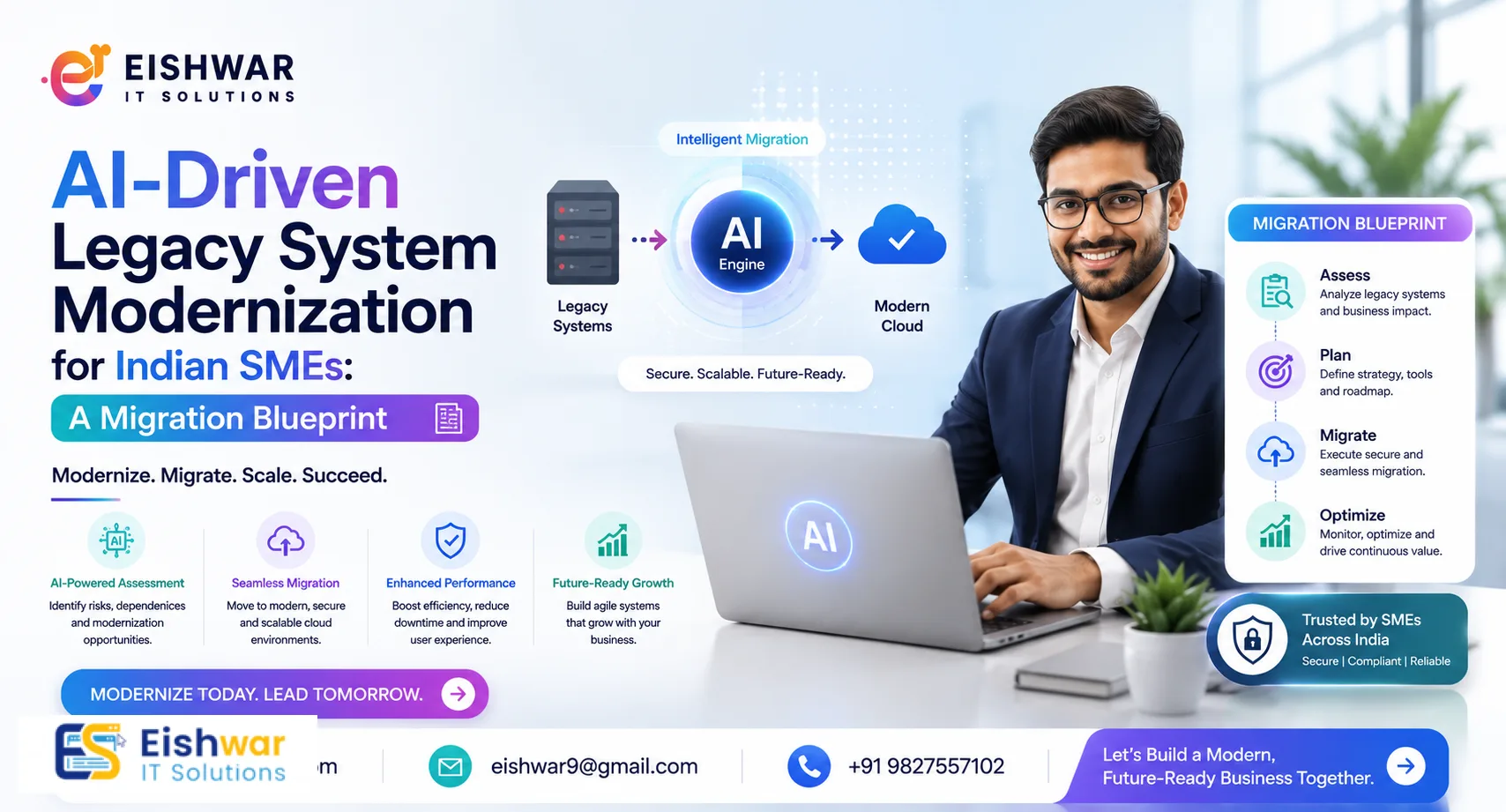
AI-Driven Legacy System Modernization for Indian SMEs: A Migration Blueprint
Introduction
Legacy systems are the silent profit killers of Indian SMEs. You know the pain: outdated software that crashes during peak hours, manual data entry that eats hours, and security patches that never come. But here's the truth—modernizing doesn't have to break the bank. With AI-driven tools, you can migrate smarter, faster, and cheaper. This blueprint walks you through every step, from audit to post-launch, with real-world examples and actionable tips tailored for Indian businesses. Whether you're a 10-person startup or a 200-employee manufacturing firm, AI can transform your legacy burden into a competitive advantage.
Learn more about our Website services
Main Section 1: Why AI is the Game-Changer for Legacy System Modernization
Traditional migrations are risky. Data loss, downtime, and budget overruns are common. AI changes the game by automating code analysis, predicting migration bottlenecks, and optimizing resource allocation. For instance, AI tools can scan your legacy codebase and identify which modules need rewriting versus simple refactoring. This cuts assessment time by 40% and reduces manual errors. Moreover, AI can simulate various migration paths to recommend the least disruptive approach, saving you from costly trial-and-error.
Take the case of a Mumbai-based logistics SME that modernized its inventory system using AI. The tool analyzed 10 years of transaction data to recommend a cloud-native architecture, slashing migration time from 6 months to 10 weeks. The result? 30% faster order processing and zero downtime during the switch. Another example: a Surat textile exporter used AI to migrate its legacy ERP to a modern platform. The AI identified 200+ redundant processes, which were eliminated, reducing operational costs by 35% within the first quarter.
Main Section 2: Step-by-Step AI-Driven Migration Blueprint for Indian SMEs
Step 1: Audit Your Legacy System with AI
Use AI-powered scanners like CAST or SonarQube to assess code quality, dependencies, and security vulnerabilities. Generate a heatmap of high-risk components. For example, a Delhi-based e-commerce store discovered that 60% of its legacy code was redundant—thanks to AI analysis. This step also includes mapping data flows and identifying integration points with other systems, such as payment gateways or CRM tools.
Step 2: Define Clear Goals and KPIs
Set measurable targets: reduce downtime by 50%, cut operational costs by 20%, or improve page load speed by 2 seconds. Align these with your business objectives. An AI dashboard can track these metrics in real time. For instance, a Chennai-based healthcare provider aimed to reduce patient wait times by 30% post-migration, which guided their choice of a cloud-based scheduling system.
Step 3: Choose the Right Modernization Approach
AI can recommend between rehosting, replatforming, refactoring, or rebuilding. For most Indian SMEs, a hybrid approach works best. Example: A Pune-based manufacturing firm used AI to refactor its ERP system gradually, avoiding a big-bang migration that could have halted production. The AI suggested a phased approach, starting with the inventory module, then finance, and finally HR, ensuring business continuity.
Step 4: Automate Data Migration and Testing
Leverage AI for data cleansing, mapping, and validation. Tools like Informatica or Talend use machine learning to detect duplicates and anomalies. Automated testing frameworks (e.g., Selenium with AI) can run thousands of test cases in hours, not weeks. For example, a Bangalore-based fintech startup used AI to validate 500,000 customer records during migration, achieving 99.99% accuracy with zero manual effort.
👉 Don't wait for the perfect moment; turn your vision into reality today.
Free ConsultationStep 5: Execute with Minimal Disruption
Use AI-driven rollback plans and canary releases. Deploy to a small user group first, monitor AI-analyzed logs, then scale. A Bangalore-based fintech startup used this approach to migrate its payment gateway with zero transaction failures. The AI continuously monitored transaction latency and flagged any anomalies, allowing the team to resolve issues before they affected customers.
Step 6: Post-Migration Optimization
AI continuously monitors performance and user behavior. Set up alerts for anomalies (e.g., sudden latency spikes). Retrain models on new data to keep improving. This ensures your modernized system stays lean and fast. For instance, a Jaipur retail chain used AI to analyze customer purchase patterns post-migration, leading to a 15% increase in cross-selling opportunities.
Main Section 3: Real-World Success Stories from Indian SMEs
Case 1: Retail Chain in Jaipur
A 50-store retail chain modernized its legacy POS system using AI. They reduced manual inventory reconciliation from 3 days to 2 hours. The AI tool predicted stockouts with 95% accuracy, cutting lost sales by 18%. Additionally, the system now automatically reorders popular items, saving the team 10 hours per week per store.
Case 2: Healthcare Clinic in Chennai
A multi-specialty clinic migrated its patient management system to the cloud with AI assistance. Patient data migration was 99.9% accurate, and appointment scheduling errors dropped by 70%. The clinic saved ₹12 lakh annually on IT maintenance. The AI also optimized doctor schedules, reducing patient wait times by 25%.
Case 3: Logistics Firm in Hyderabad
By using AI to modernize its route optimization engine, the firm reduced fuel costs by 22% and delivery times by 15%. The migration was completed in 8 weeks with only 2 hours of planned downtime. The AI now dynamically adjusts routes based on real-time traffic and weather data, improving on-time delivery rates to 98%.
Expert Tips
- Start with a small, non-critical module to test AI tools and build team confidence. For example, migrate your internal HR system before touching customer-facing applications.
- Invest in AI training for your IT staff—upskilling is cheaper than hiring new talent. Platforms like Coursera and Udemy offer affordable courses on AI for migration.
- Use AI to simulate migration scenarios before the actual move. This uncovers hidden risks, such as data dependency loops or performance bottlenecks.
- Partner with local AI vendors who understand Indian regulatory and data localization requirements, such as compliance with the Digital Personal Data Protection Act.
- Always have a rollback plan—AI can help you build one automatically based on your system's dependencies, ensuring you can revert within minutes if needed.
Common Mistakes
- Ignoring data quality: AI can't fix garbage data. Clean your data first using tools like OpenRefine or Trifacta.
- Skipping user training: Your team will resist new systems if they don't understand them. Conduct hands-on workshops and provide cheat sheets.
- Over-relying on AI: Human oversight is still crucial for strategic decisions, such as choosing between rehosting and rebuilding.
- Not setting realistic timelines: AI speeds things up, but migrations still take weeks. Factor in buffer time for unexpected issues.
- Neglecting security: AI can also be used to identify vulnerabilities—use it. Run penetration tests and vulnerability scans post-migration.
Future Trends
By 2027, AI-driven migration will become the norm for Indian SMEs. Expect more low-code/no-code platforms with embedded AI, making modernization accessible to non-technical founders. AI will also enable self-healing systems that automatically fix performance issues, such as scaling resources during traffic spikes. Additionally, edge AI will allow SMEs to modernize legacy IoT devices without full cloud migration, processing data locally for faster insights. Another trend is the rise of AI-powered 'digital twins' that simulate your entire system before migration, reducing risk to near zero.
👉 Free Website Audit
Get Free AuditFAQs
- Q: Is AI-driven modernization affordable for small Indian businesses?
A: Yes. Many AI tools offer pay-as-you-go pricing. Start with free tiers (e.g., Google Cloud's Migration Hub) and scale as you see ROI. For example, a small retail store can begin with a free AI audit tool and only pay for premium features when needed. - Q: How long does an AI-assisted migration typically take?
A: For a standard SME system, plan 6-12 weeks. AI can cut assessment and testing time by up to 50%. However, complex systems with heavy customizations may take up to 16 weeks. - Q: Will AI replace my IT team during migration?
A: No. AI augments your team by automating repetitive tasks, but humans handle strategy and decision-making. For instance, your team still decides which data to migrate and how to handle exceptions. - Q: What if my legacy system is very old (e.g., 20+ years)?
A: AI can still help. It can analyze the codebase, suggest incremental rewrites, and even generate documentation for undocumented systems. For example, AI can reverse-engineer COBOL code into modern Python or Java. - Q: How do I ensure data security during AI-driven migration?
A: Choose AI tools that comply with Indian data protection laws (e.g., encryption at rest and in transit). Run security scans before and after migration. Also, use AI to monitor for unauthorized access during the migration process. - Q: Can AI help with post-migration support?
A: Absolutely. AI can monitor system performance, detect anomalies, and even auto-remediate common issues like slow queries or memory leaks, reducing your support burden by up to 40%.
Conclusion
Legacy system modernization is no longer a luxury—it's a survival move for Indian SMEs. AI turns a risky, expensive project into a manageable, cost-effective process. By following this blueprint, you can reduce downtime, cut costs, and unlock new efficiencies. The future belongs to businesses that modernize intelligently. Start your AI-driven migration today.
CTA
Ready to modernize your legacy system with AI? Contact EishwarITSolution for a free AI readiness assessment. Our experts will analyze your current system and create a personalized migration blueprint. Don't let legacy systems hold you back—future-proof your business now.