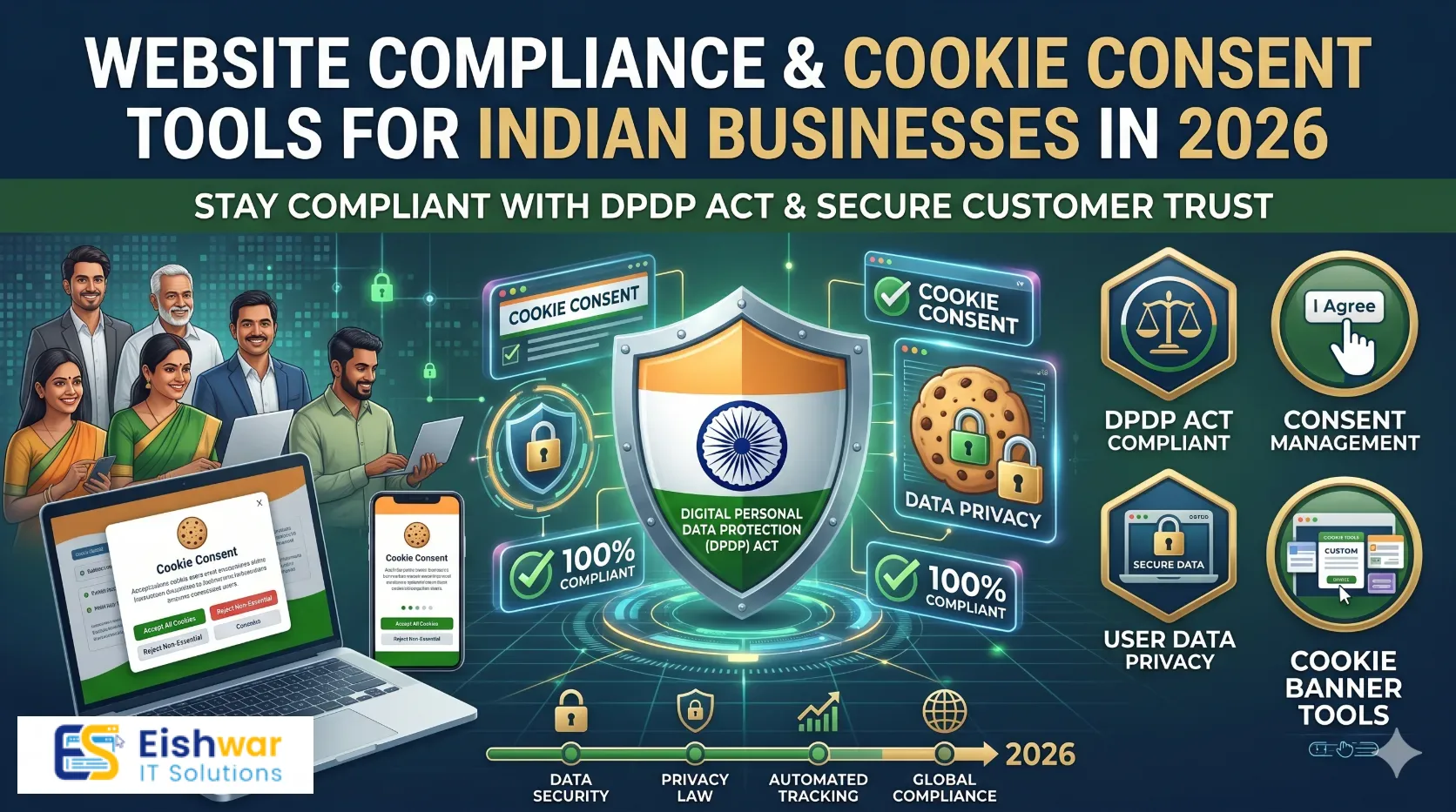
Website Compliance & Cookie Consent Tools for Indian Businesses in 202
Published on: 19 Oct 2026
Website Compliance & Cookie Consent Tools for Indian Businesses in 2026
Introduction
Indian businesses are investing more than ever in websites, landing pages, and digital campaigns. But there is a quiet shift happening alongside this growth: website compliance is becoming part of the user experience. If your website collects names, phone numbers, emails, payment details, or even analytics data, you are handling personal data. Under India's Digital Personal Data Protection Act, that comes with responsibilities.
Learn more about our Website services
In 2026, cookie banners are no longer enough on their own. Business owners, marketers, and web teams need a practical compliance stack: clear notices, real consent choices, script blocking, consent records, and policies that match how the website actually works. This guide breaks down the best website compliance and cookie consent tools for Indian businesses, with actionable steps you can use without getting lost in legal jargon.
Main Section 1: Why Website Compliance Matters for Indian Businesses in 2026
For years, many Indian websites treated privacy policies as a footer formality. A copied policy, a small cookie notice, and a checkbox on a contact form were often considered enough. That approach is changing fast. Customers are more aware, global clients ask tougher questions, and the DPDP Act has created a clear compliance framework.
The DPDP Act raises the bar
The Digital Personal Data Protection Act, 2023 set the foundation for how businesses should collect, use, store, and delete personal data. As rules and enforcement mature in 2026, Indian businesses need to show clear notice, lawful consent, purpose limitation, and easy ways for users to withdraw consent or request deletion. Penalties can be significant, so compliance is no longer a 'we will do it later' project.
For a website, this means your cookie banner, privacy policy, lead forms, analytics setup, and third-party scripts should all tell the same story. If your banner says users can reject cookies, but Google Analytics and Meta Pixel still fire before consent, you have a gap.
Customer trust is a conversion lever
Compliance is not only about avoiding penalties. A transparent consent experience can build trust. When visitors see a clean banner with clear language and an easy 'Reject all' option, they are more likely to engage with your brand. Dark patterns, pre-ticked boxes, and confusing wording may boost short-term opt-ins, but they damage long-term trust.
Global clients expect it
Many Indian agencies, SaaS companies, and e-commerce brands serve customers in the EU, UK, US, and Middle East. Those clients already expect GDPR-style consent, data processing agreements, and vendor transparency. A strong India-ready compliance setup makes it easier to win international work and pass procurement reviews.
What website compliance includes
- A privacy policy that reflects your actual data collection and sharing practices.
- A cookie consent banner with accept, reject, and granular preferences.
- Script blocking so non-essential cookies do not fire before consent.
- Consent records with timestamps, choices, and policy versions.
- Secure forms and payment flows.
- Vendor and third-party script reviews.
- A process for data subject requests, such as access, correction, and deletion.
Main Section 2: Top Website Compliance & Cookie Consent Tools for Indian Businesses
The market has three broad categories: cookie consent platforms, privacy policy generators, and full consent management platforms. Many tools overlap, so the right choice depends on your website platform, traffic volume, budget, and how global your audience is. Here are practical options worth evaluating in 2026.
👉 Don't wait for the perfect moment; turn your vision into reality today.
Free Consultation1. CookieYes
CookieYes is a popular choice for Indian small and mid-sized businesses because it is affordable, WordPress-friendly, and easy to set up. It offers a cookie scanner, consent banner, prior blocking, geolocation targeting, and consent logs. The interface is simple enough for a marketing team to manage without developer support. It works well for business websites, blogs, and WooCommerce stores. Check the plan limits for page views and features like Google Consent Mode.
2. Cookiebot by Usercentrics
Cookiebot is known for its strong automatic cookie scanning and categorization. It can detect cookies and trackers, block scripts before consent, and maintain detailed consent records. It supports Google Consent Mode and works well for businesses with global traffic. The pricing is higher than entry-level tools, so it suits companies that need a more robust, audit-friendly setup.
3. Termly
Termly combines privacy policy generation with cookie consent. It is useful for startups that need a policy, terms of service, and a banner quickly. The policy generator covers multiple jurisdictions, but you should still review the output with a legal professional for DPDP-specific requirements. Termly is a good starting point for businesses that want an all-in-one legal and consent workflow.
4. iubenda
iubenda is a strong option for Indian businesses selling internationally. It generates privacy and cookie policies for multiple countries and includes a cookie consent banner with granular preferences. The dashboard is well organized, and the tool supports multi-language websites. It is especially useful for SaaS companies and agencies managing compliance for multiple client sites.
5. Osano
Osano is an enterprise-grade consent management platform. It offers cookie consent, vendor monitoring, data subject request workflows, and compliance reporting. It is more than most small Indian businesses need, but it can be a good fit for larger companies with complex vendor ecosystems and formal procurement requirements.
6. Complianz
Complianz is a WordPress plugin focused on region-specific consent. It supports GDPR, CCPA, and other frameworks, and it integrates well with WooCommerce. For Indian businesses running WordPress websites, it offers a practical way to manage cookie categories and generate policy documents. The interface is slightly more technical, but the documentation is solid.
7. Usercentrics
Usercentrics is a full consent management platform with strong consent analytics, A/B testing for banners, and global compliance features. It is suitable for larger Indian brands and media companies that need detailed reporting and centralized control across multiple websites.
8. Axeptio
Axeptio focuses on a modern, less intrusive consent experience. It is popular with brands that care about design and user experience. Indian businesses with a strong brand aesthetic may find it useful, especially if they want a consent banner that does not feel like a legal obstacle.
| Tool | Best for | Key strength | Consideration |
|---|---|---|---|
| CookieYes | Small and mid-sized Indian businesses | Affordable, WordPress-friendly, easy setup | Check page view limits on lower plans |
| Cookiebot | Businesses with global traffic | Strong scanner and consent records | Higher cost than entry tools |
| Termly | Startups needing policy and consent | All-in-one policy generator and banner | Legal review still recommended |
| iubenda | SaaS and international websites | Multi-country policies and consent | Can get complex for simple sites |
| Osano | Large enterprises | Vendor monitoring and DSR workflows | Overkill for small businesses |
| Complianz | WordPress and WooCommerce | Region-specific consent | Slightly technical setup |
On pricing, most tools bill in USD or EUR. Entry plans often start around $5 to $15 per month for small websites. Growing businesses may spend $30 to $100 per month, while enterprise platforms are custom-priced. Always check GST, payment options, data processing agreements, and whether the vendor offers India-friendly support.
👉 Free Website Audit
Get Free AuditMain Section 3: How to Choose and Implement the Right Compliance Stack
Choosing a tool is only part of the job. The real value comes from configuration and process. A poorly configured premium tool is worse than a well-configured basic tool. Use this step-by-step approach.
Step 1: Audit what your website collects
List every place where data enters your website: contact forms, newsletter sign-ups, chat widgets, payment gateways, analytics, advertising pixels, embedded videos, heatmaps, and CRM integrations. Include third-party scripts added by marketing teams. This audit becomes the foundation for your cookie categories and privacy policy.
Step 2: Categorize cookies and scripts
Most consent tools use four categories: strictly necessary, functional, analytics, and marketing. Strictly necessary cookies can usually run without consent because they are needed for the website to work. Analytics and marketing cookies should wait for consent. Be honest about categorization. Calling an advertising pixel 'functional' will not protect you.
Step 3: Choose a tool based on your CMS and traffic
WordPress users can move quickly with CookieYes, Complianz, or iubenda. Shopify stores should check app compatibility and consent mode support. Custom web apps need a platform with a robust API and developer documentation. If you run multiple websites, consider a centralized CMP rather than managing separate plugins.
Step 4: Configure the banner properly
Use clear language. Put accept and reject buttons at the same level. Avoid pre-ticked boxes and confusing button colors. Link to your privacy policy and cookie policy. Offer granular preferences so users can choose analytics without accepting marketing cookies. For Indian audiences, plain English works well; for regional audiences, consider Hindi or other languages where relevant.
Step 5: Block scripts before consent
This is where many Indian websites fail. A banner appears, but Google Analytics and Meta Pixel still fire. Use the consent tool's script blocking feature or configure Google Tag Manager consent triggers. Test in an incognito window. Open developer tools and check the network tab to confirm that non-essential scripts wait for consent.
Step 6: Record and manage consent
Keep consent logs with a timestamp, the user's choice, the banner version, and the policy version. Make it easy for users to withdraw consent later. If you use a CRM, document how consent data is stored and who can access it. This is important for DPDP Act compliance and for demonstrating accountability.
Step 7: Update policies and train your team
Review your compliance setup every quarter. Marketing teams add new tools frequently, and each new tool can change your data flows. Train content, marketing, and sales teams on what they can and cannot do with collected data. A short internal checklist can prevent accidental non-compliance.
👉 Free Homepage Demo
Book DemoBudget guide for Indian businesses
- Solopreneur or small business: free plan or up to ₹1,500 per month for a basic consent tool.
- Growing SME: ₹3,000 to ₹10,000 per month for consent logging, geolocation, and policy generation.
- Mid-market or multi-site business: ₹15,000 to ₹50,000 per month for advanced CMP features.
- Enterprise: custom pricing with vendor monitoring, DSR workflows, and dedicated support.
Expert Tips
- Treat consent as a product experience, not a legal pop-up. Clear design reduces frustration and improves opt-in quality.
- Use Google Consent Mode if you rely on Google Analytics and Ads. It helps you model conversions while respecting consent choices.
- Keep a simple data map. You do not need a massive enterprise tool to document where data comes from and where it goes.
- Audit third-party scripts monthly. A new chat widget or retargeting pixel can quietly break your compliance setup.
- Appoint a grievance officer or a clear contact for data requests. This builds trust and aligns with DPDP expectations.
- Do not use dark patterns. A reject button that is hidden or greyed out may increase consent rates, but it creates legal and reputational risk.
Common Mistakes
- Showing a banner with only an accept button and no reject option.
- Setting analytics and marketing cookies before the user makes a choice.
- Copying a privacy policy from a US or European website without checking DPDP requirements.
- Using a cookie banner but never logging consent records.
- Forgetting to update the policy after adding a new tool, payment gateway, or CRM.
- Assuming a privacy policy alone is enough. The policy explains, but the banner and script blocking enforce.
- Ignoring mobile experience. The banner should be readable and usable on small screens.
Future Trends
- DPDP enforcement will become more visible, with greater scrutiny of consent quality and data processing notices.
- Privacy-first analytics will grow as businesses look for insights without relying heavily on third-party cookies.
- Consent management platforms will add more AI-assisted scanning and vendor monitoring.
- Global privacy frameworks will continue to converge, making multi-jurisdiction compliance a standard expectation.
- Browser privacy signals and consent mode defaults will influence how websites collect analytics data.
- Indian businesses serving global clients will treat compliance as part of procurement and sales readiness.
FAQs
Is cookie consent mandatory for Indian websites in 2026?
Yes, if you collect personal data through cookies or similar technologies, you need clear notice and consent under the DPDP Act. Strictly necessary cookies may be exempt, but analytics and marketing cookies generally require consent.
What is DPDP Act compliance for websites?
It means giving users clear notice about data collection, taking free and informed consent, limiting data use to the stated purpose, allowing withdrawal, and maintaining records. Your privacy policy, forms, cookie banner, and vendor agreements should all align.
Which is the best free cookie consent tool for Indian businesses?
CookieYes and Complianz offer free tiers for small websites. They can display a banner and block some scripts, but advanced features like consent logs, geolocation, and vendor scanning usually need a paid plan.
Do I need separate privacy policies for India and GDPR?
Not always separate documents, but your policy must cover both requirements if you serve Indian and EU users. Many tools let you generate a combined policy with region-specific sections. Have it reviewed by a legal professional.
How much do website compliance tools cost in India?
Small sites can start free or pay around ₹500 to ₹1,500 per month. Growing businesses often spend ₹3,000 to ₹10,000 per month. Enterprise consent management platforms are custom-priced and can cost significantly more.
Can I use Google Analytics without a cookie banner?
If Google Analytics sets cookies or collects personal data, you generally need consent in India and under GDPR. You can reduce reliance by using privacy-first analytics, but you should still review your compliance position.
Conclusion
Website compliance is now a core part of website design and development, not an afterthought. For Indian businesses in 2026, the right cookie consent and privacy tools help you build trust, avoid penalties, and create a cleaner data foundation for marketing and sales. Start with an audit, choose a tool that fits your CMS, and treat consent as an ongoing process.
CTA
Need help making your website DPDP-ready? Contact EishwarITSolution for a website compliance audit, cookie consent setup, and privacy policy review. Visit http://eishwar.com to book a consultation.