
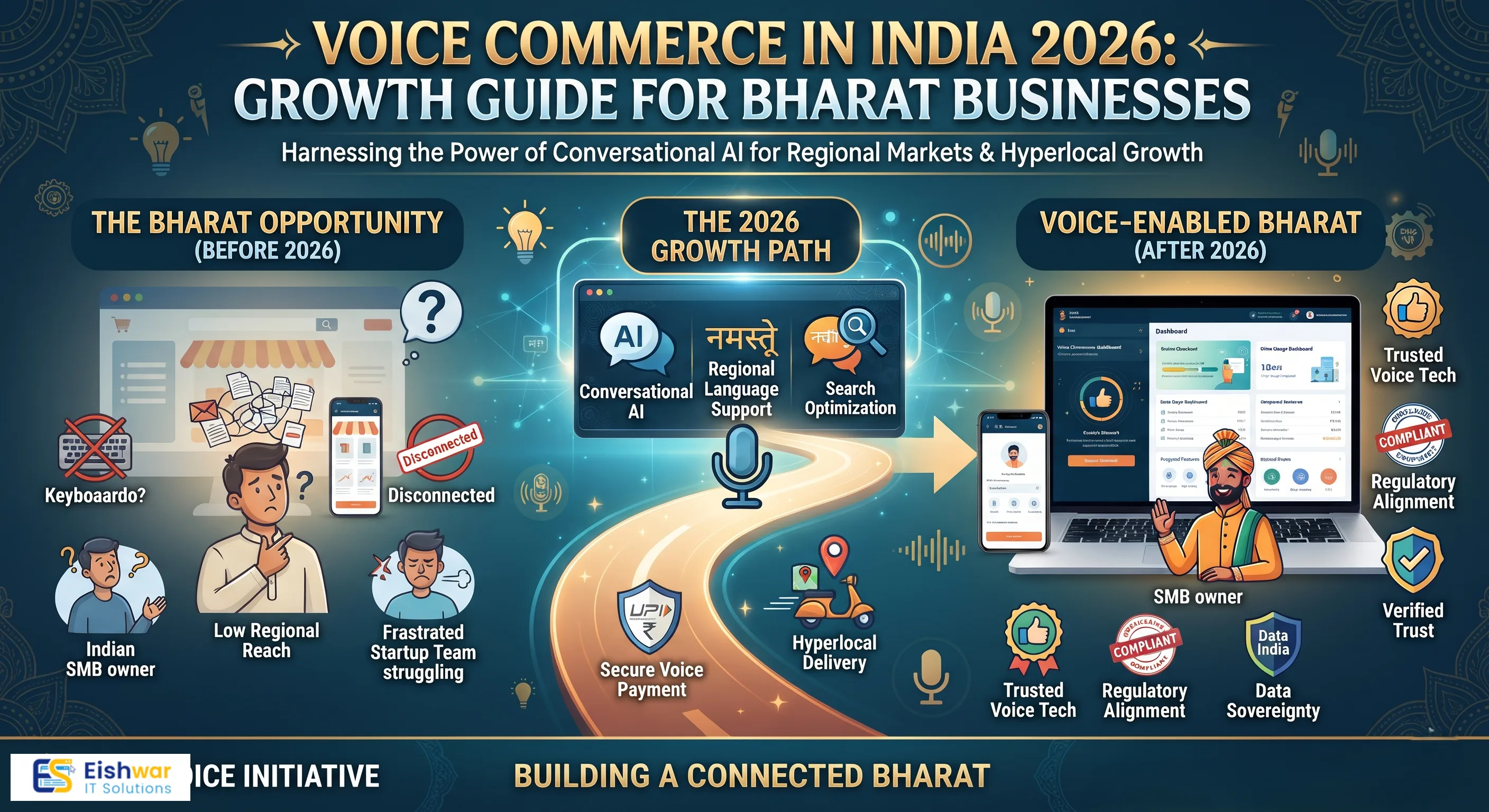
Voice Commerce in India 2027: Growth Guide for Bharat Businesses
Published on: 16 Nov 2026
Voice Commerce in India 2027: Growth Guide for Bharat Businesses
Introduction
India’s internet story is changing shape. The next million online shoppers are more likely to speak a question than type it. They may ask in Hindi, Tamil, Telugu, Bengali, or Marathi. They may use a voice assistant, a WhatsApp voice note, or a regional-language search bar. For business owners and marketers, this shift is not a side experiment. It is a new front door to discovery, support, and sales.
Learn more about our Website services
Voice commerce in India 2027 is becoming practical because three forces are meeting: affordable smartphones, cheap data, and better voice recognition for Indian languages. Add UPI-led digital payments and rising comfort with online buying, and you have a channel that can reach customers beyond metro English-first audiences.
This guide is a practical roadmap for Indian SMBs, D2C brands, local service providers, and B2B suppliers. You will learn where the opportunity sits, how to build a voice-ready strategy, which metrics matter, and what mistakes to avoid.
Main Section 1: The Voice Commerce Opportunity in India 2027
What voice commerce really means
Voice commerce is the use of spoken language to discover, compare, or buy products and services. It includes voice search on Google, product queries through assistants such as Google Assistant or Alexa, voice-enabled apps, and conversational channels like WhatsApp where customers send voice notes and get guided replies.
It is close to conversational commerce, but the interface is voice-first. The customer may not type at all. That changes how you write product descriptions, structure FAQs, and design support flows.
Why Bharat is the real growth driver
‘Bharat’ here means customers beyond the largest metros: tier-2 and tier-3 cities, small towns, and regional-language users. Many of these customers are comfortable with video and voice but less comfortable typing long English queries. Voice lowers the effort to search and ask for help. It also makes digital services more accessible for people with low literacy or limited typing skills.
For a business, this is not just about inclusion. It is about expanding the market. A customer who cannot easily type ‘best protein powder for women over 40’ may still ask that question aloud. If your content answers spoken queries clearly, you have a better chance of appearing in the answer.
Voice search vs voice commerce vs conversational commerce
Voice search is the top of the funnel: someone asks a question and sees or hears an answer. Voice commerce goes further: the customer compares options, checks availability, asks for support, and completes a purchase. Conversational commerce is the broader category. It includes chat, messaging, and voice-led conversations across WhatsApp, apps, and websites.
For most Indian SMBs, the smartest first step is not building a custom voice app. It is making your existing web presence, Google Business Profile, product feeds, and WhatsApp support voice-friendly.
Which businesses should move first?
- Local services: clinics, salons, repair services, tuition centres, and home services that receive ‘near me’ voice queries.
- D2C brands: health, beauty, food, fashion, and home products where customers ask for recommendations and usage advice.
- B2B suppliers: wholesalers and distributors that take repeat orders from retailers who prefer voice notes over forms.
- Education and healthcare: businesses that answer common questions about timings, fees, packages, and appointments.
If your customers call you with the same five questions, voice and conversational channels can reduce friction immediately.
👉 Don't wait for the perfect moment; turn your vision into reality today.
Free ConsultationMain Section 2: Building a Voice Commerce Strategy That Works for Bharat
Step 1: Listen before you build
Start with the language your customers already use. Review search queries in Google Search Console. Listen to sales calls. Read WhatsApp messages. Note the exact phrases customers use for your product category. A customer may say ‘sugar control atta’ instead of ‘diabetic-friendly flour’ or ‘cold press oil near me’ instead of ‘wood-pressed edible oil store’.
Create a simple voice query bank. Add regional-language variants and common misspellings. This becomes the raw material for your content and FAQs.
Step 2: Write for spoken questions
Spoken queries are longer and more conversational. They include question words: how, what, best, near me, for beginners, under budget, open now. Build pages and FAQs around these natural questions. Use short sentences and clear answers near the top.
For example, instead of only writing ‘Our protein powder contains 25g protein per serving’, add a question-led block: ‘How much protein is in one serving?’ followed by a direct answer. This helps both voice assistants and busy readers.
Step 3: Fix the technical basics
Voice assistants rely on fast, well-structured pages. Make sure your site loads quickly on mid-range Android phones. Use clean headings, schema markup for products, FAQs, local business details, and reviews. Keep your Google Business Profile complete with timings, services, photos, and phone numbers. For product brands, maintain accurate product feeds with stock status, price, and variants.
Step 4: Build conversational support on WhatsApp
For many Indian businesses, WhatsApp is the real voice commerce bridge. Customers send voice notes because it is faster than typing. Your team can reply with text, voice notes, catalogues, and payment links. As you scale, use WhatsApp Business API with quick replies, catalogues, and simple chatbots for FAQs. Always provide a human escalation path.
Step 5: Design for trust and low-friction payment
Voice customers still need confidence. Show return policies, delivery timelines, contact details, and reviews in simple language. Support UPI, cards, net banking, and cash on delivery where relevant. If you serve regional-language customers, offer support in the same language. Trust is the difference between a voice query and a completed order.
Step 6: Pilot small and measure honestly
Do not try to ‘voice-enable’ everything at once. Pick one customer journey: reordering a product, booking an appointment, or checking service availability. Run a four-week pilot. Track inquiries, qualified leads, and conversions. Compare voice-assisted journeys with your existing channels. Then expand what works.
Main Section 3: Tools, Metrics, and Examples for Indian Businesses
Practical tools to start with
- Google Search Console: find question-based and regional queries.
- Google Business Profile: capture ‘near me’ and local intent.
- Schema markup: help search engines understand FAQs, products, and local business details.
- WhatsApp Business API: manage voice notes, catalogues, and quick replies at scale.
- CRM and helpdesk: tag voice-originated leads and conversations.
- Analytics: track calls, WhatsApp clicks, form fills, and assisted conversions.
Metrics that matter
Voice attribution is not perfect, so use a mix of signals. Track branded search volume, direct traffic, calls, WhatsApp inquiries, voice-note conversations, appointment bookings, and conversion rate by language. Ask new customers how they found you. Add a simple dropdown on forms: Google search, voice assistant, WhatsApp, referral, social media, other.
👉 Free Website Audit
Get Free AuditDo not chase vanity metrics like ‘voice search volume’ alone. Focus on qualified inquiries and revenue. A local service business may see more calls; a D2C brand may see more WhatsApp product questions; a B2B supplier may see faster reorders.
Example 1: Local grocery and home delivery
A neighbourhood grocery store updates its Google Business Profile with categories, timings, delivery radius, and UPI acceptance. It adds FAQs such as ‘Do you deliver in [area]?’ and ‘What is the minimum order?’ When customers ask voice queries like ‘grocery home delivery near me’, the store has a better chance of appearing in local results.
Example 2: D2C wellness brand
A D2C brand adds a Hindi and English FAQ section to its product pages. It uses WhatsApp voice notes for customer support and shares a simple catalogue link. The team tags conversations by language and query type. After four weeks, it identifies the top three hesitation questions and updates the website. This reduces repeated support effort and improves conversion clarity.
Example 3: B2B supplier reorders
A distributor of packaging materials lets retailers reorder through WhatsApp. Retailers send a voice note with item names and quantities. The sales team confirms with a text summary and payment link. This is not fancy technology, but it is voice commerce in practice: spoken intent converted into a transaction.
Example 4: Service business appointments
A dental clinic adds appointment FAQs, timings, location details, and a WhatsApp booking link. Voice queries like ‘dental clinic open now near me’ become calls and WhatsApp messages. The front desk uses quick replies for common questions and escalates urgent cases to a human.
Expert Tips
- Think ‘speakable’, not just ‘searchable’. Write answers that sound natural when read aloud.
- Design for noisy, low-bandwidth environments. Keep pages light, buttons large, and content scannable.
- Localise tone, not just language. A direct translation may sound robotic. Use phrases your customers actually use.
- Keep humans in the loop. Voice notes and chatbots should escalate complex issues quickly.
- Measure assisted conversions. Voice often starts a journey that ends in a call, store visit, or WhatsApp order.
- Protect privacy. Do not ask for sensitive information over voice unless your process is secure and consented.
Common Mistakes
- Translating English content word-for-word. Regional-language voice users expect natural phrasing and local context.
- Treating voice as a gimmick. A single Alexa skill without a content and support plan rarely moves revenue.
- Ignoring mobile speed. Voice users are often on mid-range phones and mobile networks. Slow pages lose them.
- No measurement plan. If you do not tag voice-originated conversations, you cannot improve them.
- Over-automating. Complex queries need human help. A frustrated customer will not repeat themselves to a bot.
- Forgetting trust signals. Clear returns, contact details, and reviews matter more than clever voice features.
Future Trends
Voice commerce in India will not remain a standalone channel. It will blend into everyday apps and messaging. Expect better multilingual assistants, more natural voice notes in WhatsApp, and tighter integration between voice queries and payments. Retailers may use voice for in-store assistance and B2B reordering. Vernacular AI models will improve, but accuracy and privacy will remain important.
👉 Free Homepage Demo
Book DemoAnother trend is multimodal commerce: voice plus image. A customer may send a photo on WhatsApp and ask a spoken question. Businesses that keep product information, FAQs, and support workflows clean will adapt faster than those that chase every new interface.
Finally, look out for voice accessibility features becoming a standard expectation. As more public digital services and payment flows become voice-friendly, customers will carry those expectations to private businesses too.
FAQs
What is voice commerce in simple terms?
Voice commerce means using spoken language to search, compare, ask for support, or buy products and services. It can happen through voice assistants, voice search, or messaging apps where customers send voice notes.
Is voice commerce useful for small businesses in India?
Yes. Small businesses can start with practical steps: complete Google Business Profile, add question-based FAQs, support WhatsApp voice notes, and track calls and messages. You do not need a custom app to begin.
Which languages should I support first?
Start with the languages your customers already use. Check sales calls, WhatsApp messages, and search queries. Hindi and English are common starting points, but Tamil, Telugu, Bengali, Marathi, Gujarati, and Kannada may matter depending on your market.
How do I measure return on investment from voice commerce?
Track qualified calls, WhatsApp inquiries, appointments, reorders, and conversions. Use a ‘How did you find us?’ field and tag conversations by channel and language. Compare voice-assisted journeys with your existing channels over a four-week pilot.
Do I need a custom voice app?
Most Indian SMBs do not need one at the start. Optimising your website, Google Business Profile, product feeds, and WhatsApp support usually delivers faster value. Build a custom app only when a clear customer journey justifies it.
What is the difference between voice search and voice commerce?
Voice search is about finding information. Voice commerce includes discovery, comparison, support, and purchase. A customer may start with voice search and complete the journey through WhatsApp, a call, or a website checkout.
Conclusion
Voice commerce in India 2027 is less about flashy gadgets and more about meeting customers in their natural language. The businesses that win will make discovery easy, answer spoken questions clearly, and connect conversations to real transactions. Start small, measure honestly, and build trust first.
For Indian SMBs, this is a chance to serve Bharat customers without forcing them to type in English. The opportunity is practical today: better local profiles, voice-friendly FAQs, WhatsApp support, and simple measurement.
CTA
Ready to make your business voice-ready? Contact EishwarITSolution for a practical voice commerce audit and a 2027 action plan tailored to your customers.