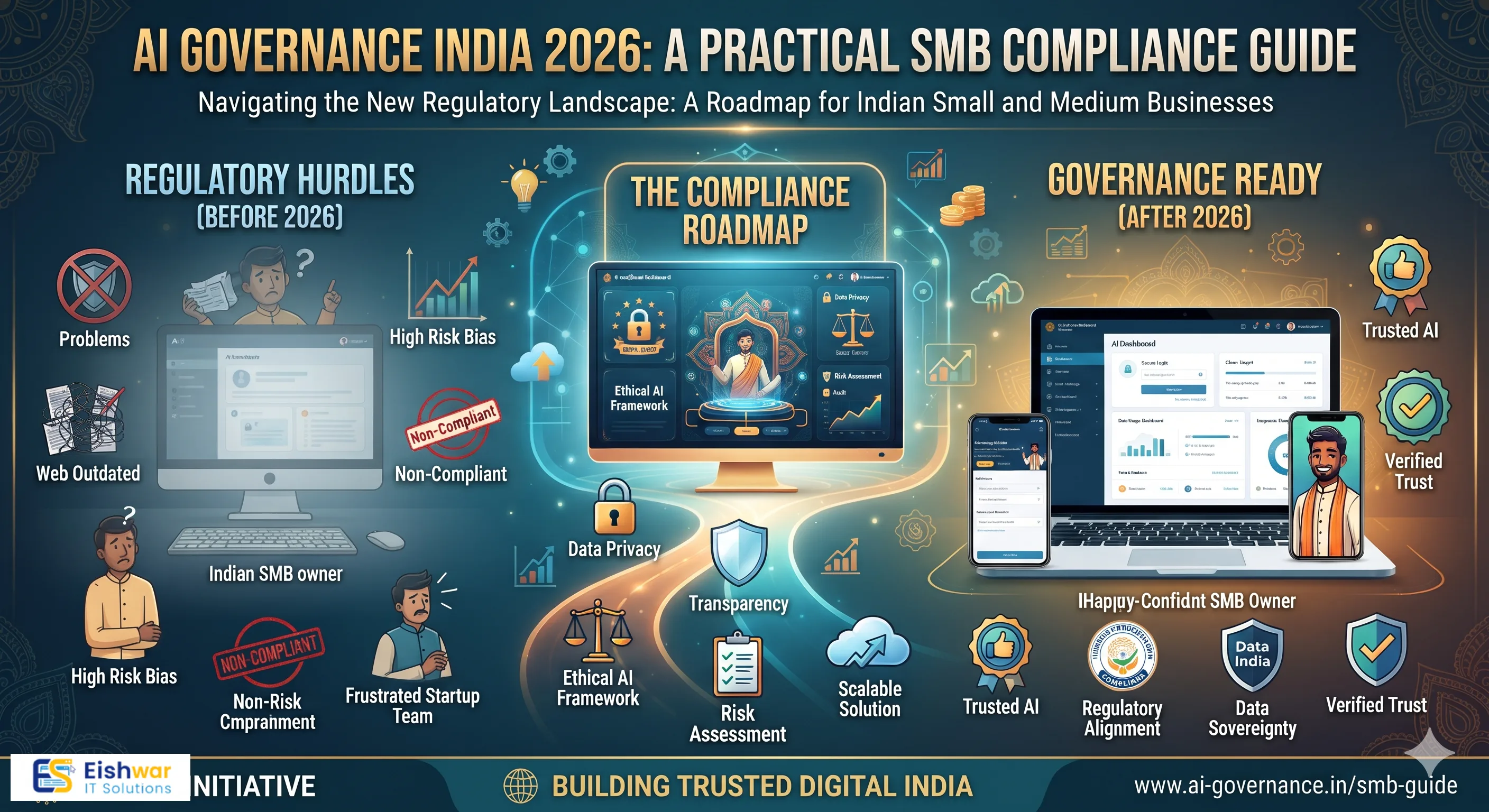
AI Governance India 2027: A Practical SMB Compliance Guide
Published on: 09 Nov 2026
AI Governance India 2027: A Practical SMB Compliance Guide
Introduction
AI is no longer a side experiment for Indian businesses. It is inside marketing campaigns, customer support, sales forecasting, hiring, finance, and product development. In 2027, the question is not whether your business should use AI. The question is how to use it safely, ethically, and profitably.
Learn more about our Website services
That is where AI governance comes in. It sounds heavy, but for most small and medium businesses it can be simple: clear ownership, approved tools, data rules, vendor checks, human oversight, and documentation. Good AI governance India 2027 is not about blocking innovation. It is about protecting your business from avoidable risks while helping teams adopt AI faster.
This guide gives business owners, marketers, and professionals a practical compliance roadmap. It avoids jargon and focuses on steps you can actually implement.
Main Section 1: Why AI Governance Is a Business Priority in India Now
AI adoption in India has moved from experiments to everyday workflows. Tools that were once used by tech teams are now used by sales, HR, finance, and customer support. This creates real value, but it also creates new risks: data leakage, biased outputs, poor-quality decisions, vendor dependency, and reputational damage.
The trust gap is now a sales issue
B2B buyers increasingly ask vendors how they use AI. They want to know whether customer data is used to train models, where data is stored, how outputs are reviewed, and who is accountable. If you cannot answer these questions clearly, deals can slow down or disappear.
For example, an Indian SaaS company pitching to a large enterprise may receive a security and AI questionnaire. A simple AI policy, approved tool list, and vendor register can turn a stressful review into a confidence-building conversation.
Regulation and expectations are catching up
India's Digital Personal Data Protection Act, sector-specific rules, and global AI standards are shaping buyer expectations. Even where compliance is not fully mandatory today, customers, investors, and partners are asking for evidence of responsible AI practices. AI governance India 2027 is becoming part of the normal control environment, much like cybersecurity and data privacy.
Governance can speed up adoption
Clear rules help teams move faster. Without guidance, employees either avoid AI completely or use unapproved tools quietly. Both outcomes are risky. With a simple policy, teams know which tools are approved, what data can be used, and when human review is required.
Consider a marketing team that wants to use generative AI for blog drafts, ad copy, and customer emails. Without a policy, every use case needs legal review. With a policy, low-risk drafting is allowed using approved tools, while customer-facing claims still need human fact-checking. That is practical governance.
Main Section 2: Build a Lean AI Governance Framework for SMBs
You do not need a large legal team or a dedicated AI department. A lean framework can be built in weeks and improved over time. The goal is to create enough structure to manage risk without slowing down the business.
1. Assign an AI owner
Start with accountability. Appoint one person to own AI governance, usually an operations leader, CTO, compliance lead, or senior manager. This person does not need to be an AI expert. They need to coordinate the register, approve tools, arrange training, and review incidents.
👉 Don't wait for the perfect moment; turn your vision into reality today.
Free ConsultationAlso identify AI champions in marketing, sales, HR, and finance. These champions help spot new use cases and ensure policies are followed in daily work.
2. Create an AI register
A simple spreadsheet is enough. List every AI tool and use case in the business. Include the tool name, use case, business owner, type of data used, vendor, risk level, approval status, and next review date.
This register does two things. It exposes shadow AI, where employees use unapproved tools. It also gives leadership a clear view of where AI is creating value and where it may create risk.
3. Tier use cases by risk
Not all AI use cases need the same controls. Use three tiers to keep things practical.
Low risk includes brainstorming, internal summaries, draft content, and code suggestions that are reviewed by a human. Medium risk includes customer emails, sales proposals, and support responses where errors could affect relationships. High risk includes hiring decisions, credit decisions, legal analysis, health-related content, pricing algorithms, and anything that significantly affects a person's rights or finances.
High-risk use cases should require documented review, human approval, and ongoing monitoring. Low-risk use cases can move quickly within approved tools and data rules.
4. Publish a simple acceptable use policy
Keep it short and specific. A good policy answers common employee questions:
- Which AI tools are approved for business use?
- What data must never be entered into public AI tools?
- When must AI-generated content be reviewed or disclosed?
- Who approves new AI use cases?
- How should AI-related incidents be reported?
For most Indian SMBs, the policy should clearly prohibit entering personal data, confidential contracts, source code, financial formulas, customer lists, and unreleased product information into unapproved tools. It should also require human review for customer-facing claims, legal content, and financial advice.
5. Add human oversight
AI should support decisions, not hide accountability. For medium- and high-risk use cases, define who reviews the output and what they must check. In customer support, a human should review sensitive responses. In hiring, AI can screen or summarise applications, but a person should make the final decision.
A useful rule: if an AI output could damage a customer relationship or create legal exposure, a named human owner must approve it.
6. Set vendor rules
Your AI risk is often your vendor's risk. Maintain a short approved tools list and review new tools before purchase. Check whether the vendor uses your data to train models, how long data is retained, where data is stored, whether subprocessors are used, and what happens when you exit.
Many SaaS products now include AI features. Review these as carefully as standalone AI tools, especially if they process customer data.
7. Prepare a basic incident response
Even with good controls, mistakes happen. An employee may paste customer data into a public tool or publish an inaccurate AI-generated claim. Define a simple response: contain the issue, inform the AI owner, document what happened, notify affected parties if required, and update the policy.
👉 Free Website Audit
Get Free AuditThis does not need to be complex. A one-page incident process can prevent small mistakes from becoming major problems.
Main Section 3: Compliance, Data Protection, and Vendor Management
AI governance is not only about models. It is about data, contracts, access, and evidence. Indian businesses should connect AI governance with existing privacy and security practices.
Map personal data before you deploy
Under India's data protection principles, personal data should be collected for lawful purposes, limited to what is needed, retained only as long as necessary, and protected with reasonable security. Before using AI on customer or employee data, map what data is involved and why.
Avoid sending personal data to tools that have not been approved. Use redaction, synthetic data, or enterprise versions with stronger controls where possible. For example, a support team can test an AI summarisation tool using anonymised tickets before rolling it out to live customer conversations.
Ask vendors the right questions
Use a standard vendor checklist. Ask whether the vendor trains models on your data, how long data is retained, who the subprocessors are, how breach notifications work, whether audit logs are available, where data is stored, and how data is deleted when you leave.
Also clarify intellectual property and output ownership. If AI generates content, code, or designs for your business, your contract should clearly state how those outputs can be used.
Document decisions
For medium- and high-risk use cases, keep a one-page AI impact assessment. Record the purpose, data used, affected users, risks, controls, approval, and review date. This does not need to be bureaucratic. It is evidence that you thought about risk before deployment.
Documentation also helps when customers, investors, or partners ask questions. It shows that your business has a repeatable process.
A 30-day quick start plan
Week 1: appoint an AI owner, list current AI tools, and identify high-risk use cases. Week 2: publish a short acceptable use policy and an approved tools list. Week 3: review vendor contracts and train teams with real examples. Week 4: create the AI register, set a review cycle, and test the incident process.
This is enough to create momentum. Improve the framework as new tools and regulations emerge.
Expert Tips
- Start with use cases that touch customers, money, or personal data. These create the most value and the most risk.
- Keep your AI policy under four pages. Long policies are rarely read and quickly become outdated.
- Use one shared AI register instead of separate lists in different departments.
- Train employees with examples from their own work, such as phishing-like prompts, customer complaints, or sales proposals.
- Review approved tools quarterly. AI features change fast, and vendor terms can change too.
- Make governance visible to customers by adding a simple AI trust section to your website or security documentation.
Common Mistakes
- Treating AI governance as a legal-only project. It is a business operations issue that needs sales, HR, finance, and IT involvement.
- Blocking all AI use. This pushes employees toward shadow AI and reduces competitiveness.
- Ignoring AI features inside existing software. Many teams forget that their CRM, HR platform, or support desk may already use AI.
- Assuming vendor compliance covers your business. You still need to decide whether a use case is appropriate and how outputs are reviewed.
- Having no audit trail. If a customer asks how AI is used, you should be able to show your register, policy, and approvals.
- Forgetting to update policies. AI tools and regulations evolve, so review your governance every quarter.
Future Trends
AI governance will become more standardised and more visible to buyers. Expect AI assurance audits, AI trust centres, and procurement questionnaires to become common in Indian B2B deals. Agentic AI, which can take actions across systems, will require stronger controls around permissions, approvals, and logging.
👉 Free Homepage Demo
Book DemoSector-specific guidance will also grow in finance, healthcare, education, and retail. Businesses that build a simple governance foundation now will be better prepared to adapt without starting from scratch.
FAQs
What is AI governance for an Indian SMB?
AI governance is the set of policies, roles, and processes that help a business use AI safely and responsibly. For an SMB, it can be as simple as an AI owner, a register of tools, an acceptable use policy, vendor checks, and human review for high-risk use cases.
Do Indian SMBs need a dedicated AI compliance team?
No. Most SMBs can start with one accountable AI owner and existing legal, IT, or operations support. The goal is practical oversight, not a large department.
How does the DPDP Act affect AI use?
The DPDP Act makes data protection principles important for AI that processes personal data. Businesses should ensure lawful purpose, data minimisation, retention limits, security, and proper handling of consent and user rights. AI tools should be reviewed before they process personal data.
What should be included in an AI acceptable use policy?
Include approved tools, prohibited data, human review requirements, disclosure rules for AI-generated content, approval steps for new use cases, and incident reporting. Keep it short and use examples employees understand.
How do we assess AI vendors?
Ask about data training, retention, subprocessors, breach notification, audit logs, data location, deletion, and output ownership. Review the vendor's security practices and contract terms before giving access to business or customer data.
What is the biggest AI governance risk for SMBs?
Shadow AI is often the biggest risk: employees using unapproved tools with sensitive data. A clear policy, approved tools list, and regular training reduce this risk significantly.
Conclusion
AI governance India 2027 is not a brake on innovation. It is a business control that protects customer trust, reduces legal and security risk, and helps teams adopt AI with confidence. Start small, document your decisions, review vendors, and keep humans accountable for important outcomes.
Businesses that treat governance as a practical operating habit will be better placed to win enterprise clients, satisfy partners, and scale AI safely.
CTA
Need help building a practical AI governance framework? Contact EishwarITSolution to review your AI tools, draft an acceptable use policy, and create a compliance roadmap suited to your business. Visit eishwar.com to get started.