
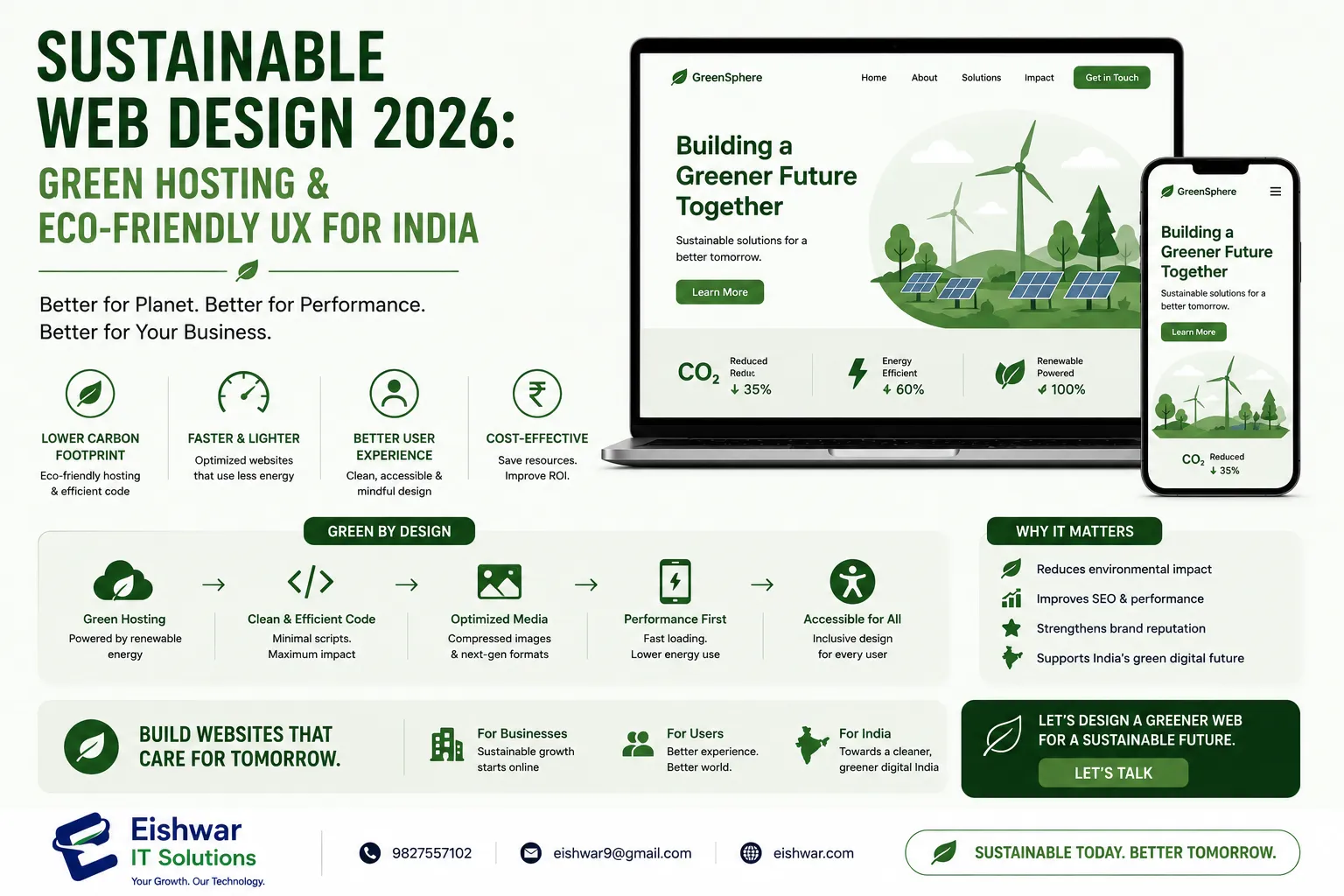
Sustainable Web Design 2026: Green Hosting & Eco-Friendly UX for India
Published on: 17 Jun 2026
Sustainable Web Design 2026: How Green Hosting and Eco-Friendly UX Are Shaping Digital India
Introduction
In 2026, the digital world is waking up to an uncomfortable truth: the internet has a carbon footprint. Every website visit, every video stream, every server request consumes energy. For Indian businesses, where internet usage is skyrocketing, this is both a responsibility and an opportunity. Sustainable web design — combining green hosting, efficient code, and eco-friendly user experience (UX) — is emerging as a powerful differentiator. At EishwarITSolution, we believe that building a website that is fast, beautiful, and kind to the planet is the smartest investment you can make. In this post, we will explore how you can make your digital presence greener, without sacrificing performance or aesthetics.
Learn more about our Website services
Main Section 1: Why Sustainable Web Design Matters for Indian Businesses
India is on track to have over 900 million internet users by 2026. Every click, every page load, every email sent consumes energy. Data centers alone account for nearly 1% of global electricity use, and that share is growing. For Indian brands, adopting sustainable web design is not just about saving the planet — it’s about aligning with consumer values. A 2025 survey by Nielsen found that 73% of Indian consumers prefer brands that demonstrate environmental responsibility. By going green online, you build trust, differentiate your brand, and often improve site speed and SEO. Sustainable design is a win-win: lower carbon emissions, better user experience, and stronger business outcomes.
Consider a practical example: an Indian e-commerce startup that switched to green hosting and optimized its product images saw a 20% reduction in page load time and a 15% increase in conversion rates. This isn't just theory; it's a proven strategy that delivers measurable business results. Moreover, as Google's algorithm increasingly prioritizes user experience metrics like Core Web Vitals, a leaner, faster site directly boosts your search rankings. For Indian brands competing in crowded markets, sustainability is not just ethical—it's a competitive advantage.
Main Section 2: Green Hosting — The Foundation of a Sustainable Website
Your hosting provider is the engine of your website. Traditional hosting relies on fossil fuels, but green hosting uses renewable energy or offsets carbon emissions. In India, several providers now offer green hosting plans, including HostGator India (carbon offset), GreenGeeks (300% renewable energy match), and local players like EcoWebHost. When choosing a host, look for certifications like Green-e or statements about renewable energy usage. Also consider server location — hosting in India reduces data travel distance, lowering latency and energy use. At EishwarITSolution, we recommend pairing green hosting with a content delivery network (CDN) to further optimize energy efficiency.
For example, a CDN caches your site's static assets on servers closer to your users, reducing the distance data travels and cutting energy consumption by up to 30%. Many CDN providers, like Cloudflare, have committed to 100% renewable energy. When evaluating hosting plans, ask providers about their energy sourcing and whether they offer carbon offset programs. A small extra cost of ₹500–1000 per year can make a significant environmental impact. We've seen clients reduce their site's carbon footprint by over 50% simply by switching to green hosting and enabling a CDN.
👉 Don't wait for the perfect moment; turn your vision into reality today.
Free ConsultationMain Section 3: Eco-Friendly UX and Design Principles
Eco-friendly UX means designing with minimalism and efficiency. Every extra image, custom font, or heavy animation requires more data transfer and processing. Start by using lightweight image formats like WebP and lazy loading. Choose system fonts or well-optimized web fonts. Reduce JavaScript bloat — use only what you need. Implement dark mode as a default option (OLED screens use less power). Simplify navigation to reduce page depth and server calls. For example, a case study by Wholegrain Digital showed that reducing page weight by 30% cut energy consumption by 15%. Apply these principles to every page: audit your site with tools like Website Carbon Calculator or Ecograder to measure your impact.
Practical tips: compress images using tools like TinyPNG or Squoosh, and serve them in modern formats like AVIF for even smaller sizes. For videos, use lazy loading and consider hosting on platforms like YouTube that use renewable energy. Streamline your CSS and JavaScript by removing unused code—tools like PurifyCSS can automate this. Also, design with a mobile-first approach, as mobile browsing consumes more energy per byte than desktop. A clean, efficient design not only reduces carbon emissions but also improves user engagement and reduces bounce rates.
Expert Tips
Here are actionable tips from sustainable web design experts: 1) Use green hosting from day one — it’s the single biggest impact. 2) Optimize images and videos: compress without losing quality, use lazy loading, and consider video streaming services that use renewable energy. 3) Keep your code clean: minify CSS/JS, remove unused code, and use efficient frameworks. 4) Enable caching and use a CDN to reduce server load. 5) Educate your team: make sustainability a KPI in your design and development process. 6) Measure and communicate: display a small “carbon neutral” badge on your site to build trust.
Additionally, consider implementing server-side rendering (SSR) for dynamic content to reduce client-side processing. Use progressive web app (PWA) techniques to cache resources locally, minimizing repeated data transfers. For e-commerce sites, optimize product pages by using placeholder images and loading high-res versions only on user interaction. These small changes add up to significant energy savings over time.
Common Mistakes
Many businesses fall into these traps: 1) Overloading pages with heavy media — videos autoplaying, high-res images, and complex animations. 2) Ignoring mobile optimization — mobile browsing consumes more energy per byte than desktop. 3) Using inefficient hosting — shared hosting with outdated servers. 4) Not measuring impact — you can't improve what you don't track. 5) Treating sustainability as a one-time project instead of an ongoing practice. 6) Forgetting about accessibility — an accessible site is often a greener site because it reduces redundant interactions.
For instance, autoplaying videos can increase page weight by several megabytes and drain user device batteries. Instead, use click-to-play for videos and provide transcripts. Another common mistake is using too many third-party scripts for analytics, ads, or social media widgets—each script adds HTTP requests and processing overhead. Audit your third-party integrations regularly and remove any that aren't essential. By avoiding these pitfalls, you can maintain a lean, fast, and sustainable website.
👉 Free Website Audit
Get Free AuditFuture Trends
By 2028, sustainable web design will be a standard requirement, not a niche. Expect to see: AI-driven carbon tracking tools that automatically optimize page elements; green hosting becoming the default in India as renewable energy costs drop; web design frameworks like Google's Web Vitals including carbon metrics; and consumer-facing carbon labels on websites. Indian brands that embrace sustainability early will lead their industries. At EishwarITSolution, we are already integrating carbon offset APIs into our client sites, and we predict that green SEO — where search engines rank sites based on efficiency — will emerge within two years.
We also anticipate the rise of 'low-carbon' design patterns, such as using serverless architectures that scale down to zero when not in use, and edge computing that processes data closer to users. As India's digital infrastructure expands, sustainable practices will become a key differentiator for brands looking to attract environmentally conscious consumers. Staying ahead of these trends will position your business as a leader in the green digital economy.
FAQs
- What is sustainable web design? Sustainable web design is the practice of creating websites that minimize energy consumption and carbon emissions through efficient coding, green hosting, and eco-friendly UX.
- How does green hosting work in India? Green hosting providers either purchase renewable energy certificates to offset their electricity use or directly source energy from solar/wind farms. Several Indian hosts now offer such plans.
- Will sustainable design hurt my website's performance? No — in fact, it often improves speed and user experience because you are reducing bloat and optimizing resources.
- How can I measure my website's carbon footprint? Use free tools like Website Carbon Calculator, Ecograder, or the Green Web Foundation's checker.
- Is dark mode really more sustainable? Yes, especially on OLED screens, dark mode can reduce energy consumption by up to 30% for the same content.
- What are the costs of going green? Green hosting may cost slightly more (₹500-1000/year extra), but the SEO and trust benefits often offset it.
- Can I retrofit an existing website? Absolutely. Start with an audit, optimize images, switch to green hosting, and gradually refactor code.
- How do I choose the right green hosting provider? Look for certifications like Green-e, check their renewable energy commitment, and consider server location for lower latency. Compare plans from HostGator India, GreenGeeks, and EcoWebHost.
- What tools can help me optimize my site for sustainability? Use Website Carbon Calculator for measurement, TinyPNG for image compression, and PurifyCSS for removing unused code. Also, leverage Google PageSpeed Insights for performance insights.
- Can sustainable design improve my SEO? Yes, because sustainable design often leads to faster load times, better mobile optimization, and improved user experience—all factors that search engines reward.
Conclusion
Sustainable web design is not a trend — it's the future of digital business in India. By adopting green hosting, eco-friendly UX, and efficient coding, you can reduce your carbon footprint, improve site performance, and build a brand that resonates with environmentally conscious consumers. The steps are clear, the tools are available, and the benefits are measurable. Start your green journey today with EishwarITSolution.
👉 Free Homepage Demo
Book DemoCTA
Ready to make your website sustainable? Contact EishwarITSolution for a free green audit and custom eco-friendly web design. Let's build a greener digital India together.