AI Chatbots for Indian B2B: Boost Lead Quality & Support
Published on: 16 Jun 2026
AI Chatbots for Indian B2B: Boost Lead Quality & Support
Introduction
The Indian B2B landscape is evolving at a breakneck pace. With a young, tech-savvy workforce and increasing digital adoption across metros and Tier-2 cities alike, businesses are seeking innovative ways to engage prospects and nurture long-term relationships. Enter AI-powered chatbots—once a novelty, now a necessity. In 2026, these intelligent assistants are not just about answering FAQs; they are strategic tools for enhancing lead quality and transforming customer support. This article explores how Indian B2B companies can harness chatbots to drive real, measurable results, backed by practical examples and actionable tips.
Learn more about our Website services
Why AI Chatbots Matter for Indian B2B
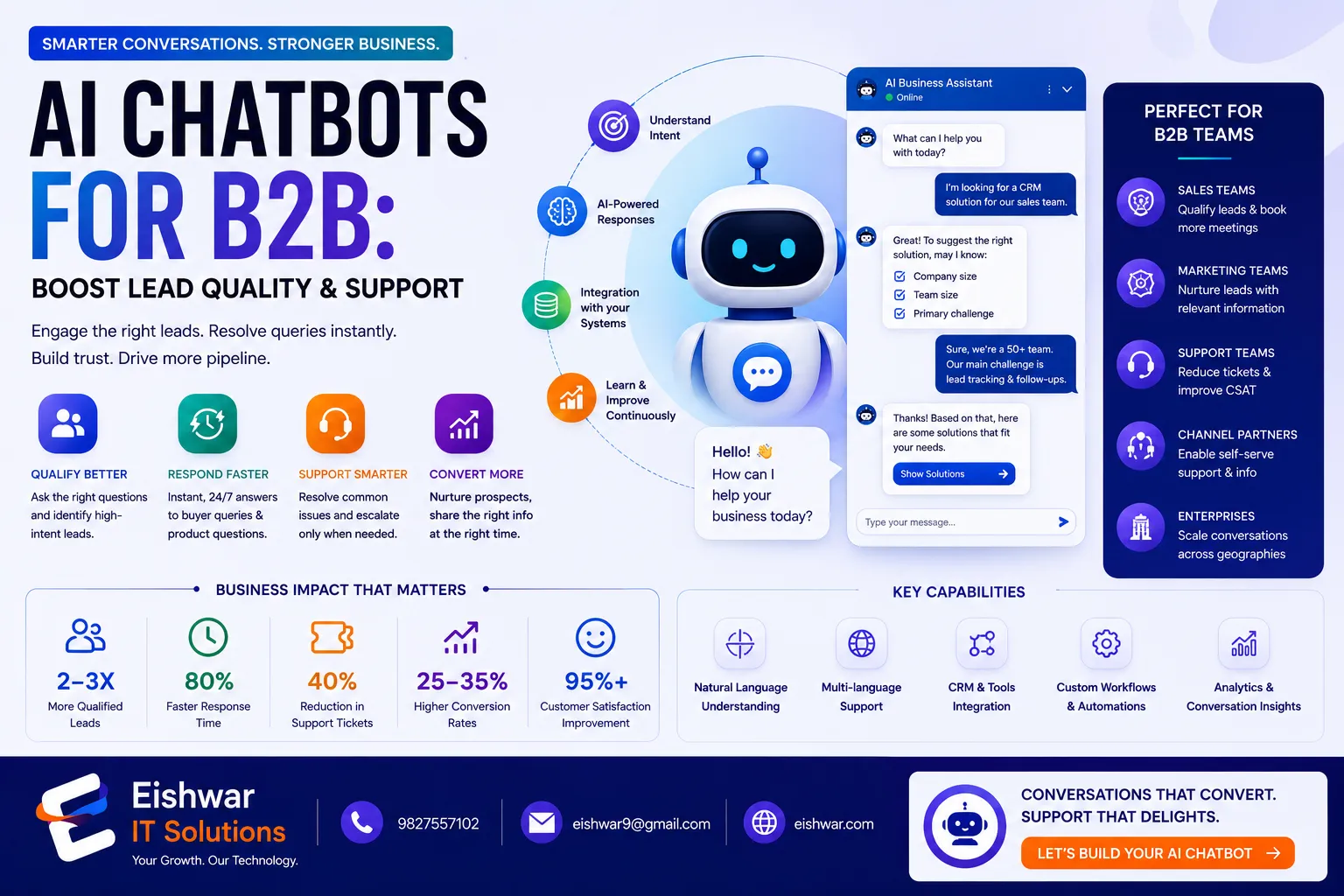
India's B2B market is unique. Decision-makers value speed, accuracy, and personalization—often expecting responses within minutes, not hours. AI chatbots deliver on all fronts. They operate 24/7, handle multiple queries simultaneously, and learn from every interaction. For a business owner in Mumbai or a marketer in Bangalore, this means no missed opportunities, even during late-night research or weekend browsing. Chatbots can qualify leads by asking relevant questions, schedule demos, and even provide product recommendations—all without human intervention. The result? Sales teams focus on high-intent prospects, boosting conversion rates by up to 30% in some cases. For example, a Delhi-based logistics firm saw a 25% increase in qualified leads after deploying a chatbot that pre-screened visitors based on shipment volume and frequency.
Enhancing Lead Quality with AI Chatbots
Lead quality is the lifeblood of B2B sales. Traditional forms and cold calls often yield low-quality leads that waste time and resources. AI chatbots change the game. By integrating with your CRM, they can score leads based on behavior, job title, company size, and engagement level. For example, a chatbot on a software company's website can ask a visitor about their budget, timeline, and specific pain points. If the responses indicate a strong fit—say, a mid-sized manufacturing firm with a clear need for ERP solutions—the lead is flagged for immediate follow-up. This process ensures that your sales team spends time on leads that are more likely to convert, reducing the cost per lead by up to 40%.
Practical Tips for Lead Qualification
- Define your ideal customer profile (ICP) and program the chatbot to ask qualifying questions aligned with it. For instance, if you target IT service providers, ask about team size and current tech stack.
- Use natural language processing (NLP) to understand open-ended responses, not just yes/no answers. This helps capture nuanced needs like 'We need a scalable solution for our growing team.'
- Set up automated follow-ups for leads that need more nurturing, such as sending a whitepaper, case study, or personalized video demo via email or WhatsApp.
- Leverage behavioral triggers: If a visitor spends more than two minutes on your pricing page, the chatbot can proactively offer a discount or a live chat with a sales rep.
Transforming Customer Support with AI
Customer support is another area where chatbots shine. Indian B2B clients expect instant resolutions—especially when dealing with time-sensitive issues like order delays or invoice discrepancies. A chatbot can handle common issues like password resets, order status updates, or billing queries in seconds. For complex problems, it seamlessly escalates to a human agent with full context, including chat history and relevant account details. This reduces response time from hours to seconds and increases customer satisfaction scores by 20-30%. Moreover, chatbots provide consistent answers across all channels—website, WhatsApp, and even email—ensuring a unified brand experience that builds trust.
👉 Don't wait for the perfect moment; turn your vision into reality today.
Free ConsultationReal-World Example
Consider a manufacturing company in Pune that supplies components to automotive firms. They deployed a chatbot on their website to handle product specifications and delivery timelines. Within three months, support ticket volume dropped by 40%, and customer satisfaction scores rose by 25%. The chatbot also identified upsell opportunities, such as suggesting complementary products based on past orders—like recommending a high-grade steel alloy when a client ordered standard bolts. This proactive approach generated an additional 15% in revenue from existing clients.
Expert Tips for Implementing AI Chatbots in Indian B2B
- Start small—deploy a chatbot for a specific use case, like lead capture for a single product line or support for common queries. This minimizes risk and allows for iterative improvements.
- Train your chatbot continuously using real conversations. Update its knowledge base regularly with new product features, pricing changes, and common customer questions.
- Integrate with existing tools like CRM (e.g., Zoho, Salesforce), ERP (e.g., SAP, Tally), and helpdesk software (e.g., Freshdesk, Zendesk) for a seamless workflow.
- Monitor performance metrics such as response time, lead conversion rate, and customer satisfaction (CSAT). Use A/B testing to refine chatbot scripts.
- Ensure language support for Hindi and other regional languages like Tamil, Telugu, or Marathi to cater to a diverse audience. This can increase engagement by up to 50% in non-metro areas.
Common Mistakes to Avoid
- Over-automation: Don't replace humans entirely. Use chatbots to augment, not replace, your team—especially for complex negotiations or sensitive issues.
- Ignoring user experience: A chatbot that is hard to navigate, gives irrelevant answers, or has a clunky interface will frustrate users. Test thoroughly before launch.
- Lack of personalization: Generic responses make prospects feel undervalued. Use data from CRM and past interactions to personalize greetings and recommendations.
- Poor escalation process: If a chatbot cannot resolve an issue, it must transfer to a human agent seamlessly, without requiring the user to repeat information. This reduces friction and builds trust.
Future Trends in AI Chatbots for Indian B2B
By 2027, expect chatbots to become even more sophisticated. Voice-enabled chatbots will handle complex queries in multiple languages, making them accessible to a wider audience. Predictive analytics will allow chatbots to anticipate customer needs—like suggesting a reorder before stock runs out—based on historical data. Integration with IoT devices will enable proactive support, such as alerting a client when a machine needs maintenance or when a shipment is delayed. For Indian B2B businesses, staying ahead means embracing these trends now, by investing in scalable chatbot platforms that can evolve with your needs.
FAQs
1. How much does it cost to implement an AI chatbot for a B2B business in India?
Costs vary widely, from free basic options (e.g., using open-source frameworks) to ₹5 lakh+ for advanced, customized solutions with NLP and CRM integration. Many providers offer tiered pricing based on features and usage—typically ₹10,000 to ₹50,000 per month for mid-range solutions. Always request a demo to assess value.
👉 Free Website Audit
Get Free Audit2. Can chatbots handle complex B2B sales processes?
Yes, but they are best used for initial qualification, routine tasks, and information gathering. For complex negotiations involving pricing, contracts, or multi-stakeholder decisions, human intervention is still recommended. Chatbots can, however, prepare a summary for the sales team to accelerate the process.
3. What platforms can I integrate with my chatbot?
Most modern chatbots integrate with CRMs like Salesforce, Zoho, HubSpot, and with messaging apps like WhatsApp Business API, Facebook Messenger, and Slack. They also work with helpdesk tools like Freshdesk and Zendesk, and can be embedded on websites via a simple snippet.
4. How do I ensure my chatbot is GDPR/IT Act compliant?
Use end-to-end encryption for data in transit and at rest, obtain explicit user consent for data collection (e.g., via a checkbox), and store data securely on Indian servers if possible. Consult with a legal expert to ensure compliance with India's Digital Personal Data Protection Act, 2023, and GDPR if you have European clients.
5. What metrics should I track to measure chatbot success?
Key metrics include lead conversion rate (e.g., from chat to demo), response time (aim for under 5 seconds), resolution rate (percentage of queries resolved without human handoff), customer satisfaction score (CSAT, target >80%), and cost savings per interaction (e.g., reduction in support team hours).
6. How long does it take to deploy a chatbot for a B2B business?
Deployment time ranges from 2-4 weeks for a basic chatbot to 8-12 weeks for a fully customized solution with NLP, CRM integration, and multilingual support. The timeline depends on complexity and the provider's expertise.
7. Can chatbots handle multiple languages effectively?
Yes, modern NLP models support Hindi, Tamil, Telugu, Marathi, and other Indian languages. However, accuracy varies—test with real users in your target regions. For best results, train the chatbot on industry-specific terms in each language.
Conclusion
AI-powered chatbots are no longer a futuristic concept—they are a practical tool for Indian B2B businesses to enhance lead quality and streamline customer support. By implementing them thoughtfully, you can gain a competitive edge, improve efficiency, and build stronger relationships with clients. The key is to start small, learn from data, and scale gradually.
Ready to Transform Your B2B Operations?
At EishwarITSolution, we specialize in custom AI chatbot solutions for Indian businesses. Let us help you design a chatbot that aligns with your goals. Contact us today for a free consultation.
CTA
Ready to Transform Your B2B Operations? At EishwarITSolution, we specialize in custom AI chatbot solutions for Indian businesses. Let us help you design a chatbot that aligns with your goals. <a href='http://eishwar.com/contact'>Contact us today for a free consultation</a>.
👉 Free Homepage Demo
Book Demo