
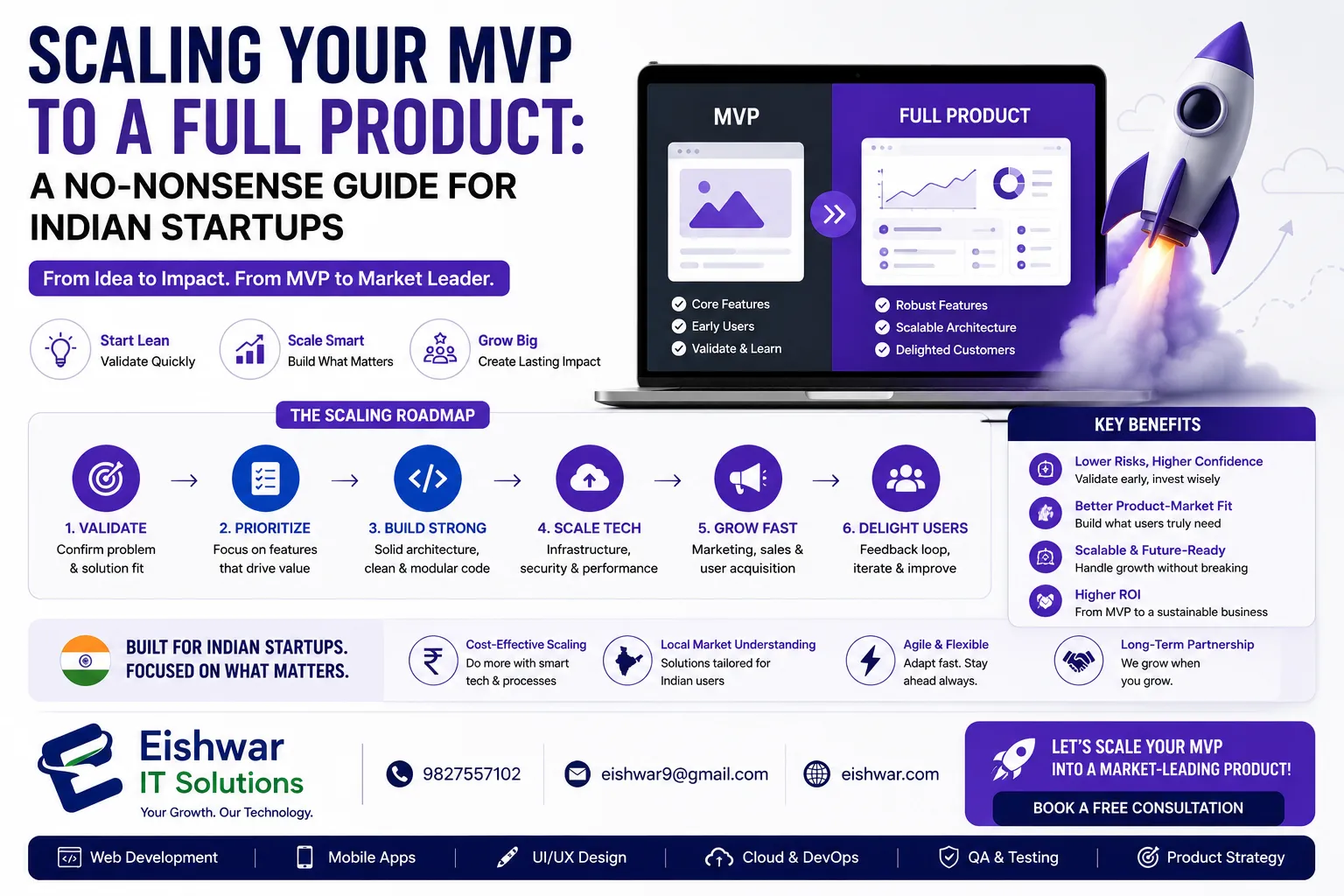
Scaling Your MVP to a Full Product: A No-Nonsense Guide for Indian Sta
Published on: 17 Jun 2026
Scaling Your MVP to a Full Product: A No-Nonsense Guide for Indian Startups
Introduction
You’ve validated your idea, launched your MVP, and even got some early traction. Congratulations – that’s more than most startups achieve. But now comes the hard part: scaling your MVP into a full product without losing the momentum that got you here. In India’s fast-paced startup ecosystem, the temptation to add features quickly can kill your product’s core value. This guide will show you how to scale smartly, keep your team aligned, and avoid common pitfalls. Whether you’re bootstrapped in Bengaluru or funded in Mumbai, the principles remain the same: focus on user needs, maintain simplicity, and build for the long haul.
Learn more about our Website services
Main Section 1: Understanding the Scaling Gap
The gap between an MVP and a full product isn’t just about adding features. It’s about evolving your architecture, team, and processes. Many Indian startups try to scale by simply piling on new features, leading to technical debt and user confusion. For instance, a fintech MVP might start with basic money transfers, but scaling requires adding bill payments, investment options, and customer support – each layer must integrate seamlessly without overwhelming the user.
Key insight: Scaling is not linear. Your MVP solved one core problem. A full product solves a range of related problems while maintaining simplicity. Think of it like building a house: the MVP is a sturdy room, but scaling means adding rooms, plumbing, and electricity without collapsing the foundation.
For example, a food delivery MVP might only handle ordering. Scaling means adding payment, real-time tracking, restaurant management, and analytics – but each addition must feel seamless. A practical tip: start by mapping your user journey from end to end. Identify where users get stuck or drop off, and prioritize those pain points first.
Actionable tip: Before scaling, audit your MVP’s codebase and user feedback. Identify the top 3 pain points your users face. Focus on those first. Use tools like Google Analytics or Mixpanel to track user behavior, and conduct quick surveys via Typeform to gather qualitative insights. For example, if users abandon the checkout process, that’s a clear signal to streamline payment options before adding new features.
Main Section 2: The Right Way to Add Features
Feature creep is the enemy of scaling. Instead, use a prioritization framework like RICE (Reach, Impact, Confidence, Effort) or the MoSCoW method (Must have, Should have, Could have, Won’t have). These frameworks help you make data-driven decisions, especially when resources are tight. For Indian startups, where every rupee counts, avoid building features that only a few users request.
For Indian startups, where resources are often tight, prioritize features that:
- Increase user retention
- Reduce churn
- Improve core functionality
Example: Your MVP might have a simple login. Scaling could mean adding Google or OTP login. That’s a high-impact, low-effort feature that improves user experience. Similarly, if your MVP lacks a search function, adding it can dramatically improve usability. Another example: an edtech MVP with basic video lessons might benefit from adding downloadable notes or quizzes – these are low-effort features that boost engagement.
👉 Don't wait for the perfect moment; turn your vision into reality today.
Free ConsultationAlways A/B test new features with a subset of users before full rollout. This prevents breaking your existing product. For instance, if you’re adding a new payment gateway, test it with 10% of users first to ensure it doesn’t cause errors. Use tools like Optimizely or Google Optimize for A/B testing. Also, consider using feature flags (e.g., LaunchDarkly) to toggle features on and off without deploying new code.
Main Section 3: Scaling Your Team and Processes
As your product grows, so must your team. But hiring too fast can dilute culture and increase costs. Instead, consider a hybrid approach: keep a core in-house team and use freelancers or agencies for specific tasks. For example, you might hire a full-time product manager and developer, but outsource UI/UX design or content writing to freelancers.
For Indian startups, leveraging local talent from platforms like Upwork or Toptal can be cost-effective. Also, invest in documentation and agile processes early. A well-documented codebase and clear processes reduce onboarding time for new team members. For instance, maintain a wiki (using Confluence or Notion) with architecture diagrams, coding standards, and deployment procedures.
Practical advice: Implement daily stand-ups, sprint planning, and retrospectives. Use tools like Jira or Trello. This keeps everyone aligned and focused. For a small team, even a simple Google Sheet can work initially. Also, set up a Slack channel for quick communication and a weekly all-hands meeting to share progress.
Don’t forget to communicate your product vision to every new hire. They should understand why the MVP existed and where you’re heading. Create a one-page vision document that outlines your mission, target audience, and key milestones. Share it during onboarding and revisit it quarterly to ensure alignment.
Expert Tips
- Measure what matters: Focus on metrics like Daily Active Users (DAU), Net Promoter Score (NPS), and feature adoption rate. Vanity metrics like total sign-ups can mislead. For example, a high sign-up rate but low DAU indicates poor retention – fix that before adding features.
- Keep your tech stack flexible: Avoid locking into a single vendor. Use microservices or modular architecture so you can swap components later. For instance, if you start with AWS, design your app to be cloud-agnostic so you can migrate to Azure or Google Cloud if needed.
- User feedback loops: Continue collecting feedback even after scaling. Use tools like Hotjar or SurveyMonkey to understand user behavior. Set up a feedback widget (e.g., UserVoice) within your app to capture real-time suggestions.
- Plan for failure: Have rollback plans for new features. If a feature doesn’t stick, remove it quickly. For example, if you add a new onboarding flow and it increases drop-off, revert to the old one within 24 hours. Use version control (Git) and automated deployment pipelines to make rollbacks easy.
- Invest in testing: Automated testing (unit, integration, and end-to-end) saves time in the long run. Write tests for critical paths, like login and payment, to catch regressions early.
Common Mistakes
- Over-engineering: Building for a future that may never come. Stick to what users need now. For example, don’t build a complex recommendation engine if users just want a simple search bar.
- Ignoring mobile: In India, mobile-first is critical. Ensure your scaled product works flawlessly on smartphones. Test on low-end devices and slow networks, as many users in tier-2 and tier-3 cities have limited bandwidth.
- Neglecting customer support: As you scale, support tickets increase. Invest in chatbots or a small support team early. For instance, use a tool like Zendesk or Freshdesk to manage tickets, and train your team to handle common issues.
- Forgetting your core value: Don’t dilute what made your MVP special. Keep your unique selling proposition (USP) front and center. If your MVP was known for its simplicity, don’t clutter it with unnecessary features.
- Scaling too fast: Rapid growth can strain infrastructure and team morale. Scale incrementally, and monitor performance metrics like server response time and error rates.
Future Trends
By 2026, AI-driven personalization will be standard in MVP scaling. Indian startups will use machine learning to predict user needs and automate feature rollouts. For example, an e-commerce MVP could use AI to recommend products based on browsing history, increasing conversion rates. Also, no-code platforms will allow non-technical founders to scale faster, but they come with limitations like vendor lock-in and scalability issues. Expect more hybrid models where code and no-code coexist – for instance, using no-code for landing pages and custom code for core logic. Finally, data privacy regulations in India, such as the Digital Personal Data Protection Act, will tighten, so build compliance into your product from day one. This means implementing consent management, data encryption, and user data deletion features early.
👉 Free Website Audit
Get Free AuditFAQs
1. How do I know when my MVP is ready to scale?
Look for consistent user growth, positive feedback, and a clear demand for additional features. If you’re turning away customers due to missing functionality, it’s time. Also, monitor metrics like retention rate and customer lifetime value (CLV). If these are strong, scaling is likely safe.
2. Should I rebuild my MVP from scratch when scaling?
Not necessarily. Only rebuild if the codebase is unmaintainable or if you’re switching tech stacks. Often, refactoring is enough. For example, if your MVP was built with a monolithic architecture, you might refactor it into microservices gradually rather than rewriting everything.
3. How do I prioritize features for scaling?
Use the RICE framework: Reach, Impact, Confidence, Effort. Focus on features that help the most users with the least effort. For instance, adding a search bar might have high reach and impact with low effort, making it a top priority.
4. What’s the biggest mistake Indian startups make when scaling?
Adding too many features too quickly, leading to a bloated product and confused users. Stay lean. Another common mistake is ignoring localization – ensure your product supports multiple Indian languages and payment methods like UPI.
5. How do I keep my team motivated during scaling?
Celebrate small wins, communicate the vision regularly, and involve the team in decision-making. Avoid burnout by managing workload. For example, set realistic sprint goals and recognize achievements with shout-outs in team meetings.
👉 Free Homepage Demo
Book Demo6. How do I handle technical debt during scaling?
Allocate time each sprint to refactor code and pay down debt. Use code reviews and automated testing to prevent new debt. Prioritize debt that impacts performance or user experience.
7. What tools should I use for scaling?
For project management, use Jira or Asana. For monitoring, use New Relic or Datadog. For user feedback, use Hotjar or Qualtrics. Choose tools that integrate well with your existing stack.
Conclusion
Scaling your MVP into a full product is both exciting and risky. The key is to stay user-focused, prioritize ruthlessly, and keep your team aligned. Indian startups have a unique advantage: a huge, diverse market that rewards solutions that are simple and effective. Take it step by step, and you’ll build a product that lasts. Remember, scaling is a marathon, not a sprint – pace yourself, learn from failures, and celebrate every milestone.
CTA
Ready to scale your MVP without losing momentum? Contact EishwarITSolution for expert guidance on product development and scaling strategies tailored for Indian startups. Our team specializes in helping startups navigate the scaling journey with practical, cost-effective solutions.