
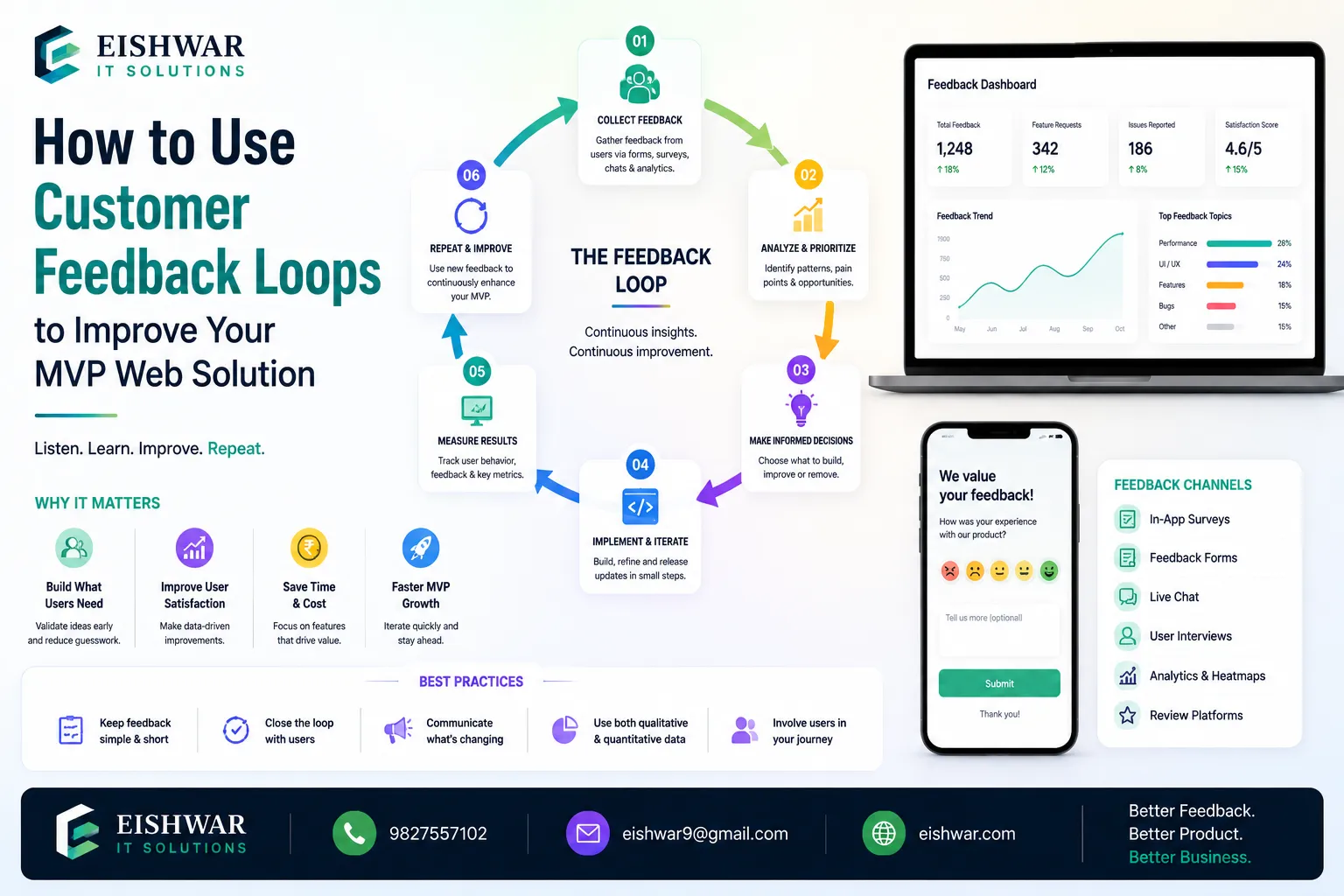
How to Use Customer Feedback Loops to Improve Your MVP Web Solution Af
Published on: 15 Jun 2026
How to Use Customer Feedback Loops to Improve Your MVP Web Solution After Launch
Introduction
Launching a Minimum Viable Product (MVP) is a major milestone for any startup. But the real work begins after launch. Your MVP is not the final product; it is a starting point for learning. The most successful Indian startups use customer feedback loops to continuously refine their web solutions, turning early adopters into loyal users. In this guide, we'll show you exactly how to set up and optimize feedback loops for your MVP web solution, with practical examples tailored for the Indian market.
Learn more about our Website services
Consider this: a 2023 survey by Startup India found that 68% of startups that actively collected and acted on user feedback within the first three months post-launch saw a 40% higher retention rate compared to those that didn't. Feedback loops are not just about fixing bugs—they are about building a relationship with your users. In a diverse market like India, where internet speeds, device types, and language preferences vary dramatically, feedback loops help you adapt quickly. For instance, a user in a tier-2 city might struggle with a feature that works perfectly in Mumbai. Without feedback, you'd never know. This guide will walk you through every step, from choosing channels to closing the loop, with actionable advice and real-world examples.
Main Section 1: What Are Customer Feedback Loops and Why They Matter for Your MVP
A customer feedback loop is a systematic process of collecting, analyzing, and acting on user feedback to improve your product. For an MVP web solution, this loop helps you validate assumptions, prioritize features, and fix issues before they become costly. In India, where user behavior varies widely across regions and devices, feedback loops are essential for building a product that truly resonates.
Think of it as a conversation: your users tell you what works and what doesn't, and you respond with updates. This builds trust and loyalty. Without a feedback loop, you risk building features nobody wants or missing critical bugs that drive users away. For example, a startup in Delhi launched an MVP for online tutoring. They assumed students wanted video calls, but feedback revealed that many preferred text-based chat due to poor internet connections. By pivoting based on feedback, they doubled their user base in two months. Feedback loops also help you avoid the 'build it and they will come' fallacy. Instead, you build with your users, ensuring every feature adds real value. In the Indian context, where word-of-mouth is powerful, a product that listens earns referrals and reduces churn.
Main Section 2: Step-by-Step Process to Build an Effective Feedback Loop for Your MVP Web Solution
Step 1: Choose the Right Feedback Channels
Start with channels your users already use. For Indian audiences, WhatsApp, email, and in-app widgets work well. Avoid overcomplicating. Tools like Typeform, Google Forms, or even a simple email can collect valuable insights. For example, a food delivery startup in Pune used a WhatsApp chatbot to ask users about their experience after each order. They got a 35% response rate, compared to 10% via email. The key is to meet users where they are. In-app widgets, like a feedback button in the corner, work well for active users. For passive users, send a follow-up email 24 hours after their first interaction. Remember, in India, mobile-first design is crucial—ensure your feedback forms are optimized for smartphones, with minimal typing required. Use emojis or star ratings for quick input.
👉 Don't wait for the perfect moment; turn your vision into reality today.
Free ConsultationStep 2: Ask the Right Questions at the Right Time
Timing matters. Ask for feedback after a user completes a key action, like signing up or making a purchase. Keep questions short and specific. For example: 'What was the most confusing part of the signup process?' Avoid vague questions like 'How do you like our product?' Instead, use the 'One Thing' technique: ask users to name one thing they would change. This yields actionable insights. For instance, a fintech startup in Bangalore asked users to rate the loan application process on a scale of 1-5, then followed up with an open-ended question. They discovered that users were dropping off at the document upload stage because the file size limit was too low. By increasing the limit, they improved completion rates by 20%. Also, consider using Net Promoter Score (NPS) surveys periodically to gauge overall satisfaction.
Step 3: Analyze Feedback for Patterns
Use a simple spreadsheet or a tool like Notion to categorize feedback. Look for recurring themes. If multiple users mention slow loading times on mobile, that's a priority. Create categories like 'Bugs', 'Feature Requests', 'Usability Issues', and 'Positive Feedback'. For example, a travel booking startup in Goa noticed that 15% of feedback mentioned difficulty in finding cancellation policies. They added a prominent link, reducing support tickets by 30%. Use sentiment analysis tools like MonkeyLearn or even manual tagging to identify trends. In India, where users may provide feedback in multiple languages, consider using translation tools to ensure no insight is missed. Analyze feedback weekly, and share summaries with your team to align priorities.
Step 4: Prioritize and Implement Changes
Not all feedback is equal. Use the Impact-Effort matrix: focus on changes that have high impact and low effort. For example, fixing a broken link is quick and improves user experience significantly. For high-effort, high-impact items, plan them for future sprints. Low-impact, low-effort items can be done when time permits. Avoid low-impact, high-effort changes. For instance, a SaaS startup in Hyderabad received a request for a dark mode feature. While it had high effort, the impact was moderate for their user base. They prioritized it for a later release and instead fixed a critical payment gateway error that was causing 10% of transactions to fail. Use a tool like Trello or Jira to track feedback items and their status. Communicate your prioritization rationale to users to manage expectations.
Step 5: Close the Loop with Users
Let users know their feedback led to a change. Send a follow-up email or in-app notification. This encourages more feedback and shows you value their input. For example, after fixing the payment error, the Hyderabad startup sent an email to affected users saying, 'Thanks to your feedback, we've resolved the payment issue. Your next transaction will be seamless.' This resulted in a 15% increase in repeat transactions. Closing the loop builds trust and turns users into advocates. In India, where personal relationships matter, a personalized message goes a long way. Use the user's name and reference their specific feedback. Even if you can't implement their suggestion, explain why and thank them. This transparency fosters loyalty.
👉 Free Website Audit
Get Free AuditMain Section 3: Real-World Examples of Feedback Loops in Indian Startups
Consider a food delivery startup in Bangalore that launched an MVP web solution. They added a simple 'Rate Your Order' feature after delivery. Users often complained about late deliveries. The startup used this feedback to optimize their route planning, reducing delays by 30% in three months. They also noticed that users in certain areas complained about missing items. By analyzing feedback, they identified a packaging issue and fixed it, reducing complaints by 50%.
Another example: a fintech startup in Mumbai used an in-app chat widget to collect feedback on their loan application process. Users found the document upload confusing. The startup simplified the UI and added tooltips, increasing completion rates by 25%. They also used feedback to introduce a 'Track Application' feature, which users had repeatedly requested. This reduced support calls by 40%.
A third example: an edtech startup in Chennai launched an MVP for online courses. They used Google Forms to ask users about course content. Feedback revealed that users wanted shorter video lessons (under 10 minutes). The startup restructured their content, leading to a 50% increase in course completion rates. They also added a 'Download for Offline' feature based on feedback from users in areas with poor connectivity.
Expert Tips
- Start small: Don't try to collect feedback from everyone. Focus on your most active users first. They are your early adopters and most likely to provide constructive insights.
- Use analytics alongside feedback: Combine qualitative feedback with quantitative data from tools like Google Analytics to get a complete picture. For example, if users complain about slow loading, check your page speed data to confirm.
- Be responsive: Reply to feedback within 24 hours. Even a simple 'Thank you' builds goodwill. For negative feedback, acknowledge the issue and provide a timeline for resolution.
- Avoid bias: Don't only listen to loud voices. Use surveys to get representative feedback. Segment your users by demographics, usage frequency, and device type to ensure diverse perspectives.
- Iterate quickly: In the MVP stage, speed matters. Implement small changes within days, not weeks. This shows users you are agile and responsive.
- Celebrate wins: When a feedback-driven change leads to improvement, share it with your team and users. This motivates everyone and reinforces the value of feedback.
Common Mistakes
- Ignoring negative feedback: Negative feedback is gold. It highlights areas for improvement. Don't dismiss it; instead, investigate and act.
- Acting on every piece of feedback: Prioritize based on impact and alignment with your vision. Not all feedback is relevant or feasible.
- Not closing the loop: Failing to inform users about changes reduces trust and future engagement. Always follow up.
- Overcomplicating the process: Use simple tools. Fancy software isn't necessary at the MVP stage. A spreadsheet and email can suffice.
- Asking for feedback too often: Bombarding users with surveys leads to fatigue. Space out requests and keep them brief.
- Ignoring silent users: Users who don't give feedback may still have issues. Use analytics to identify drop-off points and proactively reach out.
Future Trends
By 2026, AI-powered sentiment analysis will become more accessible, allowing startups to analyze feedback from social media, emails, and chats automatically. Voice-based feedback will also rise, especially in India where voice search is growing. Expect more personalized feedback requests based on user behavior. For example, if a user spends 10 minutes on a page without taking action, a chatbot might ask, 'Need help?' Additionally, integration with CRM tools will enable startups to track feedback across the customer journey, from onboarding to retention. In India, where regional languages are key, multilingual feedback collection will become standard. Startups that embrace these trends will stay ahead of the curve.
👉 Free Homepage Demo
Book DemoFAQs
1. How often should I collect feedback for my MVP?
Collect feedback continuously, but analyze it weekly. Don't overwhelm users with surveys every day. Use passive channels like in-app widgets for ongoing collection, and send targeted surveys after key actions (e.g., first purchase, feature use). A good rule is to ask for feedback no more than once per user per week.
2. What tools can Indian startups use for feedback loops?
Affordable options include Typeform, Google Forms, SurveyMonkey, and in-app widgets like Intercom or UserVoice. For WhatsApp-based feedback, consider tools like WATI or Twilio. For analytics, use Google Analytics or Mixpanel. For sentiment analysis, MonkeyLearn offers affordable plans. Many of these tools have free tiers suitable for startups.
3. How do I encourage users to give feedback?
Offer small incentives like discount codes or entry into a prize draw. Keep surveys short and respect their time. Personalize requests by mentioning their recent activity. For example, 'We noticed you just completed your first order. How was it?' Also, make it easy—use star ratings or emojis instead of long forms. In India, offering a small reward like a ₹50 coupon can boost response rates by 30%.
4. Should I act on all feedback immediately?
No. Prioritize based on frequency and impact. Fix critical bugs first, then address feature requests that align with your roadmap. Use the Impact-Effort matrix to decide. For example, if 20% of users report a login issue, fix it immediately. If one user requests a niche feature, consider it for later. Communicate your prioritization to users to manage expectations.
5. Can feedback loops help with user retention?
Absolutely. When users see their input leads to improvements, they feel valued and are more likely to stay. A study by Harvard Business Review found that companies that close the feedback loop see a 10-15% increase in retention. In India, where competition is fierce, retention is key. Feedback loops also reduce churn by addressing issues before they escalate.
6. How do I handle feedback in multiple languages?
Use translation tools like Google Translate or integrate multilingual support in your feedback forms. In India, consider offering feedback in Hindi, Tamil, Telugu, and other regional languages. Tools like Typeform allow multiple language versions. Analyze feedback in the original language to avoid nuances being lost, then translate for team understanding.
7. What if users give conflicting feedback?
Look for patterns and consider your product vision. If 40% want feature A and 30% want feature B, test both with a small group. Use A/B testing to see which improves key metrics. Conflicting feedback is normal; prioritize based on your target audience and business goals.
Conclusion
Customer feedback loops are not optional; they are the engine of continuous improvement for your MVP web solution. By listening to your users, acting on their insights, and closing the loop, you build a product that truly serves the Indian market. Start small, stay consistent, and watch your startup grow. Remember, every piece of feedback is an opportunity to learn and improve. In a dynamic market like India, agility and user-centricity are your greatest assets. Implement these strategies today, and you'll not only retain users but also turn them into advocates.
CTA
Ready to refine your MVP web solution with expert guidance? Contact EishwarITSolution today for a free consultation. Let's build something great together.