
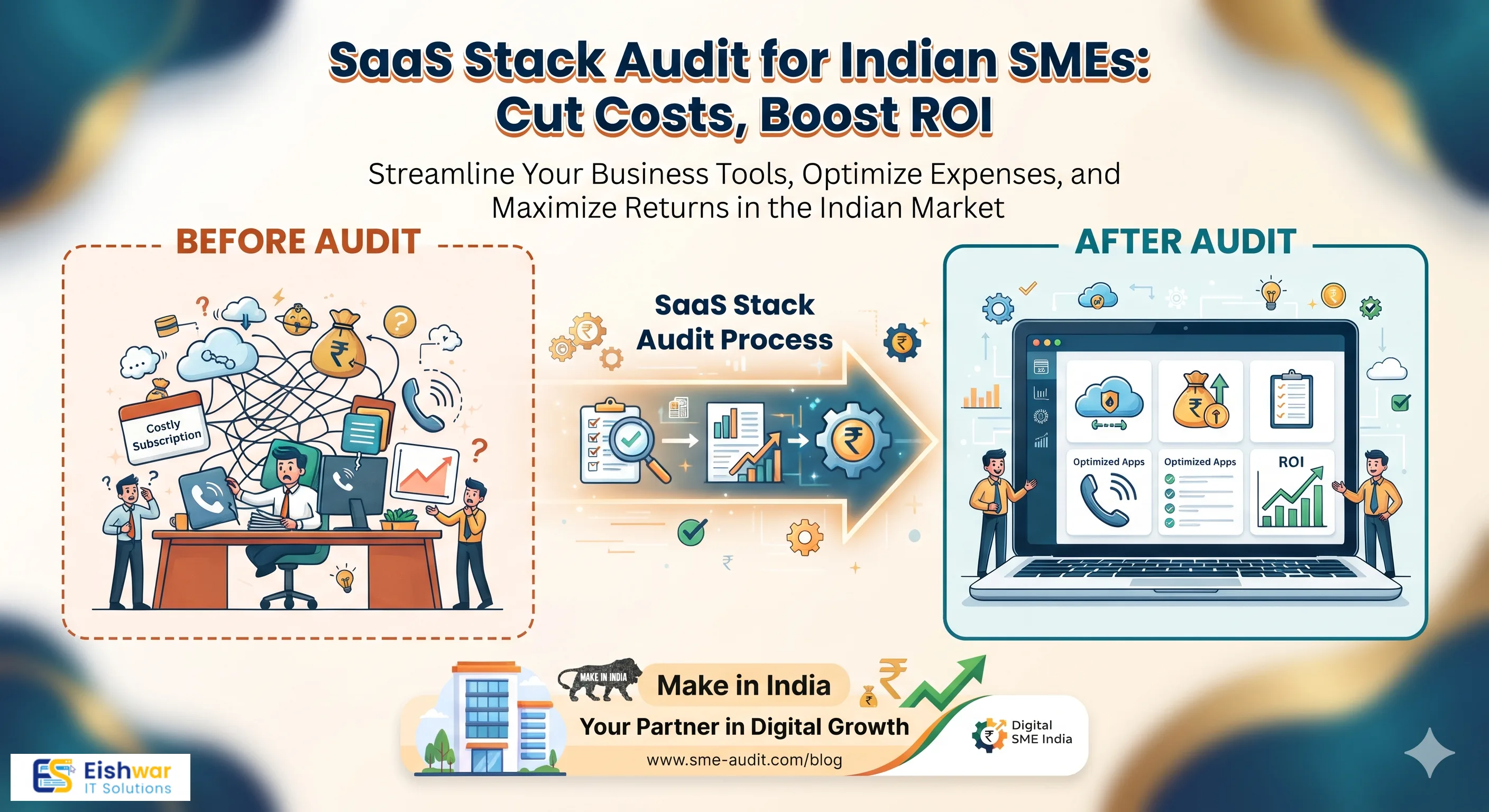
SaaS Stack Audit for Indian SMEs: Cut Costs, Boost ROI
Published on: 09 Nov 2026
SaaS Stack Audit for Indian SMEs: Cut Costs, Boost ROI
Introduction
Most Indian SMEs do not have a software problem. They have a software visibility problem. A business starts with email, accounting, CRM, and a payment tool. Within two years, every department adds its own apps: project management, HRMS, WhatsApp integrations, analytics, design tools, support desks, and AI add-ons. Each tool looks affordable on its own. Together, they create a silent profit leak.
Learn more about our Website services
A SaaS stack audit fixes that. It is a structured review of every software subscription your business pays for, who uses it, what it costs, and whether it still earns its place. For SMEs in India, this is not a one-time cost-cutting exercise. It is a practical digital transformation habit that keeps your business lean, secure, and ready to scale.
This guide gives you a 30-day audit process, negotiation tactics, ROI calculations, and common pitfalls to avoid. It is written for business owners, marketers, and professionals who want better returns from their digital tools without disrupting daily operations.
Main Section 1: Why SaaS Sprawl Is a Silent Profit Leak
SaaS sprawl happens when software subscriptions grow faster than your ability to manage them. In a small business, it often starts innocently. One team buys a design tool on a credit card. Another signs up for a free trial that becomes an annual plan. A salesperson adopts a CRM because it integrates with their phone. HR adds a payroll portal. Marketing adds a scheduler, a landing page builder, and a heatmap tool.
The result is a crowded stack with overlapping features. You may have two CRMs, three project trackers, four analytics dashboards, and several tools nobody remembers buying. The monthly charges are small enough to escape attention, but the annual total is significant. Add integration costs, training time, cybersecurity risk, and productivity loss, and the real cost becomes much larger than the invoice.
Common signs your SME has SaaS sprawl
- You discover a subscription during a bank statement review.
- Different teams use different tools for the same job.
- More than 20% of paid seats are inactive.
- No one knows the renewal date of key software.
- Employees export data into spreadsheets because tools do not connect.
- You pay for features that only one person uses once a month.
Consider a typical 45-person distribution business in India. It might pay for a CRM, accounting software, inventory tool, HRMS, support desk, email marketing tool, WhatsApp API, analytics platform, design tool, cloud storage, project management app, e-signature tool, and two AI writing subscriptions. If two tools overlap, three have unused seats, and one was bought for a project that ended, the business could be wasting 15% to 30% of its software budget every year.
The goal is not to remove every tool. The goal is to make sure every tool has an owner, a use case, a measurable benefit, and a fair price. That is where a SaaS stack audit creates value.
Main Section 2: How to Run a 30-Day SaaS Stack Audit
A good SaaS stack audit is simple, repeatable, and business-focused. You do not need a large IT team. You need one coordinator, access to billing statements, and cooperation from department heads. Run it in four weeks.
👉 Don't wait for the perfect moment; turn your vision into reality today.
Free ConsultationWeek 1: Build a complete software inventory
Start with bank statements, credit card bills, UPI business payments, invoices, and email receipts from the last 12 months. List every recurring software charge. Include tools bought by individuals, teams, and external agencies. Do not rely on memory.
For each tool, capture the tool name, vendor, department, business owner, primary use case, number of paid seats, number of active users, monthly cost, annual cost, billing currency, renewal date, contract notice period, and payment method. This inventory becomes your single source of truth.
Week 2: Measure usage, not assumptions
Ask vendors for usage reports or check admin dashboards. Look at daily active users, weekly active users, feature adoption, storage usage, API calls, and login frequency. A seat is not valuable just because it is paid for. It is valuable when it helps someone complete a business task faster, cheaper, or more reliably.
Classify each tool as critical, useful, optional, or redundant. Critical tools support revenue, compliance, payroll, security, or customer delivery. Useful tools improve productivity but have alternatives. Optional tools are nice-to-have. Redundant tools overlap with another tool that already does the job well.
Week 3: Calculate the true cost and risk
Monthly subscription price is only one part of the cost. Add implementation fees, integration costs, training time, admin effort, data storage, support tickets, and security review time. Also check contract terms. Some vendors auto-renew, some require 30 or 60 days notice, and some charge in dollars with currency fluctuation risk.
Review risk too. Does the vendor store customer data? Does it support role-based access? Is data hosted in India or abroad? Does it have a data processing agreement? For Indian SMEs handling personal data, this matters more as compliance expectations tighten under India's data protection framework.
Week 4: Decide, negotiate, and document
For every tool, choose one action: keep, consolidate, right-size seats, renegotiate, replace, or cancel. Assign an owner and a deadline. Document the decision so the same debate does not return next quarter.
A simple decision rule works well. If a tool is critical and well adopted, keep it and negotiate better terms. If two tools do the same job, consolidate into the one with better adoption and integration. If a tool is useful but underused, reduce seats or move to a lower plan. If a tool is optional and unused, cancel it.
Main Section 3: From Audit to Action — Cut Costs and Improve ROI
An audit only creates value when decisions turn into action. Here is how to move from spreadsheet to savings without disrupting the business.
1. Consolidate overlapping tools
Look for tools that solve the same problem. CRM, sales engagement, and customer support often overlap. Project management, task tracking, and documentation often overlap. Social media scheduling and analytics often overlap. Choose a primary system for each business function and connect the rest through integrations or exports.
Do not consolidate blindly. A single all-in-one suite can reduce cost and complexity, but it can also force teams into poor workflows. Compare total cost, migration effort, user adoption, integration quality, and vendor support before you switch.
👉 Free Website Audit
Get Free Audit2. Right-size seats and plans
Many SMEs buy seats for the whole team because it is easier. Then half the team logs in once a month. Reduce inactive seats, downgrade to lower plans where possible, and move occasional users to shared or pay-per-use options. Set a rule that new seats require manager approval.
3. Negotiate renewals with data
Contact vendors 45 to 60 days before renewal. Share usage data, ask for a better price, and request annual billing discounts only if cash flow allows. Ask about startup or SME pricing, multi-year discounts, free onboarding, additional training, or waived implementation fees. If a vendor will not budge, get a competing quote before you renew.
4. Fix procurement and renewal management
Most SaaS waste comes from unmanaged buying. Create a simple procurement process. Any new software above a set monthly amount needs a business case, a named owner, a renewal date, and an exit plan. Use a central business card or virtual card for subscriptions. Maintain a renewal calendar with reminders 60 days before every auto-renewal.
5. Improve adoption and integration
Cutting costs is only half the job. The other half is getting more value from the tools you keep. Train teams on core features. Connect tools so data flows automatically. Review adoption every quarter. If a tool is critical but underused, fix training and workflow before you replace it.
6. Measure ROI with a simple formula
Use this formula: annual savings = cancelled subscriptions + reduced seats + renegotiated discounts - migration cost - training cost. Then add productivity gains separately. For example, if you cancel three tools worth Rs 36,000 per year, reduce 12 seats worth Rs 48,000 per year, and renegotiate one contract for Rs 20,000 per year, you save Rs 1,04,000. If migration and training cost Rs 25,000, net first-year savings are Rs 79,000. The second-year savings are higher because migration costs disappear.
Expert Tips
- Assign one owner for every SaaS tool. Shared ownership usually means no ownership.
- Audit before renewal, not after. Your negotiating power is strongest before auto-renewal.
- Use admin dashboards to measure active users. Do not rely on department feedback alone.
- Separate must-have tools from nice-to-have tools. Protect revenue, compliance, and security tools first.
- Include security and data protection in every review. Cheap tools become expensive when data leaks.
- Create a simple internal SaaS catalog with owner, cost, renewal date, and login link.
- Reward cost savings and smart consolidation, not just new software purchases.
- Review your stack every quarter and run a deeper audit every year.
Common Mistakes
- Cancelling tools without exporting data, documenting workflows, or informing users.
- Looking only at monthly price and ignoring implementation, training, and integration costs.
- Assuming the cheapest tool is the best value. Poor adoption can make a low-cost tool expensive.
- Forgetting auto-renewal clauses and notice periods.
- Ignoring currency risk and GST input credit when comparing vendors.
- Over-consolidating into one suite that does everything badly for your core workflows.
- Letting every department buy tools independently with no visibility.
- Not tracking savings after the audit, so the same waste returns.
Future Trends
SaaS management is becoming more automated and more important for SMEs. Here are trends to watch.
👉 Free Homepage Demo
Book Demo- AI-powered SaaS spend management: tools will flag unused seats, duplicate apps, and renewal risks automatically.
- Usage-based pricing: more vendors will charge by consumption, making usage monitoring essential.
- SaaS security posture management: SMEs will need to review app permissions, data access, and vendor risk.
- Embedded finance and pay-per-use models: software costs may move from fixed subscriptions to transaction-based pricing.
- Vendor consolidation: businesses will prefer fewer, better-integrated platforms over dozens of point tools.
- Privacy-led vendor reviews: data protection and vendor accountability will become standard parts of software procurement.
FAQs
What is a SaaS stack audit?
A SaaS stack audit is a review of every software subscription a business pays for. It checks cost, usage, ownership, overlap, risk, and business value. The output is a clear action plan to keep, consolidate, renegotiate, or cancel tools.
How often should Indian SMEs audit software subscriptions?
Run a light review every quarter and a full SaaS stack audit once a year. Also audit before any major renewal, funding round, expansion, or cost-cutting exercise.
How much can an SME save through a SaaS audit?
Savings vary by business size and stack maturity. Many SMEs find 15% to 30% of software spend can be reduced through unused seat removal, duplicate tool consolidation, and better renewal negotiation. The bigger gain often comes from improved adoption and fewer manual workarounds.
Will cutting SaaS tools hurt operations?
Not if you protect critical tools and manage change carefully. Export data, document workflows, train users, and migrate in phases. Cancel redundant tools only after teams confirm they have a workable alternative.
What should we do about contracts and data when cancelling?
Check notice periods and auto-renewal terms first. Export all data in a usable format, confirm retention and deletion terms, revoke integrations, and update access for employees and agencies. Keep a record of the cancellation confirmation.
Who should own SaaS management in a small business?
A finance or operations lead can coordinate the audit, with department heads owning individual tools. In smaller teams, the business owner or a senior manager should review the renewal calendar monthly.
What KPIs should we track after the audit?
Track total software spend, spend per employee, active users per paid seat, number of duplicate tools, renewal compliance, and savings achieved. Review these numbers quarterly.
Conclusion
A SaaS stack audit is one of the fastest ways for Indian SMEs to improve digital transformation ROI without buying anything new. It turns a messy collection of subscriptions into a managed portfolio of tools that support growth. Start with visibility, measure usage, negotiate with data, and make consolidation a habit. You will cut waste, reduce risk, and give your teams a simpler stack to work with.
CTA
Ready to find hidden savings in your software stack? Book a free SaaS stack review with EishwarITSolution and get a practical action plan to cut costs, consolidate tools, and improve ROI. Visit eishwar.com to start.