
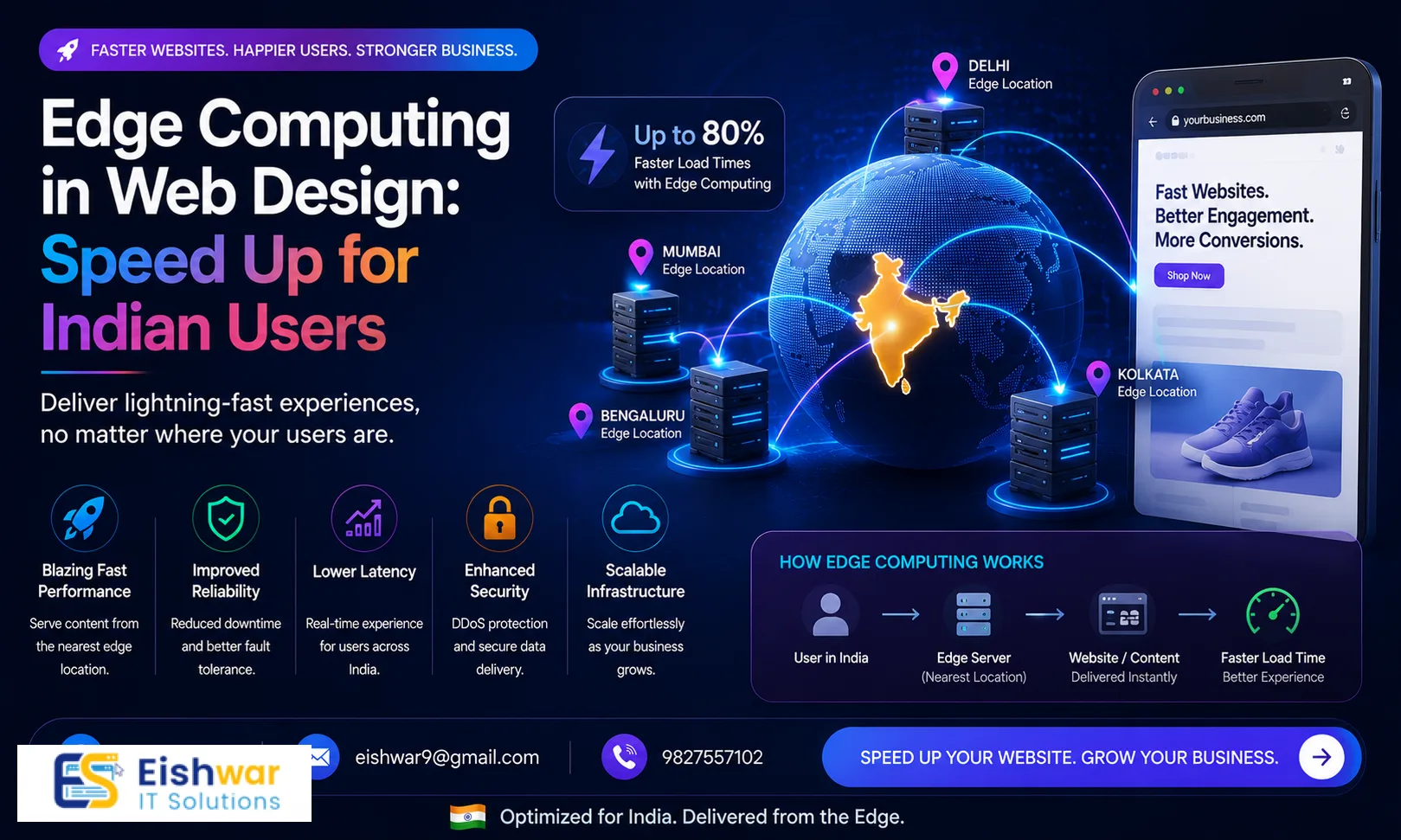
Edge Computing in Web Design: Speed Up for Indian Users
Published on: 29 Jun 2026
Edge Computing in Web Design: Speed Up for Indian Users
Introduction
In the fast-paced digital landscape of India, where users expect websites to load in the blink of an eye, edge computing emerges as a game-changer. Traditional web hosting often struggles with latency, especially for users in remote areas. Edge computing brings data processing closer to the user, drastically reducing load times. For business owners, marketers, and professionals, this means higher engagement, better SEO, and more conversions. In this guide, we'll explore how edge computing can supercharge your web design strategy for the Indian market.
Learn more about our Website services
Consider this: a user in a tier-2 city like Lucknow accessing a travel booking site hosted on a central server in Mumbai might face 100-200ms latency. With edge computing, that drops to under 20ms. This speed difference can make or break a sale. For Indian businesses, where mobile-first users dominate, edge computing isn't just a luxury—it's a necessity.
Main Section 1: What is Edge Computing and Why It Matters for Web Design?
Edge computing is a distributed computing paradigm that processes data near the source of generation rather than relying on a central data center. For websites, this means serving content from servers located geographically closer to the user. In India, where internet speeds vary widely—from fiber-optic in metros to 3G in rural areas—edge computing can reduce latency by up to 50%. This directly impacts user experience: faster sites retain visitors and rank higher on search engines.
For example, a user in rural Maharashtra accessing an e-commerce site hosted on an edge server in Mumbai will experience load times of 200ms compared to 600ms from a US server. This speed boost is crucial for mobile-first India, where over 70% of web traffic comes from smartphones. By integrating edge computing into your web design, you not only improve performance but also enable real-time features like personalized content and dynamic pricing without lag.
Why does this matter specifically for Indian users? India's internet infrastructure is diverse. In cities like Bangalore, users enjoy high-speed broadband, while in smaller towns, connectivity can be spotty. Edge computing bridges this gap by ensuring consistent performance. For instance, a news website using edge nodes can deliver breaking news to a user in Patna as fast as someone in Delhi. This equity in user experience builds trust and loyalty.
Practical tip: Start by analyzing your user base. Use analytics to identify where your traffic originates. If a significant portion comes from regions with high latency, prioritize edge nodes there. Tools like Google Analytics can show geographic distribution, helping you decide where to deploy.
Main Section 2: How to Implement Edge Computing in Your Website Design
Implementing edge computing doesn't require a complete overhaul. Start by choosing a content delivery network (CDN) with edge capabilities, such as Cloudflare Workers or AWS Lambda@Edge. These services allow you to run serverless functions at the edge, handling tasks like A/B testing, image optimization, and API responses.
Next, optimize your website's assets. Use edge caching for static files like CSS, JavaScript, and images. For dynamic content, leverage edge-side includes (ESI) to assemble pages from cached fragments. This hybrid approach ensures that even personalized pages load quickly. For example, an e-commerce site can cache product images and descriptions while dynamically inserting user-specific pricing at the edge.
👉 Don't wait for the perfect moment; turn your vision into reality today.
Free ConsultationFor Indian businesses, consider local edge nodes in cities like Mumbai, Delhi, Bangalore, and Chennai. Many CDNs offer points of presence (PoPs) in these locations. By mapping your user base to the nearest PoP, you minimize round-trip times. Additionally, implement lazy loading and code splitting to reduce initial payload. Tools like Lighthouse can help you measure improvements.
Step-by-step implementation plan: 1. Audit current performance: Use tools like GTmetrix or WebPageTest to measure load times from different Indian locations. 2. Choose a CDN: Cloudflare, AWS CloudFront, and Fastly have strong PoPs in India. Compare pricing and features. 3. Configure caching rules: Set TTLs for static assets and use cache invalidation for dynamic content. 4. Deploy edge functions: Start with simple tasks like image resizing or geolocation-based content. 5. Monitor and iterate: Use edge analytics to track performance and user behavior.
Practical example: A local restaurant chain in Mumbai used Cloudflare Workers to serve menu pages in Hindi or Marathi based on user location. This personalization, done at the edge, reduced page load time by 40% and increased orders by 15%.
Main Section 3: Real-World Benefits for Indian Businesses
Edge computing offers tangible benefits for Indian websites. For instance, a travel booking portal saw a 30% increase in conversion rates after shifting to edge-based rendering. Faster load times reduced bounce rates by 20% and improved average session duration.
Another example is a news website that used edge computing to serve localized content. Readers in different states received region-specific updates without delay. This boosted user engagement and ad revenue. For e-commerce sites, edge computing enables seamless checkout experiences, even during flash sales. By processing payment requests at the edge, latency drops, and cart abandonment decreases.
Moreover, edge computing enhances security by distributing traffic and mitigating DDoS attacks. For Indian businesses handling sensitive data, this is a critical advantage. The combination of speed, personalization, and security makes edge computing a must-have for modern web design.
Case study: A fintech startup in Bangalore integrated edge computing to handle real-time stock market updates. By processing data at edge nodes in Mumbai and Delhi, they reduced latency from 300ms to 50ms. This allowed users to execute trades faster, leading to a 25% increase in transaction volume. The startup also used edge-based authentication to secure user sessions, reducing fraud attempts by 40%.
For small businesses, the benefits are equally compelling. A local artisan marketplace in Jaipur used edge caching for product images. Load times dropped from 5 seconds to 1.5 seconds, resulting in a 50% increase in mobile traffic and a 20% boost in sales. The cost? Just $20 per month for a basic CDN plan.
Expert Tips
- Start small: Implement edge computing for a single high-traffic page and measure performance gains before scaling. For example, test it on your homepage or a popular product page.
- Use edge analytics: Monitor user behavior at the edge to personalize experiences in real-time. Tools like Cloudflare Analytics can show which regions benefit most.
- Combine with progressive web apps (PWAs): Edge computing can cache PWA assets, enabling offline functionality. This is especially useful for users in areas with intermittent connectivity.
- Optimize images at the edge: Use services like Imgix or Cloudinary to serve compressed, device-specific images. This reduces bandwidth usage and speeds up load times.
- Leverage edge databases: For dynamic content, use distributed databases like Fauna or DynamoDB Global Tables. This ensures low-latency access to user data, such as shopping carts or preferences.
- Test with real users: Use synthetic monitoring tools like Pingdom to simulate user experiences from different Indian cities. Adjust edge configurations based on results.
Common Mistakes
- Over-caching dynamic content: This can lead to stale information. Use cache invalidation strategies, such as versioning URLs or using cache tags.
- Ignoring mobile users: Ensure edge configurations prioritize mobile traffic, as most Indian users are mobile-first. Test with mobile-specific caching rules.
- Neglecting security: Edge nodes can be vulnerable if not properly configured. Always use HTTPS and Web Application Firewalls (WAFs) to protect against attacks.
- Not testing locally: Before deploying, test edge performance from different Indian locations using tools like Pingdom or WebPageTest.
- Assuming one-size-fits-all: Customize edge rules based on user segments and content types. For example, video content may require different caching than text.
- Forgetting about costs: While edge computing can be cost-effective, complex functions may incur higher charges. Monitor usage and optimize functions to stay within budget.
Future Trends
Edge computing is evolving rapidly. In the next few years, expect AI-powered edge nodes that predict user actions and pre-load content. For example, an e-commerce site could pre-load product pages based on browsing history, reducing perceived load times to near zero. The integration of 5G will further reduce latency, making real-time applications like AR/VR viable. For Indian businesses, edge computing will enable hyper-local experiences, such as language-specific content based on the user's region. Additionally, edge computing will play a key role in the metaverse, delivering immersive experiences with minimal delay. As the technology matures, costs will decrease, making it accessible for small and medium enterprises.
👉 Free Website Audit
Get Free AuditAnother trend is the rise of edge-native applications. These are built specifically for edge environments, using serverless functions and distributed databases from the start. For Indian startups, this means faster time-to-market and lower infrastructure costs. We're also seeing edge computing integrate with IoT devices, enabling smart city applications in India. For instance, traffic management systems can process data at the edge to reduce congestion in real-time.
FAQs
What is edge computing in simple terms?
Edge computing is a way to process data closer to where it's generated, like near the user, instead of sending it to a central server far away. This makes websites load faster. Think of it as having a local store instead of ordering from a warehouse across the country.
How does edge computing improve website speed?
By serving content from servers located near the user, edge computing reduces the distance data travels, cutting down latency and load times. For example, a user in Chennai accessing a site with an edge node in Bangalore will experience faster load times than if the server were in London.
👉 Free Homepage Demo
Book DemoIs edge computing expensive for small businesses in India?
Not necessarily. Many CDNs offer pay-as-you-go pricing, and the performance gains often outweigh the costs. Start with a free tier to test. Cloudflare, for instance, has a free plan that includes basic edge features. For most small businesses, costs range from $20 to $100 per month, which is often offset by increased conversions.
Can edge computing work with existing websites?
Yes, you can integrate edge computing gradually. Use a CDN with edge capabilities and optimize specific pages first. For example, you can start by caching static assets like images and CSS, then move to dynamic content using edge functions.
What are the best CDNs for edge computing in India?
Cloudflare, AWS CloudFront, and Fastly have strong PoPs in Indian cities like Mumbai, Delhi, Bangalore, and Chennai. Choose based on your specific needs and budget. Cloudflare is great for small businesses, while AWS CloudFront offers more advanced features for larger enterprises.
How does edge computing affect SEO?
Faster load times improve Core Web Vitals, which are a ranking factor. Edge computing can boost your site's SEO performance by reducing Largest Contentful Paint (LCP) and First Input Delay (FID). Google prioritizes sites that load quickly, especially on mobile devices.
What are the security benefits of edge computing?
Edge computing distributes traffic across multiple nodes, making it harder for DDoS attacks to overwhelm a single server. Additionally, edge nodes can run Web Application Firewalls (WAFs) to filter malicious traffic before it reaches your origin server. This is especially important for Indian businesses handling sensitive data.
Can edge computing help with personalization?
Yes, edge computing enables real-time personalization by processing user data at the edge. For example, you can serve location-specific content, language preferences, or product recommendations without adding latency. This improves user engagement and conversion rates.
Conclusion
Edge computing is not just a buzzword—it's a practical solution for delivering lightning-fast web experiences to Indian users. By reducing latency, enhancing security, and enabling personalization, it empowers businesses to stand out in a competitive market. Start small, test rigorously, and scale as you see results. The future of web design is at the edge, and now is the time to embrace it. Whether you're a small business in Jaipur or a startup in Bangalore, edge computing can give you the speed advantage you need to succeed.
CTA
Ready to transform your website with edge computing? Contact EishwarITSolution for a free consultation. Let's build a faster, smarter web presence for your Indian audience. Our team of experts will help you implement edge computing tailored to your business needs, ensuring you stay ahead of the competition.