AI-Generated Websites: Pros, Cons & Tips for Indian Businesses
Published on: 14 Aug 2026
AI-Generated Websites: Pros, Cons & Tips for Indian Businesses
Introduction
In the fast-paced digital landscape of India, having a website is no longer optional—it's essential. But what if you could create a professional website in minutes without hiring a designer or writing a single line of code? That's the promise of AI-generated websites. As we move through 2026, AI website builders are becoming increasingly sophisticated, offering Indian businesses a tempting shortcut to an online presence.
Learn more about our Website services
But is this technology the right fit for your business? In this comprehensive guide, we'll explore the rise of AI-generated websites, weighing their pros and cons specifically for Indian businesses. We'll also provide actionable tips, highlight common pitfalls, and discuss future trends. By the end, you'll have a clear understanding of whether to embrace AI for your web design or stick with traditional methods.
Main Section 1: What Are AI-Generated Websites and How Do They Work?
AI-generated websites are built using artificial intelligence algorithms that automate the design and content creation process. Platforms like Wix ADI, Bookmark, and Framer AI use machine learning to analyze user inputs—such as business type, industry, and preferences—and generate a complete website in minutes.
These tools typically work by:
- Asking you a series of questions about your business
- Analyzing your existing content or social media profiles
- Selecting templates and layouts that match your industry
- Generating placeholder text, images, and even color schemes
- Allowing you to customize and publish
For Indian businesses, this can be a game-changer. Small business owners, startups, and even local shops can now have a professional-looking website without a hefty budget. However, the quality and effectiveness of these sites can vary widely.
Let's dive deeper into how these tools work in practice. When you sign up for a platform like Wix ADI, you're prompted to answer questions about your business name, location, and industry. The AI then scans the web for relevant information about your business—such as your Google My Business listing, social media pages, or even reviews—and uses that data to populate your site. It also suggests color palettes and fonts based on your industry. For instance, a yoga studio might get calming greens and serif fonts, while a tech startup might get bold blues and modern sans-serifs. The entire process takes about 10–15 minutes, and you can tweak everything afterward.
Another key aspect is the content generation. AI tools use natural language processing (NLP) to write headlines, product descriptions, and even blog posts. However, these texts often lack the nuance and local flavor that Indian audiences appreciate. For example, an AI might generate a generic tagline like "Quality products at affordable prices," which doesn't resonate as well as "Serving authentic flavors since 1995" for a South Indian restaurant. This is why human editing is non-negotiable.
Main Section 2: Pros of AI-Generated Websites for Indian Businesses
Speed and Cost-Effectiveness
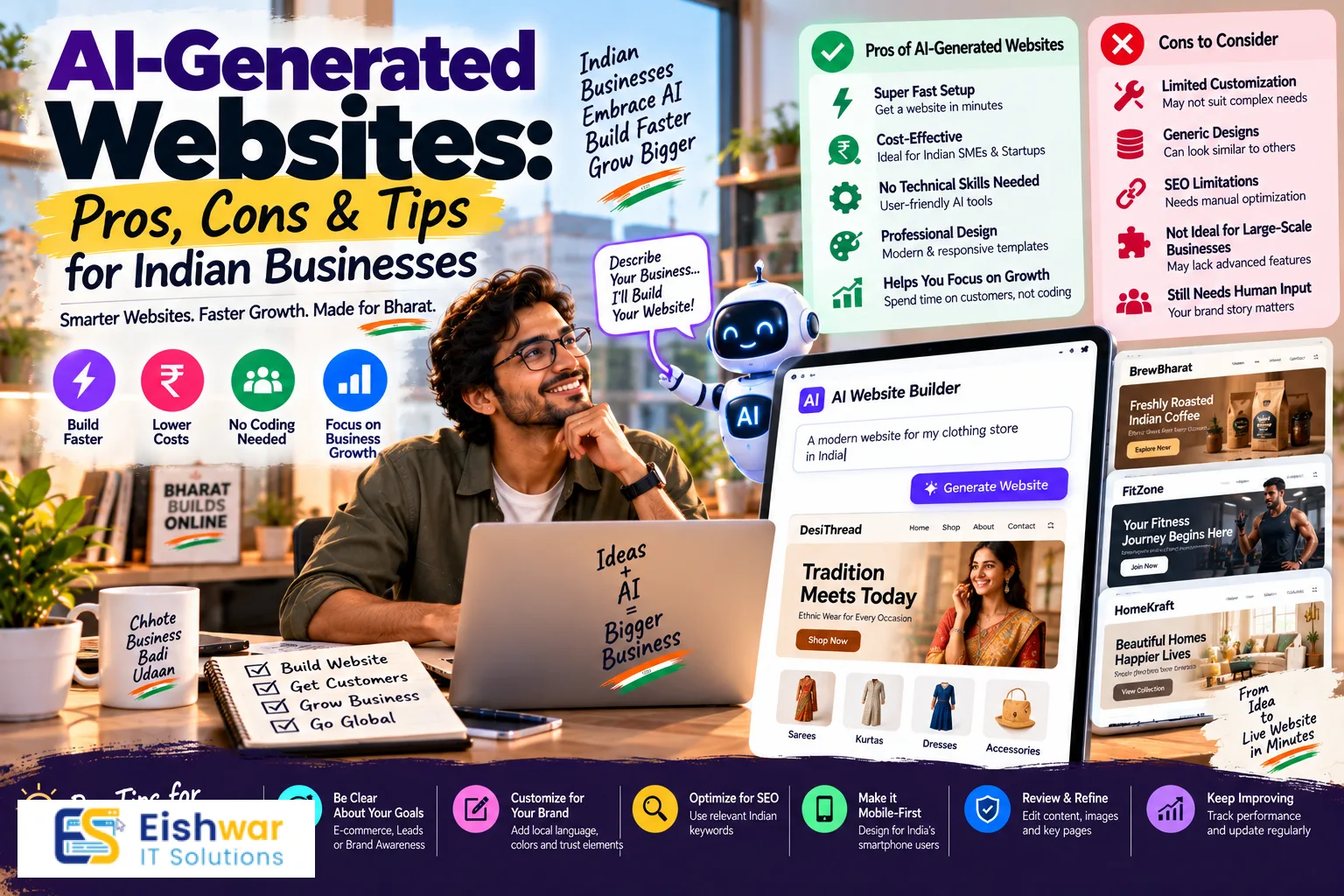
One of the biggest advantages of AI website builders is speed. In the time it takes to drink a cup of chai, you can have a website ready. This is especially beneficial for Indian businesses that need to establish an online presence quickly—like a new restaurant or a local service provider. Costs are also lower, with many AI builders offering free or low-cost plans compared to hiring a professional web designer. For instance, a basic plan on Wix costs around ₹500 per month, while a custom-designed website might set you back ₹20,000–₹50,000 upfront. For a small business owner in Jaipur or Kochi, this cost difference is significant.
👉 Don't wait for the perfect moment; turn your vision into reality today.
Free ConsultationMoreover, AI builders often include hosting, domain, and SSL certificates in their packages, which saves you the hassle of coordinating multiple vendors. This all-in-one approach is particularly appealing for first-time website owners who might be overwhelmed by technical details.
Ease of Use
You don't need to be tech-savvy to use AI website builders. The intuitive interfaces and drag-and-drop features make it accessible to everyone, from a Delhi-based boutique owner to a Bengaluru tech startup founder. This democratizes web design, allowing more Indian businesses to compete online. For example, a local florist in Chennai can create a beautiful portfolio site in an afternoon, complete with a photo gallery and a contact form, without ever touching code.
Additionally, most AI builders offer tutorials, live chat support, and community forums in multiple Indian languages, which lowers the learning curve further. This is a huge advantage in a country where digital literacy varies widely.
Scalability and Flexibility
Many AI builders are cloud-based and offer scalability. As your business grows, you can easily add new pages, integrate e-commerce, or update content without starting from scratch. This flexibility is crucial in a dynamic market like India, where consumer behavior changes rapidly. For instance, a small clothing brand that starts with a simple catalog can later add an online store with payment gateways like Paytm or Razorpay, all within the same platform.
Moreover, AI builders often have integrations with popular tools like Google Analytics, Mailchimp, and social media platforms, making it easy to track performance and automate marketing. This is particularly valuable for businesses that want to scale their digital presence without hiring a dedicated tech team.
Built-in SEO Features
Most AI-generated websites come with basic SEO tools, such as meta tags, alt text, and mobile optimization. This helps Indian businesses rank better in search engines, especially for local searches like "best salon in Mumbai" or "plumber in Pune." For example, an AI builder might automatically generate a meta description for your homepage, but you can customize it to include your primary keyword and a compelling call-to-action.
Furthermore, AI builders often ensure that your site is fast-loading and mobile-friendly, which are key ranking factors for Google. Given that over 70% of Indian internet users access the web via mobile, this is a critical advantage.
Main Section 3: Cons of AI-Generated Websites and How to Mitigate Them
Lack of Unique Branding
AI websites often rely on templates, which means your site might look similar to others in your industry. This can dilute your brand identity. To mitigate this, customize the template extensively—use your own logo, brand colors, and unique images. Add custom content that tells your brand's story. For instance, if you run a heritage hotel in Udaipur, use photos of your actual property, share stories of its history, and highlight local experiences. This personal touch sets you apart from competitors who might use the same template.
👉 Free Website Audit
Get Free AuditAlso, consider tweaking the layout beyond the default. Many AI builders allow you to rearrange sections, change fonts, and adjust spacing. Spend time on these details to make the site feel uniquely yours.
Limited Customization and Functionality
AI builders are not as flexible as custom-coded websites. If you need complex features like custom booking systems, advanced e-commerce integrations, or unique animations, you may hit limitations. In such cases, consider hybrid approaches—use AI for initial design, then hire a developer for custom enhancements. For example, a clinic might use an AI builder for the main site but hire a developer to integrate a patient portal with appointment scheduling and medical records.
Before committing, list all the features you need. If you anticipate needing advanced functionality in the near future, choose a builder that offers a robust app market or API access. Alternatively, plan for a migration path early on.
Potential Quality and Trust Issues
AI-generated content can sometimes be generic or contain errors. A poorly written website can harm your credibility. Always review and edit the AI-generated text. Ensure your content is accurate, engaging, and tailored to your Indian audience. Also, check for cultural relevance—what works globally may not resonate locally. For instance, an AI might suggest a headline like "Experience Luxury," but for a budget hotel in Goa, a more appropriate headline would be "Affordable Stays with Beach Views."
Additionally, AI-generated images might be irrelevant or of low quality. Replace them with real photos of your products, team, or premises. This not only improves trust but also boosts engagement.
Dependency and Long-Term Costs
While AI builders are cheap initially, costs can rise as you add premium features or if you need to migrate later. Additionally, you may become dependent on the platform's proprietary tools, making it hard to switch. Plan for the long term and read the terms carefully. For example, some builders charge extra for removing their branding, using a custom domain, or accessing advanced analytics. These costs can add up over time.
To avoid lock-in, choose a builder that allows you to export your content and data. Also, regularly back up your site content externally, so you have a copy if you decide to move.
Expert Tips for Using AI-Generated Websites Effectively
To get the most out of AI-generated websites, follow these expert tips:
- Start with a clear strategy: Define your website's goals—whether it's lead generation, e-commerce, or brand awareness. This helps the AI produce a more relevant design. For instance, if your goal is to generate leads, ensure the AI includes prominent contact forms and call-to-action buttons.
- Customize everything: Don't settle for default content. Replace placeholder text with your own, use high-quality images, and ensure your branding is consistent. For example, if your brand uses a specific shade of orange, adjust the color scheme to match.
- Focus on user experience: AI may not understand your audience's preferences. Test your website on different devices and get feedback from real users. For instance, if your target audience is older, ensure the font size is readable and navigation is simple.
- Invest in SEO: Use the built-in SEO tools but also do your own keyword research. Target local keywords like "best [service] in [city]" to attract nearby customers. For example, a bakery in Pune might target "custom cakes in Pune" or "birthday cakes near me."
- Keep content fresh: Regularly update your site with new blog posts, offers, or news to keep it relevant and improve SEO. For instance, a fashion retailer could post weekly style tips or seasonal lookbooks.
- Leverage analytics: Use tools like Google Analytics to track user behavior. This data can inform design changes and content updates. For example, if you notice high bounce rates on your homepage, consider simplifying the layout or improving the headline.
- Integrate social proof: Add customer testimonials, reviews, and case studies. This builds trust, especially for new visitors. For instance, a local gym could showcase before-and-after photos of clients with their permission.
Common Mistakes to Avoid with AI-Generated Websites
Many Indian businesses make the same mistakes when using AI builders. Here are the top ones to avoid:
👉 Free Homepage Demo
Book Demo- Ignoring mobile optimization: With a majority of Indian users browsing on mobile, ensure your AI site is fully responsive. Test on various devices, including budget Android phones, to ensure a smooth experience.
- Using generic stock images: Customers connect with real images. Use photos of your actual team, products, or premises. For example, a restaurant should show its actual dishes and interiors, not generic food photos.
- Skipping the editing phase: AI-generated content is a starting point, not the final product. Edit thoroughly for grammar, tone, and accuracy. For instance, an AI might write "We provide best services" which should be corrected to "We provide the best services in the city."
- Not adding local touches: Incorporate local language, cultural references, or region-specific offers to build trust. For example, a website targeting customers in Mumbai might include a section on "Monsoon Offers" or use Marathi phrases in the copy.
- Neglecting security: Ensure your AI builder provides SSL certificates and secure payment gateways if you're selling online. For example, if you're using an e-commerce feature, verify that it supports UPI and major Indian payment methods.
- Overloading with features: Just because AI can add a chat widget, a booking system, and a newsletter signup doesn't mean you need all of them. Too many features can overwhelm visitors. Focus on what's essential for your business.
- Forgetting about loading speed: AI-generated sites can sometimes be heavy due to excessive scripts. Optimize images and use caching to ensure fast loading times, as slow sites frustrate users and hurt SEO.
Future Trends: The Evolution of AI in Web Design for India
The future of AI-generated websites looks promising. Expect to see more personalized and context-aware designs. AI will likely integrate with voice search, augmented reality, and hyper-localization. For Indian businesses, this means even more tools to create engaging, localized experiences. However, the human touch—creativity, empathy, and cultural understanding—will remain invaluable.
As AI advances, we may see AI-generated websites that adapt in real-time to user behavior, offering personalized product recommendations or content. This could be a boon for e-commerce in India, where consumer preferences vary widely by region and culture. For instance, an AI might show different homepage banners to a user in Delhi versus one in Chennai, based on local festivals or weather patterns.
Another trend is the integration of AI with voice search. With the rise of voice assistants like Alexa and Google Assistant, websites will need to be optimized for voice queries. AI builders might automatically generate FAQ pages that answer common voice questions, making it easier for businesses to rank in voice search results.
Augmented reality (AR) is also set to play a role. Imagine a furniture store website where customers can use AR to see how a sofa looks in their living room. AI builders might offer AR plugins that allow businesses to create such immersive experiences without coding.
Hyper-localization will become more sophisticated. AI could analyze local trends, competitor activities, and customer feedback to suggest content that resonates with specific communities. For example, a grocery delivery service in Hyderabad might get AI suggestions to highlight local brands like Chai Point or local produce during regional festivals.
Despite these advancements, the need for human oversight will persist. AI can generate designs and content, but it cannot replicate the emotional intelligence and cultural nuance that a local expert brings. Therefore, the best approach is a partnership between AI and human creativity.
FAQs
1. Are AI-generated websites suitable for all types of Indian businesses?
AI websites are ideal for small to medium-sized businesses, startups, and local services. However, large enterprises or businesses with complex needs may require custom development. It's best to assess your specific requirements before choosing. For example, a multi-location retail chain might need a centralized inventory system that AI builders don't support out-of-the-box.
2. How much does an AI-generated website cost?
Costs vary. Many AI builders offer free plans with limited features, while premium plans range from ₹500 to ₹5,000 per month. Customization and add-ons may increase the cost. Compare options to find the best value. For instance, a small business might start with a free plan and upgrade as they grow. Keep in mind that some builders charge extra for removing ads or using a custom domain.
3. Can I migrate my AI-generated website to another platform later?
It depends on the platform. Some allow easy export, while others lock you in. Check the terms and data portability before committing. If you think you might migrate, choose a builder that supports export. For example, WordPress.com allows you to export your content, but some proprietary builders like Wix have limited export options. Always ask about this before signing up.
4. Will AI-generated websites hurt my SEO?
Not necessarily. Many AI builders include SEO features. However, you must optimize content yourself. Focus on keyword-rich, high-quality content and proper meta tags to rank well. For instance, an AI might generate a meta description, but you should customize it to include your primary keyword and a compelling call-to-action. Also, ensure your site loads quickly and is mobile-friendly, as these are key ranking factors.
5. Is AI-generated content considered plagiarism?
AI generates unique content, but it may resemble existing web content. Always run plagiarism checks and edit to make it original. Original content is crucial for SEO and credibility. Tools like Grammarly or Copyscape can help you ensure your content is unique. Additionally, adding your own insights and local examples will make it truly original.
6. Can AI-generated websites handle e-commerce for Indian businesses?
Yes, many AI builders offer e-commerce functionality, including product listings, shopping carts, and payment gateways. However, you need to ensure that the builder supports Indian payment methods like UPI, Paytm, and Razorpay. Also, consider the scalability of the e-commerce features as your business grows. For example, if you plan to sell thousands of products, you might need a more robust platform like Shopify, which can be integrated with AI tools.
7. How do I ensure my AI-generated website is culturally relevant for Indian audiences?
To ensure cultural relevance, customize the content to reflect local languages, festivals, and customs. For instance, if your business targets customers in North India, you might include Hindi phrases or references to festivals like Diwali. Also, use images that represent the diversity of India. Avoid generic stock photos that don't reflect your actual customer base. Engage with local users to get feedback on your site's cultural appropriateness.
Conclusion
AI-generated websites are a powerful tool for Indian businesses, offering speed, cost savings, and ease of use. However, they come with limitations in branding and customization. The key is to use AI as a starting point and then invest in customizing and optimizing your site. By understanding the pros and cons, and following expert tips, you can make an informed decision that benefits your business. As AI technology continues to evolve, staying informed and adaptable will ensure you remain competitive in the digital landscape.
CTA
Ready to elevate your online presence? Whether you choose AI-generated or professionally designed, EishwarITSolution can help you create a website that stands out. Contact us today for a free consultation and let's build your digital success story!