
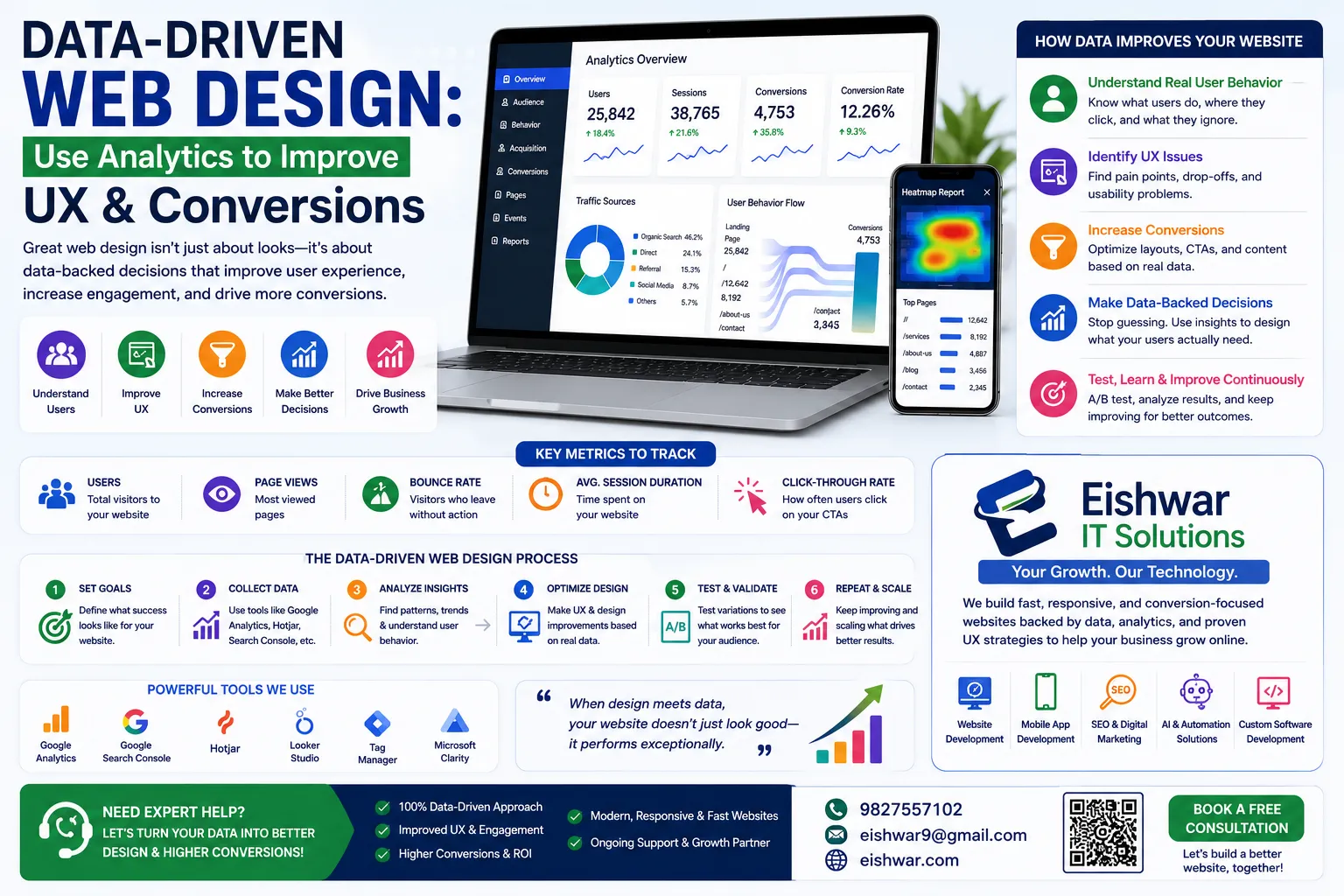
Data-Driven Web Design: Use Analytics to Improve UX & Conversions
Published on: 18 Jun 2026
Data-Driven Web Design: Use Analytics to Improve UX & Conversions for Indian Businesses
Introduction
In 2026, guessing what your website visitors want is a costly mistake. Indian businesses that rely on intuition alone often see high bounce rates, low engagement, and missed sales opportunities. Data-driven web design flips the script—you use real user behavior to shape every pixel, button, and page. This approach improves UX, boosts conversions, and gives you a competitive edge in a crowded digital market.
Learn more about our Website services
For EishwarITSolution, helping business owners like you turn raw data into actionable design improvements is our specialty. In this guide, we'll walk you through the exact steps to collect, interpret, and apply analytics to your website—so you can stop guessing and start growing.
Main Section 1: Why Data-Driven Design Matters for Indian Businesses
India's internet users are diverse—from metro city professionals to rural first-time smartphone owners. A one-size-fits-all design fails to capture this complexity. Data-driven design helps you understand your specific audience: where they click, how long they stay, and what makes them leave.
For example, a Jaipur-based e-commerce store saw a 40% drop in mobile conversions. By analyzing session recordings, they discovered a confusing checkout button placement. After moving it above the fold, conversions jumped 25% in two weeks. That's the power of data.
Key benefits include:
- Higher conversion rates: Design decisions backed by data reduce friction. For instance, a simple change like enlarging a CTA button based on click heatmaps can lift conversions by 10-15%.
- Better user experience: Understand pain points and fix them. Session recordings might reveal users repeatedly clicking a non-clickable image—turning it into a link improves navigation instantly.
- Cost efficiency: Spend design resources on what actually works. Instead of redesigning your entire homepage, data might show you only need to tweak the headline and hero image.
- Competitive advantage: Most Indian SMEs ignore analytics—you won't. While competitors rely on guesswork, you'll make precise improvements that keep users engaged.
Additionally, data-driven design helps you cater to regional nuances. For example, users in tier-2 cities may prefer simpler layouts with larger text, while metro users expect sleek, fast-loading interfaces. Analytics can segment this data, allowing you to tailor experiences without a full redesign.
Main Section 2: Essential Analytics Tools for Web Design
You don't need a data science degree. Start with these free or affordable tools:
- Google Analytics 4 (GA4): Tracks user demographics, behavior flow, and conversions. Set up events for button clicks and form submissions. For example, track 'Add to Cart' clicks to see where users drop off.
- Hotjar or Microsoft Clarity: Heatmaps show where users click, scroll, and hover. Session recordings reveal real user journeys. Use Clarity's rage click detection to find frustrated users.
- Crazy Egg: A/B testing and scroll maps to see how far users scroll. If 60% of users never see your footer content, consider moving key information higher.
- Optimizely: For advanced A/B testing on headlines, CTAs, and layouts. Test variations like 'Get Started' vs. 'Try Free' to see which drives more sign-ups.
- PageSpeed Insights: Google's tool to measure load speed—a critical UX factor. Aim for under 3 seconds on mobile; a 1-second delay can reduce conversions by 7%.
For Indian businesses, start with GA4 and Hotjar (free tier). Connect them to your site and let data accumulate for at least two weeks before making changes. Pro tip: Use GA4's 'Explorer' reports to compare behavior across devices—you might find mobile users abandon forms more often due to small input fields.
👉 Don't wait for the perfect moment; turn your vision into reality today.
Free ConsultationMain Section 3: How to Analyze Data and Apply Design Changes
Follow this 4-step framework:
Step 1: Identify Key Metrics
Focus on metrics that indicate user satisfaction and conversion readiness:
- Bounce rate (aim under 50%)
- Average session duration (target 2+ minutes)
- Conversion rate (e.g., form fills, purchases)
- Click-through rate on CTAs
- Page load time (under 3 seconds)
For Indian businesses, also track 'exit pages'—if users leave on your pricing page, it might be too confusing or expensive.
Step 2: Spot Patterns
Use heatmaps to find where users click most. If they click a non-clickable element, consider making it interactive. If they abandon a form halfway, simplify fields. For example, a Delhi-based service provider noticed users clicked on a decorative icon repeatedly—they turned it into a live chat trigger, reducing bounce rate by 12%.
Step 3: Formulate Hypotheses
Based on data, create hypotheses. Example: 'If we move the CTA button above the fold, conversions will increase by 15%.' Or 'If we reduce form fields from 8 to 5, submission rates will rise by 20%.'
Step 4: A/B Test and Iterate
Run A/B tests on one variable at a time (e.g., button color, headline text). Let tests run for at least one week to gather statistical significance. Implement the winning variant and repeat. For instance, a Pune-based SaaS company tested two headlines: 'Boost Productivity' vs. 'Save 5 Hours Weekly.' The latter increased sign-ups by 18%.
Real case: A Mumbai-based SaaS company used Hotjar to discover that 70% of users never scrolled past the hero section. They redesigned the hero to include a clear value proposition and CTA. Result: 30% more demo requests.
Expert Tips
- Segment your data: Filter by device (mobile vs desktop) and location (metro vs tier-2 cities). Indian mobile users behave differently—they might prefer thumb-friendly buttons and faster load times.
- Qualitative data matters: Pair analytics with user surveys or feedback widgets. Ask 'What almost stopped you from completing this action?' A simple pop-up survey can reveal friction points that numbers miss.
- Don't over-optimize: Focus on the top 3 friction points first. Changing too many things at once makes it hard to attribute results. For example, fix your checkout flow before tweaking font sizes.
- Use session recordings weekly: Watch 10-15 recordings each week to catch usability issues that numbers miss. Look for 'hesitation clicks'—users hovering but not clicking—which indicate confusion.
- Align with business goals: If your goal is lead generation, prioritize form analytics over page views. Track form abandonment rates and test different field layouts.
Common Mistakes
- Ignoring mobile data: Over 70% of Indian web traffic is mobile. If your data shows desktop-only patterns, you're missing the big picture. Always filter by device in GA4.
- Looking at vanity metrics: High page views don't mean success if bounce rate is high. Focus on engagement and conversion metrics like time on page and goal completions.
- Making changes without testing: A redesign based on gut feeling can hurt performance. Always A/B test. For example, changing a CTA color from blue to red might seem intuitive, but test it first.
- Not setting up goals in GA4: Without goals, you can't measure conversions. Define what a 'conversion' means for your business—a purchase, a form fill, or a newsletter sign-up.
- Data overload: Trying to track everything leads to paralysis. Pick 3-5 key metrics and master them. For an e-commerce site, focus on add-to-cart rate, checkout completion, and average order value.
Future Trends
By 2027, AI-powered analytics will become mainstream. Tools like Google Analytics' predictive metrics will forecast user behavior, allowing you to pre-emptively optimize design. For example, AI might predict which users are likely to abandon their cart, triggering a personalized discount pop-up. Indian businesses will also adopt real-time personalization—using data to serve different content to different visitors instantly. Voice search analytics will grow as more Indians use voice assistants. Start preparing now by collecting clean, structured data. Also, watch for 'privacy-first' analytics tools as regulations tighten—prefer tools that anonymize user data while still providing insights.
👉 Free Website Audit
Get Free AuditFAQs
What is data-driven web design?
Data-driven web design uses analytics and user behavior data to inform design decisions, rather than relying on intuition or trends alone. It improves UX and conversions by addressing real user needs. For example, if heatmaps show users ignore a sidebar, you might remove it to simplify the layout.
Do I need a data analyst to implement this?
No. Small business owners can start with free tools like Google Analytics and Hotjar. Focus on a few key metrics and use their dashboards. As you grow, you can hire an expert to handle advanced segmentation or predictive modeling.
How long does it take to see results from data-driven design?
Typically 4-8 weeks. You need at least 2 weeks of baseline data, then implement changes and test for another 2-4 weeks. Small tweaks like button color changes can show impact sooner, sometimes within a week.
What are the best tools for Indian businesses on a budget?
Google Analytics 4 (free), Microsoft Clarity (free), Hotjar (free tier), and Google PageSpeed Insights (free). These cover heatmaps, recordings, and performance metrics. For A/B testing, use Google Optimize (free) or Optimizely's starter plan.
Can data-driven design help with SEO?
Yes. Improving UX signals (like lower bounce rate and longer session duration) positively impacts SEO. Also, data can reveal which pages need better content or internal links. For example, if users exit quickly on a blog page, you might add more relevant internal links to keep them engaged.
What is the first step to start?
Install Google Analytics 4 and a heatmap tool on your website. Set up at least one goal (e.g., form submission). Let data collect for 2 weeks, then review the reports. Start with one page—like your homepage—and analyze user behavior before making changes.
👉 Free Homepage Demo
Book DemoConclusion
Data-driven web design isn't just a trend—it's a necessity for Indian businesses aiming to thrive in 2026 and beyond. By leveraging analytics, you move from guesswork to precision, creating a website that truly serves your audience and drives conversions. Start small: install a tool, watch user recordings, and make one change based on what you see. The results will speak for themselves. Remember, every click tells a story—listen to it.
CTA
Ready to transform your website with data-driven design? Contact EishwarITSolution for a free analytics audit. Our experts will show you exactly where your site can improve. Don't leave growth to chance—let data lead the way.