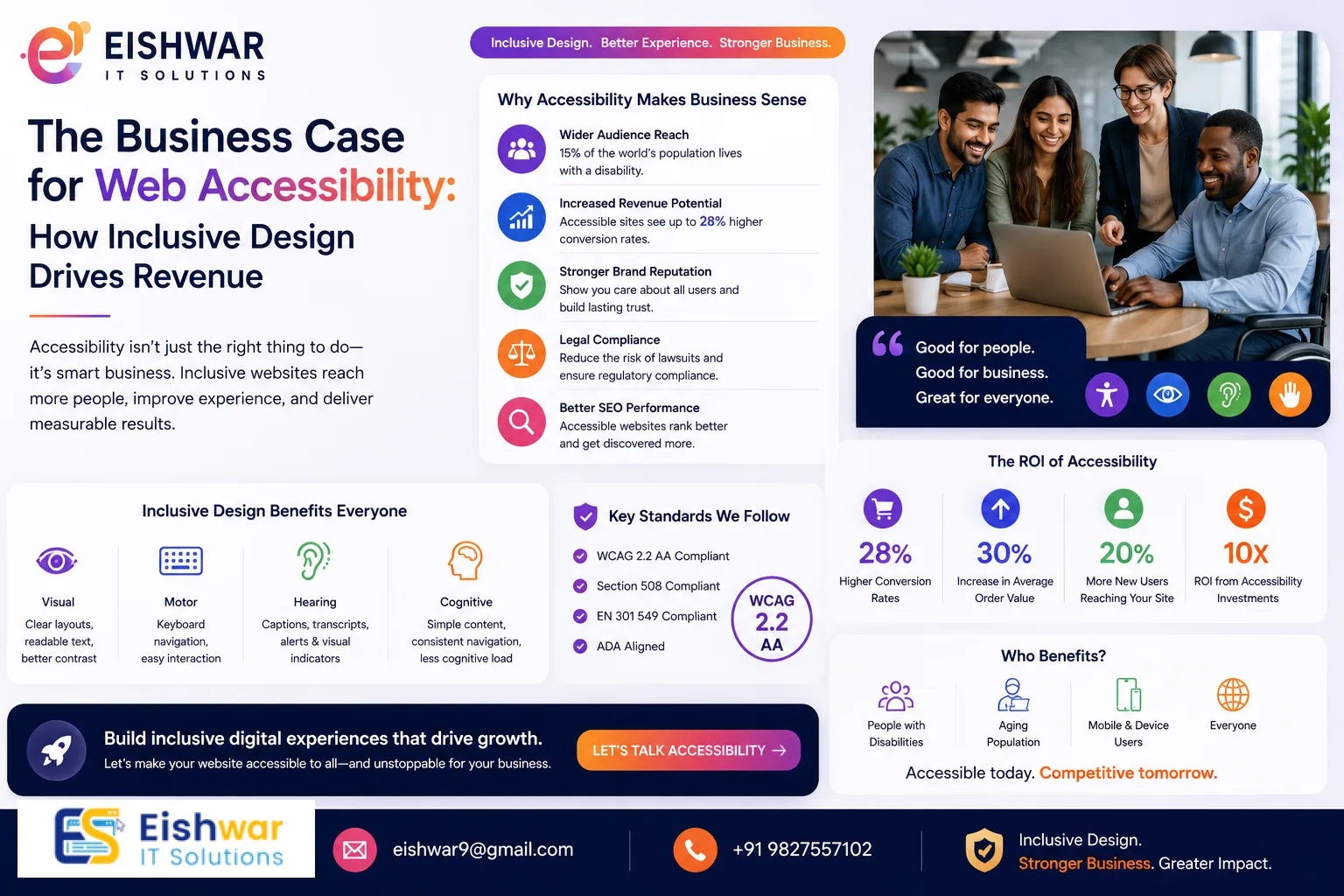
The Business Case for Web Accessibility: How Inclusive Design Drives R
Published on: 10 Jun 2026
The Business Case for Web Accessibility: How Inclusive Design Drives Revenue in India
Introduction
Imagine losing 15% of your potential customers before they even see your products. That's the reality for businesses with inaccessible websites. In India, where over 2.68 crore people live with some form of disability, ignoring web accessibility is not just a social oversight—it's a costly business mistake. But here's the good news: making your website accessible isn't just about compliance or doing good. It directly impacts your bottom line.
Learn more about our Website services
At EishwarITSolution, we've seen firsthand how inclusive design transforms user experience, boosts SEO, and opens new revenue streams. In this guide, we'll break down the business case for web accessibility in India, share actionable tips, and show you why 2026 is the year to prioritize inclusive design.
Main Section 1: The Market Opportunity – Why Accessibility Matters for Indian Businesses
India's disability market is massive and underserved. According to the Census 2011, 2.68 crore Indians have disabilities—and that number is likely higher today, given underreporting and an aging population. Add to that the over 10 crore people aged 60+, who often experience age-related impairments like reduced vision or hearing, and you're looking at a significant user base frequently excluded from digital experiences. For example, a senior citizen trying to read fine print on a low-contrast website or a person with motor disabilities struggling to click tiny buttons—these are real barriers that cost you customers.
Beyond disability, accessibility benefits everyone. Think about someone with a broken arm, a new mother holding a baby, or a user in a noisy environment. They all rely on accessible features like voice commands, captions, and clear navigation. Consider a commuter checking train schedules on a bumpy bus—large touch targets and high contrast make the experience smoother. By designing inclusively, you're not just serving a niche—you're improving UX for all users, which leads to higher satisfaction and repeat visits.
Moreover, accessible websites tend to rank higher on search engines. Google rewards sites that are easy to navigate, have proper heading structures, and include alt text for images. For instance, a travel booking site that uses descriptive alt text for destination images and clear headings for itineraries will likely outrank competitors that don't. This means better SEO, more organic traffic, and lower bounce rates—a direct boost to your digital marketing ROI.
Main Section 2: The Financial Impact – How Accessibility Drives Revenue
Let's talk numbers. A study by Accenture found that companies that embrace inclusive design see 28% higher revenue than their peers. Why? Because accessible websites convert better. When users can easily navigate, read content, and complete actions, they're more likely to make a purchase or fill out a form. For example, an e-commerce site with keyboard-navigable product filters and clear error messages on checkout forms can reduce cart abandonment by up to 20%, directly increasing sales.
Consider the legal angle too. In India, the Rights of Persons with Disabilities Act (2016) mandates equal access to digital services. Non-compliance can lead to lawsuits, fines, and reputational damage. In 2025, we saw a rise in accessibility-related legal notices in India—a trend that will only grow. A major bank recently faced a public backlash when its mobile app was inaccessible to visually impaired users, leading to negative press and customer churn. Proactive accessibility mitigates these risks.
👉 Don't wait for the perfect moment; turn your vision into reality today.
Free ConsultationThen there's the brand loyalty factor. When users feel included and valued, they become loyal advocates. They share their positive experiences, leave glowing reviews, and choose your brand over competitors. For instance, a food delivery app that offers voice ordering for users with motor impairments can build a dedicated customer base. Inclusive design isn't just ethical—it's a competitive advantage that drives repeat business and word-of-mouth marketing.
Main Section 3: Practical Steps to Make Your Website Accessible (Without Breaking the Bank)
You don't need a massive budget to start. Here are actionable steps you can take today:
- Use semantic HTML: Proper heading tags (
h1,h2, etc.) and ARIA labels help screen readers navigate your site. For example, a news site usingh1for the main headline andh2for sections ensures users can skip to relevant content. - Add alt text to images: Describe what's in the image for visually impaired users. This also boosts SEO. Instead of 'image123.jpg', use 'red saree with gold embroidery on mannequin'.
- Ensure color contrast: Use tools like WebAIM's contrast checker to meet WCAG AA standards. For instance, avoid light gray text on white backgrounds—aim for a ratio of at least 4.5:1 for normal text.
- Provide captions and transcripts: For videos and audio content. Great for users with hearing impairments and for those in quiet spaces. A tutorial video with captions can be watched without sound on a train.
- Make forms accessible: Label fields clearly, provide error messages, and ensure keyboard navigation. For example, a registration form should have visible labels and error messages like 'Please enter a valid email address' rather than just a red border.
- Test with real users: Involve people with disabilities in your testing process. Their feedback is invaluable. A simple test with a screen reader user can reveal issues like unlabeled buttons that automated tools miss.
For Indian businesses, consider localizing accessibility features—supporting regional languages like Hindi, Tamil, or Bengali in alt text and captions, and understanding cultural contexts like color symbolism (e.g., red for weddings vs. warnings) can make a huge difference.
Expert Tips
We reached out to leading accessibility experts in India for their insights:
Ravi Sharma, Accessibility Consultant: 'Start with a simple audit. Use free tools like WAVE or axe DevTools. Fix the low-hanging fruit first—like alt text and heading structure. You'll see immediate improvements in both accessibility and SEO. For example, adding alt text to product images can boost image search traffic by 30%.'
Neha Gupta, UX Designer: 'Don't treat accessibility as an afterthought. Integrate it into your design process from day one. It's much cheaper and more effective than retrofitting later. Use inclusive design personas—like a user with low vision or a user who navigates by keyboard—during wireframing.'
👉 Free Website Audit
Get Free AuditArun Kumar, Digital Marketer: 'Track your analytics before and after accessibility improvements. You'll likely see lower bounce rates, higher time on site, and better conversion rates. That data is your strongest business case. For instance, a client saw a 15% increase in form submissions after improving keyboard navigation.'
Common Mistakes
Even well-intentioned businesses make these errors. Avoid them:
- Over-relying on overlays: Accessibility overlays (widgets that claim to fix accessibility) often break functionality and frustrate users. Invest in native accessibility instead. A user with a screen reader might find overlay controls confusing or inaccessible.
- Ignoring mobile users: In India, the majority of web traffic comes from mobile. Ensure your site is responsive and touch-friendly. Buttons should be at least 48x48 pixels to avoid accidental taps.
- Using vague link text: Avoid 'click here' or 'read more.' Use descriptive text like 'view our pricing' or 'learn about accessibility.' This helps screen reader users understand the link's purpose without context.
- Forgetting about keyboard navigation: Many users rely on keyboards, not mice. Make sure all interactive elements are reachable via Tab key. A dropdown menu that requires a mouse hover will exclude keyboard users.
- Not testing with assistive technology: Automated tools catch only 30% of issues. Manual testing with screen readers like JAWS or NVDA is essential. For example, an automated tool might miss a missing form label that a screen reader user would notice immediately.
Future Trends
The accessibility landscape is evolving fast. Here's what to watch for in 2026 and beyond:
- AI-powered accessibility tools: Automated captioning, alt text generation, and personalized user experiences are becoming mainstream. Use them wisely—human oversight is still crucial. For instance, AI-generated alt text might miss cultural nuances in an Indian wedding scene.
- Voice user interfaces: With the rise of smart speakers and voice search, designing for voice interactions will become essential. A user with motor impairments might prefer voice commands to navigate a shopping site.
- Global standards tightening: Expect stricter enforcement of accessibility laws in India, possibly modeled after the European Accessibility Act. This means more audits and potential penalties for non-compliance.
- Inclusive design as a competitive differentiator: Brands that lead on accessibility will stand out in crowded markets. It's already a factor in B2B procurement decisions. A company with an accessible website may win contracts over a competitor that isn't.
FAQs
1. What is web accessibility?
2. Is web accessibility mandatory in India?
3. How does accessibility affect SEO?
4. What are WCAG guidelines?
5. How much does it cost to make a website accessible?
6. Can I use free tools to check accessibility?
Conclusion
Web accessibility is not a checkbox—it's a business growth strategy. By embracing inclusive design, you open your brand to millions of potential customers, improve your SEO, reduce legal risks, and build lasting loyalty. The Indian market is ripe for this shift, and early adopters will reap the rewards. Start small. Audit your site. Fix the most critical issues. And remember, every step towards accessibility is a step towards a more inclusive and profitable digital presence.
👉 Free Homepage Demo
Book DemoCTA
Ready to make your website accessible and boost your business? Contact EishwarITSolution today for a free accessibility audit. Our team of experts will help you create an inclusive digital experience that drives results.