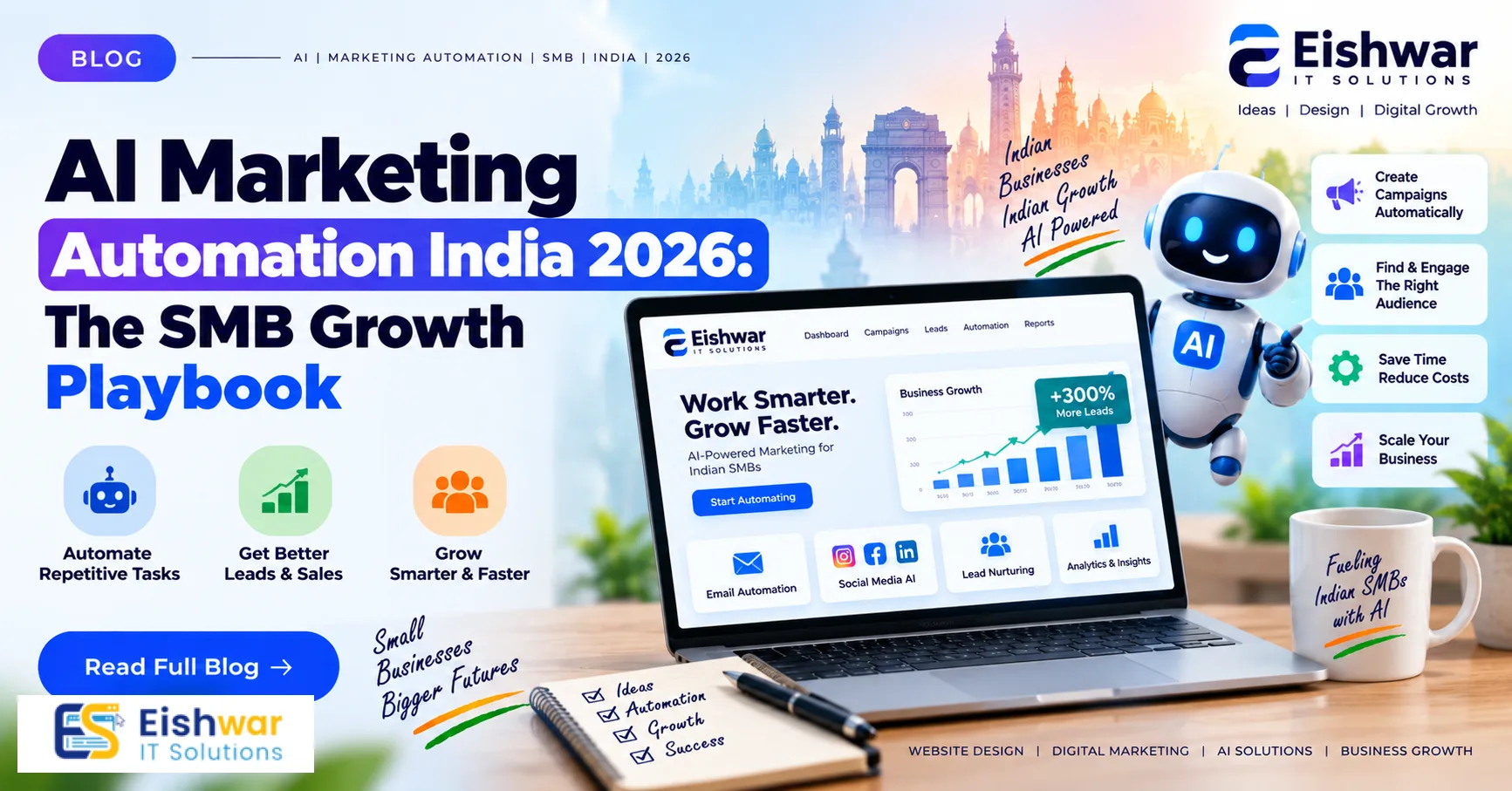
AI Marketing Automation India 2026: The SMB Growth Playbook
Published on: 24 Aug 2026
AI Marketing Automation India 2026: The SMB Growth Playbook
Introduction
Imagine your marketing team waking up to a dashboard that shows exactly which leads are ready to buy, which campaigns are driving revenue, and which customers are about to churn – all without manual number-crunching. In 2026, this isn't a futuristic fantasy; it's the new reality for Indian SMBs that have embraced AI-powered marketing automation.
Learn more about our Website services
With the digital landscape in India becoming more competitive than ever, small and medium businesses (SMBs) are turning to artificial intelligence to streamline their marketing efforts, personalize customer experiences, and maximize ROI. But what does AI marketing automation really mean for your business? And how can you leverage it effectively without getting lost in the hype?
In this comprehensive guide, we'll dive deep into the world of AI marketing automation in India, exploring its benefits, practical applications, expert tips, common mistakes to avoid, and future trends. Whether you're a business owner, marketer, or professional, this playbook will equip you with the knowledge to thrive in 2026.
Main Section 1: Understanding AI Marketing Automation and Its Surge in India
AI marketing automation combines artificial intelligence with marketing software to automate and optimize marketing tasks, from email campaigns to social media scheduling, lead scoring, and customer segmentation. Unlike traditional automation, AI adds a layer of intelligence that learns from data, predicts outcomes, and makes decisions in real-time.
In India, the adoption of AI marketing automation has skyrocketed. According to a recent report by NASSCOM, over 60% of Indian enterprises are expected to deploy AI in their marketing functions by 2026. The reasons are clear: increased efficiency, cost savings, and the ability to deliver personalized experiences at scale.
For SMBs, this technology levels the playing field. You no longer need a massive marketing team to compete with larger corporations. With AI-powered tools, you can automate repetitive tasks, gain valuable insights from customer data, and engage with your audience in more meaningful ways.
Key drivers of this surge include:
- Affordable cloud-based solutions: Tools like HubSpot, Marketo, and Zoho now offer AI features at price points accessible to SMBs. For instance, HubSpot's Starter plan starts at just ₹1,500 per month, making enterprise-grade AI capabilities available to even the smallest businesses.
- Increased digital adoption: India's internet user base is projected to reach 900 million by 2026, making digital marketing essential. With over 700 million smartphone users, the potential reach is unprecedented.
- Data-driven decision making: With the rise of data analytics, businesses realize the power of informed decisions. The availability of affordable data storage and processing has democratized access to insights that were once the domain of large corporations.
But it's not just about technology; it's about changing the way you think about marketing. AI marketing automation is not a replacement for human creativity but an enhancer. It handles the heavy lifting, allowing your team to focus on strategy and innovation. For example, instead of spending hours manually segmenting email lists, your team can now spend that time crafting compelling narratives that resonate with each segment.
Main Section 2: Key Applications of AI Marketing Automation for Indian SMBs
AI marketing automation can be applied across various aspects of your marketing strategy. Here are some of the most impactful applications for Indian SMBs:
👉 Don't wait for the perfect moment; turn your vision into reality today.
Free Consultation1. Lead Scoring and Nurturing
Not all leads are created equal. AI-powered lead scoring analyzes historical data to identify which leads are most likely to convert, allowing you to prioritize your efforts. For example, a Mumbai-based SaaS company used AI scoring to increase their conversion rate by 30% by focusing on high-intent leads. They implemented a scoring model that considered factors like website visits, email engagement, and social media interactions, enabling their sales team to focus on leads that were genuinely interested.
2. Hyper-Personalization
Personalization goes beyond addressing a customer by name. AI can analyze browsing behavior, purchase history, and social interactions to deliver personalized recommendations and content. An e-commerce store in Delhi saw a 25% increase in sales after implementing AI-driven product recommendations. The system analyzed each customer's past purchases and browsing patterns to suggest products that were highly relevant, leading to higher conversion rates and average order values.
3. Predictive Analytics for Customer Retention
AI can predict which customers are likely to churn, enabling you to take proactive measures. By analyzing engagement patterns, you can offer targeted incentives to retain valuable customers. A telecom company in Bangalore reduced churn by 15% using predictive analytics. They identified customers who showed signs of disengagement, such as decreased usage or late bill payments, and automatically triggered retention campaigns with special offers or personalized outreach.
4. Content Generation and Curation
AI tools like ChatGPT can generate blog posts, social media captions, and email subject lines, saving time and ensuring consistency. However, human oversight is essential to maintain brand voice and quality. For instance, a boutique agency in Jaipur uses AI to draft initial versions of client newsletters, which their team then refines to add a human touch. This approach cuts content creation time by 50% while maintaining quality.
5. Automated Campaign Management
From scheduling emails to adjusting ad bids in real-time, AI automates the entire campaign lifecycle. This ensures your marketing runs 24/7 without constant manual intervention. For example, a digital marketing agency in Hyderabad uses AI to automatically pause underperforming ad sets and reallocate budget to high-performing ones, resulting in a 20% reduction in cost per acquisition.
6. Chatbots for Customer Engagement
AI-powered chatbots provide instant responses to customer queries, improving customer satisfaction and reducing response time. A retail chain in Pune implemented a chatbot that handled 70% of customer queries, freeing up staff for more complex issues. The chatbot was trained on common questions about product availability, store hours, and returns, and it seamlessly escalated to human agents when needed.
These applications are not just for large enterprises; they are accessible and affordable for SMBs. The key is to start small, focus on your biggest pain points, and scale as you see results. For instance, if you're struggling with lead response time, start with an AI-powered lead scoring system. Once that's running smoothly, you can add chatbots or predictive analytics.
Main Section 3: How to Implement AI Marketing Automation in Your SMB
Implementing AI marketing automation may seem daunting, but with a structured approach, you can integrate it seamlessly into your existing operations. Here's a step-by-step guide:
👉 Free Website Audit
Get Free AuditStep 1: Define Your Goals and KPIs
What do you want to achieve? Increased lead generation, higher conversion rates, better customer retention? Set clear, measurable goals. For instance, "increase email open rates by 20% within 6 months" provides a concrete target. Similarly, you might aim to reduce customer acquisition cost by 15% or boost customer lifetime value by 10%. Clear goals will guide your tool selection and implementation strategy.
Step 2: Audit Your Current Marketing Processes
Identify areas that are time-consuming, repetitive, or prone to error. These are prime candidates for automation. For example, if you spend hours manually segmenting email lists, AI can do this in seconds. Also, look for processes where data is underutilized – AI can unlock insights from data you already have but aren't leveraging effectively.
Step 3: Choose the Right Tools
There are numerous AI marketing automation tools available. Some popular options for SMBs include:
- HubSpot: All-in-one marketing, sales, and service platform with AI-powered features like predictive lead scoring and content optimization.
- Zoho CRM: Offers AI assistant Zia for lead scoring, predictions, and anomaly detection. Zia can also answer natural language queries about your data.
- Marketo: Advanced automation for B2B marketing, with AI capabilities for account-based marketing and predictive audiences.
- Mailchimp: Email marketing with AI-powered send time optimization and content recommendations.
Consider your budget, technical expertise, and specific needs when choosing. Many tools offer free trials, so take advantage of those to test before committing.
Step 4: Integrate with Your Existing Systems
Ensure your automation tools integrate with your CRM, website, and other software to create a unified data ecosystem. This is crucial for AI to work effectively. For instance, if your CRM and email marketing platform aren't synced, AI can't analyze the full customer journey. Use APIs or native integrations to connect your tools.
Step 5: Train Your Team
Invest in training to help your team understand how to use the tools and interpret AI insights. A well-trained team is essential for successful implementation. Consider workshops, online courses, or hiring a consultant for initial setup. Encourage your team to experiment and ask questions – the more comfortable they are, the more they'll leverage the technology.
Step 6: Start Small and Scale
Begin with one or two automated processes, measure results, and then expand. This approach minimizes disruption and allows you to learn and adapt. For example, start with automated email workflows for lead nurturing. Once you see the impact, add AI-powered lead scoring or chatbots. Scaling gradually also helps manage costs and ensures your team isn't overwhelmed.
Expert Tips
- Focus on Data Quality: AI relies on data. Ensure your data is clean, accurate, and up-to-date. Regularly deduplicate your contact lists and remove outdated information. Poor data leads to poor AI predictions, so invest time in data hygiene.
- Balance Automation with Human Touch: While automation is powerful, customers still value human interaction. Use AI to handle routine tasks but keep a personal touch for high-value interactions. For instance, use AI to score leads, but have a salesperson call the highest-scoring leads personally.
- Continuously Monitor and Optimize: AI is not set-and-forget. Regularly review performance metrics and adjust your strategies accordingly. A/B testing is your friend. For example, test different email subject lines or call-to-action buttons to see what resonates best with your audience.
- Personalize Beyond Name: Use AI to understand customer preferences and behaviors. Tailor your messaging to their stage in the buying journey. A customer who just downloaded a whitepaper needs different content than one who has requested a demo.
- Invest in Security: With increased data collection, ensure you comply with data protection regulations like India's DPDP Act and build customer trust. Use encryption, access controls, and regular security audits to protect customer data.
Common Mistakes
- Over-Automating: Automating everything can lead to impersonal interactions. Find the right balance. For example, don't send automated emails for every action; sometimes a personal follow-up is more effective.
- Ignoring Data Privacy: Mishandling customer data can damage your reputation and lead to legal issues. Always prioritize privacy. Ensure you have consent for data collection and use, and be transparent about how you use data.
- Choosing Tools Without Research: Not all tools are suitable for your business. Take time to evaluate features, pricing, and reviews. Look for tools that offer good customer support and have a track record of success in your industry.
- Neglecting Human Oversight: AI can make mistakes. Always have a human review critical communications. For example, an AI-generated email might contain errors or tone issues that need human correction.
- Expecting Immediate Results: AI marketing automation requires time to learn and optimize. Be patient and persistent. It may take a few months to see significant ROI, but the long-term benefits are worth it.
Future Trends
As we look beyond 2026, AI marketing automation will continue to evolve. Here are some trends to watch:
👉 Free Homepage Demo
Book Demo- Hyper-Personalization at Scale: AI will enable real-time personalization across all channels, creating seamless customer journeys. For example, a customer browsing your website might receive a personalized email within minutes, followed by a targeted ad on social media.
- Voice and Visual Search: With the rise of voice assistants and visual search, AI will help optimize content for these new search modalities. Ensure your content is structured to answer voice queries and that your images are tagged with relevant metadata.
- AI-Powered Content Creation: AI will become more sophisticated in generating creative content, but human creativity will remain essential. AI can handle data-driven content like reports or product descriptions, while humans focus on storytelling and emotional connection.
- Integration with IoT and AR: Marketing automation will integrate with Internet of Things (IoT) devices and Augmented Reality (AR) experiences to create immersive customer interactions. For example, a smart mirror in a retail store could recommend products based on the customer's preferences, syncing with their mobile app.
- Ethical AI: There will be a greater focus on transparent and ethical AI use, ensuring fairness and avoiding bias. Companies will need to audit their AI systems for bias and ensure they comply with evolving regulations.
FAQs
Q1: What is AI marketing automation and how does it differ from traditional automation?
AI marketing automation uses artificial intelligence to analyze data, predict outcomes, and make decisions, whereas traditional automation follows pre-defined rules. AI can adapt and learn from new data, making it more flexible and effective. For example, traditional automation might send a welcome email to every new subscriber, while AI can personalize the email based on the subscriber's interests and behavior.
Q2: Is AI marketing automation affordable for small businesses in India?
Yes, many AI-powered tools offer tiered pricing, making them accessible to SMBs. Additionally, the ROI from increased efficiency and conversions often outweighs the costs. For instance, a small business might spend ₹5,000 per month on an AI tool but see a 20% increase in sales, which more than justifies the expense. Start with a basic plan and upgrade as you grow.
Q3: Do I need a technical team to implement AI marketing automation?
Not necessarily. Many tools are user-friendly with intuitive interfaces. However, having some technical knowledge or investing in training can help you maximize the benefits. For example, understanding how to set up integrations or interpret analytics can make a big difference. If you don't have technical staff, consider hiring a consultant for initial setup.
Q4: How can AI marketing automation help with customer retention?
AI can analyze customer behavior to predict churn risk, allowing you to proactively engage with at-risk customers through personalized offers or outreach, thereby increasing retention. For example, if a customer hasn't made a purchase in 60 days, AI can trigger a discount offer or a personalized email to re-engage them. This proactive approach can significantly reduce churn rates.
Q5: What are the best AI marketing automation tools for Indian SMBs?
Popular options include HubSpot, Zoho CRM, Marketo, and Mailchimp. The best tool depends on your specific needs, budget, and integration requirements. For example, if you're a B2B company, Marketo might be more suitable, while Mailchimp is great for email marketing. Take advantage of free trials to find the best fit.
Q6: How long does it take to see results from AI marketing automation?
Results vary based on the complexity of your setup and the quality of your data. Some businesses see improvements within a few weeks, while others may take a few months to realize significant ROI. For instance, AI-powered email send time optimization can show immediate improvements in open rates, but predictive analytics for churn may take longer to yield measurable results.
Conclusion
AI marketing automation is not just a trend; it's a fundamental shift in how businesses approach marketing. For Indian SMBs, it offers an unprecedented opportunity to compete with larger players, personalize customer experiences, and drive sustainable growth. By understanding its applications, implementing it strategically, and avoiding common pitfalls, you can unlock the full potential of AI in your marketing efforts.
CTA
Ready to take your marketing to the next level with AI automation? Contact EishwarITSolution today for a free consultation and discover how we can help you implement AI-powered marketing strategies tailored to your business needs. Let's grow together!