
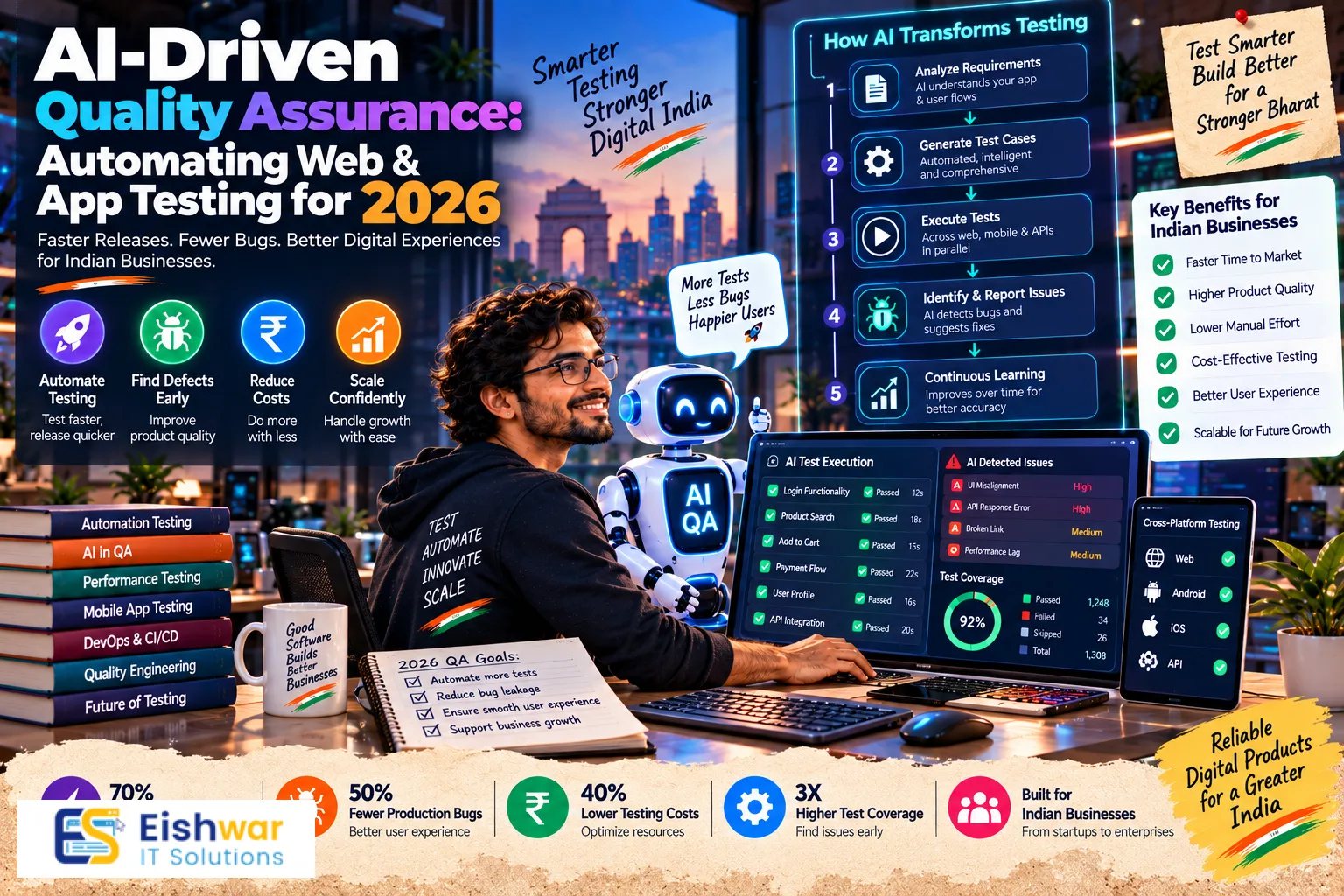
AI-Driven Quality Assurance: Automating Web & App Testing for 2026
Published on: 13 Aug 2026
AI-Driven Quality Assurance: Automating Web & App Testing for 2026
Introduction
In the fast-paced digital world of 2026, users expect flawless web and app experiences. A single bug or slow load time can drive users to competitors, and in markets like India—where digital adoption is skyrocketing—the stakes are even higher. Yet, manual testing is no longer enough to keep up with rapid development cycles. Enter AI-driven quality assurance (QA)—a game-changer that automates testing, detects bugs earlier, and ensures your product stands out in a competitive landscape.
Learn more about our Website services
For business owners, marketers, and professionals, understanding how AI can streamline QA is essential. It’s not just about saving time; it’s about delivering a superior user experience that drives conversions and loyalty. In this article, we’ll explore how AI-driven QA works, its benefits, practical implementation tips, and future trends you can’t afford to ignore. Whether you’re a startup founder in Bengaluru or a project manager in Mumbai, this guide will equip you with the knowledge to leverage AI for better testing outcomes.
Main Section 1: What is AI-Driven Quality Assurance?
AI-driven quality assurance uses artificial intelligence and machine learning to automate and enhance the testing process. Unlike traditional automated testing, which follows pre-scripted steps, AI-powered testing can learn from data, predict potential issues, and adapt to changes in your application. It’s like having a smart assistant that not only runs tests but also thinks about what to test next.
For example, AI can analyze user behavior to identify which test cases are most critical, prioritize them, and even generate new test scenarios on the fly. This means your QA team can focus on complex edge cases while AI handles repetitive tasks. Imagine a scenario where your app’s login page is updated. Traditional automated tests would break because the script expects the old UI. AI-driven tools, however, can self-heal by recognizing the new element and adjusting the test automatically, saving hours of manual rework.
In India, where businesses are rapidly digitizing—from fintech apps to e-commerce platforms—AI-driven QA is becoming a necessity. It allows startups and enterprises alike to release updates faster without compromising quality. For instance, a leading Indian e-commerce company used AI-driven visual testing to catch UI discrepancies across 50+ device-browser combinations, reducing their release cycle from two weeks to three days. This is the power of AI in action.
Main Section 2: Key Benefits of AI-Driven QA for Your Business
Implementing AI-driven QA offers several tangible benefits that go beyond just saving time. Here’s a deeper look at how it can transform your business:
- Faster Time-to-Market: AI automates test case generation and execution, reducing testing time from days to hours. This means you can launch features and products more quickly than competitors. For example, a SaaS startup in Pune cut its regression testing time by 80% using AI, allowing them to ship new features every week instead of every month.
- Higher Accuracy: AI eliminates human error, ensuring consistent and reliable test results. It can also detect subtle bugs that manual testers might miss, such as memory leaks or race conditions. A study by Capgemini found that AI-driven testing can increase defect detection rates by up to 40%.
- Cost Efficiency: While there’s an initial investment, AI-driven QA reduces long-term costs by catching bugs early, when they’re cheaper to fix. It also reduces the need for a large manual QA team. For a mid-sized company, this can mean savings of 30-50% on QA costs annually.
- Scalability: As your application grows, AI can scale testing efforts without a proportional increase in resources. This is crucial for businesses planning to expand. For instance, if you’re adding a new payment gateway, AI can automatically generate tests for it based on existing patterns.
- Improved User Experience: By catching issues before users do, you ensure a smooth experience, which boosts customer satisfaction and retention. In India’s competitive app market, a 0.5-second delay can lead to a 20% drop in conversions. AI helps you avoid such pitfalls.
Main Section 3: How to Implement AI-Driven QA in Your Workflow
Ready to adopt AI-driven QA? Here’s a step-by-step guide to help you integrate it smoothly into your development process:
👉 Don't wait for the perfect moment; turn your vision into reality today.
Free Consultation- Assess Your Current Testing Process: Start by identifying bottlenecks and repetitive tasks that can be automated. For example, if your team spends hours on regression testing after every release, that’s a prime candidate for AI. Document your current workflows to understand where AI can add the most value.
- Choose the Right Tools: Popular AI testing platforms include Testim, Mabl, and Applitools. Evaluate them based on your tech stack, budget, and team expertise. For instance, if you’re a React-based startup, Testim’s robust React support might be ideal. If you need heavy visual testing, Applitools is a strong choice. Don’t forget to consider open-source options like Selenium with AI plugins (e.g., Healenium) for cost-sensitive projects.
- Start Small: Pilot AI-driven QA on a single project or module. Measure the impact on testing time and bug detection before scaling. For example, choose a feature that’s frequently updated, like a user profile page, and run AI tests alongside your manual ones. Compare the results to see the difference.
- Train Your Team: Ensure your QA engineers are comfortable with AI tools. Provide training and encourage a culture of continuous learning. Many tool vendors offer certification programs. Additionally, foster a mindset where AI is seen as a collaborator, not a threat. Your team should know how to interpret AI-generated test results and when to override them.
- Integrate with CI/CD: Embed AI testing into your continuous integration and delivery pipeline to get instant feedback on every code change. For example, use Jenkins or GitHub Actions to trigger AI tests automatically when a developer pushes code. This ensures that bugs are caught early, reducing the cost of fixes.
Remember, AI is not a replacement for human testers but a powerful ally. Use it to augment your team’s capabilities. For instance, while AI handles regression and smoke tests, your human testers can focus on exploratory testing to uncover unexpected issues.
👉 Free Website Audit
Get Free AuditExpert Tips
To get the most out of AI-driven QA, consider these expert tips:
- Focus on Data Quality: AI relies on data to learn. Ensure your test data is clean, relevant, and representative of real user scenarios. For example, if you’re testing an e-commerce app, use data that includes various product categories, price ranges, and user demographics. Poor data leads to poor AI performance.
- Combine AI with Manual Testing: Use AI for regression and repetitive tests, but keep manual testing for exploratory and usability checks. For instance, AI can’t judge if a button’s color is aesthetically pleasing or if the user flow feels intuitive. That’s where human testers shine.
- Monitor AI Performance: Regularly evaluate the accuracy of your AI tools. Adjust algorithms and test sets as your application evolves. Set up dashboards to track metrics like false positives and false negatives. If you notice an increase in false positives, it might be time to retrain the model with new data.
- Leverage Visual Testing: AI-powered visual testing can catch UI discrepancies across devices and browsers, which is crucial for mobile-first markets like India. For example, a button might look fine on an iPhone but overlap on an Android device. Visual AI tools can detect these issues automatically, saving you from embarrassing user experiences.
- Involve Developers Early: Encourage developers to write testable code and provide input on test scenarios. This collaboration ensures that AI tests are aligned with the actual implementation and reduces the learning curve.
Common Mistakes to Avoid
While AI-driven QA is powerful, there are pitfalls to avoid:
- Over-Reliance on AI: Don’t assume AI is infallible. Always have a human review critical test results. For example, AI might miss a cultural nuance in a user interface that a human tester would catch. Balance automation with human judgment.
- Ignoring Test Environment: Ensure your testing environment mirrors production. AI can’t fix environment discrepancies. If your staging server has different configurations than production, AI tests might pass in staging but fail in production. Use containerization to maintain consistency.
- Neglecting Security Testing: AI-driven QA is great for functionality, but don’t forget to include security testing in your automation strategy. AI can help identify vulnerabilities, but you still need dedicated security tools and practices. For instance, use AI to scan for common vulnerabilities like SQL injection or XSS, but also conduct regular penetration testing.
- Lack of Integration: AI testing tools that aren’t integrated with your CI/CD pipeline can lead to delays and missed bugs. If tests are run manually, you lose the benefit of immediate feedback. Ensure your AI tools have APIs or plugins for your CI/CD system.
- Ignoring Test Maintenance: Even with self-healing AI, tests need occasional maintenance. Don’t set and forget. Regularly review test coverage and update test scenarios as your application evolves.
Future Trends in AI-Driven QA
As we move through 2026, expect these trends to shape AI-driven QA:
👉 Free Homepage Demo
Book Demo- Self-Healing Tests: AI will automatically update test scripts when the application changes, reducing maintenance overhead. This is already emerging, but by 2026, it will be standard. For example, if a button’s ID changes, the AI will automatically update the test script without human intervention.
- Predictive Analytics: AI will predict where bugs are likely to occur based on code changes and historical data, allowing proactive fixes. For instance, if a developer modifies a payment module, AI can flag it as high-risk and suggest targeted tests, preventing a potential outage.
- AI-Integrated DevOps: QA will become even more embedded in DevOps, with AI orchestrating the entire testing lifecycle. This means AI will not only run tests but also decide what to test, when to test, and how to interpret results, all in real-time.
- Shift-Left Testing: AI will enable testing earlier in the development process, catching bugs before they become costly. For example, AI can analyze code as it’s being written and suggest fixes immediately, rather than waiting for a QA phase.
- AI-Driven Performance Testing: Beyond functional testing, AI will simulate real-world user loads to identify performance bottlenecks. This is crucial for apps that experience peak traffic, like e-commerce during festive sales in India.
FAQs
1. What is AI-driven quality assurance?
AI-driven quality assurance uses artificial intelligence to automate testing processes, including test case generation, execution, and analysis. It helps identify bugs faster and improve overall software quality by learning from data and adapting to changes.
2. How does AI improve testing accuracy?
AI can analyze vast amounts of data to detect patterns and anomalies that humans might miss. It also eliminates human error, ensuring consistent and reliable test results. For example, AI can identify a subtle memory leak that might go unnoticed in manual testing.
3. Is AI-driven QA suitable for small businesses?
Yes, many AI testing tools offer scalable pricing and can be adopted incrementally. Small businesses can start with pilot projects and expand as they see ROI. For instance, a small startup can use open-source AI tools like Healenium to get started with minimal investment.
4. What are the best AI testing tools?
Popular tools include Testim, Mabl, Applitools, and Selenium with AI plugins. The best choice depends on your specific needs, tech stack, and budget. For example, if you need strong visual testing, Applitools is excellent; if you need robust CI/CD integration, Mabl is a good choice.
5. Will AI replace manual testers?
No, AI is designed to augment human testers, not replace them. Manual testing is still needed for exploratory, usability, and complex scenario testing. AI handles repetitive tasks, freeing humans to focus on creative and critical thinking.
6. How long does it take to implement AI-driven QA?
Implementation time varies based on project complexity and team readiness. A pilot project can be set up in a few weeks, with full integration taking a few months. The key is to start small and iterate.
7. What are the costs associated with AI-driven QA?
Costs vary widely. Some tools have monthly subscriptions per user, while others are open-source. For a small team, costs might start at a few hundred dollars per month. However, the ROI is often realized through reduced bug-fixing costs and faster releases.
Conclusion
AI-driven quality assurance is no longer a luxury—it’s a necessity for businesses that want to stay competitive in 2026. By automating testing, you can reduce costs, accelerate releases, and deliver a superior user experience that drives growth. Whether you’re a startup or an established enterprise in India, embracing AI-driven QA is a smart investment in your digital future. The time to act is now; don’t let manual testing hold you back.
Ready to Transform Your Testing?
Don’t let manual testing slow you down. Contact EishwarITSolution today to implement AI-driven quality assurance for your web and app projects. Our experts will help you choose the right tools, integrate them into your workflow, and achieve faster, more reliable releases. Let’s build something great together!
CTA
Ready to transform your testing? Contact EishwarITSolution today to implement AI-driven quality assurance for your web and app projects. Our experts will help you choose the right tools, integrate them into your workflow, and achieve faster, more reliable releases. Let’s build something great together!