
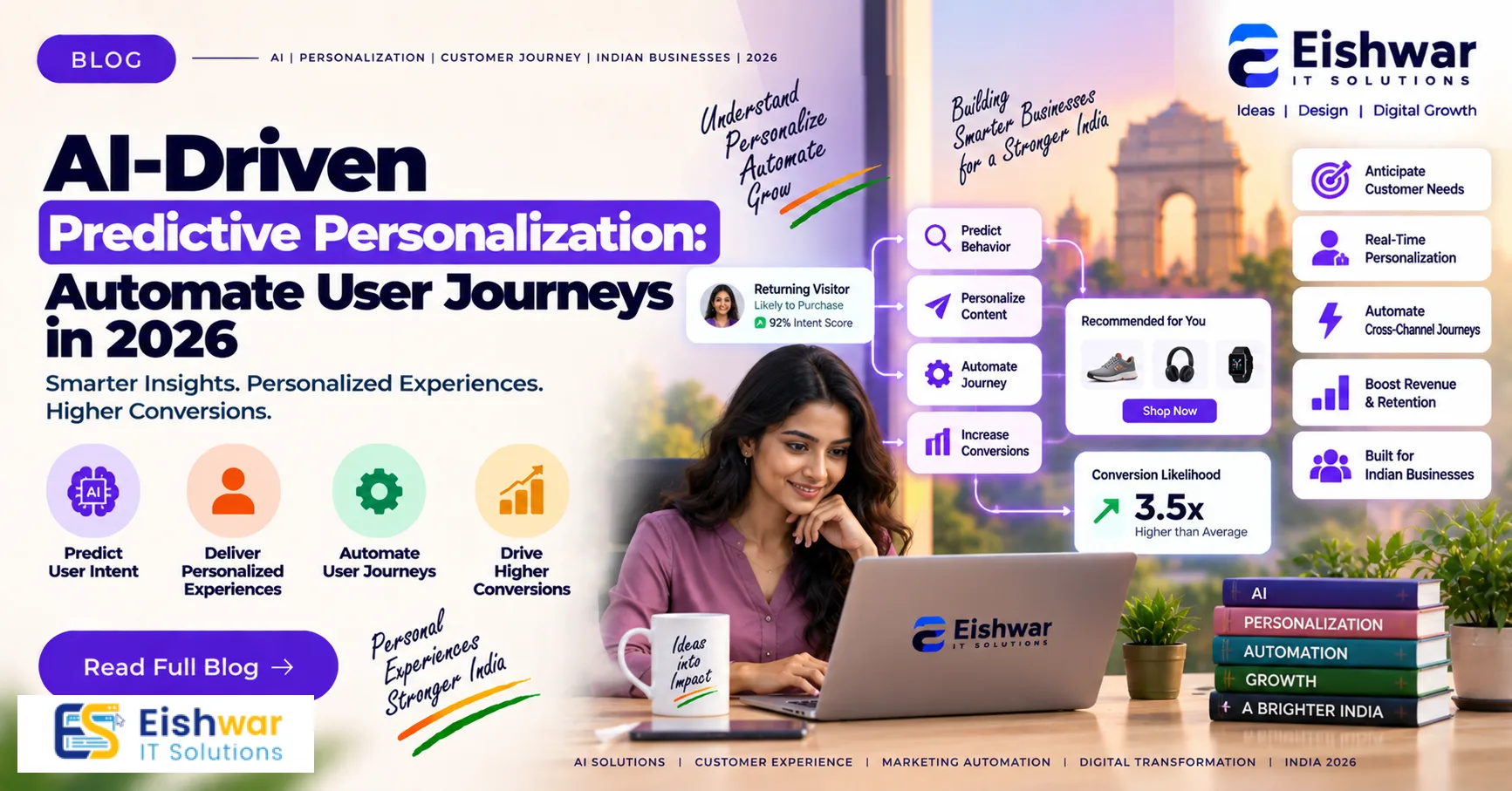
AI-Driven Predictive Personalization: Automate User Journeys in 2026
Published on: 14 Aug 2026
AI-Driven Predictive Personalization: Automate User Journeys in 2026
Introduction
Imagine visiting a website that instantly knows what you need before you even click. It recommends the right product, answers your question in a chat, and guides you to checkout—all without manual effort. That's the power of AI-driven predictive personalization. In 2026, this isn't just a luxury; it's a necessity for businesses in India and worldwide. As consumer expectations rise, static experiences fail to engage. AI automates the entire user journey, making every interaction feel tailor-made. In this article, we'll explore how AI-driven predictive personalization can transform your web and app development strategy, boost engagement, and drive conversions—all while staying ahead of the curve.
Learn more about our Website services
Main Section 1: What is AI-Driven Predictive Personalization?
AI-driven predictive personalization uses machine learning algorithms to analyze user data—past behavior, preferences, demographics, and real-time actions—to predict future needs and deliver personalized content, recommendations, and experiences automatically. Unlike rule-based personalization (e.g., "if user is from Mumbai, show Mumbai offers"), predictive AI learns from patterns and adapts dynamically. It goes beyond simple segmentation by identifying subtle correlations and anticipating user intent before it's explicitly expressed.
For example, an e-commerce app can predict that a user who frequently buys running shoes is likely to be interested in new arrivals from Nike. It then surfaces those products on the homepage, in push notifications, and even in email campaigns—without manual segmentation. This automation saves time and increases relevance, leading to higher click-through rates and conversions. The core difference lies in the ability to learn and evolve: rule-based systems require constant manual updates, while predictive models improve automatically as more data flows in.
In practical terms, predictive personalization can be applied across various channels—web, mobile apps, email, and even offline interactions. For instance, a retail app might use past purchase history and browsing patterns to send a push notification about a flash sale on a user's favorite brand, timed perfectly when they're most likely to engage. The result is a seamless, intuitive experience that feels almost magical to the user.
Main Section 2: How AI Automates User Journeys in Web & Apps
AI automates every stage of the user journey—from awareness to activation, retention, and loyalty. Here's how:
- Discovery: AI analyzes search queries, browsing history, and social signals to personalize search results and landing pages. For instance, a travel app might show different destinations to a family planner vs. a solo backpacker. It can also adjust the layout, imagery, and copy to match the user's preferences, increasing the likelihood of engagement.
- Engagement: Chatbots and virtual assistants use natural language processing (NLP) to provide instant, context-aware support. They can recommend products, answer FAQs, and even upsell—all in real-time. Advanced systems can detect user sentiment and adjust their tone accordingly, making interactions feel more human.
- Conversion: AI predicts the best time to show a discount, which payment options to highlight, and what messaging resonates. It can dynamically adjust checkout fields to reduce friction—for example, pre-filling shipping details based on past orders or offering a one-click checkout for returning users.
- Retention: Predictive models identify churn risks and trigger personalized re-engagement campaigns—like a special offer for a user who hasn't visited in 30 days. They can also recommend complementary products or content to increase lifetime value.
By automating these touchpoints, businesses can deliver a seamless, consistent experience that feels human but scales infinitely. For example, an online learning platform might use AI to send a personalized study plan based on a user's progress, or a banking app might proactively alert a user about unusual spending patterns and suggest budgeting tips.
👉 Don't wait for the perfect moment; turn your vision into reality today.
Free ConsultationMain Section 3: Real-World Applications for Indian Businesses
Indian businesses are uniquely positioned to benefit from AI personalization due to the diverse and mobile-first audience. Here are practical examples:
- E-commerce: Flipkart uses AI to personalize product recommendations based on browsing and purchase history, but even smaller stores can use off-the-shelf tools like Shopify's AI-driven recommendations. For instance, a local saree boutique can use AI to suggest matching accessories based on past purchases, increasing average order value.
- EdTech: Platforms like Byju's can use predictive analytics to suggest courses based on a student's learning pace and quiz performance, keeping them engaged. AI can also identify students at risk of dropping out and trigger personalized interventions, such as extra practice modules or motivational messages.
- Healthcare: Apps like Practo can predict what services a user might need based on their search patterns (e.g., dermatology vs. general medicine) and show relevant doctors. AI can also send reminders for follow-up appointments or health check-ups, improving patient outcomes.
- Banking & Fintech: Apps can predict when a user might need a loan or investment options based on transaction history, and offer personalized financial advice. For example, if a user's spending on travel increases, the app might suggest a travel credit card with rewards.
The key is to start small—pick one journey stage, implement AI, and iterate. For instance, a small business might begin by personalizing email campaigns using AI-driven subject lines and content, then expand to on-site recommendations and push notifications.
Expert Tips
Based on our experience at EishwarITSolution, here are actionable tips for implementing AI-driven predictive personalization:
- Start with data hygiene: Ensure your data is clean, structured, and compliant with India's data protection laws (DPDP Act). Garbage in, garbage out. Invest in data cleaning tools and regular audits to maintain data quality.
- Use a hybrid approach: Combine AI predictions with human oversight for high-stakes decisions. For example, let AI recommend, but let a human approve sensitive content. This ensures that AI doesn't make inappropriate or offensive suggestions.
- Focus on privacy: Be transparent about data usage. Offer opt-in/opt-out options. This builds trust and avoids legal issues. Use privacy-preserving techniques like differential privacy and federated learning where possible.
- Test and learn: Run A/B tests to measure the impact of personalization. Use metrics like CTR, conversion rate, and time on site. Continuously refine your models based on performance data.
- Leverage existing tools: Don't reinvent the wheel. Use platforms like Google Analytics 4 (GA4) with predictive metrics, or AI-powered CMS like Contentstack. These tools often have built-in personalization features that are easy to implement.
Common Mistakes
Avoid these pitfalls when adopting AI personalization:
👉 Free Website Audit
Get Free Audit- Over-personalization: Creeping users out by showing you know too much. Balance personalization with respect for privacy. For example, avoid referencing specific personal details in a way that feels intrusive.
- Ignoring mobile-first: India is mobile-first; ensure your personalization works seamlessly on small screens and slow networks. Optimize images and scripts to reduce load times.
- Not updating models: AI models need regular retraining to stay relevant. Market trends change, and so do user behaviors. Schedule periodic model updates and monitor performance.
- Lack of cross-channel consistency: If a user sees a personalized offer on web but not in the app, they may get frustrated. Ensure omnichannel alignment by integrating your personalization across all touchpoints.
- Skipping analytics: Without measuring, you can't improve. Set clear KPIs and track them religiously. Use dashboards to visualize performance and identify areas for improvement.
Future Trends
Looking ahead, AI-driven personalization will evolve in exciting ways:
- Hyper-personalization: AI will use real-time context (location, weather, device) to deliver even more relevant experiences. For example, a food delivery app might suggest hot soups on a rainy day.
- Voice and visual search: Personalization will extend to voice assistants and image recognition, making journeys more natural. Users can simply speak or upload a photo to get personalized recommendations.
- Privacy-first AI: With stricter regulations, AI will use on-device processing and federated learning to personalize without compromising privacy. This approach keeps data on the user's device, reducing security risks.
- Generative AI for content: AI will generate personalized copy, images, and even videos at scale, using tools like GPT-4 and DALL-E. This will enable truly unique experiences for each user.
- Predictive customer service: AI will anticipate issues and resolve them proactively, turning support into a seamless experience. For example, if a user is stuck on a checkout page, AI might offer a chat with a support agent or a discount code to complete the purchase.
FAQs
Q1: What is AI-driven predictive personalization?
AI-driven predictive personalization uses machine learning algorithms to analyze user data and predict future behavior, enabling businesses to deliver personalized experiences automatically. This includes product recommendations, content, and offers tailored to each user.
Q2: How does AI personalization improve user experience?
It makes users feel understood and valued. By showing relevant content and offers, users spend less time searching, leading to higher satisfaction, engagement, and conversion rates.
Q3: Is AI personalization affordable for small businesses?
Yes. Many tools offer scalable pricing, and you can start with free tiers or use built-in features in platforms like Google Analytics 4, Shopify, or WordPress. The ROI often outweighs the cost.
Q4: What data do I need for AI personalization?
At minimum, you need behavioral data (page views, clicks, purchases), demographic data (age, location), and contextual data (device, time). The more quality data, the better predictions.
Q5: How can I ensure my personalization is privacy-compliant?
Follow regulations like India's DPDP Act, GDPR, and others. Get explicit consent, anonymize data, and provide clear opt-out options. Use privacy-preserving techniques like differential privacy.
👉 Free Homepage Demo
Book DemoQ6: How long does it take to see results?
It depends on your data and implementation. Some businesses see improvements in a few weeks, while others may take a few months. Continuous optimization is key.
Q7: Do I need a data science team?
Not necessarily. Many AI tools are user-friendly and require no coding. However, for advanced custom solutions, partnering with experts like EishwarITSolution can help.
Conclusion
AI-driven predictive personalization is no longer optional—it's a competitive advantage. By automating user journeys, you can deliver experiences that delight customers, boost engagement, and drive revenue. Whether you're a startup or an established enterprise in India, starting with a clear strategy and the right tools can transform your web and app presence. The future is personalized, and AI is the key.
CTA
Ready to implement AI-driven predictive personalization in your web or app? Contact EishwarITSolution today for a free consultation. Our experts will help you choose the right AI tools, integrate them seamlessly, and start seeing results. Get in touch now and stay ahead of the competition in 2026!