
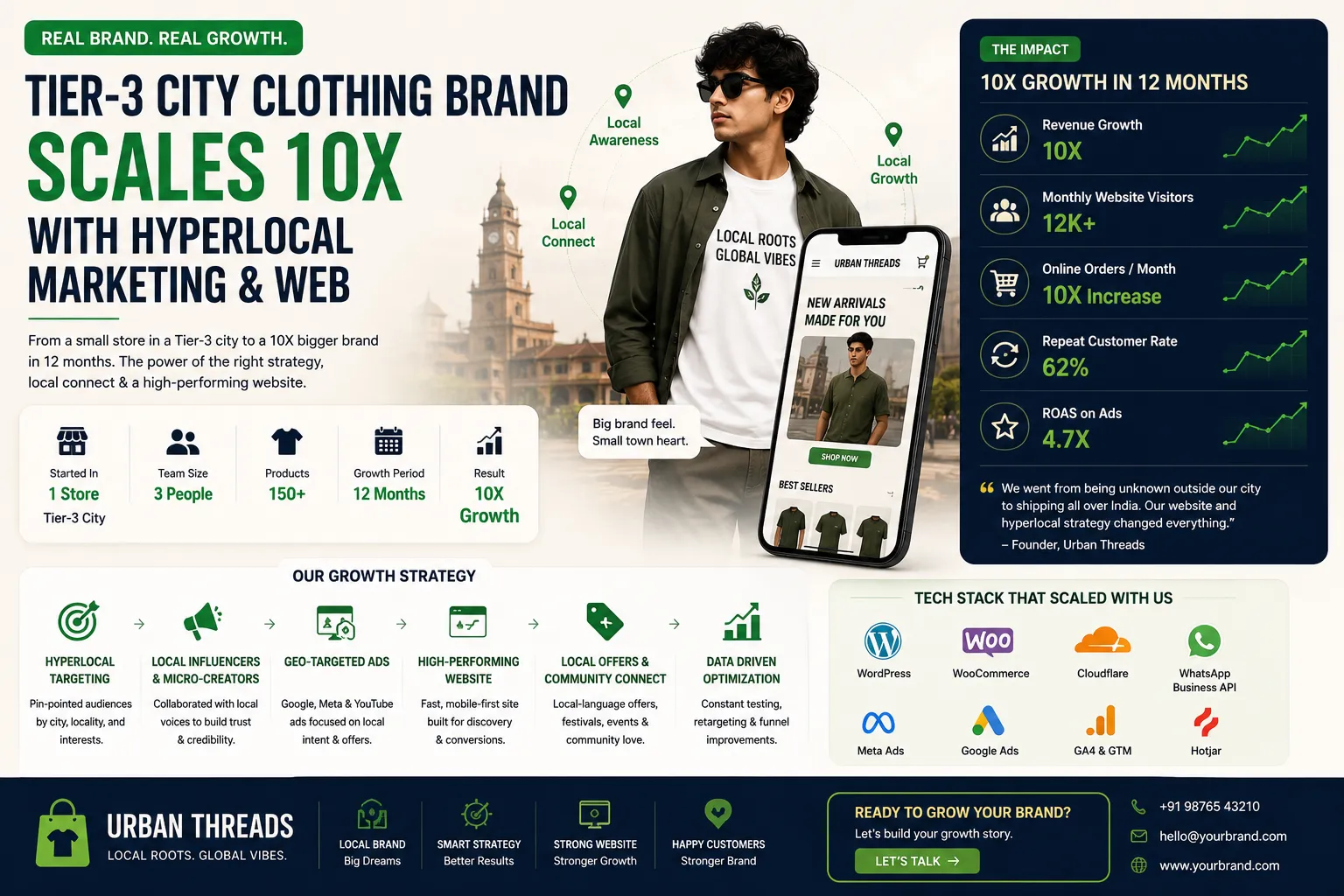
Tier-3 City Clothing Brand Scales 10x with Hyperlocal Marketing & Web
Published on: 16 Jun 2026
Tier-3 City Clothing Brand Scales 10x with Hyperlocal Marketing & Web App
Introduction
In the heart of a tier-3 city in India, a small clothing brand named "VastraKala" was struggling to compete with big e-commerce players. Founded by two college friends in 2018, the brand had a loyal local customer base but limited reach. Fast forward to 2024, and VastraKala has grown 10x in revenue, expanded to two physical stores, and built a thriving online community. How did they do it? By combining hyperlocal marketing with a custom web app that bridged the offline-online gap. This case study breaks down every step of their journey, the tools they used, and the lessons you can apply to your own business.
Learn more about our Website services
Main Section 1: The Problem – Limited Reach and Heavy Competition
VastraKala started as a small boutique in a busy market area. The owners had a keen eye for traditional Indian wear with modern twists, but their customer base was limited to walk-ins and word-of-mouth. They tried selling on major e-commerce platforms, but high commissions and intense competition from bigger brands made it nearly impossible to profit. Their website was a basic WordPress site with no e-commerce functionality. The owners realized they needed a different approach—one that leveraged their local strength while also tapping into the digital world.
Key Challenges
- Low online visibility beyond the city: The brand was virtually invisible to customers outside their immediate neighborhood, even though their products had national appeal.
- High dependency on physical footfall: Over 90% of sales came from walk-ins, making revenue unpredictable and seasonal fluctuations devastating.
- Inability to compete with large e-commerce players on price or variety: Big brands offered discounts and massive catalogs that VastraKala simply couldn't match without sacrificing quality.
- No integrated system to manage inventory across offline and online channels: This led to overselling, stockouts, and frustrated customers who would order online only to find the item unavailable in-store.
Main Section 2: The Solution – Hyperlocal Marketing + Custom Web App
Instead of trying to compete nationally, VastraKala decided to double down on their local market. They partnered with a digital agency (similar to EishwarITSolution) to build a custom web app that served as a local e-commerce platform with a twist: it integrated with their physical store inventory in real-time, offered hyperlocal delivery within a 10 km radius, and used location-based SEO to attract nearby customers.
Step 1: Hyperlocal SEO & Google My Business Optimization
The first step was to optimize their Google My Business profile with accurate location, business hours, high-quality photos of products, and regular posts. They also encouraged customers to leave reviews, which helped them rank higher for searches like "traditional wear in [city name]" and "best Indian clothing store near me." Within three months, their GMB profile received over 200 reviews and a 4.8-star rating. This alone drove a 30% increase in foot traffic from local searches.
Step 2: Custom Web App with Local-First Features
The web app was designed to feel like a local boutique. Key features included:
- Real-time inventory sync: Customers could see if a product was available in-store or for home delivery. This eliminated the frustration of ordering an item that was out of stock.
- Hyperlocal delivery: Orders within 5 km were delivered within 2 hours by the store's own delivery team. This speed beat even Amazon's same-day delivery in the area.
- Local payment options: Cash on delivery, UPI, and even store credit for repeat customers. This built trust among customers who were wary of online payments.
- Personalized recommendations: Based on past purchases and browsing behavior, the app suggested items that matched the user's style. For example, if a customer bought a silk saree, the app would recommend matching blouses or jewelry.
Step 3: WhatsApp Marketing & Community Building
Using the web app's customer database, VastraKala built targeted WhatsApp broadcast lists. They sent weekly updates about new arrivals, exclusive discounts for local customers, and style tips. They also created a private Facebook group for loyal customers, where members could share outfit photos, get styling advice, and participate in polls for new designs. This community became a powerful word-of-mouth engine, with members referring friends and family.
👉 Don't wait for the perfect moment; turn your vision into reality today.
Free ConsultationMain Section 3: The Results – 10x Growth in 18 Months
Within 18 months of implementing this strategy, VastraKala achieved remarkable results:
- Revenue: Grew from ₹12 lakhs per month to ₹1.2 crores per month (10x growth). This was driven by a combination of increased online orders and higher footfall.
- Customer base: Expanded from 500 regular customers to over 8,000 active customers. The web app's ease of use and local focus attracted new customers who previously shopped at generic online stores.
- Online orders: 60% of total orders now come through the web app. This shift reduced dependency on physical footfall and smoothed out seasonal fluctuations.
- Repeat purchase rate: Increased from 15% to 45%. Personalized recommendations and community engagement kept customers coming back.
- Footfall: Physical store footfall increased by 40% due to online-to-offline promotions, such as "order online, pick up in-store and get 10% off."
Expert Tips
- Start with hyperlocal SEO: Optimize your Google My Business profile and use location-based keywords in your website content. This is the quickest way to attract nearby customers. For example, use phrases like "best kurtis in [city name]" or "ethnic wear near [landmark]."
- Build a web app, not just a mobile app: Web apps are easier to maintain, don't require app store approvals, and work on any device. They also allow for real-time updates without user downloads. Plus, they're more cost-effective for small businesses.
- Integrate offline and online inventory: Use an inventory management system that syncs across all channels. This prevents overselling and improves customer trust. Tools like Zoho Inventory or even a simple Google Sheet with real-time updates can work initially.
- Leverage WhatsApp for customer engagement: WhatsApp has over 400 million users in India. Use broadcast lists and groups to share updates and offers directly with your customers. But be careful not to spam—send only valuable content.
- Focus on community, not just transactions: Build a community around your brand. Encourage user-generated content, host local events, and make customers feel like part of your family. For instance, VastraKala started a monthly "Style Night" where customers could try new arrivals in-store with personalized styling advice.
Common Mistakes
- Ignoring local SEO: Many small businesses focus only on social media and ignore Google My Business. This is a huge missed opportunity. A well-optimized GMB profile can drive more traffic than any social media post.
- Copying big brands: Don't try to replicate the strategies of national or global brands. What works for them may not work for a local business. For example, offering free shipping nationwide might be unsustainable for a small brand.
- Neglecting mobile optimization: Most local customers browse on mobile phones. Ensure your web app and website are mobile-friendly. Test on different devices and screen sizes.
- Overcomplicating technology: You don't need a complex ERP system. Start with simple tools that solve your immediate problems. A basic web app with inventory sync and a payment gateway is often enough.
- Underestimating the power of word-of-mouth: In tier-3 cities, personal recommendations carry immense weight. Invest in referral programs and excellent customer service. A single happy customer can bring in dozens of new ones.
Future Trends
Hyperlocal marketing is only going to become more important. With the rise of quick commerce and same-day delivery, local businesses that can offer speed and convenience will thrive. Additionally, AI-powered personalization will allow even small brands to offer tailored shopping experiences. Voice search optimization for local queries (e.g., "find ethnic wear near me") will also become crucial. Finally, the integration of AR/VR for virtual try-ons will help bridge the gap between online and offline shopping, especially for clothing and accessories. VastraKala is already experimenting with a simple AR feature that lets customers see how a saree looks on their avatar.
👉 Free Website Audit
Get Free AuditFAQs
- What is hyperlocal marketing? Hyperlocal marketing targets customers within a specific geographic area, often using location-based SEO, local ads, and community engagement. It's about being the go-to brand for your neighborhood.
- Do I need a custom web app for my small business? Not necessarily, but a web app can provide a seamless shopping experience and integrate with your physical store. Start with a simple e-commerce website and upgrade as needed. The key is to have a digital presence that feels local.
- How long does it take to see results from hyperlocal SEO? Typically 3-6 months, depending on competition and how consistently you optimize your profiles and content. Be patient and keep updating your GMB profile with fresh posts and reviews.
- What budget do I need for hyperlocal marketing? You can start with as little as ₹5,000-10,000 per month for local ads and SEO tools. The key is consistency. Even a small budget can yield results if used wisely.
- Can this work for non-clothing businesses? Absolutely. Any local business—restaurants, salons, electronics stores—can benefit from hyperlocal marketing and a web app. The principles of local SEO, community building, and real-time inventory apply across industries.
- How do I handle delivery logistics for hyperlocal orders? Start with a small delivery radius (e.g., 5 km) and use your own staff or a local courier service. As you grow, you can partner with hyperlocal delivery platforms like Dunzo or Swiggy Genie.
- What if I don't have a physical store? You can still use hyperlocal marketing by focusing on a specific area and offering fast delivery. Many successful online-only brands start by targeting one neighborhood before expanding.
Conclusion
VastraKala's journey proves that small businesses in tier-3 cities can compete and win against giants by focusing on their local strengths and using the right digital tools. Hyperlocal marketing, combined with a custom web app, created a powerful ecosystem that drove 10x growth. The key takeaway: You don't need to be everywhere. You just need to be the best option for your local customers. Start small, think local, and leverage technology to amplify your reach.
👉 Free Homepage Demo
Book DemoCTA
Ready to transform your local business with a custom web app and hyperlocal marketing? Contact EishwarITSolution today for a free consultation. Let's build your success story together.