
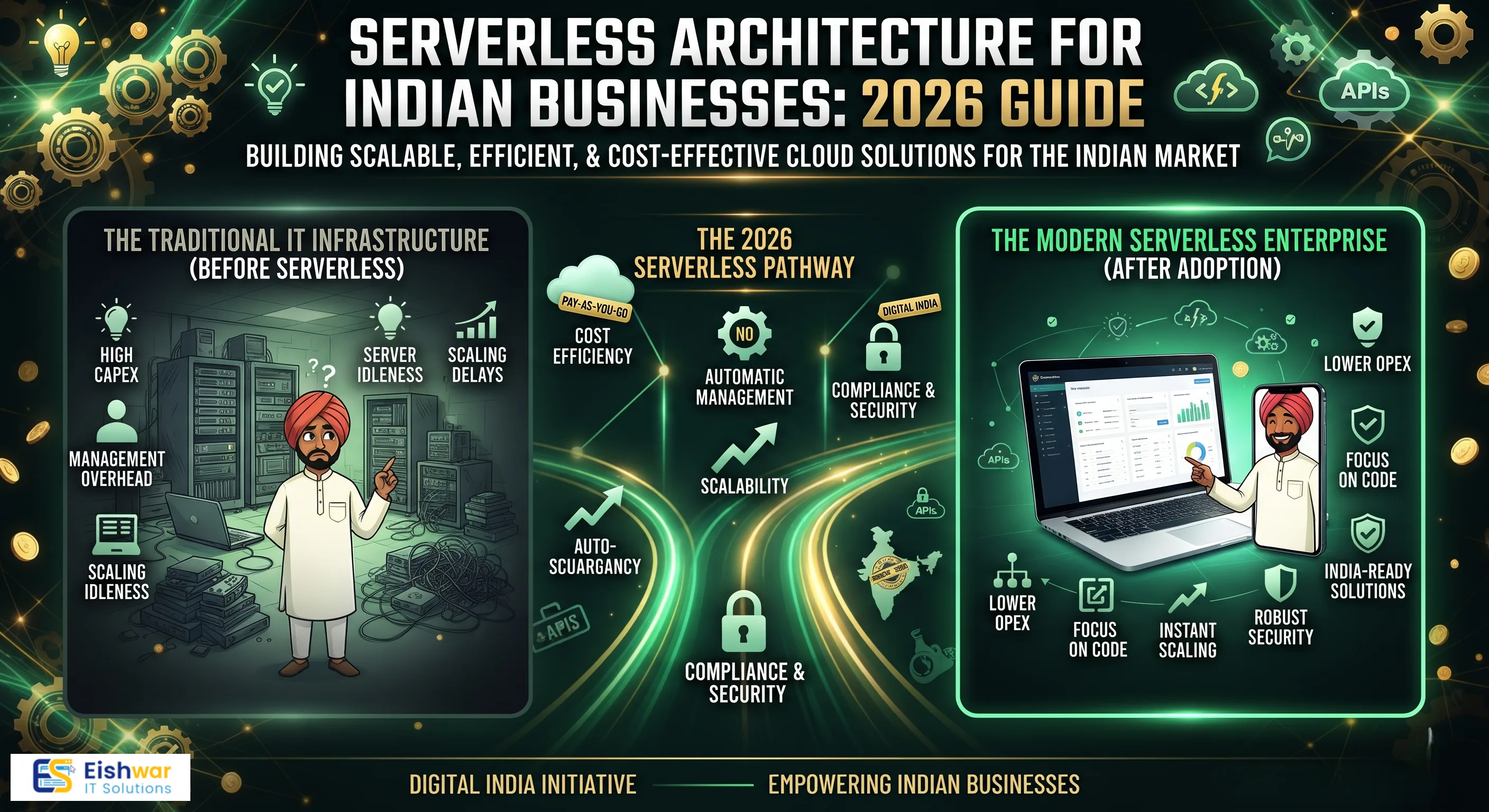
Serverless Architecture for Indian Businesses: 2027 Guide
Published on: 16 Nov 2026
Serverless Architecture for Indian Businesses: 2027 Guide
Introduction
In 2027, Indian businesses are building more digital products than ever: e-commerce stores, SaaS dashboards, lead-generation sites, payment workflows and WhatsApp-powered customer journeys. The pressure is simple: launch faster, handle traffic spikes, control cloud bills and keep customer data safe. Serverless architecture is one practical way to do that. It lets your team run code and managed services without provisioning or maintaining servers. Instead of paying for idle machines, you pay for usage and let the cloud provider handle scaling.
Learn more about our Website services
But serverless is not a magic switch. It works brilliantly for some workloads and poorly for others. This guide explains what serverless architecture means for Indian businesses, where it fits, how to estimate costs, how to avoid common traps and how to plan a safe first project.
A useful way to think about serverless is to separate no servers from no operations. Servers still exist, but the cloud provider manages them. Your team still owns application design, security, data modelling, deployment, monitoring and cost control. That distinction prevents the common mistake of assuming serverless removes the need for engineering discipline. It simply moves the discipline to smaller functions, event contracts, permissions, observability and spend guardrails.
Main Section 1: What Serverless Architecture Means for Indian Businesses
The simple definition
Serverless architecture is a cloud model where the provider manages servers, operating systems, scaling and availability. Your team writes functions or uses managed services, connects them through APIs and events, and pays based on usage. Common examples include AWS Lambda, Azure Functions, Google Cloud Functions and Cloudflare Workers. A typical serverless stack also uses API Gateway, object storage, queues, managed databases and a content delivery network.
This is different from shared hosting, VPS or a fixed cloud server. With traditional hosting, you rent capacity and manage it. With serverless, capacity appears when an event happens and disappears when the work is done. That event can be an HTTP request, a payment webhook, a file upload, a scheduled reminder or a message in a queue. In practice, serverless is less about a single product and more about a style of architecture. You compose small services, connect them with events and keep state in managed databases or storage.
Why it matters for Indian businesses in 2027
Indian businesses often deal with uneven demand. A D2C brand may see quiet weekdays and a festive sale spike. A B2B service company may receive a burst of leads after a campaign. A SaaS startup may have lean engineering teams but global customers. Serverless gives these businesses a way to handle spikes without buying servers for peak capacity all year.
Cloud regions in India, better edge networks and mature managed services have made serverless more practical than before. Businesses can now combine a static or server-rendered frontend with serverless APIs and managed data services. This reduces DevOps overhead and helps small teams ship faster. There is also a customer-experience angle. Indian users expect fast page loads, reliable payment flows and quick confirmations on WhatsApp or email. Serverless supports that by scaling APIs on demand and processing notifications in the background.
👉 Don't wait for the perfect moment; turn your vision into reality today.
Free ConsultationWhere serverless fits best
Serverless is strongest for event-driven work: APIs, webhooks, scheduled jobs, image processing, notifications, data sync and lightweight microservices. It is less suitable for long-running batch jobs, heavy stateful applications, lift-and-shift monoliths and steady high-traffic systems where fixed capacity may be cheaper. The goal is not to go fully serverless. The goal is to use serverless where it creates business value. A simple test is to ask whether the work happens in short bursts, can be triggered by an event and can tolerate a small amount of latency. If yes, serverless is worth evaluating.
Main Section 2: Practical Use Cases and Architecture Patterns
1. Payment and order webhooks
An Indian e-commerce business may receive payment callbacks, refund events and logistics updates. A serverless function can validate the webhook, update the order database, send a confirmation and trigger a WhatsApp or email notification. Because the work is event-driven and spiky, serverless is a good fit. Design the function to be idempotent so repeated callbacks do not create duplicate orders. Validate signatures, store the raw event for audit, check idempotency keys and move slow work to a queue.
2. Lead capture and CRM sync
Service businesses often run Google Ads, Meta campaigns and landing pages. A serverless endpoint can receive form submissions, run spam checks, enrich the lead and push it to a CRM. This keeps the website fast and avoids maintaining a separate server for a simple lead workflow. Add rate limiting and validation to prevent abuse. If the CRM is unavailable, queue the lead and retry instead of losing marketing spend.
3. Catalog and user-generated media
When a seller uploads a product image or a customer uploads a review photo, a serverless workflow can resize the image, compress it, create WebP versions and store thumbnails. This improves page speed and reduces manual work. The same pattern works for video thumbnails, PDF invoices and document previews. Keep originals, generate only the sizes you use and set lifecycle rules for temporary files.
4. Scheduled business jobs
Indian businesses run daily reports, GST invoice summaries, inventory sync, abandoned cart reminders and subscription renewals. Scheduled serverless jobs are easy to deploy and cost little when they run for a few minutes each day. For longer jobs, split them into smaller tasks and use a queue. Log records processed, failures and duration so a slow month-end job is visible before customers notice.
5. SaaS MVPs and microservices
A startup can launch a SaaS MVP with a serverless API, managed database and object storage. This avoids early infrastructure work and lets the team focus on product and customer feedback. As usage grows, the team can move predictable high-volume services to containers or reserved capacity. Keep tenant isolation, audit logging and backups in the MVP design.
A practical architecture pattern
A common pattern for Indian businesses is: CDN-hosted frontend, API Gateway for routing, serverless functions for business logic, managed database for transactions, object storage for files, queue for background work and a monitoring tool for alerts. Keep each function small and focused. Use environment variables and a secrets manager for credentials. Use infrastructure as code so environments are repeatable. Clear boundaries, retries, idempotency and observability matter more than the provider name.
👉 Free Website Audit
Get Free AuditMain Section 3: Cost, Performance, Security and Implementation Roadmap
Understanding serverless costs
Serverless pricing usually depends on requests, compute duration, memory and additional managed services. Small workloads can be very affordable. However, costs can grow through data transfer, logging, NAT gateways, provisioned concurrency and poorly optimized functions. Indian businesses should set budgets and alerts from day one. Review cost per 1,000 requests and cost per active user, not just the total bill.
For example, a lead-generation workflow with a few thousand requests per month may cost less than a small VPS. A high-volume API with heavy database calls may need caching, connection pooling and query optimization. Serverless does not remove architecture decisions. It changes where you make them. Review the full request path: CDN, API gateway, function, database, queue, third-party API and monitoring. Set budget alerts and connect the bill to leads, orders or active users.
Performance and cold starts
Cold starts happen when a function runs after being idle. They can add latency to user-facing requests. Reduce impact by choosing the right runtime, keeping packages small, avoiding unnecessary dependencies, using provisioned concurrency for critical endpoints and caching responses. For Indian audiences, choose nearby regions and use a CDN for static assets. Measure p95 latency, error rate and cold start rate before optimizing. Not every endpoint needs the same target. Fix cold starts on critical paths first and leave background jobs alone.
Security and compliance basics
Serverless shifts some security work to the cloud provider, but your application remains your responsibility. Use least-privilege permissions, validate inputs, store secrets securely, rate-limit public endpoints, enable logging and monitor unusual activity. Apply a web application firewall where needed. Review dependencies and keep functions patched. For customer data, understand where data is stored and how it is processed. Serverless can be secure, but only when access controls and monitoring are designed properly. Know which region holds customer data, which third parties receive it and how long logs are retained.
Implementation roadmap for Indian teams
- Audit workloads and pick one low-risk workflow such as a contact form, webhook or scheduled report.
- Choose a provider based on existing skills, region availability, pricing and support.
- Define success metrics: latency, error rate, monthly cost and deployment time.
- Set budgets, alerts and log retention limits before launch.
- Build CI/CD, infrastructure as code and observability from the start.
- Run a security review and load test with realistic Indian traffic patterns.
- Scale gradually and move workloads only when the data supports it.
A thirty-day pilot is often enough to learn whether serverless fits. Pick one workflow, define a success metric and compare it with the current process. If it works, expand to a second workflow. If not, you have useful data without a risky full migration.
Expert Tips
Start with a workflow that has clear business value and low risk. A payment webhook or lead sync is often better than rebuilding the entire website.
👉 Free Homepage Demo
Book DemoDesign for retries. Networks fail and webhooks repeat. Make functions idempotent so duplicate events do not create duplicate records.
Use queues for spikes. If a festive sale sends thousands of events, a queue protects your database and gives you controlled processing.
Keep functions small. One function should do one job. This improves security, debugging and cost control.
Track cost per business outcome. A serverless bill is useful only when you connect it to leads, orders or active users. Otherwise you are optimizing the wrong number.
Common Mistakes
Treating serverless as no operations. You still need monitoring, security, deployment and cost management.
Ignoring data transfer, logging and managed service costs. These can quietly become the largest part of the bill.
Putting a long-running monolith into one function. Break work into smaller tasks and use queues for background processing.
Hardcoding secrets or using overly broad permissions. This creates avoidable security risk.
Choosing serverless for every workload. Steady, predictable high traffic may be cheaper on containers or reserved servers.
Future Trends
Serverless will become more hybrid. Teams will mix functions, containers, edge compute and managed databases instead of treating serverless as an all-or-nothing choice. Edge serverless will improve latency for Indian users in Tier 2 and Tier 3 cities. FinOps tools will make cost monitoring more automated. Event-driven design will continue to grow as businesses connect payments, logistics, CRM and messaging platforms. Expect more managed services and better local cloud regions. The winning pattern will be a pragmatic mix: serverless for spiky event work, containers for steady services and managed data services for reliability.
FAQs
Is serverless cheaper for small Indian businesses?
It can be cheaper for spiky or low-volume workloads because you pay for usage. It may not be cheaper for steady high-traffic systems. Compare the full bill, including data transfer, logging and managed services. Run a small pilot and measure cost per lead, order or active user before committing.
Can I use serverless with WordPress?
You can use serverless for specific tasks such as image processing, form handling or webhooks. Running the full WordPress stack on serverless is possible but often complex. Many businesses keep WordPress on managed hosting and use serverless for side workflows. That hybrid approach is usually easier to maintain.
Is serverless secure enough for customer data?
Yes, when configured correctly. Use least-privilege access, secrets management, input validation, rate limiting, logging and regular security reviews. The cloud provider secures the platform, but your application and permissions remain your responsibility. Data residency, retention and third-party integrations should be reviewed with the same care as any other architecture.
Will serverless handle festive sale traffic?
Serverless can scale well for APIs and event processing, but your database, third-party APIs and payment gateways must also scale. Load test before the sale and use queues, caching and rate limits to protect critical systems. A queue can absorb a spike and prevent the database from being overwhelmed.
What skills does my team need?
Your team needs basic cloud knowledge, API design, infrastructure as code, logging and cost monitoring. You do not need a large DevOps team to start, but you do need someone responsible for security and observability. Good documentation and a clear on-call process matter more than having every advanced tool.
Which serverless provider should Indian businesses choose?
Choose based on your existing cloud, region availability, team skills, pricing and support. AWS, Azure, Google Cloud and Cloudflare are common options. A pilot project is the best way to compare real costs and performance. Do not choose a provider only because it is popular; choose it because it fits your team and your workload.
Conclusion
Serverless architecture gives Indian businesses a practical way to launch faster, handle uneven demand and reduce infrastructure management. It is most useful for event-driven workflows, APIs, webhooks, scheduled jobs and media processing. It is not the right choice for every workload, and it still requires architecture, security and cost discipline. Start with one business-critical but low-risk workflow, measure results and scale what works.
CTA
Ready to evaluate serverless for your Indian business? Talk to EishwarITSolution for a practical architecture review, cost estimate and implementation roadmap. Visit http://eishwar.com to start the conversation.