
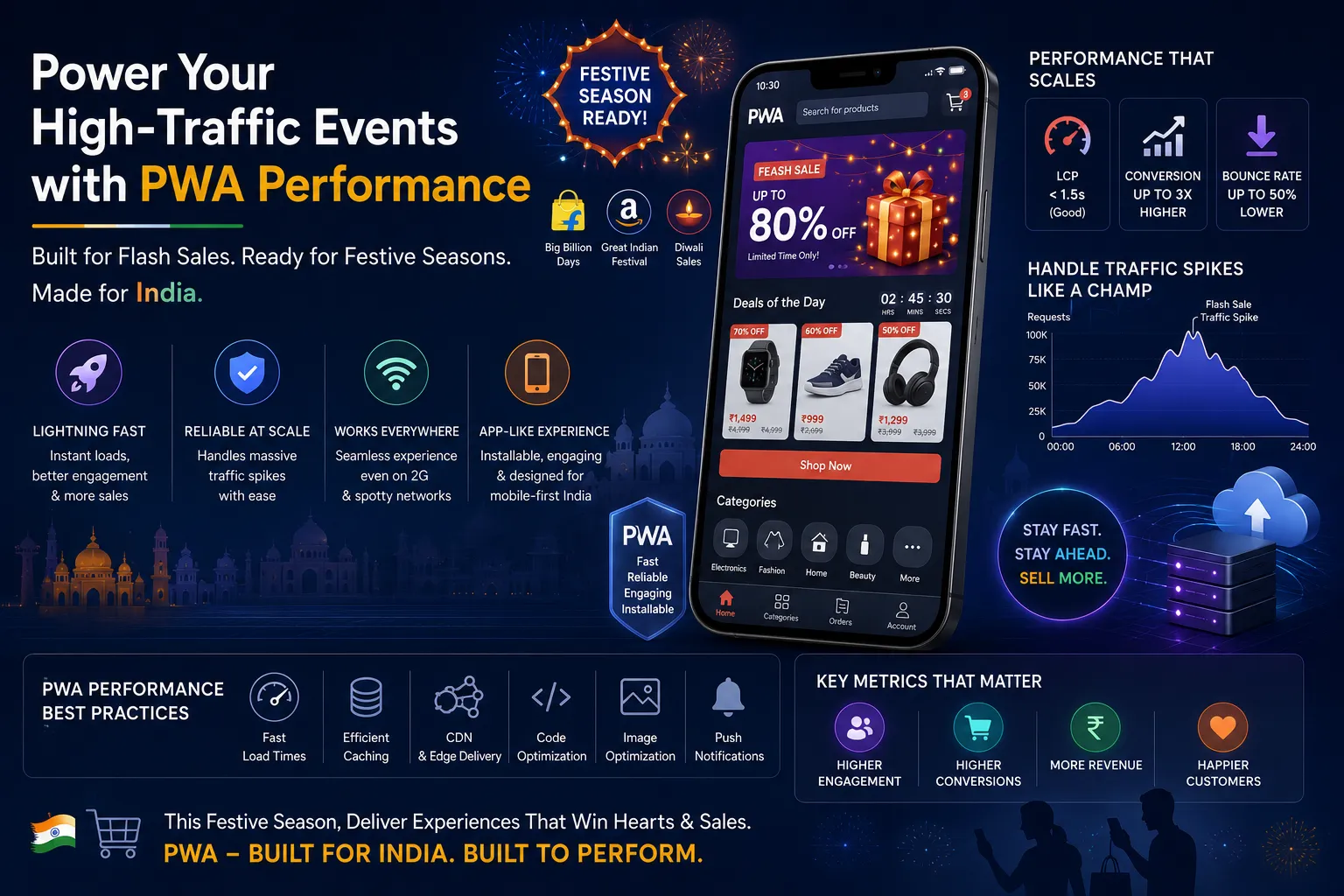
PWA Performance for High-Traffic Events: Handling Flash Sales & Festiv
Published on: 18 Jun 2026
PWA Performance for High-Traffic Events: Handling Flash Sales & Festive Seasons in India
Introduction
India's e-commerce landscape is defined by explosive traffic surges during flash sales and festive seasons like Diwali, Dussehra, and Eid. For businesses relying on Progressive Web Apps (PWAs), these events are both a massive opportunity and a stress test. When thousands of users rush to grab deals, a slow or crashing PWA means lost revenue and damaged trust. This guide dives deep into how you can prepare your PWA to handle high-traffic events seamlessly, ensuring your business captures every possible conversion.
Learn more about our Website services
At EishwarITSolution, we've helped Indian businesses scale their PWAs for peak traffic. Here's what you need to know.
Main Section 1: Understanding the Challenges of High-Traffic Events
Why Flash Sales and Festive Seasons Stress Your PWA
Flash sales and festive seasons create artificial demand spikes. Unlike steady growth, these events can increase traffic 10x or more within minutes. The primary challenges include:
- Server Overload: Your backend may struggle to handle concurrent requests. For example, during a Diwali sale, a popular electronics retailer saw a 15x spike in checkout requests, causing database timeouts.
- Slow Asset Delivery: Large images, scripts, and stylesheets delay page loads. A 500KB hero image can take 5 seconds to load on a 3G connection, leading to high bounce rates.
- Database Contention: Inventory checks, cart updates, and payment processing create bottlenecks. In-memory caches like Redis can help, but misconfiguration leads to stale data.
- Service Worker Cache Miss: If not configured correctly, users may fetch stale or missing data. For instance, a flash sale for limited-stock items requires real-time inventory updates, which a cache-first strategy can't provide.
For example, during Amazon's Great Indian Festival, traffic spikes are so severe that even giants invest heavily in pre-scaling. Your PWA must be equally resilient.
Main Section 2: Pre-Event Performance Optimization Strategies
1. Load Testing and Capacity Planning
Simulate traffic spikes using tools like Apache JMeter or Locust. Test your PWA's response time, error rates, and throughput under load. Identify the breaking point and scale your infrastructure accordingly. Cloud providers like AWS or Azure offer auto-scaling groups that add resources on demand. For example, you can set a trigger to add 10 EC2 instances when CPU utilization exceeds 70%.
2. Optimize Your Service Worker
Your service worker is the heart of PWA performance. For high-traffic events:
- Pre-cache critical assets: Homepage, product listing pages, and checkout scripts. Use the Cache API to pre-cache these during installation.
- Use a stale-while-revalidate strategy for product data to serve cached content instantly while updating in the background. This ensures users see fast load times even if the network is slow.
- Implement a custom offline fallback for inventory-heavy pages to avoid 404s. For example, show a cached version of the product page with a note that inventory may be outdated.
3. Image and Media Optimization
India's diverse network conditions (2G to 5G) demand lightweight media. Use modern formats like WebP and AVIF. Implement lazy loading for below-the-fold images. A 100KB product image vs. 500KB can save seconds on slower connections. Tools like ImageOptim or Cloudinary can automate compression.
👉 Don't wait for the perfect moment; turn your vision into reality today.
Free Consultation4. Minimize JavaScript and CSS
Remove unused code, split bundles, and defer non-critical scripts. Tools like Lighthouse and WebPageTest can highlight render-blocking resources. Aim for a First Contentful Paint (FCP) under 1.5 seconds. For example, defer third-party analytics scripts until after the page is interactive.
Main Section 3: Real-Time Traffic Management During the Event
1. CDN and Edge Caching
Use a Content Delivery Network (CDN) like Cloudflare or Akamai to serve static assets from edge locations near your users. India has multiple major cities; edge caching reduces latency for users in Mumbai, Delhi, Bengaluru, etc. For dynamic content, use edge-side includes (ESI) to cache fragments.
2. Dynamic Scaling with Kubernetes or Serverless
Container orchestration (Kubernetes) or serverless functions (AWS Lambda) can scale your API endpoints automatically. For example, a flash sale might trigger a 100x increase in checkout requests; serverless can handle that without manual intervention. Set up horizontal pod autoscaling based on CPU or memory usage.
3. Rate Limiting and Queue Management
Protect your backend from abuse by implementing rate limiting. For high-demand products, use a virtual queue system (like Queue-it) to manage user flow without crashing the site. For example, allow only 1000 checkout requests per minute per IP.
4. Real User Monitoring (RUM)
Deploy RUM tools like Google Analytics 4 or Datadog to track actual user experience in real time. Monitor metrics like Largest Contentful Paint (LCP), Cumulative Layout Shift (CLS), and Time to Interactive (TTI). If LCP exceeds 4 seconds, trigger alerts. For example, set up a Slack notification when error rates exceed 5%.
Expert Tips
Tip 1: Pre-Warm Your Cache
Hours before the event, run a script to visit key pages and populate the service worker cache. This ensures first-time visitors get fast load times. Use a headless browser like Puppeteer to automate this.
Tip 2: Use a Staging Environment
Test your entire stack in a staging environment that mirrors production. Include a mock flash sale to validate performance. For example, simulate 50,000 concurrent users and monitor database connection pools.
Tip 3: Optimize Your Database Queries
Use indexing, query caching, and read replicas. For inventory checks, consider using in-memory stores like Redis to reduce database load. For example, cache product stock levels with a TTL of 30 seconds to balance freshness and performance.
Tip 4: Implement Graceful Degradation
If a feature fails (e.g., product recommendations), serve a static fallback. Users should still be able to browse and checkout. For example, if the recommendation API times out, show a default set of popular products.
Common Mistakes
- Ignoring mobile performance: Over 70% of Indian e-commerce traffic is mobile. Optimize for 3G/4G networks. Test on real devices with throttled connections.
- Not testing with real user conditions: Simulate slow network speeds and device throttling. Use Chrome DevTools to emulate a Moto G4 on slow 3G.
- Over-caching dynamic content: Cache product availability for too long, leading to overselling. Use a short TTL (e.g., 30 seconds) for inventory data.
- Neglecting third-party scripts: Analytics, chat widgets, and ads can slow down your PWA. Load them asynchronously or defer them until after the page is interactive.
Future Trends
As India's internet users cross 900 million by 2026, PWAs will become even more critical. Emerging trends include:
👉 Free Website Audit
Get Free Audit- AI-driven predictive scaling: Machine learning models that forecast traffic spikes and auto-scale resources. For example, use historical data to predict Diwali traffic and pre-provision servers.
- WebAssembly (Wasm) for heavy computations: Offload complex tasks like image processing or encryption to Wasm for faster performance.
- Streaming responses: Use the Streams API to render HTML progressively, improving perceived performance. For example, stream product listings as they become available.
FAQs
What is the best caching strategy for flash sales?
Use a stale-while-revalidate strategy for product pages. Serve cached content instantly while updating the cache in the background. For inventory, use network-first with a short timeout to avoid overselling. This balances speed and accuracy.
How can I test my PWA for high traffic without real users?
Use load testing tools like Apache JMeter, Locust, or k6. Simulate concurrent users, ramp-up patterns, and different network conditions. Monitor server metrics and PWA performance indicators. For example, test with 10,000 virtual users and measure response times.
Should I use a CDN for my PWA?
Absolutely. A CDN reduces latency by serving static assets from edge servers close to users. For India, choose a CDN with PoPs in major cities like Mumbai, Delhi, Chennai, and Bengaluru. This can cut load times by 50% or more.
What metrics should I monitor during a flash sale?
Focus on LCP (under 2.5s), FID (under 100ms), CLS (under 0.1), error rate (under 1%), and server response time (under 200ms). Use Real User Monitoring tools for live data. Set up dashboards to track these in real time.
Can a PWA handle 1 million concurrent users?
Yes, with proper architecture. Use auto-scaling cloud infrastructure, CDN, efficient caching, and database read replicas. Load test to determine your limits and scale accordingly. For example, use Kubernetes with horizontal pod autoscaling to handle spikes.
How do I handle payment gateway failures during high traffic?
Implement retry logic with exponential backoff. Use a queue to process payments asynchronously. Monitor payment gateway response times and switch to a fallback gateway if the primary one fails. For example, use Razorpay as primary and PayU as backup.
What is the role of service workers in flash sales?
Service workers cache critical assets and enable offline functionality. During flash sales, they reduce server load by serving cached content. Use a network-first strategy for dynamic data like inventory to ensure accuracy.
Conclusion
High-traffic events like flash sales and festive seasons are make-or-break moments for Indian e-commerce businesses. By optimizing your PWA's performance—through pre-event preparation, real-time management, and continuous monitoring—you can turn traffic spikes into revenue spikes. Start implementing these strategies today to ensure your PWA delivers a fast, reliable experience when it matters most.
CTA
Ready to make your PWA unstoppable during peak traffic? Contact EishwarITSolution for a comprehensive performance audit and scaling consultation. Let's ensure your next flash sale is a success.