
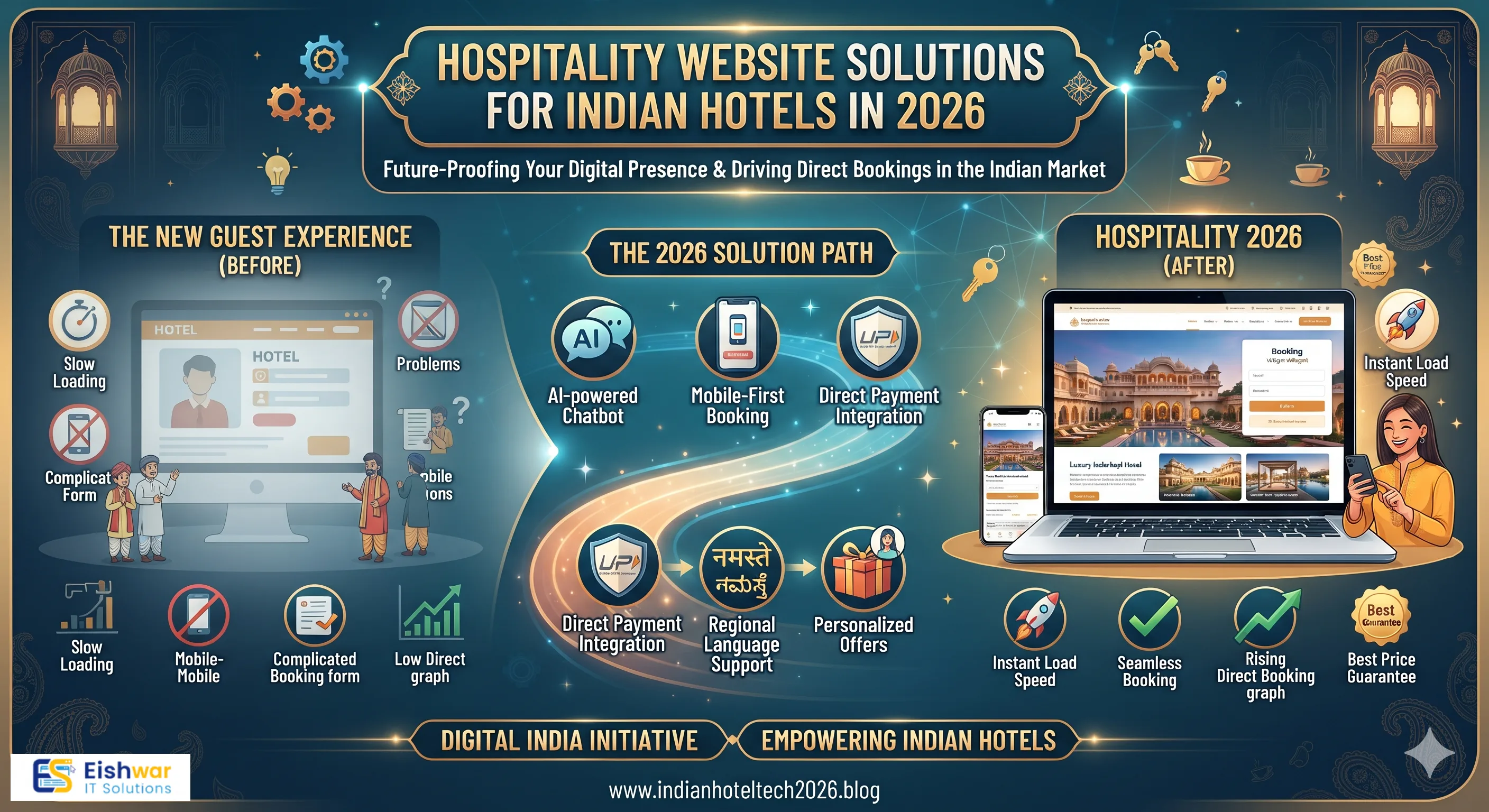
Hospitality Website Solutions for Indian Hotels in 2027
Published on: 09 Nov 2026
Hospitality Website Solutions for Indian Hotels in 2027
Introduction
For Indian hotels, resorts, homestays, and boutique stays, the website is no longer a digital brochure. It is the front desk, sales team, and trust builder working together. Travellers discover you on Google, compare you on OTAs, check reviews on social media, and then decide whether to book directly or pay a commission-heavy platform. That split-second decision often depends on how confident your website makes them feel.
Learn more about our Website services
In 2027, hospitality website solutions for Indian hotels must do more than look attractive. They must load fast on mobile, show real-time availability, accept UPI and cards, answer common questions, and make direct booking feel safer than booking through an OTA. This guide breaks down what works, what to avoid, and how to turn your hotel website into a reliable revenue channel.
Main Section 1: Why Indian Hotels Need Industry-Specific Websites
Generic business websites can explain services. Hospitality websites must sell an experience, reduce anxiety, and complete a transaction. A guest is not only asking what you offer. They are asking: Is this property clean? Is the location convenient? Will my family feel comfortable? Can I trust the photos? What happens if my plans change? Is direct booking safe?
An industry-specific website answers those questions in the visitor's language. It prioritises room categories, location, amenities, policies, reviews, and booking flow. It also respects how Indian travellers behave: heavy mobile usage, WhatsApp enquiries, UPI payments, comparison shopping, and a preference for clear cancellation policies.
OTA dependency is convenient, but expensive
OTAs bring visibility and demand. They also charge commissions, control the guest relationship, and often retarget your visitors with competing properties. Many Indian hotels use OTAs to fill rooms, then wonder why direct bookings stay low. The answer is rarely price alone. Usually, the website gives guests no compelling reason to book direct.
A strong hospitality website gives that reason: a best-rate promise, complimentary breakfast, flexible check-in, a local experience add-on, or a direct-booking discount. It also makes the booking process shorter and more transparent than an OTA checkout.
What Indian guests expect in 2027
- Fast mobile pages that open even on patchy networks.
- Clear room photos, sizes, amenities, and real guest reviews.
- Prices in INR with taxes and fees explained upfront.
- UPI, credit card, debit card, net banking, and pay-at-hotel options where suitable.
- WhatsApp support for quick questions before booking.
- Location context: airport distance, railway station, nearby attractions, parking, and local transport.
- Policies for cancellation, child stay, extra bed, pets, and ID requirements.
These details are not decoration. They remove friction. Every unanswered question is a reason for a traveller to open another tab and book elsewhere.
Main Section 2: Must-Have Features for Hospitality Websites
Industry-specific website solutions for hotels should connect marketing, content, and booking technology. The design can be beautiful, but if the booking engine is clunky or the site hides key information, revenue leaks.
1. A booking engine built for direct conversion
The booking engine should show real-time availability, current rates, room-level inclusions, and cancellation terms. Guests should be able to compare room types without leaving the page. Avoid forcing users to call or email for standard bookings. If a guest has to wait for a reply, they will often book on an OTA or a competitor's site instead.
👉 Don't wait for the perfect moment; turn your vision into reality today.
Free ConsultationFor Indian properties, support UPI and popular cards. Show GST invoices where applicable. Make it clear whether payment is collected now or at the property. A progress indicator reduces abandonment, especially on mobile.
2. Mobile-first speed and one-thumb usability
Most travel research starts on a phone. Large hero videos and uncompressed images may look impressive on a laptop but frustrate mobile users. Compress images, use modern formats, lazy-load below-the-fold content, and keep the primary Book Now button visible. The booking flow should work with one thumb and minimal typing.
3. Trust signals placed where decisions happen
Do not hide reviews on a separate page. Put review highlights near room cards and booking buttons. Show verified photos, awards, hygiene practices, safety details, and staff hospitality. For homestays and boutique properties, host profiles and local stories build confidence.
4. WhatsApp and human support without slowing the funnel
Indian travellers often ask one or two quick questions before booking. A WhatsApp button for stay-related queries can rescue uncertain visitors. Keep the button unobtrusive. Use pre-filled messages such as room availability for specific dates. Make sure someone responds quickly during business hours.
5. Location and experience content that sells the stay
A hotel website should help guests imagine their trip. Add pages or sections for local attractions, airport transfers, family activities, food experiences, and business facilities. A business hotel near a convention centre needs different content from a beach resort or a hill-station homestay. Industry-specific websites win because they speak to the guest's actual trip context.
6. SEO structure that captures destination intent
Use clean URLs, descriptive title tags, and structured data for hotels, rooms, reviews, and FAQs. Create helpful location pages for nearby landmarks, not thin duplicate pages. For example, a Jaipur boutique hotel can publish practical guides for travellers arriving at Jaipur airport or planning a heritage weekend. The goal is to answer search intent and lead naturally to booking.
Focus on semantic keywords such as hotel website design India, direct booking website for hotels, resort website development, homestay website design, and hospitality SEO. Use them where they feel natural, not in every sentence.
Main Section 3: From Website Traffic to Direct Bookings
Traffic alone does not create revenue. A hospitality website needs a clear path from discovery to enquiry to booking. Small improvements in clarity and speed often outperform big redesigns.
Measure the booking journey
Track room page views, booking engine starts, checkouts, abandoned bookings, WhatsApp clicks, and calls. If many people view rooms but few start a booking, the room information or pricing may be unclear. If they start and abandon, the booking flow or payment options may be the problem. Use analytics to fix the real bottleneck.
Give direct bookers a genuine reason
Best-rate guarantees are common, so make yours visible. Offer a meaningful direct-booking benefit: free breakfast, flexible cancellation, early check-in, a local experience, or a room upgrade subject to availability. Explain it simply near the booking button.
👉 Free Website Audit
Get Free AuditBuild seasonal campaigns around intent
Indian travel demand shifts around long weekends, festivals, weddings, school holidays, and pilgrimage seasons. Create campaign landing pages for these moments. A resort can promote monsoon packages; a business hotel can target weekday stays near an office hub; a homestay can highlight festival experiences. Use email, WhatsApp broadcasts, and retargeting to bring previous visitors back.
Reduce OTA leakage
Keep room names, photos, and inclusions consistent across OTAs and your own website. If guests find different information, they lose trust. Train the front desk to ask how guests found the hotel and encourage direct booking for future stays. Add a subtle thank-you offer for direct bookers to return.
A practical 90-day action plan
- Days 1 to 30: Audit mobile speed, booking flow, room content, policies, and trust signals. Fix broken links and unclear pricing.
- Days 31 to 60: Improve SEO for destination and room keywords, add FAQs, connect analytics, and launch a direct-booking offer.
- Days 61 to 90: Run WhatsApp and email campaigns to past guests, test landing pages for weekends or festivals, and review abandoned booking data.
Expert Tips
Start with the questions your front desk answers every day. Those questions belong on the website. If guests repeatedly ask about parking, early check-in, ID proof, or airport pickup, add clear answers near the booking section.
Use real photography. Travellers can spot generic stock images quickly. Show rooms, bathrooms, views, dining areas, and the entrance. For homestays, show the hosts and neighbourhood context.
Keep the booking path short. Every extra form field, pop-up, or forced account creation adds friction. Allow guest checkout where possible.
Write for skimmers. Use short paragraphs, descriptive room names, and benefit-led headings. A guest should understand your property in under 30 seconds.
Connect website data to revenue. A beautiful site that does not track bookings is hard to improve. Define one primary conversion, such as a completed booking or a qualified enquiry, and optimise around it.
Common Mistakes
- Hiding prices or making guests call for standard rates.
- Using slow, oversized image sliders on mobile.
- Copying the same content across every room type.
- Ignoring cancellation and child policies until checkout.
- Treating WhatsApp as the only booking channel.
- Running ads to a homepage instead of a specific room or package page.
- Letting OTA photos, descriptions, and inclusions disagree with the website.
- Forgetting structured data and local business details.
Each mistake creates doubt or delay. In hospitality, doubt is expensive because travellers usually have several tabs open.
Future Trends
In 2027 and beyond, expect more Indian hotels to use AI-assisted chat for routine questions, but human escalation will remain important for high-value bookings. Personalisation will improve: returning visitors may see relevant packages, and past guests may receive offers based on stay history.
Voice search and conversational discovery will grow, especially for destination queries. Hotels that publish clear, structured answers about location, amenities, and policies will be easier for assistants to recommend.
👉 Free Homepage Demo
Book DemoDirect booking will become more experience-led. Travellers will compare not only room rates but also local experiences, flexible policies, and sustainability practices. Websites that tell a credible story and make booking effortless will win.
Privacy and payment security will stay non-negotiable. Use HTTPS, reputable payment gateways, and clear data practices. A single trust failure can damage years of reputation.
FAQs
How much does a hospitality website cost in India?
Costs vary by property size and features. A focused website with a booking engine, content, and SEO setup can be a modest investment compared with OTA commissions. Custom integrations, multi-language content, and advanced analytics add cost. Ask for a scope that includes mobile speed, booking flow, and post-launch support.
Can a small homestay compete with OTAs?
Yes, by owning a niche. A homestay can win with local experiences, host-led hospitality, clear policies, and a simple direct booking option. Use OTAs for discovery, then give guests a reason to book direct next time.
Do I need a separate booking engine?
Most hotels benefit from a dedicated booking engine or a well-integrated booking plugin. It should show real-time availability, secure payments, and mobile-friendly checkout. The right choice depends on property size and existing property management systems.
How can I reduce abandoned bookings?
Show total price early, explain taxes and cancellation terms, offer UPI and cards, reduce form fields, and keep the Book Now button visible. Send a helpful follow-up email or WhatsApp message only where consent allows.
What SEO content works for hotels?
Room pages, location guides, FAQs, local attraction content, event or wedding pages, and practical travel tips work well. Avoid thin duplicate pages. Focus on what a traveller needs before booking.
How often should I update the website?
Update rates, availability, offers, and policies regularly. Review room photos and reviews every quarter. Refresh destination content before peak seasons. Speed and security checks should be ongoing.
Conclusion
Hospitality website solutions for Indian hotels are most effective when they reduce uncertainty and make direct booking feel easy. Guests want clear rooms, honest photos, transparent pricing, local context, and fast support. They also want to book on the device in their hand, using the payment method they trust.
Your website does not need to be the most elaborate site in the market. It needs to be the most reassuring and useful for your ideal guest. Fix the booking path, answer real questions, and give travellers a reason to choose you directly.
CTA
Ready to turn your hotel website into a direct booking channel? Talk to EishwarITSolution about industry-specific website solutions built for Indian hotels, resorts, and homestays. Visit eishwar.com to discuss your property's goals.