
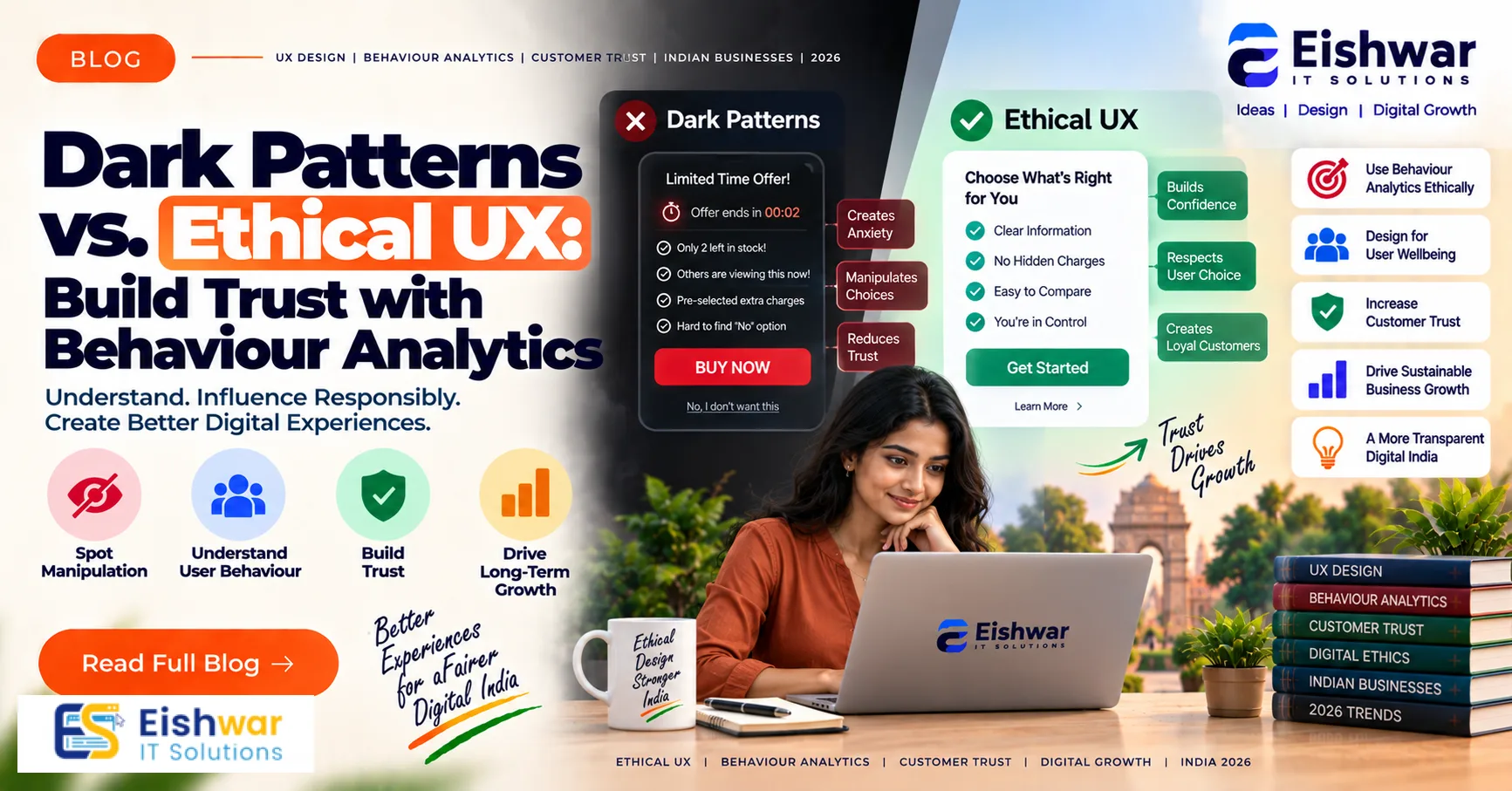
Dark Patterns vs. Ethical UX: Build Trust with Behaviour Analytics
Published on: 14 Aug 2026
Dark Patterns vs. Ethical UX: Build Trust with Behaviour Analytics
Introduction
Imagine booking a flight online, only to discover at the last step that the price has mysteriously increased because you forgot to uncheck a pre-selected travel insurance. Or trying to cancel a subscription, but the 'Cancel' button is hidden in a maze of links. These are classic examples of dark patterns—design choices that deliberately trick users into doing things they didn't intend. While such tactics might seem like a quick win for conversions, they come at a steep cost: the erosion of user trust.
Learn more about our Website services
As we move deeper into 2026, Indian consumers are becoming more aware and less tolerant of such tactics. With the rise of behaviour analytics, businesses now have the tools to understand user intent and design experiences that are not only ethical but also highly effective. Behaviour analytics—the practice of collecting and analyzing user interaction data—allows you to see exactly where users struggle, hesitate, or abandon tasks. This data is gold for ethical UX, as it reveals friction points that can be fixed transparently rather than exploited. In this article, we'll explore the fine line between dark patterns and ethical UX, and how behaviour analytics can guide you toward building lasting trust with your audience.
Main Section 1: What Are Dark Patterns and Why They're a Losing Game
Definition and Common Types
Dark patterns are user interface designs crafted to trick users into actions they wouldn't otherwise take. Coined by UX specialist Harry Brignull, the term encompasses a range of deceptive practices. Common types include:
- Confirmshaming: Guilt-tripping users into opting in (e.g., 'No thanks, I don't want to save money'). This tactic leverages social pressure to nudge users away from the desired choice.
- Hidden Costs: Revealing extra charges only at the final step of checkout. For example, a shopping site might add a 'handling fee' or 'service charge' that wasn't mentioned earlier.
- Forced Continuity: Making it easy to subscribe but hard to cancel. Users often find themselves trapped in recurring payments because the cancellation process is buried or requires multiple steps.
- Bait and Switch: Showing one thing but delivering another. A classic example is a 'download' button that actually leads to a promotional page.
- Misdirection: Using visual cues to distract from important information. For instance, a bright 'Accept' button for cookies while the 'Decline' option is greyed out or placed in a less visible area.
These patterns exploit cognitive biases, such as the status quo bias (users tend to stick with pre-selected options) and the fear of loss (users avoid actions that seem to take away benefits). While they may boost short-term metrics, they damage the user experience and brand reputation.
The Short-Term Gains vs. Long-Term Losses
While dark patterns may boost short-term conversions, they erode trust. A 2025 study found that 78% of Indian users would abandon a brand after a single deceptive experience. In the age of social media, one bad review can go viral, costing you far more than any short-term gain. For example, a popular Indian food delivery app once used a pre-checked 'donation' box at checkout. When users noticed, the backlash on Twitter was swift, leading to a public apology and a drop in app ratings. The loss of customer trust far outweighed the extra revenue from donations.
👉 Don't wait for the perfect moment; turn your vision into reality today.
Free ConsultationMoreover, dark patterns often lead to higher customer support costs. Users who feel tricked are more likely to contact support, request refunds, or file complaints. This not only increases operational expenses but also ties up resources that could be used for product improvement.
Regulatory Landscape in India
India's Consumer Protection Act and the upcoming Digital India Act are tightening regulations around deceptive design. The government is actively penalizing companies that use dark patterns. For example, in 2025, a major e-commerce platform was fined ₹10 lakh for 'confirmshaming' tactics. The message is clear: dark patterns are not just unethical—they're illegal. The Central Consumer Protection Authority (CCPA) has also issued guidelines that specifically list dark patterns as a form of unfair trade practice. As a result, businesses must now conduct regular UX audits to ensure compliance.
Furthermore, the upcoming Digital India Act is expected to include provisions that require 'fair and transparent' design, giving users more control over their data and choices. This regulatory shift means that even if you're not ethically motivated, you have a legal obligation to eliminate dark patterns.
Main Section 2: Ethical UX as a Growth Strategy
What is Ethical UX?
Ethical UX is a design philosophy that prioritizes user well-being and autonomy. It means being transparent, respecting user choices, and ensuring that the design serves the user's best interest, not just the business's bottom line. Ethical UX is not about being 'nice'—it's about creating sustainable, long-term value. When users feel respected, they are more likely to engage, return, and recommend your product.
Why Ethical UX Wins in 2026
Consumers are increasingly making purchasing decisions based on brand values. A 2026 survey by a leading Indian market research firm revealed that 82% of users are more likely to buy from a website that clearly labels sponsored content and makes cancellation easy. Ethical UX builds brand loyalty, reduces churn, and attracts a premium customer segment. For instance, companies like Zoho and Freshworks have built their reputations on transparent, user-friendly interfaces, and they consistently rank high in customer satisfaction.
Moreover, ethical UX aligns with the growing demand for corporate social responsibility. Millennials and Gen Z, who are now the largest consumer groups, are particularly sensitive to unethical practices. They are willing to pay a premium for brands that demonstrate integrity. By adopting ethical UX, you not only avoid the risk of regulatory penalties but also differentiate yourself in a crowded market.
How Behaviour Analytics Fuels Ethical UX
Behaviour analytics—the analysis of user actions like clicks, scrolls, and time spent—allows you to understand what users actually want. Instead of guessing, you can design based on real data. For instance, if analytics show that users frequently abandon the checkout page when a mandatory account creation is required, you can switch to a guest checkout option. This isn't just ethical; it's smart. Behaviour analytics can also reveal 'rage clicks'—instances where users click repeatedly in frustration—which often indicate a design flaw that needs fixing.
👉 Free Website Audit
Get Free AuditBy leveraging behaviour analytics, you can identify friction points that frustrate users and address them transparently, rather than exploiting them. This approach not only improves user satisfaction but also boosts conversion rates in the long run. For example, a travel booking site noticed that users were spending a lot of time on the payment page, but many were dropping off. Analytics showed that the 'terms and conditions' link was hidden, and users were hesitant to proceed. By making the link visible and simplifying the language, the site saw a 12% increase in completed bookings.
Main Section 3: Practical Steps to Replace Dark Patterns with Ethical Design
Step 1: Audit Your Current UX
Use behaviour analytics tools like Hotjar, Crazy Egg, or Google Analytics to map your user journey. Look for elements that could be considered deceptive: pre-checked boxes, confusing opt-outs, or hidden terms. List them and prioritize fixing the worst offenders. For example, if you have a pre-checked 'Subscribe to newsletter' box, uncheck it immediately. If your cancellation process requires more than three clicks, simplify it.
To conduct a thorough audit, create a checklist of common dark patterns and go through each page of your site. Use session recordings to see how users interact with these elements. You might be surprised to find that what seemed like a minor design choice is actually causing significant frustration.
Step 2: Implement Transparent Design Principles
- Clear Labels: Use straightforward language for buttons and actions. For example, instead of 'Submit', use 'Subscribe to Newsletter' or 'Proceed to Payment'.
- Easy Cancellation: Make canceling a subscription as easy as subscribing. Provide a clear 'Cancel' button in the account settings, and consider sending a confirmation email with a direct link.
- Visible Costs: Show all costs upfront, including taxes and shipping. Avoid adding surprise fees at checkout.
- Honest Defaults: Never pre-select options that are against the user's interest. For instance, if you offer a premium plan, don't pre-select it; let the user choose.
These principles are not just about avoiding dark patterns; they are about creating a positive user experience. When users understand what they're signing up for, they are more likely to complete the action and feel good about it.
Step 3: Use Behaviour Analytics to Test and Iterate
Run A/B tests comparing dark pattern versions vs. ethical versions. You might find that ethical versions perform better in the long run. For example, a Mumbai-based SaaS company removed a mandatory newsletter sign-up and saw a 15% increase in user retention. The key is to measure not just immediate conversions but also repeat visits, time on site, and customer lifetime value. Use analytics to track these metrics over time, and don't be afraid to iterate based on what you learn.
When running A/B tests, ensure that your sample size is large enough to draw meaningful conclusions. Also, consider segmenting your audience by device type, location, or user behaviour to uncover insights specific to different groups. For instance, mobile users might have different pain points than desktop users.
👉 Free Homepage Demo
Book DemoExpert Tips
- Always Ask 'What's in It for the User?' Before adding any UX element, ask yourself if it genuinely benefits the user. If not, remove it. This simple question can prevent many dark patterns from ever being implemented.
- Use Behaviour Analytics to Spot Confusion: High bounce rates or repeated clicks on a non-clickable element indicate confusion. Fix the design, not the user's behaviour. For example, if users are clicking on a text that isn't a link, make it a link or remove it.
- Be Transparent About Data Collection: Clearly explain what data you collect and why. This builds trust and complies with privacy laws like GDPR and India's DPDP Act. Use plain language and avoid jargon.
- Create an Ethical UX Checklist: Develop a checklist that your design team must pass before launch. Include items like 'No pre-checked boxes' and 'Cancellation is within 2 clicks'. This ensures that ethical considerations are part of the design process, not an afterthought.
- Involve Users in Testing: Conduct user testing with real Indian users from diverse backgrounds to ensure your design is ethical and culturally sensitive. What might be acceptable in one culture could be offensive in another.
Common Mistakes
- Assuming Dark Patterns Are Necessary for Conversions: Many businesses think they need to trick users to hit targets. This is a myth. Ethical design can convert just as well, if not better. For example, a study by the Baymard Institute found that 17% of users abandon checkout due to a complicated process, not because of a lack of dark patterns.
- Ignoring Mobile Users: In India, most users access the internet via mobile. Dark patterns on mobile are even more deceptive due to smaller screens. Ensure your ethical UX is mobile-first. Test on various devices and screen sizes to ensure a consistent experience.
- Not Testing with Real Users: Relying only on analytics without qualitative feedback can miss the 'why' behind user behaviour. Combine quantitative data with user interviews. For instance, analytics might show a high drop-off at a form, but only user interviews can reveal that the form asks for too much personal information.
- Overcomplicating the UX: In an attempt to be ethical, some brands over-explain and clutter the interface. Ethical doesn't mean complex. Keep it simple and clear. Use tooltips or expandable sections to provide additional information without overwhelming the user.
- Failing to Monitor Post-Launch: Ethical UX is not a one-time task. Continuously monitor behaviour analytics to ensure new features don't introduce dark patterns. Set up alerts for unusual user behaviour, such as a sudden increase in bounce rates on a specific page.
Future Trends
AI-Driven Ethical Design
In 2026, AI is increasingly used to detect dark patterns automatically. Tools can scan your website and flag potentially deceptive elements, helping you stay compliant and ethical. This proactive approach will become standard practice. For example, AI algorithms can analyze button colors, text, and placement to identify patterns that are likely to mislead users. This not only saves time but also ensures that your design is consistently ethical.
Privacy-Enhancing Behaviour Analytics
With growing privacy concerns, behaviour analytics is evolving to provide insights without compromising user data. Techniques like federated learning and differential privacy will allow businesses to analyze behaviour anonymously, ensuring ethical data usage. This means you can still gain valuable insights into user behaviour while respecting user privacy. For instance, instead of tracking individual users, you can analyze aggregate patterns that reveal common friction points.
User-Centric Regulation
Expect more stringent regulations in India specifically targeting dark patterns. The government is likely to introduce a 'dark patterns' list, similar to the EU's guidelines, making it easier for users to identify and report deceptive design. This will empower users and hold businesses accountable. As a result, companies that proactively adopt ethical UX will have a competitive advantage, as they will be ahead of the regulatory curve.
FAQs
1. What are dark patterns in UX design?
Dark patterns are design tricks that intentionally mislead users into actions they wouldn't take otherwise, such as signing up for subscriptions or sharing personal data. They exploit cognitive biases and are often used to boost conversions at the expense of user trust.
2. How do behaviour analytics help avoid dark patterns?
Behaviour analytics reveal how users actually interact with your site, highlighting areas of confusion or frustration. This data allows you to redesign those areas transparently, improving user experience and trust. For example, if analytics show that users are clicking on a non-clickable element, you can make it a link or remove it, reducing frustration.
3. Are dark patterns illegal in India?
Yes, the Indian government has started penalizing companies that use dark patterns under the Consumer Protection Act. The upcoming Digital India Act is expected to have specific provisions against deceptive design. The CCPA has also issued guidelines that classify dark patterns as unfair trade practices.
4. Can ethical UX really increase conversions?
Absolutely. While dark patterns may give a temporary boost, ethical UX builds long-term trust and loyalty, leading to higher customer lifetime value and repeat purchases. Many businesses report increased conversions after removing dark patterns. For instance, a study by the Nielsen Norman Group found that clear and transparent design can increase conversion rates by up to 20%.
5. What is the first step to make my website ethical?
Start by auditing your current user journey. Use behaviour analytics to identify any elements that could be considered deceptive, and then make a plan to change them. Prioritize issues that affect user trust the most, such as hidden costs or difficult cancellation processes. You can also use an ethical UX checklist to guide your audit.
Conclusion
In the race to win customers, it's tempting to take shortcuts with dark patterns. But the cost is too high. In 2026, the brands that will thrive are those that build genuine trust through ethical UX. Behaviour analytics gives you the superpower to see your design through the user's eyes, enabling you to create experiences that are not only profitable but also respectful and transparent. Start your ethical UX journey today—your users will thank you, and so will your bottom line.
CTA
Ready to transform your website into a trust-building machine? Contact EishwarITSolution today for a free UX audit. Our experts will help you identify dark patterns and implement ethical design strategies that boost conversions and loyalty. Let's build a better web together!