
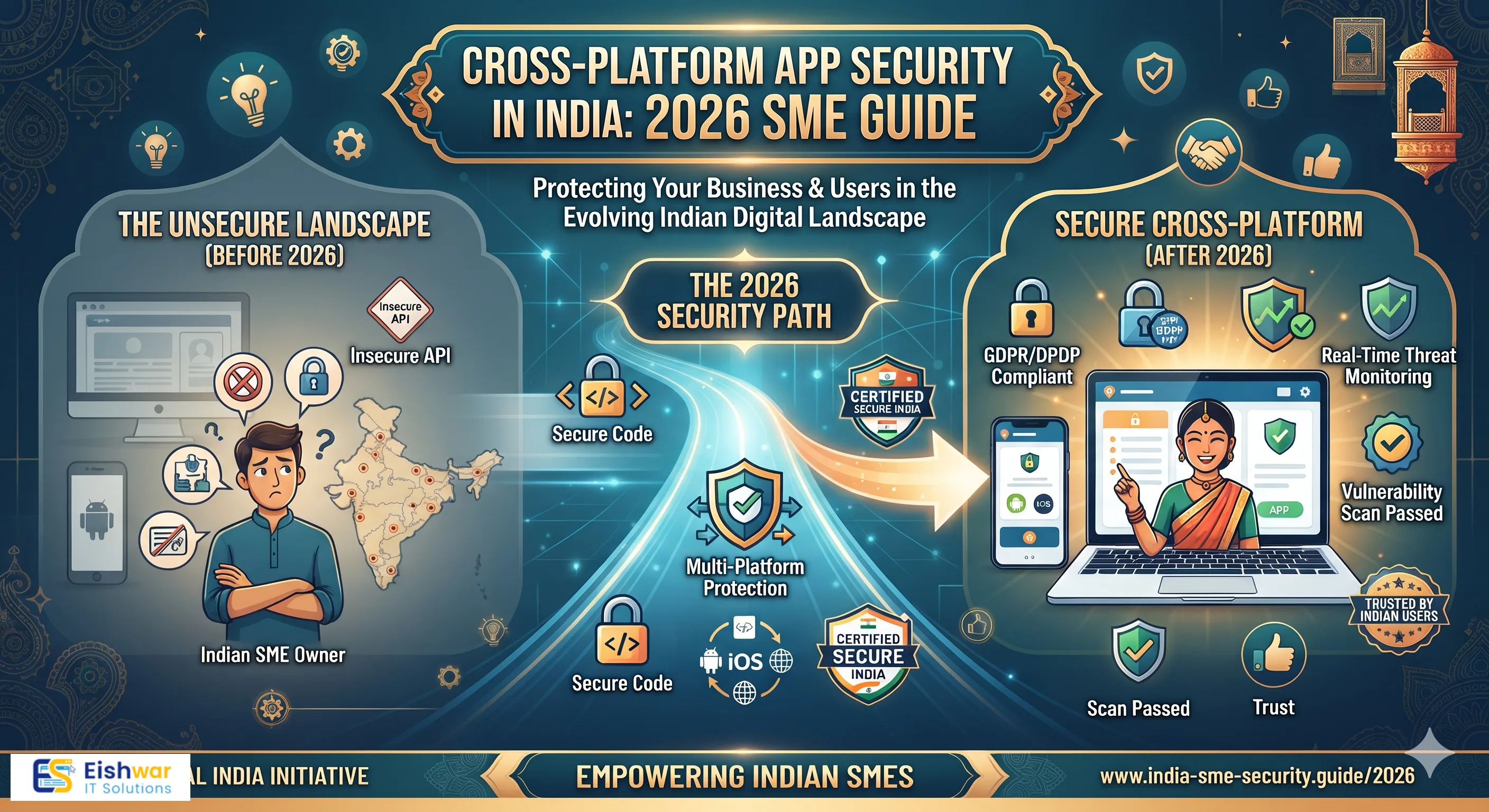
Cross-Platform App Security in India: 2027 SME Guide
Published on: 09 Nov 2026
Cross-Platform App Security in India: 2027 SME Guide
Introduction
Cross-platform app security is no longer a large-enterprise concern in India. If your business runs on a Flutter, React Native, .NET MAUI, or similar app, a single weak API, exposed token, or outdated package can put customer data, payments, and brand trust at risk.
Learn more about our Website services
The 2027 reality is simple: Indian customers expect convenience and safety. Regulators expect responsible data handling. App stores expect clear privacy and security declarations. At the same time, SME teams need to ship fast and control costs. That is why security has to be designed into the product, not bolted on after launch.
This guide is a practical cross-platform app security playbook for business owners, marketers, and professionals. It avoids jargon where possible and focuses on actions that reduce real risk without demanding an enterprise-sized budget.
Main Section 1: The 2027 Threat Landscape for Indian Cross-Platform Apps
Cross-platform development gives Indian SMEs a big advantage: one codebase, faster releases, and consistent experiences across Android and iOS. It also concentrates risk. A shared authentication flow, a common API layer, or a third-party SDK can affect every user on every platform at once.
What attackers and fraudsters look for
Most incidents do not start with a sophisticated nation-state attack. They start with basic gaps that are easy to miss during rapid development.
- Hardcoded secrets: API keys, payment credentials, or admin tokens left inside the app bundle.
- Weak authentication: OTP flows without rate limits, reusable session tokens, or missing device checks.
- Exposed APIs: Endpoints that trust the app blindly and return more data than the screen needs.
- Unsafe storage: Tokens or personal data saved in plain preferences or unencrypted local databases.
- Outdated dependencies: Old packages and SDKs with known vulnerabilities that never get patched.
- Leaky logs and analytics: Phone numbers, addresses, or payment references appearing in crash reports and marketing tools.
- Cloud misconfiguration: Public storage buckets, overly broad roles, or test environments connected to production data.
In India, these gaps matter because the app often connects to UPI payments, delivery addresses, KYC documents, loyalty data, or B2B pricing. A small leak can become a customer support crisis, a legal issue, or a fake-app problem.
India-specific pressure points
The Digital Personal Data Protection Act, commonly called DPDP, has pushed data responsibility into boardroom conversations. Even SMEs must think about consent, purpose limitation, retention, and breach response. CERT-In reporting expectations and app store data safety labels add more discipline.
There is also the marketplace reality. Fake apps, phishing links, and social engineering campaigns often imitate trusted Indian brands. If your app handles money or personal data, users need visible trust signals: verified publisher details, clear permissions, secure login options, and responsive support.
A practical example
Imagine a D2C brand with a React Native app and a small backend team. The app includes a marketing analytics SDK and a coupon engine. During a release, a developer stores the coupon service token in the app to speed up testing. Months later, someone extracts the token and abuses discount codes at scale.
👉 Don't wait for the perfect moment; turn your vision into reality today.
Free ConsultationThe fix is not exotic. Move the secret to the server, issue short-lived user tokens, add rate limits, and monitor unusual coupon redemptions. That is cross-platform app security in practice: reducing the blast radius of small mistakes.
Main Section 2: Build Security Into Cross-Platform Development From Day One
Security is cheaper when it is part of design, not a rescue project. For cross-platform apps, the most effective approach is to treat the mobile app as an untrusted client. The backend should enforce rules, validate requests, and decide what data is allowed.
Start with threat modeling, not tools
Before sprint one, list what you are protecting: customer accounts, payment data, order history, business documents, inventory, or chat messages. Then ask four questions for each flow:
- Who should access this?
- What can go wrong if they access more than intended?
- Where is the data stored and for how long?
- How will we detect and respond to abuse?
A one-hour threat modeling session can prevent expensive rework. It also helps marketers and product owners understand why certain friction, like multi-factor authentication or device verification, is necessary.
Secure the architecture and APIs
Use an API gateway or backend-for-frontend layer to centralize authentication, rate limiting, logging, and request validation. Apply role-based access control so a customer cannot call an admin endpoint by changing an ID. Use short-lived access tokens and refresh token rotation. For high-risk actions, require step-up verification.
Do not hide business logic in the app. Discount rules, pricing logic, referral validation, and content access checks belong on the server. Certificate pinning can help against some interception attacks, but plan it carefully because certificate changes can break apps if not managed well.
Protect data on the device
Use platform secure storage for tokens: Keychain on iOS and Keystore-backed storage on Android. Avoid plain preferences or unencrypted local databases for sensitive values. If you cache personal data for offline use, encrypt it, limit what is cached, and clear it when no longer needed.
Also review screenshots and app switcher previews. A banking or HR app that shows salary details in the recent apps view is creating avoidable exposure. Mask sensitive fields, disable screenshots where appropriate, and log users out after reasonable inactivity.
Secure the software supply chain
Cross-platform projects depend on packages, plugins, and SDKs. Maintain a software bill of materials, scan dependencies in CI/CD, and remove unused libraries. Pin versions, review permissions, and check the reputation of third-party SDKs before adding them.
Separate development, staging, and production environments. Use different keys and credentials. Automate code signing and release checks. Obfuscate release builds where supported, but remember that obfuscation is not encryption. It raises the effort level, not a guarantee.
A budget-smart security baseline
- Must have now: secure authentication, server-side authorization, encrypted storage, dependency scanning, and PII-safe logging.
- Add within 90 days: API rate limits, device binding for sensitive accounts, automated vulnerability scans, and an incident response checklist.
- Plan for the next cycle: independent penetration testing, app shielding for high-risk apps, and advanced fraud monitoring.
Main Section 3: Compliance, Testing, and Monitoring Without Enterprise Budgets
Many Indian SMEs hesitate because they assume compliance and testing require a large security team. In reality, a focused process, clear ownership, and a few good partners can cover the highest risks.
👉 Free Website Audit
Get Free AuditMake DPDP and app store requirements practical
Create a simple data map for the app. Note what personal data you collect, why you collect it, where it is stored, who can access it, and how long you keep it. Update your privacy notice in plain language. Collect only what you need. Give users a clear way to request deletion or correction.
For app stores, keep privacy labels, permission descriptions, and data safety forms accurate. If you add an analytics or CRM SDK, check what it collects and whether your notice covers it. Marketing teams should not install tracking tools that bypass consent or leak personal data.
Test the app and the API together
A mobile app can look secure while its API is wide open. Test both sides. Use static analysis for code issues, dependency scanning for known vulnerabilities, and dynamic testing for runtime behaviour. Run a focused penetration test before major launches or after significant architecture changes.
Include these checks in your release checklist:
- No secrets in the app bundle or source repository.
- Authentication and authorization tested for different roles.
- OTP and login endpoints rate-limited and monitored.
- Sensitive data masked in logs, screenshots, and notifications.
- Dependencies reviewed and patched.
- Backup and restore tested for critical data.
Monitor what matters
Set up alerts for abnormal login attempts, sudden API traffic spikes, repeated coupon abuse, and unusual admin activity. Scrub personal data from crash reports. Keep an incident response sheet with names, contact numbers, escalation steps, and a customer communication template.
Do not wait for a perfect security operations centre. A weekly review of access logs, failed logins, and app store reviews can reveal issues early. Review vendor permissions quarterly. Remove former employee access immediately.
A realistic 30-90 day roadmap
Days 1 to 30: inventory data, remove hardcoded secrets, enforce secure storage, add rate limits to login and OTP, and fix critical dependency alerts.
Days 31 to 60: implement role-based access, add monitoring for sensitive actions, update privacy notices, and train the release team on secure coding basics.
Days 61 to 90: run an independent security assessment, create an incident response playbook, and add security checks to every release. This sequence is achievable for most Indian SMEs and protects the highest-risk areas first.
Expert Tips
- Treat the app as public: assume attackers can inspect the bundle. Never store secrets in mobile code.
- Validate on the server: every price, role, discount, and record access should be checked server-side.
- Keep authentication boring and strong: short sessions, refresh rotation, MFA for admins, and rate limits on OTP.
- Minimize data: if the app does not need a field, do not collect it. This helps security and DPDP compliance.
- Review SDKs like vendors: a free analytics plugin can still create legal and security exposure.
- Make security visible in releases: include a one-page security checklist in your definition of done.
- Prepare for the bad day: a simple incident response plan is better than panic during a live issue.
Common Mistakes
- Believing cross-platform means one security model fits every platform. iOS and Android have different storage, permission, and attestation options.
- Using client-side checks for payments, coupons, or subscription access.
- Allowing unlimited OTP attempts or weak password reset flows.
- Logging full API responses during development and forgetting to remove them in production.
- Ignoring third-party SDK updates because the app still works.
- Giving every team member production admin access.
- Treating a privacy policy update as the whole compliance programme.
Future Trends
Cross-platform app security in India will become more automated and more identity-focused. Passkeys and device-bound credentials will reduce dependence on OTPs. App attestation and risk-based authentication will help distinguish genuine users from bots and tampered apps.
👉 Free Homepage Demo
Book DemoAI will cut both ways. Security teams will use AI to spot anomalies faster, while fraudsters will use it to create convincing phishing campaigns and fake support conversations. Supply chain security will get more attention as businesses consolidate around a smaller number of trusted SDKs. Privacy-preserving analytics and consent-aware tracking will move from nice-to-have to standard practice.
For SMEs, the winning approach is not chasing every new tool. It is building a repeatable security rhythm: review data, secure APIs, test releases, monitor abuse, and train the team.
FAQs
What is cross-platform app security?
Cross-platform app security is the practice of protecting apps built with frameworks like Flutter, React Native, or .NET MAUI across Android, iOS, and shared backend services. It covers secure authentication, API protection, encrypted storage, dependency management, compliance, and monitoring.
Is a cross-platform app less secure than a native app?
Not automatically. The framework matters less than architecture and process. A well-built cross-platform app with server-side authorization, secure storage, and regular testing can be very secure. A poorly built native app can be just as risky.
How much does an app security audit cost in India?
Costs vary by app size, number of APIs, user roles, and compliance needs. A focused SME assessment may start with a limited scope, while a full penetration test for a payments or healthcare app costs more. Ask for a clear scope, deliverables, and retesting terms.
Does DPDP apply to small businesses?
DPDP applies to processing of digital personal data in India, with limited exemptions. Even SMEs should practise data minimisation, clear consent, secure storage, retention limits, and a breach response process. Legal advice helps confirm your specific obligations.
How often should we test our app?
Run automated dependency and static checks on every release. Do heavier manual testing before major launches, after adding sensitive features, or at least once a year for business-critical apps. High-risk apps may need more frequent reviews.
What should we fix first?
Start with exposed secrets, weak authentication, missing server-side authorization, unencrypted sensitive storage, and critical dependency alerts. These issues are common and can cause serious harm quickly.
Conclusion
Cross-platform app security is a business enabler, not a brake on growth. Indian SMEs that secure their apps early protect revenue, customer trust, and regulatory standing. They also ship with more confidence because they know where the risks are and how to respond.
You do not need an enterprise security department to start. You need the right priorities: treat the app as untrusted, enforce rules on the server, protect stored data, manage dependencies, test before release, and monitor real usage. Do that consistently, and your cross-platform investment becomes safer and more valuable.
CTA
Ready to make your cross-platform app safer for 2027? Talk to EishwarITSolution for a practical security review, secure development roadmap, or app security audit tailored to your business.
Visit eishwar.com and book a consultation today.