
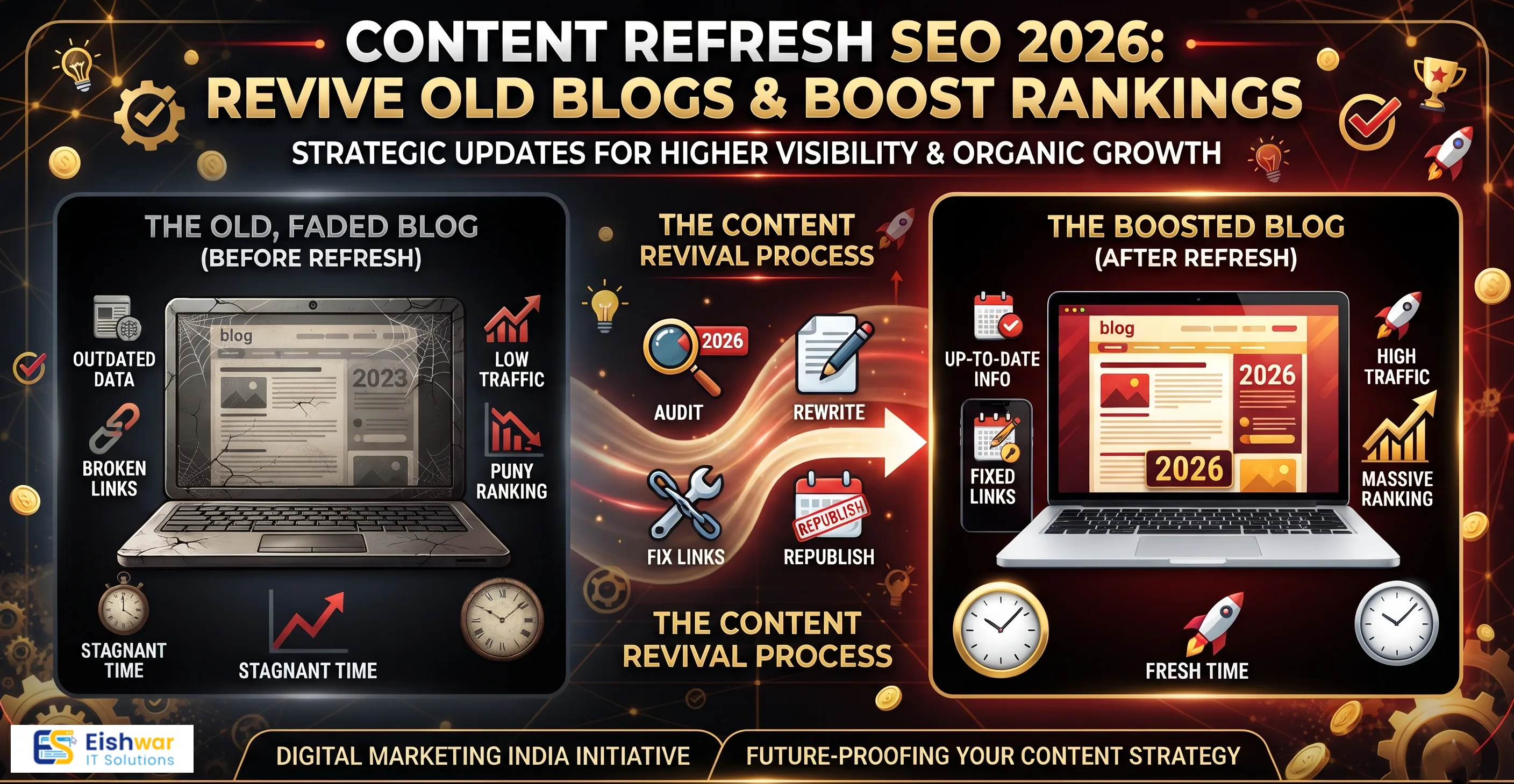
Content Refresh SEO 2027: Revive Old Blogs & Boost Rankings
Published on: 16 Nov 2026
Content Refresh SEO 2027: Revive Old Blogs & Boost Rankings
Introduction
Most Indian businesses publish new blogs every month, yet many high-potential pages quietly lose rankings, clicks, and leads. The reason is simple: search behaviour changes, competitors improve, and old facts become outdated. In 2027, content refresh SEO is one of the smartest ways to recover lost visibility without starting from zero.
Learn more about our Website services
Content refresh SEO means auditing, updating, restructuring, and republishing existing content so it better matches current search intent. For business owners, marketers, and professionals in India, it offers faster wins than new content because the page already has history, backlinks, and topical relevance. This guide gives you a practical workflow to revive old blogs, service pages, and guides for better rankings.
Think of it like renovating a shop in a busy market instead of opening a new store in an unknown lane. You keep the location, improve the experience, and make it easier for the right customers to walk in.
Main Section 1: Why Content Refresh SEO Matters for Indian Businesses in 2027
Search competition in India is no longer limited to big brands. Local businesses, D2C startups, SaaS companies, consultants, and agencies are all publishing content. As a result, older pages that once ranked easily now face stronger competitors. Google is also better at understanding intent, freshness, and usefulness. A page that was helpful in 2022 may look thin, outdated, or vague in 2027.
Content refresh SEO solves this efficiently. Instead of asking your team to create another blog from scratch, you improve an asset that already exists. This approach often delivers faster results because the URL may already have backlinks, internal links, keyword history, and user engagement signals.
Key benefits for Indian businesses
- Faster wins: Pages ranking on positions 4 to 15 often need focused improvements, not a completely new article.
- Better use of budget: Refreshing can cost less than producing and promoting new content.
- Preserved backlinks: You keep the URL and its link equity when you update the page properly.
- Stronger topical authority: Updated pages help Google see your site as current and comprehensive.
- Improved conversions: You can add clearer CTAs, case studies, pricing guidance, and trust signals.
Consider a Pune-based IT services company with an old blog on cloud migration costs. The page ranks on page two and gets occasional leads. By updating pricing ranges, adding GST-related notes, including a client example, and improving the title tag, the page can become more useful and more clickable. That is content refresh SEO in action.
Quick signs that a page needs a refresh
- Organic traffic has declined over the last 6 to 12 months.
- The page ranks on page two but gets very few clicks.
- Statistics, screenshots, pricing, or regulations are outdated.
- The content does not answer the query in the first 100 to 150 words.
- Competitors now cover subtopics that your page ignores.
- The page has weak internal links or no clear next step.
In India, freshness also matters because policies, tax rules, platform features, and consumer behaviour change quickly. A blog on digital payments from 2021 may need updates for 2027 tools, UPI trends, compliance notes, and customer expectations. A generic page on local SEO may need examples from Indian cities, language preferences, and mobile-first behaviour.
👉 Don't wait for the perfect moment; turn your vision into reality today.
Free ConsultationMain Section 2: How to Audit Old Content and Choose the Best Pages to Refresh
Do not refresh pages randomly. Start with data. A structured content audit helps you identify pages that can deliver the fastest and most meaningful business impact.
Build a simple content inventory
Create a spreadsheet with one row per URL. Include the page title, target keyword, topic cluster, word count, last updated date, organic traffic, impressions, clicks, average position, conversions, backlinks, and internal links. You can pull much of this data from Google Search Console, Google Analytics 4, Ahrefs, Semrush, or Screaming Frog.
For Indian SMBs, even a basic monthly export from Search Console is enough to begin. Look for pages with high impressions but low click-through rate, or pages that used to bring traffic but have slowly declined.
Score each page before you edit
Use a simple 1 to 5 score for search intent match, freshness, depth, readability, internal links, conversion path, and backlink value. Add up the scores and prioritise the weakest pages that also have strategic importance. A service page with old pricing and a blog post with strong backlinks usually deserve attention first.
Four actions to consider
- Refresh: Update the existing page when the topic is still relevant and the URL has value.
- Consolidate: Merge several thin posts into one stronger guide when topics overlap.
- Redirect: Send users and search engines to a better page when the old URL no longer serves a purpose.
- Remove: Delete only when the content is harmful, duplicate, or completely irrelevant, and redirect if it has links or traffic.
For example, an Indian marketing agency may have three blogs on email marketing tips. Instead of updating all three, merge them into a single 2027 guide with sections for segmentation, automation, deliverability, and GDPR-style consent practices. Redirect the weaker URLs to the new guide. This often outperforms three competing pages.
Main Section 3: A Practical Content Refresh Workflow for 2027
Once you have a priority list, follow a repeatable workflow. The goal is not to change everything, but to make the page clearly better for the user and the search engine.
Step 1: Reconfirm search intent
Search the target keyword in Google and study the top results. Are they guides, service pages, comparisons, tools, or news posts? Does the searcher want pricing, definitions, examples, or a vendor? Update your page to match the dominant intent. If the query is commercial, add pricing factors, process steps, FAQs, and a consultation CTA. If it is informational, add clear explanations, examples, and next steps.
Step 2: Update facts, examples, and local context
Replace outdated statistics, screenshots, tool names, and regulations. For Indian audiences, use rupee examples, local case studies, city-level insights, and relevant compliance notes. If your business serves multiple states, mention where practices differ. Freshness is not only about adding a new date. It is about making the content accurate and useful today.
👉 Free Website Audit
Get Free AuditStep 3: Improve structure and readability
Use descriptive H2 and H3 headings. Keep paragraphs short. Add bullet lists, comparison tables, and summary boxes where useful. Put the direct answer near the top, then expand with details. This helps users scan quickly and improves the chance of earning featured snippets.
Step 4: Add missing subtopics and internal links
Compare your page with top-ranking competitors and People Also Ask questions. Add missing subtopics only when they serve the user. Link to related guides, service pages, and case studies using descriptive anchor text. Strong internal links help search engines understand context and keep visitors moving through your site.
Step 5: Strengthen trust signals
Add an author bio, review date, cited sources, client examples, original screenshots, or expert commentary. If the page makes claims about results, support them with evidence. Indian buyers often compare multiple vendors, so transparent information builds confidence.
Step 6: Optimise metadata and schema
Rewrite the title tag and meta description if they are weak. Include the focus keyword naturally. Add FAQ schema only when the questions appear visibly on the page. For service pages, consider relevant structured data where appropriate. Avoid stuffing keywords into every line.
Step 7: Republish and request indexing
Update the visible date, add a short change note if appropriate, and request indexing in Google Search Console. Do not change the URL unless there is a strong reason. If you must change it, set up a 301 redirect and update internal links.
Step 8: Measure results over 28, 56, and 90 days
Track impressions, clicks, average position, scroll depth, and conversions. Compare the refreshed page with a control group of pages you did not update. This helps you learn what works for your audience instead of guessing.
Expert Tips
- Refresh in topic clusters rather than isolated pages. If one blog on SEO audits performs well, update related posts and link them together.
- Keep high-performing sections unless there is a clear reason to remove them. Do not delete your best examples just because you want a new look.
- Do not update the publish date without meaningful changes. Users and search engines can recognise cosmetic edits.
- Add India-specific examples, rupee pricing, local regulations, and regional language considerations where relevant.
- Ask sales and customer support teams which questions buyers ask most often. Their insights often reveal gaps in old content.
- Use original data wherever possible, such as a small survey of your customers or a summary of campaign results.
- Refresh pages that support revenue first, such as service pages, comparison pages, pricing guides, and high-intent blogs.
Common Mistakes
- Changing URLs without 301 redirects, which can cause traffic and link equity loss.
- Updating only the date while leaving outdated facts and weak sections unchanged.
- Stuffing the focus keyword into headings, paragraphs, and metadata unnaturally.
- Ignoring internal links and leaving the page isolated from your service pages.
- Removing sections that already satisfy users just to make the article shorter.
- Forgetting to update images, alt text, screenshots, and embedded videos.
- Refreshing too many pages at once without tracking results.
- Writing generic advice that could apply to any country instead of addressing Indian business realities.
Future Trends
Content refresh SEO will become more data-driven in 2027 and beyond. AI-assisted audits will help teams spot content decay faster, but human judgement will still decide what is useful. Expect more focus on entity clarity, author credibility, original insights, and content operations dashboards that track page health over time.
👉 Free Homepage Demo
Book DemoIndian businesses may also need to refresh content for multilingual audiences, voice-friendly answers, and visibility across YouTube, LinkedIn, and Google Discover. Instead of treating refresh as a one-time project, smart teams will build a quarterly content maintenance habit. The businesses that win will be the ones that treat old content as a portfolio of assets, not as an archive.
FAQs
What is content refresh SEO?
Content refresh SEO is the process of updating existing web pages so they better match current search intent, facts, and user expectations. It can include rewriting sections, adding examples, improving structure, updating metadata, and strengthening internal links.
How often should Indian businesses refresh old content?
Review high-priority pages every 3 to 6 months and other pages every 9 to 12 months. Fast-changing topics like digital marketing, tax, technology, and regulations may need more frequent updates.
Will updating old content hurt rankings?
Not if you keep the URL stable, preserve valuable sections, and make genuine improvements. Rankings can drop temporarily if you remove useful content or change intent, so monitor performance and avoid changing everything at once.
How do I know which pages to refresh first?
Start with pages that have declining traffic, high impressions but low clicks, rankings between positions 4 and 15, valuable backlinks, or direct business importance. Service pages and high-intent blogs usually deserve priority.
Can content refresh help without new backlinks?
Yes. Better intent match, improved structure, updated information, stronger internal links, and higher click-through rates can improve performance even without new backlinks. Existing backlinks make the opportunity even stronger.
Should I change the publish date after refreshing?
Update the visible date only when you make meaningful changes. You can also add an updated note or change log. Avoid changing the date for minor edits because it reduces trust with users.
Conclusion
Content refresh SEO is one of the highest-return activities for Indian businesses in 2027. It helps you recover lost rankings, protect existing backlinks, improve conversions, and build topical authority without starting from scratch. Use data to choose the right pages, follow a structured workflow, and measure results over time.
Your old blogs are not dead assets. With the right updates, they can become some of your best-performing pages. Start small, refresh one high-potential page this week, and build a quarterly maintenance habit.
CTA
Want to find out which old pages are holding back your traffic? Book a content refresh audit with EishwarITSolution and get a prioritised action plan for 2027. Request your free content audit or explore our SEO services in India.