Blockchain Supply Chain Finance for Indian MSMEs: 2026 Guide
Published on: 14 Aug 2026
Blockchain Supply Chain Finance for Indian MSMEs: 2026 Guide
Introduction
In 2026, Indian MSMEs face a persistent challenge: accessing timely working capital. Traditional financing often involves lengthy paperwork, high interest rates, and collateral demands. But blockchain supply chain finance is emerging as a game-changer. By digitizing and automating financing processes, blockchain enables faster, transparent, and more accessible funding for small businesses.
Learn more about our Website services
This guide explores how blockchain supply chain finance works, its benefits for Indian MSMEs, and practical steps to implement it. Whether you're a business owner, marketer, or professional, you'll gain actionable insights to stay ahead in the evolving financial landscape.
Main Section 1: Understanding Blockchain Supply Chain Finance
Blockchain supply chain finance leverages distributed ledger technology (DLT) to streamline financing processes within supply chains. It connects buyers, suppliers, and financial institutions on a single, transparent platform. Smart contracts automate transactions, reducing manual intervention and fraud.
For Indian MSMEs, this means quicker invoice verification, lower costs, and improved trust. Unlike traditional financing, which relies on credit scores and collateral, blockchain enables asset-backed lending based on real-time data.
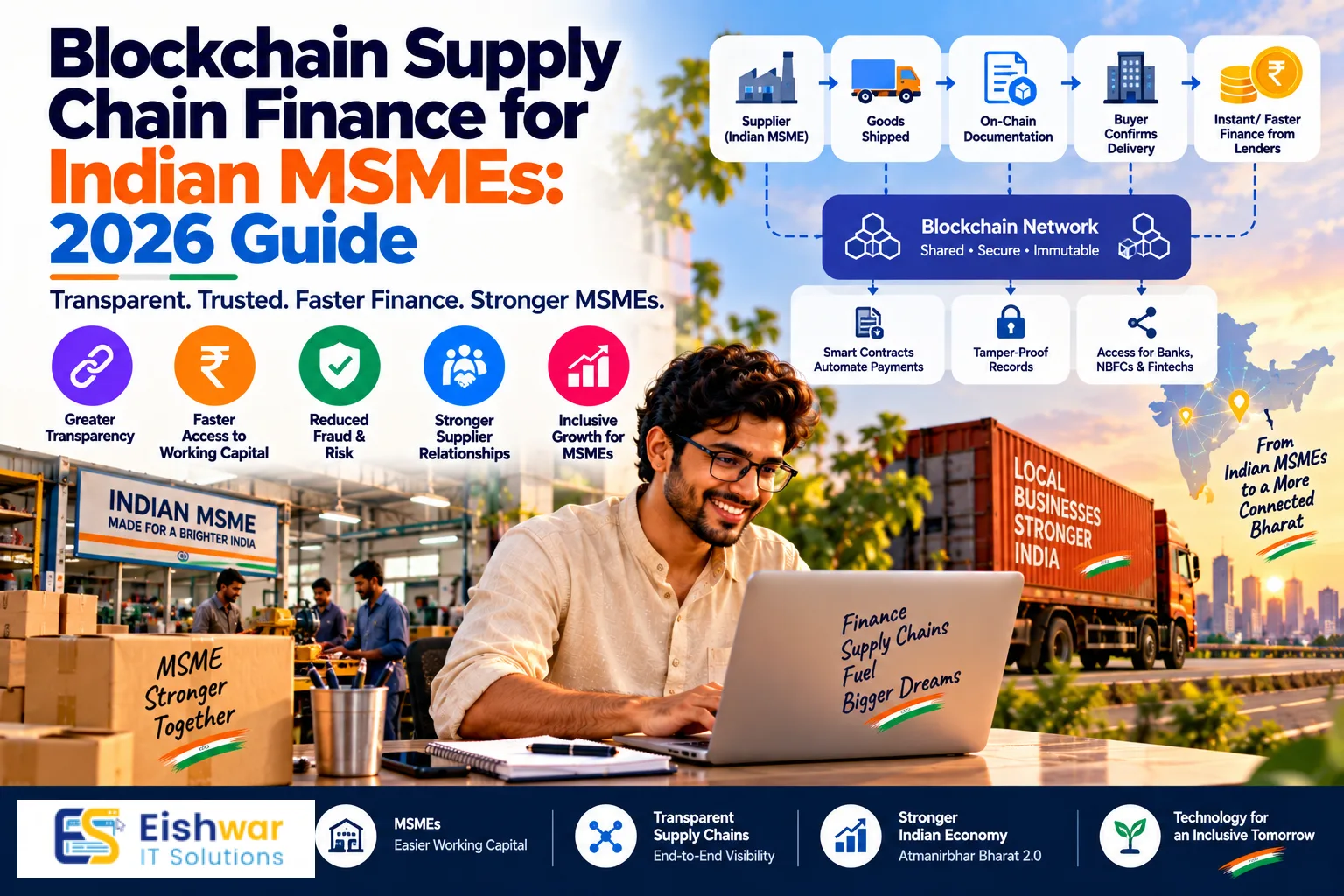
To understand the mechanics, consider a typical scenario: A supplier delivers goods to a buyer and uploads the invoice to a blockchain platform. The buyer verifies the delivery, and a smart contract automatically triggers payment or issues a digital promissory note. This note can be sold to a financier at a discount, providing immediate liquidity to the supplier. The entire process is recorded on an immutable ledger, visible to all authorized parties, reducing disputes and delays.
In India, where the MSME sector contributes around 30% to the GDP and employs over 110 million people, such efficiency is critical. The traditional 'bill discounting' process often takes 15-30 days, but blockchain can compress this to hours or even minutes.
Main Section 2: Key Benefits for Indian MSMEs
2.1 Faster Access to Working Capital
Blockchain reduces the time from invoice to payment. Smart contracts trigger payments automatically once goods are delivered and verified. This helps MSMEs maintain liquidity without waiting 60-90 days.
For example, a small textile manufacturer in Surat can upload an invoice to a blockchain platform after shipping fabric to a buyer in Mumbai. The buyer confirms receipt, and the smart contract releases payment within 24 hours, compared to the usual 60-day cycle. This immediate cash flow allows the manufacturer to purchase raw materials for the next order without taking high-interest loans.
2.2 Lower Costs and Reduced Fraud
By eliminating intermediaries and automating processes, blockchain reduces transaction fees. Immutable records prevent duplicate invoicing and fraudulent claims, saving MSMEs from financial losses.
Traditional invoice discounting involves multiple intermediaries—factoring agents, credit rating agencies, and legal verification—each adding 1-3% in fees. Blockchain platforms can cut these costs by up to 50%, as seen in pilots by platforms like TradeFin. Additionally, the tamper-proof nature of blockchain ensures that once an invoice is recorded, it cannot be altered or reused, significantly reducing fraud risks that cost Indian banks an estimated ₹40,000 crore annually.
2.3 Enhanced Transparency and Trust
All parties have access to a single version of truth. This transparency builds trust among buyers, suppliers, and financiers, making it easier for MSMEs to secure funding.
👉 Don't wait for the perfect moment; turn your vision into reality today.
Free ConsultationFor instance, a small auto parts supplier in Pune can share its blockchain-based transaction history with a bank, demonstrating a consistent payment record. This transparency can help the supplier negotiate better interest rates or obtain unsecured credit lines, which were previously inaccessible due to lack of verifiable data.
Main Section 3: Implementation Strategies for 2026
3.1 Partner with Blockchain Platforms
Indian MSMEs can collaborate with platforms like TradeFin, WeTrade, or InfraBlock to access blockchain-based supply chain finance. These platforms offer ready-to-use solutions tailored to local needs.
When selecting a platform, consider factors such as integration ease, scalability, and support for local languages. For example, TradeFin offers a mobile-first interface with Hindi and Tamil support, making it accessible for smaller businesses. Additionally, look for platforms that have partnerships with Indian banks and NBFCs, as this can streamline the financing process.
3.2 Digitize Invoices and Documents
Adopt digital invoicing and e-way bills that are compatible with blockchain systems. This ensures seamless integration and faster processing.
Start by moving from paper-based invoices to e-invoicing under the GST regime. The government's e-invoice system is already mandatory for businesses with turnover above ₹10 crore, but even smaller MSMEs can benefit. Use software that generates e-invoices in a standard format (like JSON) that can be easily uploaded to blockchain platforms. Also, ensure that your e-way bills are digitized, as they provide proof of goods movement, which is crucial for triggering smart contracts.
3.3 Educate Your Team
Train your staff on blockchain basics and benefits. Understanding how to use these tools is crucial for successful adoption.
Conduct workshops and webinars with your finance and operations teams. Cover topics like how to upload invoices, verify transactions, and resolve disputes. Many platforms offer free training modules and certification programs. For example, the National Institute for Micro, Small and Medium Enterprises (NI-MSME) offers courses on digital finance, including blockchain applications. Investing in training ensures that your team can maximize the benefits and avoid common pitfalls.
Expert Tips
- Start small: Pilot a single supply chain segment to test blockchain financing. For example, choose one product line or one major buyer to implement the system. This allows you to measure impact and iron out issues before scaling.
- Choose the right platform: Look for solutions that integrate with your existing ERP or accounting software. For instance, if you use Tally or Zoho, ensure the blockchain platform offers plug-ins or APIs for seamless data transfer.
- Collaborate with stakeholders: Ensure your buyers and suppliers are on board to maximize benefits. Hold joint meetings to explain the advantages and address concerns. A shared understanding reduces friction and speeds up adoption.
- Leverage government initiatives: Explore schemes like MSME Sambandh or TReDS that may incorporate blockchain. The government's TReDS platform is already digitizing invoice discounting, and some platforms are integrating blockchain for added security. Stay updated on policy changes that could offer subsidies or incentives.
- Monitor regulatory updates: The RBI and SEBI are actively exploring blockchain regulations. Keep an eye on circulars and consult with legal experts to ensure compliance.
Common Mistakes
- Ignoring data quality: Poor data on the blockchain can lead to errors. Ensure that your invoice details, product descriptions, and delivery confirmations are accurate before uploading. A single mismatch can cause payment delays.
- Overlooking legal compliance: Ensure your blockchain contract complies with Indian contract law. Smart contracts are legally binding, but they must be drafted to align with the Indian Contract Act, 1872. Consult a legal expert to review your smart contract templates.
- Choosing a complex solution: Avoid over-engineering; pick user-friendly platforms. Some platforms offer advanced features like AI analytics, but if your team is not tech-savvy, start with a simple interface that focuses on core financing functions.
- Neglecting cybersecurity: Even blockchain can be vulnerable; implement robust security measures. Use multi-factor authentication, encryption, and regular security audits. Also, ensure that your private keys are stored securely, as losing them could lock you out of your assets.
- Failing to plan for scalability: As your business grows, your blockchain needs will evolve. Choose a platform that can handle increased transaction volumes and add new features without requiring a complete overhaul.
Future Trends
By 2026, expect to see AI integrated with blockchain for predictive financing, tokenized assets for easier collateral, and cross-border supply chain finance using stablecoins. The convergence of blockchain and IoT will enable real-time tracking, further reducing risks.
👉 Free Website Audit
Get Free AuditAI can analyze historical transaction data on the blockchain to predict a supplier's future cash flow needs, allowing financiers to offer pre-approved credit lines. Tokenization can convert physical assets like inventory or machinery into digital tokens, which can be used as collateral for loans, making financing more accessible. Stablecoins, pegged to fiat currencies, can facilitate cross-border transactions without the volatility of cryptocurrencies, enabling Indian MSMEs to trade with global partners more efficiently.
Additionally, the integration of IoT devices—such as GPS trackers and smart sensors—will provide real-time visibility into goods movement. This data can be fed into smart contracts, automatically triggering payments when goods reach specific checkpoints, further reducing fraud and delays. As these technologies mature, they will create a more inclusive and efficient financial ecosystem for MSMEs.
FAQs
1. What is blockchain supply chain finance?
It's a digital financing method that uses blockchain to automate and secure transactions between buyers, suppliers, and financiers. It enables real-time verification, reduces paperwork, and speeds up payments.
2. How can Indian MSMEs benefit from blockchain supply chain finance?
They gain faster access to working capital, reduced costs, and increased transparency, improving cash flow and trust. For example, a small manufacturer can get invoices paid in days instead of months, and lower fees mean more profit.
3. Is blockchain supply chain finance legal in India?
Yes, blockchain is not prohibited. However, ensure compliance with RBI guidelines and existing trade finance regulations. The RBI has issued advisories on digital lending, and blockchain platforms must adhere to these to operate legally.
4. What are the costs associated with implementing blockchain?
Costs vary by platform and scale. Many providers offer subscription models, making it affordable for MSMEs. For instance, some platforms charge a monthly fee of ₹5,000-₹15,000, depending on transaction volume, while others take a small percentage per transaction (0.5-1%).
👉 Free Homepage Demo
Book Demo5. Can blockchain replace traditional bank loans?
Not entirely, but it complements them. Blockchain financing can be faster and more flexible, especially for invoice-based lending. However, for long-term capital investments, traditional loans may still be necessary. Blockchain can provide short-term working capital while banks handle larger, collateralized loans.
6. What are the prerequisites for adopting blockchain supply chain finance?
You need a stable internet connection, digital invoicing capability, and basic digital literacy. Additionally, you must have a PAN, GST registration, and a bank account to participate in most platforms.
7. How long does it take to see benefits after implementation?
Most MSMEs report seeing improvements in cash flow within the first 2-3 months. The initial setup, including platform onboarding and team training, typically takes 1-2 weeks, after which transactions can be processed immediately.
Conclusion
Blockchain supply chain finance is not just a trend; it's a practical solution for Indian MSMEs to overcome working capital challenges. By adopting this technology, you can streamline operations, build trust, and unlock growth opportunities in 2026. The key is to start small, choose the right partners, and stay informed about regulatory developments. As the ecosystem matures, early adopters will gain a competitive edge, while laggards may struggle to catch up. The time to act is now.
CTA
Ready to transform your MSME's financing? Contact EishwarITSolution today for a free consultation on blockchain integration for your business. Our experts will assess your needs, recommend suitable platforms, and guide you through the implementation process. Don't let working capital constraints hold you back—embrace blockchain and secure your business's future.