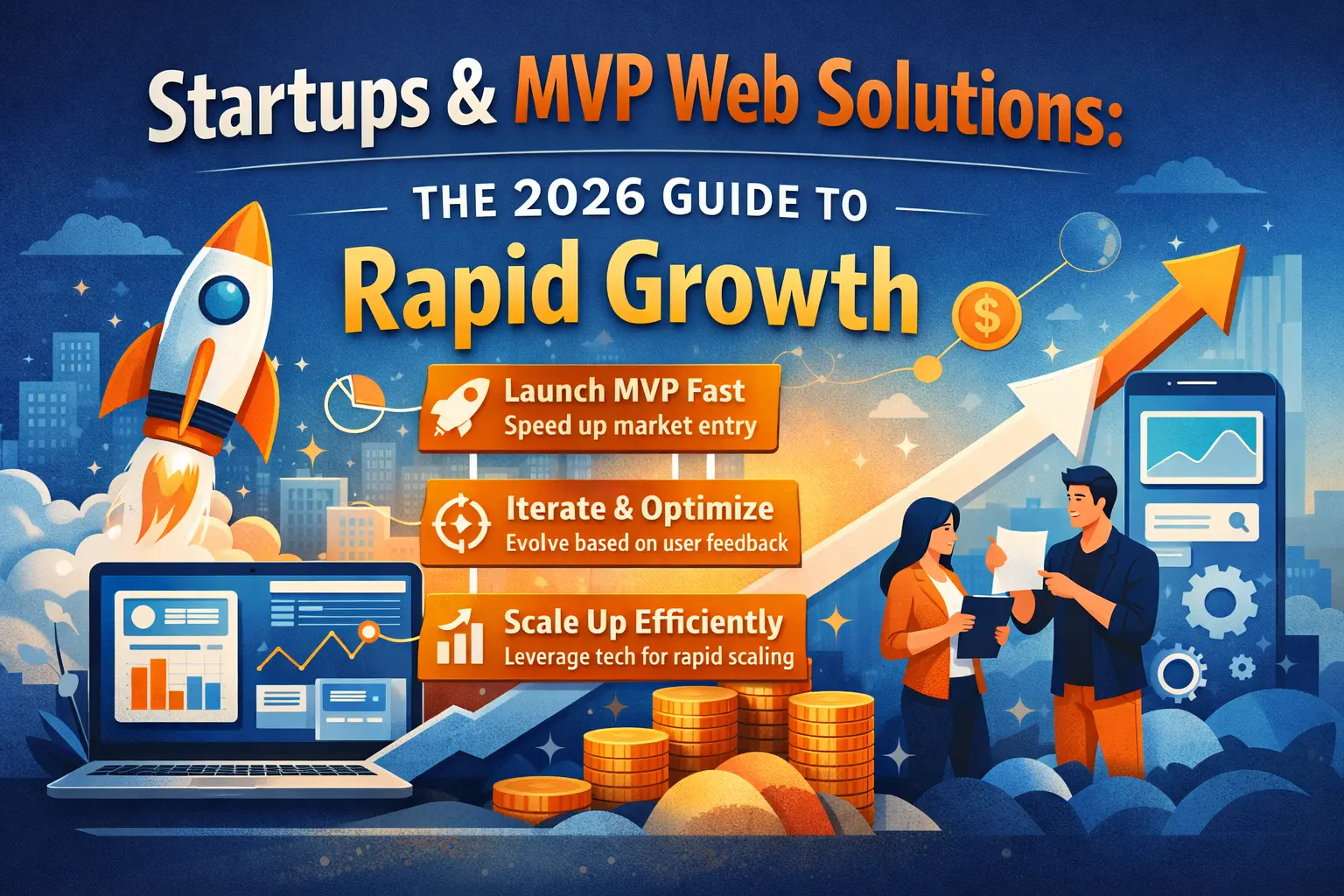
Startups & MVP Web Solutions: The 2026 Guide to Rapid Growth
Published on: 06 Mar 2026
In the fast-paced digital economy of 2026, the traditional "build it and they will come" mentality is a relic of the past. Today’s most successful founders are adopting a "validate, then build" approach. An MVP (Minimum Viable Product) is not a "half-baked" product; it is a strategic version of your web solution that includes just enough features to satisfy early adopters and provide a feedback loop for future development.
Learn more about our Api services
1. Why Every Web Startup Needs an MVP in 2026
Building a full-scale web application from day one is a high-stakes gamble. According to recent industry data, nearly 90% of startups fail, and the #1 reason is building something the market doesn't actually want.
Key Benefits of the MVP Approach:
Cost Efficiency: By focusing only on core features, you avoid spending $100k+ on "nice-to-have" functionalities that users might never touch.
Faster Time-to-Market: In 2026, speed is a competitive advantage. An MVP allows you to launch in 6–10 weeks rather than 6–12 months.
Validated Learning: You get real-world data on user behavior, allowing you to pivot before you’re too deep into a specific architecture.
Investor Readiness: Investors are no longer moved by pitch decks alone. A working MVP with even 50 active users is a powerful proof of concept.
2. The 2026 MVP Tech Stack: What to Use?
The tools available to founders have evolved. In 2026, the native-vs-web debate has largely been settled in favor of high-performance cross-platform frameworks.
The "Validation-First" Stack:
Frontend: Next.js or React for web; Flutter if you need a seamless mobile-web experience.
Backend-as-a-Service (BaaS): Tools like Supabase or Firebase allow you to skip months of database configuration and authentication coding.
AI Integration: Use LLM APIs (like Gemini or OpenAI) to power features that would have previously required an entire data science team.
No-Code/Low-Code Layers: For simple internal tools or landing pages, platforms like Bubble or Webflow are now robust enough to handle production-grade traffic.
3. Step-by-Step: Building Your MVP Web Solution
Creating a successful MVP requires a disciplined framework. Follow these six steps to ensure your web solution stays lean and effective.
Step 1: Define the "One Core Action"
What is the single most important task a user performs to get value from your app? For Airbnb, it was booking a room. For Uber, it was requesting a ride. If your feature list has more than 3 "must-haves," you are likely overbuilding.
Step 2: Map the User Journey
Visualize the path from "Landing Page" to "Goal Accomplished." Keep the friction to a minimum.
Step 3: Choose Your Development Strategy
The "Flintstone" MVP: Manually perform the backend tasks while the frontend looks automated (excellent for testing service-based ideas).
The Single-Feature MVP: Solve one specific problem exceptionally well (e.g., a tool that only converts PDF to editable Excel).
The Pre-order MVP: A high-converting landing page to gauge interest before a single line of code is written.
Step 4: The Build Phase (Stay Agile)
Use 2-week sprints. If a feature takes longer than one sprint to build, evaluate if it's truly "minimum."
Step 5: Launch & Gather "Actionable" Metrics
Ignore vanity metrics like "total signups." Focus on retention (do they come back?) and referral (do they tell others?).
👉 Don't wait for the perfect moment; turn your vision into reality today.
Free ConsultationStep 6: The Pivot or Persevere Decision
Based on the data, do you double down on your features, or do you change direction? This is where the "Lean Startup" methodology pays off.
4. Common Pitfalls to Avoid
The "Feature Creep" Trap: Adding "just one more thing" is the fastest way to kill your runway.
Ignoring UI/UX: "Minimal" doesn't mean "Ugly." If the user experience is frustrating, you aren't testing your idea—you're testing their patience.
Building for Everyone: Target a specific niche first. If you build a tool for "everyone," you’re building for no one.
5. Case Study: The 2026 Success Story
Look at "EcoStream," a 2026 startup that used an MVP to revolutionize carbon credit trading. Instead of building a complex global marketplace, they built a simple web portal for one specific township. They validated the demand in 3 weeks, secured $2M in seed funding, and are now scaling nationally.
Conclusion: Start Small to Win Big
The synergy between Startups & MVP Web Solutions is the most reliable path to innovation in 2026. By embracing the "Minimum Viable" mindset, you protect your capital, respect your time, and—most importantly—build a product that solves real problems for real people.